
SafeGuard AI
Intelligent Real-Time Harassment Detection System
Overview
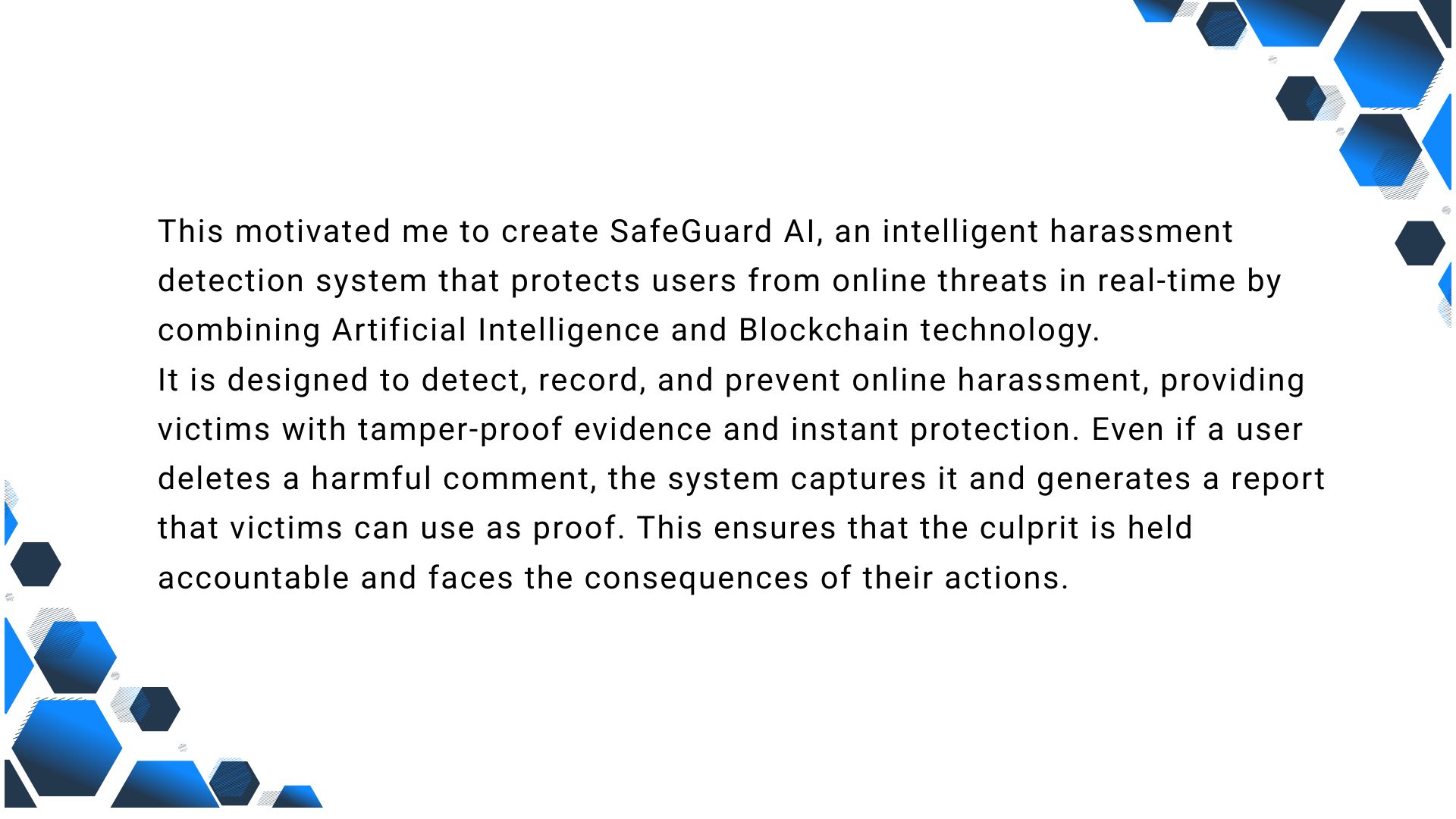
SafeGuard AI is an intelligent harassment detection system that protects users from online threats in real-time by combining Artificial Intelligence and Blockchain technology.
It is designed to detect, record, and prevent online harassment, providing victims with tamper-proof evidence and instant protection.
Quick Stats
| Metric | Value |
|---|---|
| Detection Speed | < 500ms per message |
| Accuracy | 93%+ on threat detection |
| Blockchain | 100% tamper-proof evidence |
| Languages | English |
Average Detection Speed: ~500ms per message; longer messages may take slightly longer depending on length.
Problem Statement
The Crisis
Online harassment and cyberbullying are serious concerns in India, especially for women.
- Reports show a steady rise in harassment across social media and digital platforms.
- Cyberbullying cases have increased significantly since the pandemic, with many incidents going unreported.
- Victims often struggle to collect digital evidence to support their cases.
- Major platforms face challenges in real-time detection and moderation.
- Psychological impacts such as stress, anxiety, and fear of online spaces remain widespread.
The Challenge
Current solutions often lack:
- Real-time detection
- Immutable evidence for legal cases
- Pattern recognition for coordinated attacks
- Victim-centric design
Solution
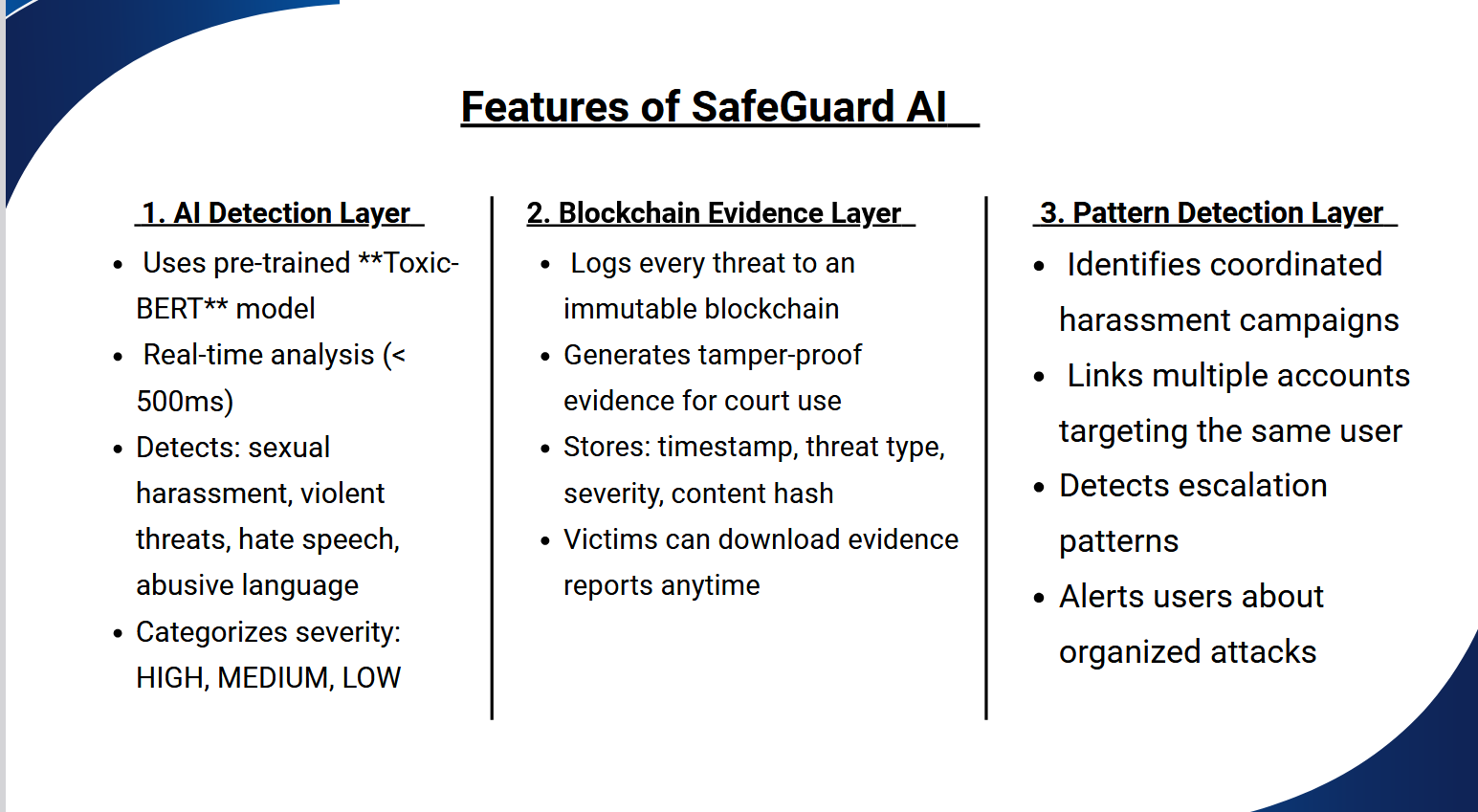
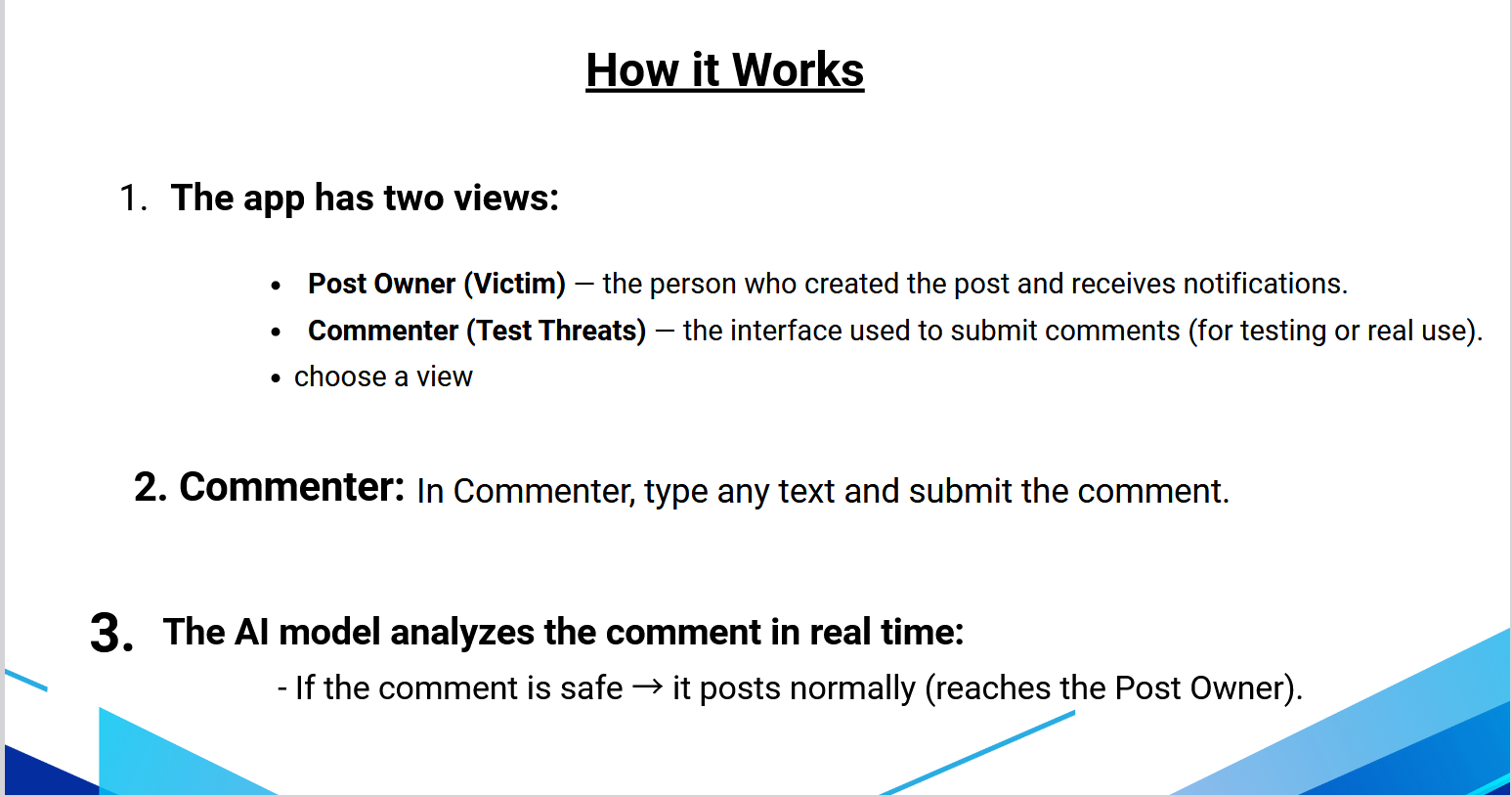
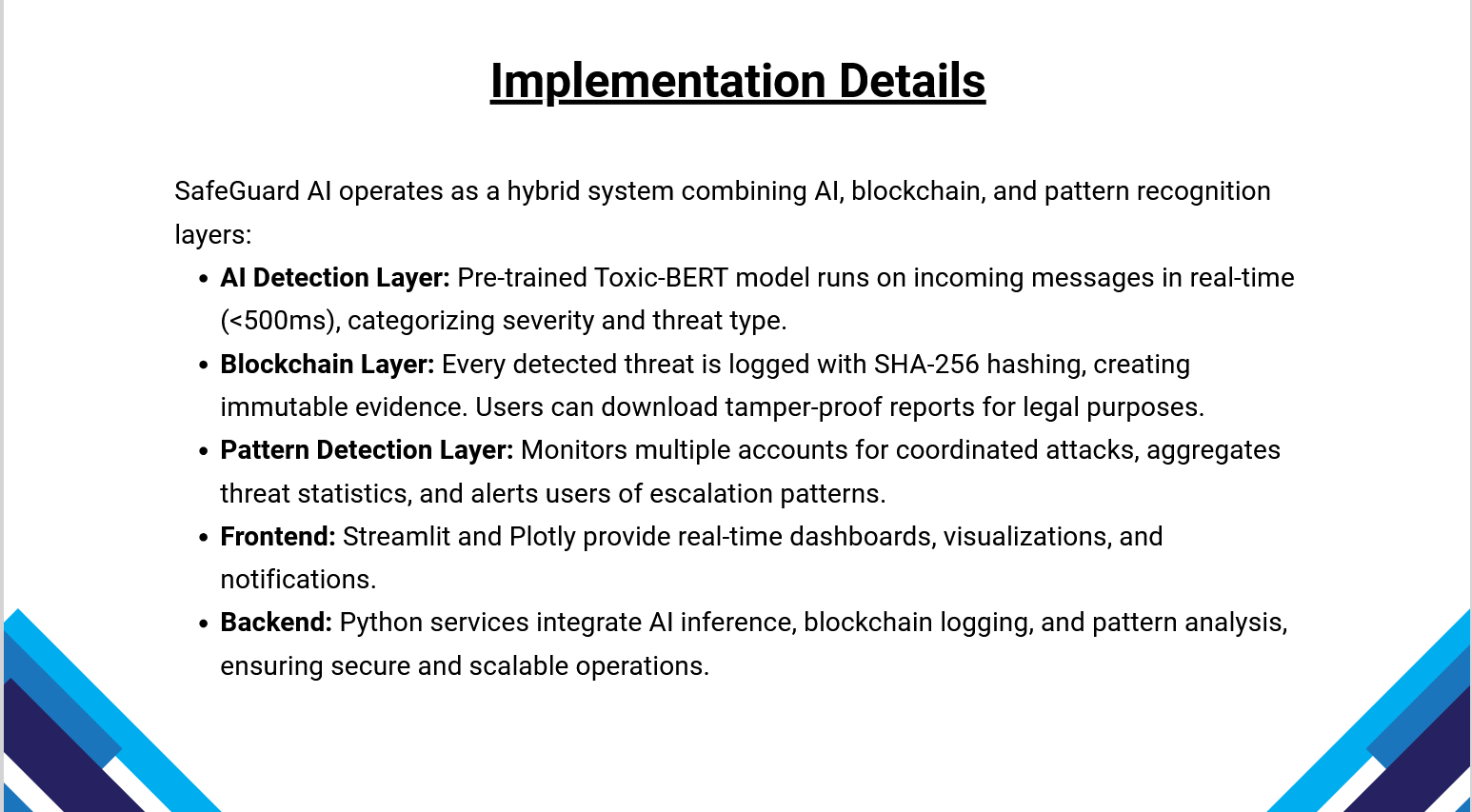
SafeGuard AI addresses these challenges through a three-layer protection system:
1. AI Detection Layer
- Uses pre-trained Toxic-BERT model
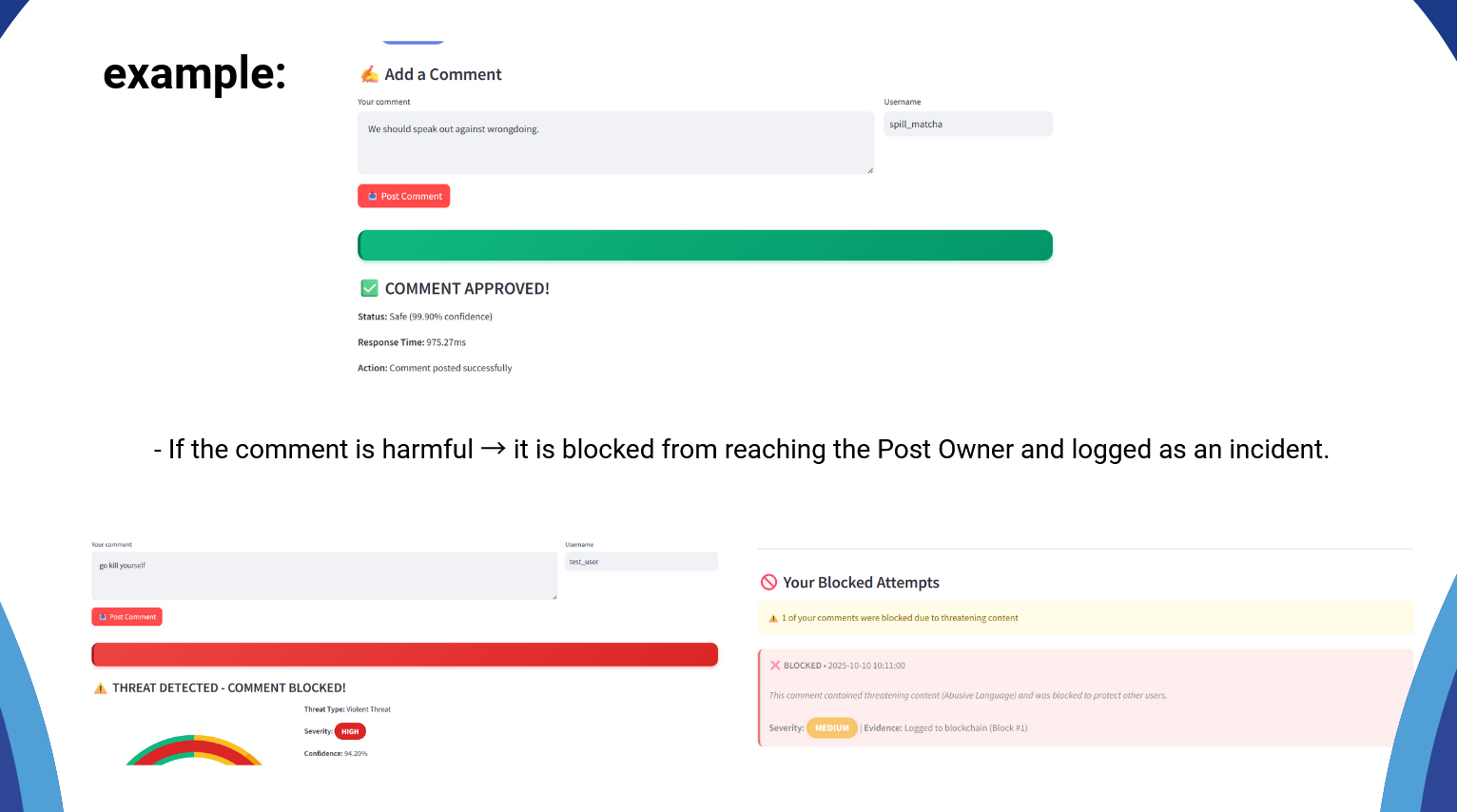
- Real-time analysis (< 500ms)
- Detects: sexual harassment, violent threats, hate speech, abusive language
- Categorizes severity: HIGH, MEDIUM, LOW
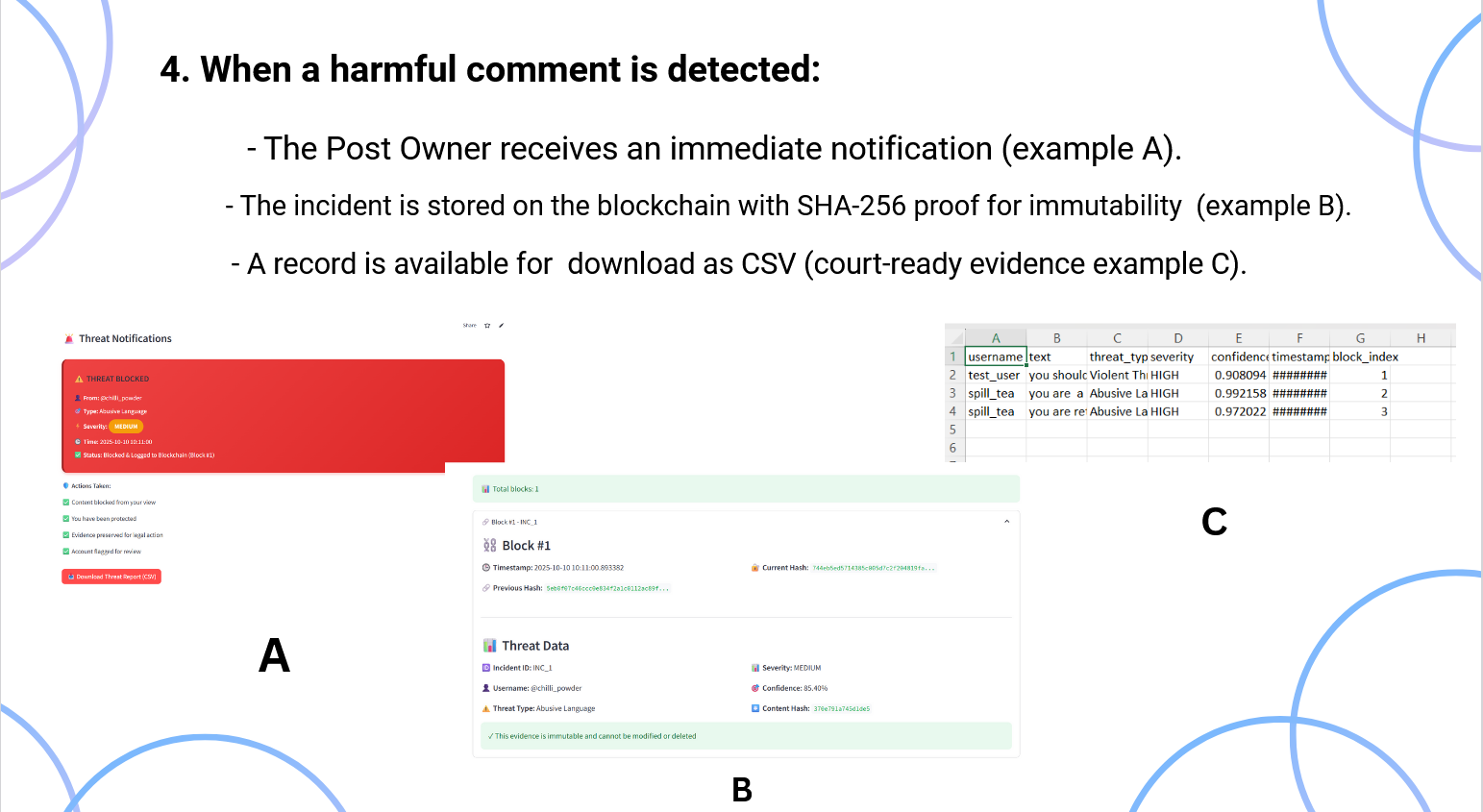
2. Blockchain Evidence Layer
- Logs every threat to an immutable blockchain
- Generates tamper-proof evidence for court use
- Stores: timestamp, threat type, severity, content hash
- Victims can download evidence reports anytime
3. Pattern Detection Layer
- Identifies coordinated harassment campaigns
- Links multiple accounts targeting the same user
- Detects escalation patterns
- Alerts users about organized attacks
Why Blockchain?
- Stores instances securely
- Tamper-proof: even if the original content is deleted, evidence remains
- Includes timestamp and threat type for each user
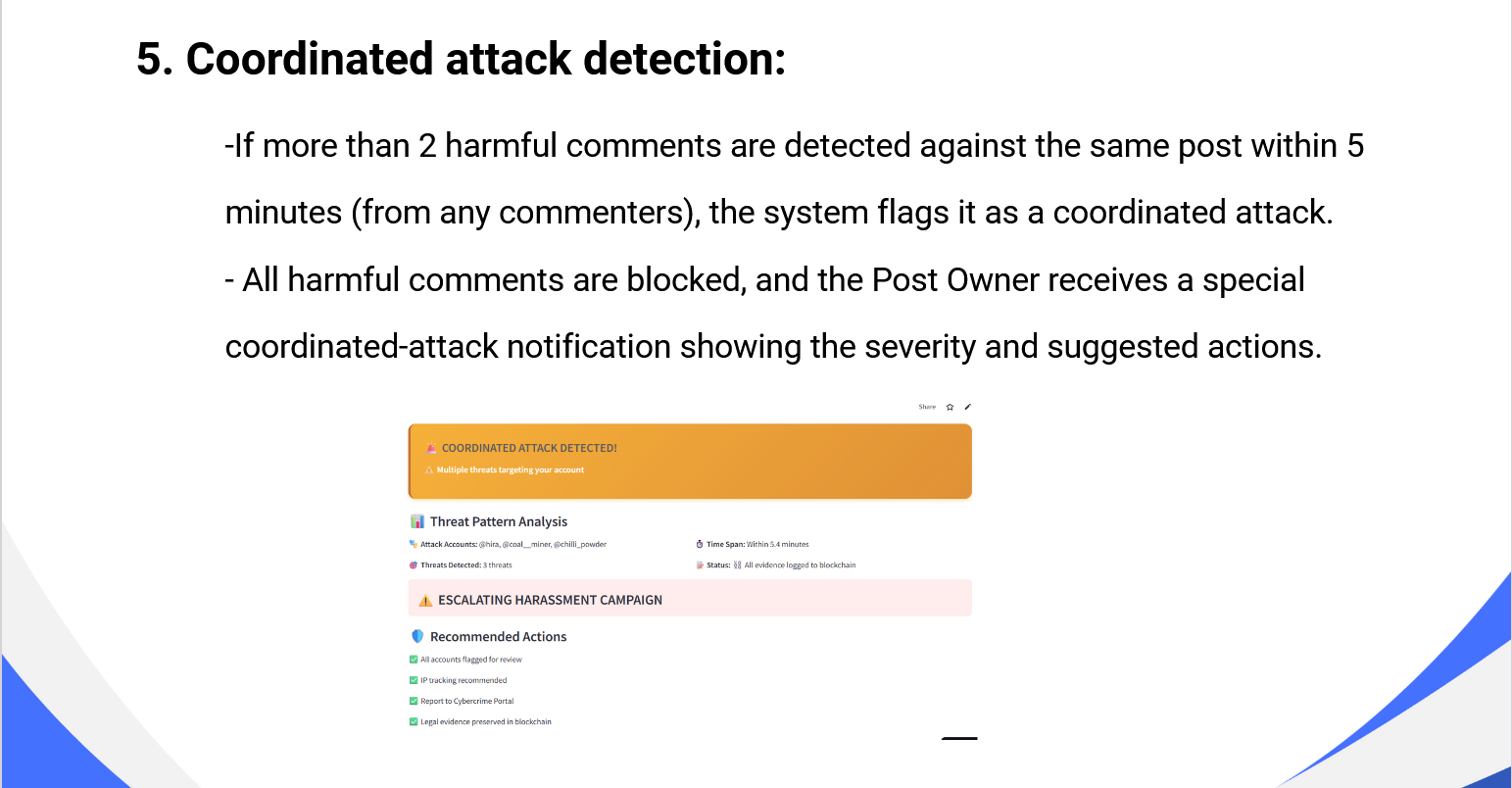
Pattern Recognition for Coordinated Attacks
Detects when a user receives multiple threatening or toxic comments from different accounts in a short period.
Flags possible coordinated harassment campaigns instead of treating each comment individually.
Summarizes the attack:
- Number of threats
- Accounts involved
- Time span of the attack
Helps protect users by providing early warnings and allowing for escalation or reporting of organized attacks.
Key Features
| Feature Category | Highlights |
|---|---|
| Beautiful UI/UX | - Modern gradient design (UX/UI designed with Claude AI) - Responsive layout - Intuitive navigation - Dual views: Post Owner & Commenter |
| AI-Powered Detection | - Real-time threat analysis - Confidence scoring - Multi-category detection |
| Blockchain Security | - Immutable evidence logging - SHA-256 hashing - Chain verification - Built-in Blockchain Explorer |
| Smart Alerts | - Pattern attack detection - Severity gauges - Real-time notifications - Coordinated attack warnings |
| Analytics Dashboard | - Live threat statistics - Severity and type distribution - Timeline visualizations - Graphs created using Plotly - System performance metrics |
| Evidence Export | - Download threat reports (CSV) - Court-ready documentation - Complete incident history - Blockchain proof included |
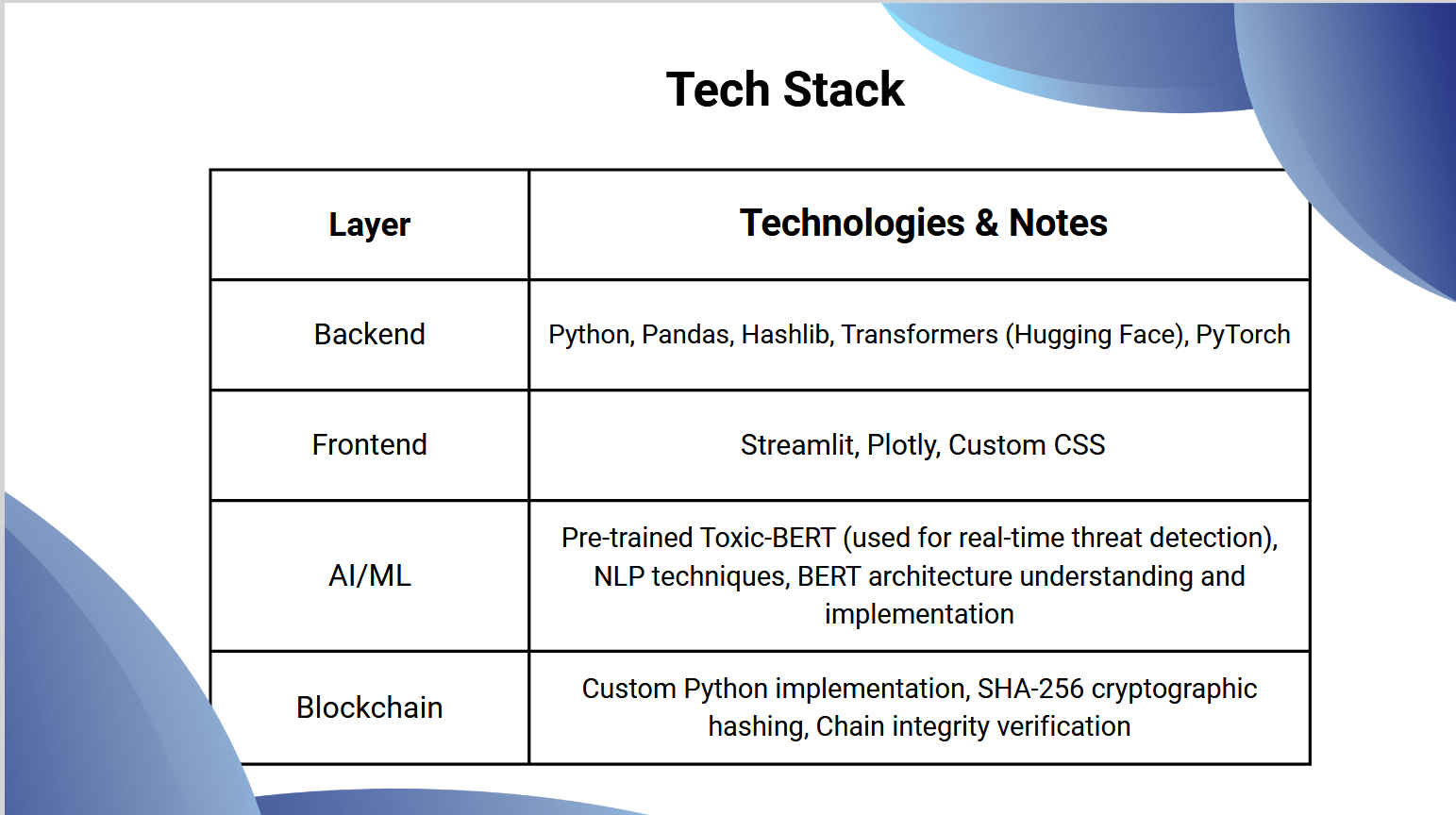
Tech Stack
| Layer | Technologies & Notes |
|---|---|
| Backend | Python, Pandas, Hashlib, Transformers (Hugging Face), PyTorch |
| Frontend | Streamlit, Plotly, Custom CSS |
| AI/ML | Pre-trained Toxic-BERT (used for real-time threat detection), NLP techniques, BERT architecture understanding and implementation |
| Blockchain | Custom Python implementation, SHA-256 cryptographic hashing, Chain integrity verification |
Personal Contributions and Learning
- Learned about BERT and real-time harassment detection.
- Studied coordinated attack detection linking multiple accounts.
- Created interactive graphs using Plotly for attack patterns and threat statistics.
- Assisted with UX/UI design using Claude AI.
- User testing: Preeti Va acted as a user tester, providing feedback on usability, interface clarity, and overall experience, helping refine SafeGuard AI’s design.
Challenges & Mitigation
Multilingual Support
- Challenge: Initially aimed to support multiple languages (English + Hindi), but multilingual harassment detection models are limited. Collecting and labeling raw datasets would take too much time.
- Mitigation: Focused on English-language detection using pre-trained Toxic-BERT for high accuracy and real-time performance. Future work includes fine-tuning multilingual models for regional Indian languages.
Custom Model Training
- Challenge: Training a custom BERT model could improve classification accuracy and better capture tone/context of messages, but it requires extensive data collection and labeling not feasible during the hackathon.
- Mitigation: Used pre-trained Toxic-BERT for real-time toxicity detection, combined with a keyword-based categorization system for Sexual Harassment, Violent Threat, Hate Speech, and Abusive Language. While robust, subtle or nuanced messages may not always be perfectly classified. Severity assigned as HIGH (>0.9), MEDIUM (>0.7), LOW (≤0.7).
Interdisciplinary Approach
SafeGuard AI is not just code it combines multiple fields:
- AI/ML: Real-time harassment detection using pre-trained models
- Blockchain Security: Tamper-proof evidence storage
- Social Sciences / Psychology: Understanding victim behavior and harassment patterns
- UX/UI Design: Creating accessible, user-friendly interfaces for victims
- Legal / Ethics Awareness: Ensuring evidence is admissible and data handling is ethical
This combination of disciplines ensures the system is technically strong, socially aware, and legally usable.
Future Scope
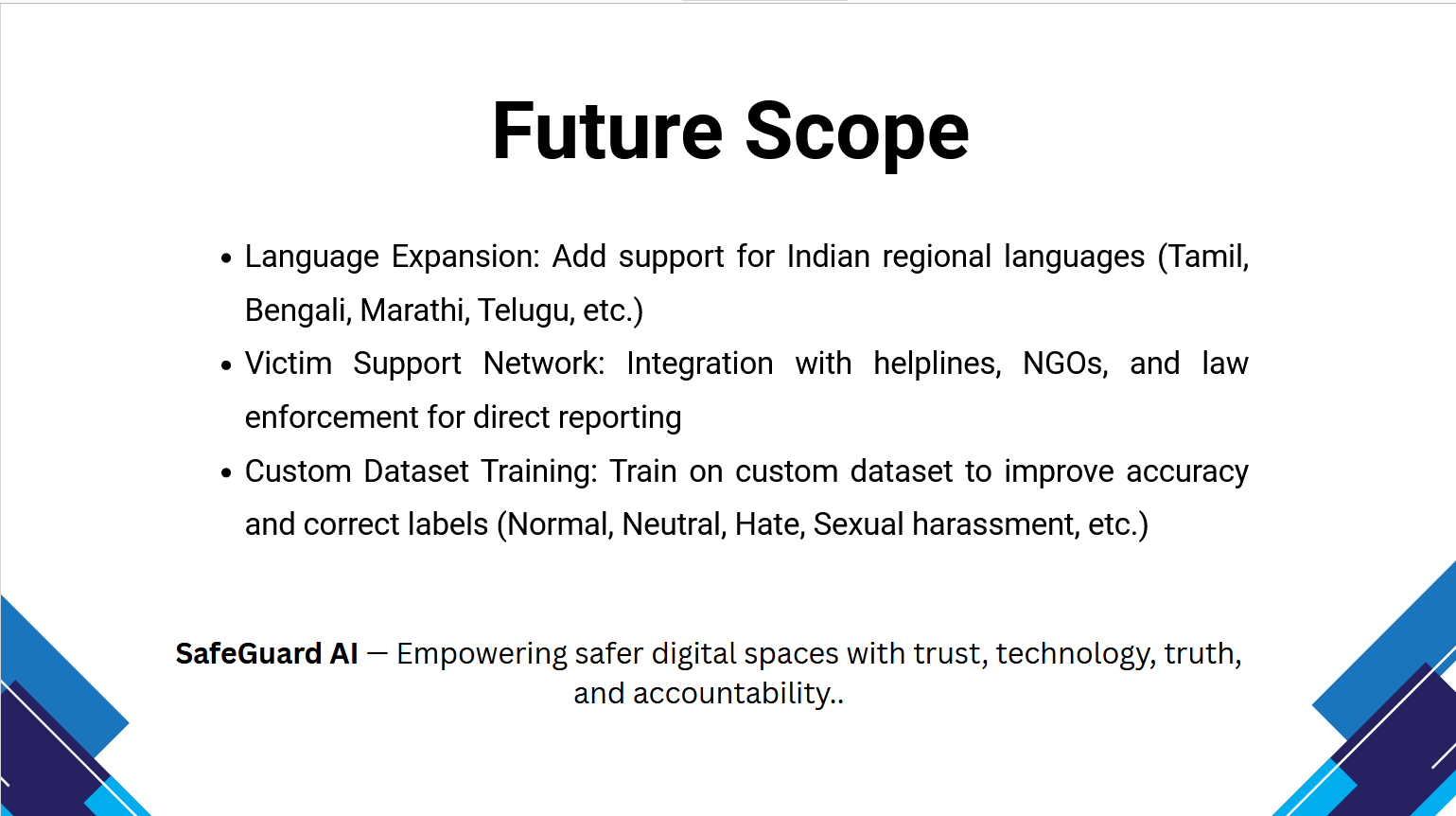
- Language Expansion: Add support for Indian regional languages (Tamil, Bengali, Marathi, Telugu, etc.)
- Victim Support Network: Integration with helplines, NGOs, and law enforcement for direct reporting
- Custom Dataset Training: Train on custom datasets to improve accuracy and label subtle harassment types
Built With
- bert
- natural-language-processing
- python
- pytorch
- streamlit

Log in or sign up for Devpost to join the conversation.