Inspiration
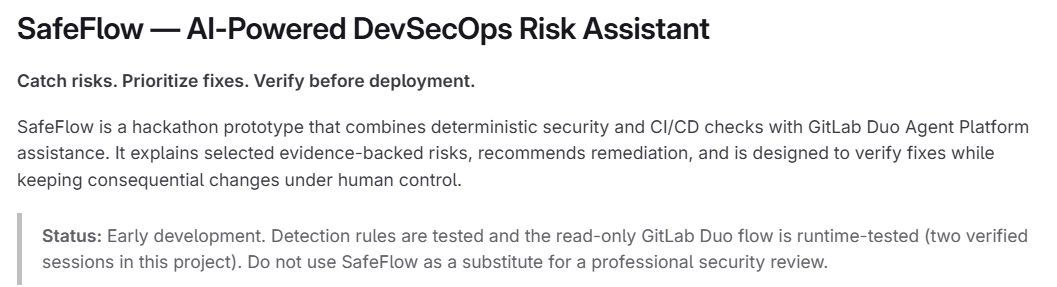
As a freelance web developer, I kept running into the same problem: AI security tools that sound confident but show no evidence. Hallucinated line numbers, invented vulnerabilities, "trust me" findings. I wanted to build the opposite: an AI reviewer that behaves like a good security engineer — it shows you exactly what it read, admits what it did not check, and never touches your repository without a human saying yes.
What it does
SafeFlow is an evidence-first DevSecOps risk reviewer for GitLab, with two layers:
- A deterministic Python engine (no AI): rules that detect CI/CD risks like security gates with
allow_failure: true, findings with stable rule IDs, severity, evidence confidence, JSON and Markdown reports, and a CLI. - A read-only GitLab Duo custom flow ("SafeFlow Review") built on the GitLab Duo Agent Platform: it explains risks from real repository files, proposes minimal remediation — and pauses at a human approval gate. It has no file-editing, commit, or merge-request tools at all.
The core idea is an evidence-source taxonomy: every claim the AI makes must be labeled as repository-file (with the exact file path and line range read), issue-description, synthetic-fixture, or unchecked. If it could not verify something, it must say so — never guess.
How I built it
I built the deterministic engine first, so every AI behavior could be tested against a ground truth: rules, a findings model, reporters with secret redaction, a CLI, and 25 unit tests including a regression scenario that verifies a finding disappears after the fix. All tests run on GitLab CI on every push.
Then the Duo flow: a read-only toolset (read_file, find_files, list_dir, get_issue, list_issue_notes — nothing that writes), an approval HumanInputComponent with approve/modify/reject routes, and a system prompt enforcing the evidence taxonomy. Config guardrail tests assert the flow file keeps its read-only shape and evidence requirements.
Finally, I runtime-tested it for real: two sessions triggered from GitLab issues by mentioning the flow's service account, verified through the GitLab API and session logs.
Challenges I ran into
- No REST API exists for Duo flows or sessions. I verified runtime behavior by combining the issue notes API, the todos API, and reading session pages — and only documented what I could prove.
- The flow cannot confirm which ref its file tools read (access to
.git/HEADis blocked). Instead of hiding this, I made it a requirement: the flow must mark that claimunchecked. Watching the AI honestly flag its own blind spot was the best moment of the project. - Proving "read-only" is hard to fake. I ran the rejection path end to end: the maintainer rejected the proposal, then I verified via the GitLab API that zero commits, pushes, or branch changes occurred at any point during the session.
Accomplishments I'm proud of
- Session 9412534: the flow located and read the real
.gitlab-ci.yml(lines 1–15), cited line ranges for every claim, labeled each with its evidence source, and stopped at the approval gate. - The verified rejection path: rejected proposal → zero repository writes, confirmed by API. Human control isn't a UI promise; it's a tested behavior.
What I learned
Evidence-first prompting changes AI behavior more than model choice. Forcing the model to label every claim's source — and to say "unchecked" instead of guessing — produced reviews I would actually trust. I also learned to verify AI runtime claims with APIs before writing a single line of documentation.
What's next for SafeFlow
More detection rules, and connecting the heuristic checks to real scanner outputs — today's rules are honestly documented as text heuristics, not a production scanner.
Built With
- agent
- agents
- ai
- api
- ci/cd
- devsecops
- duo
- gitlab
- human-in-the-loop
- platform
- python
- rest
- security
- testing
- unit
- yaml
