-
-
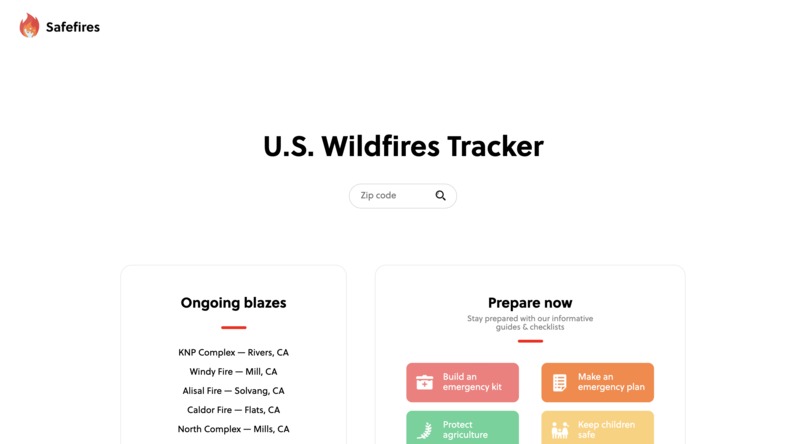
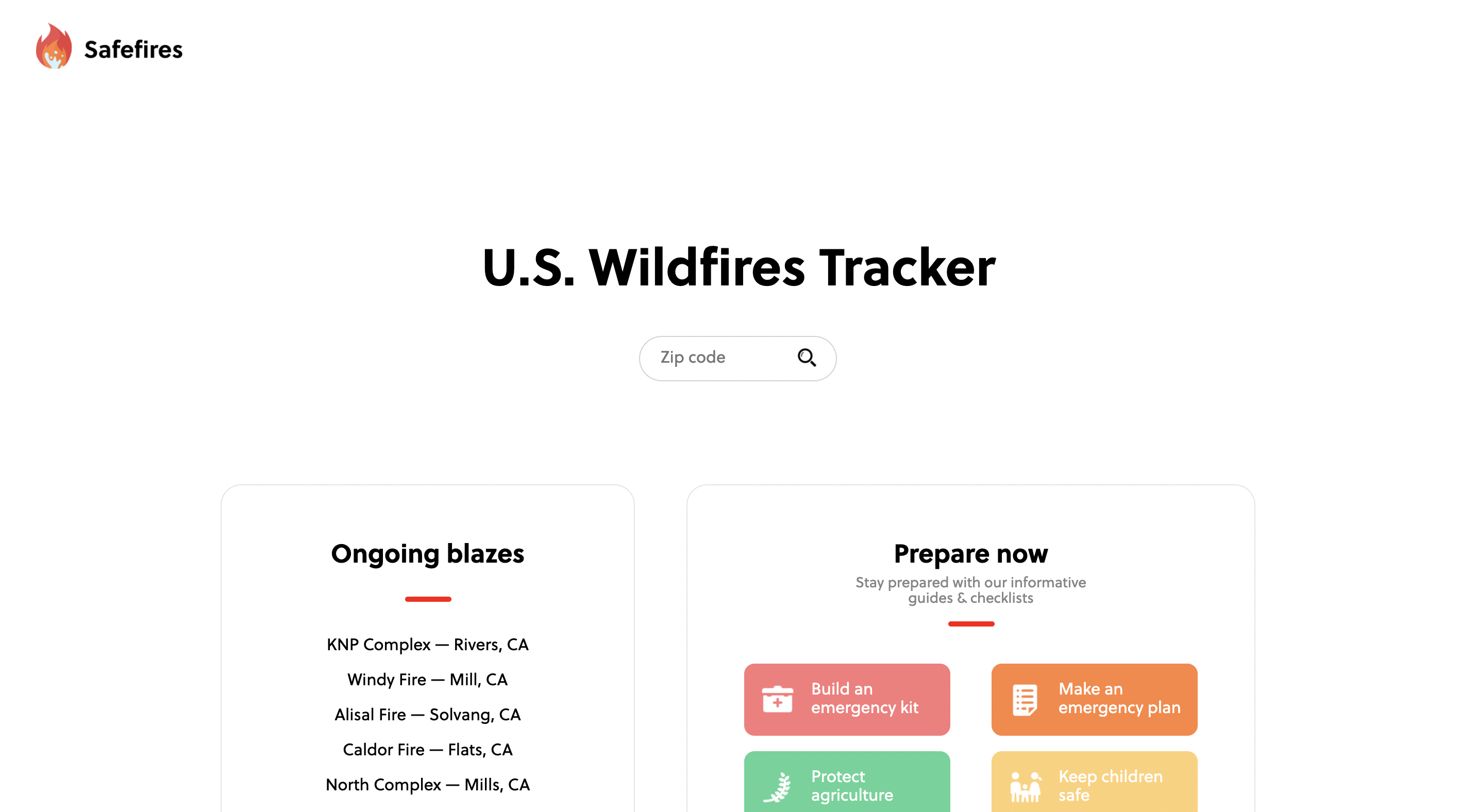
Home page
-
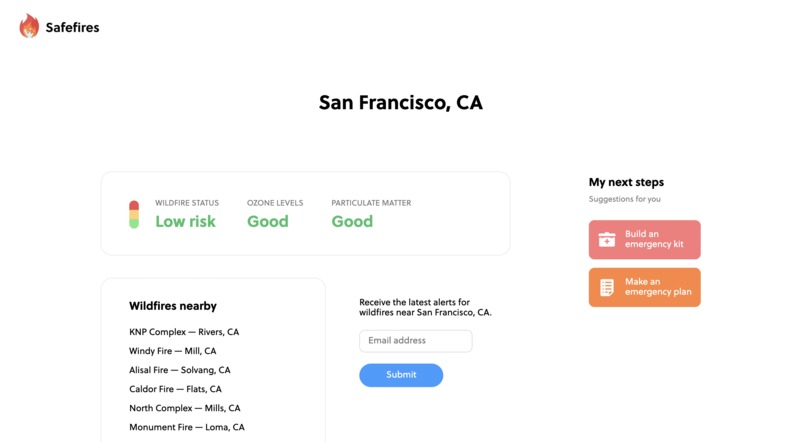
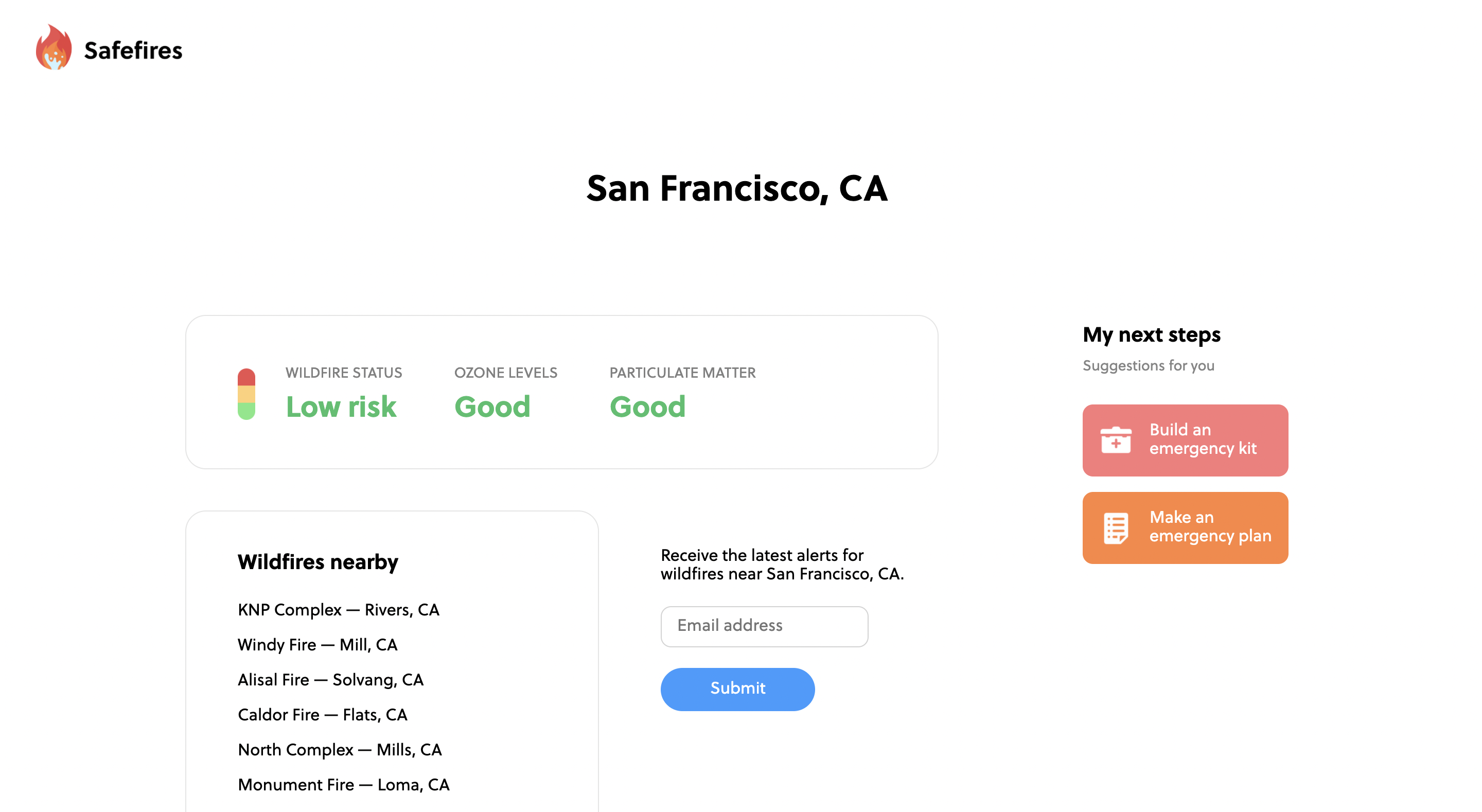
Location dashboard
-
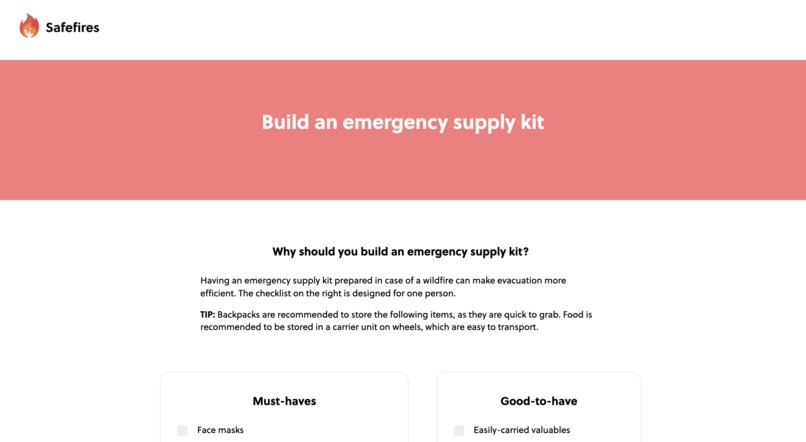
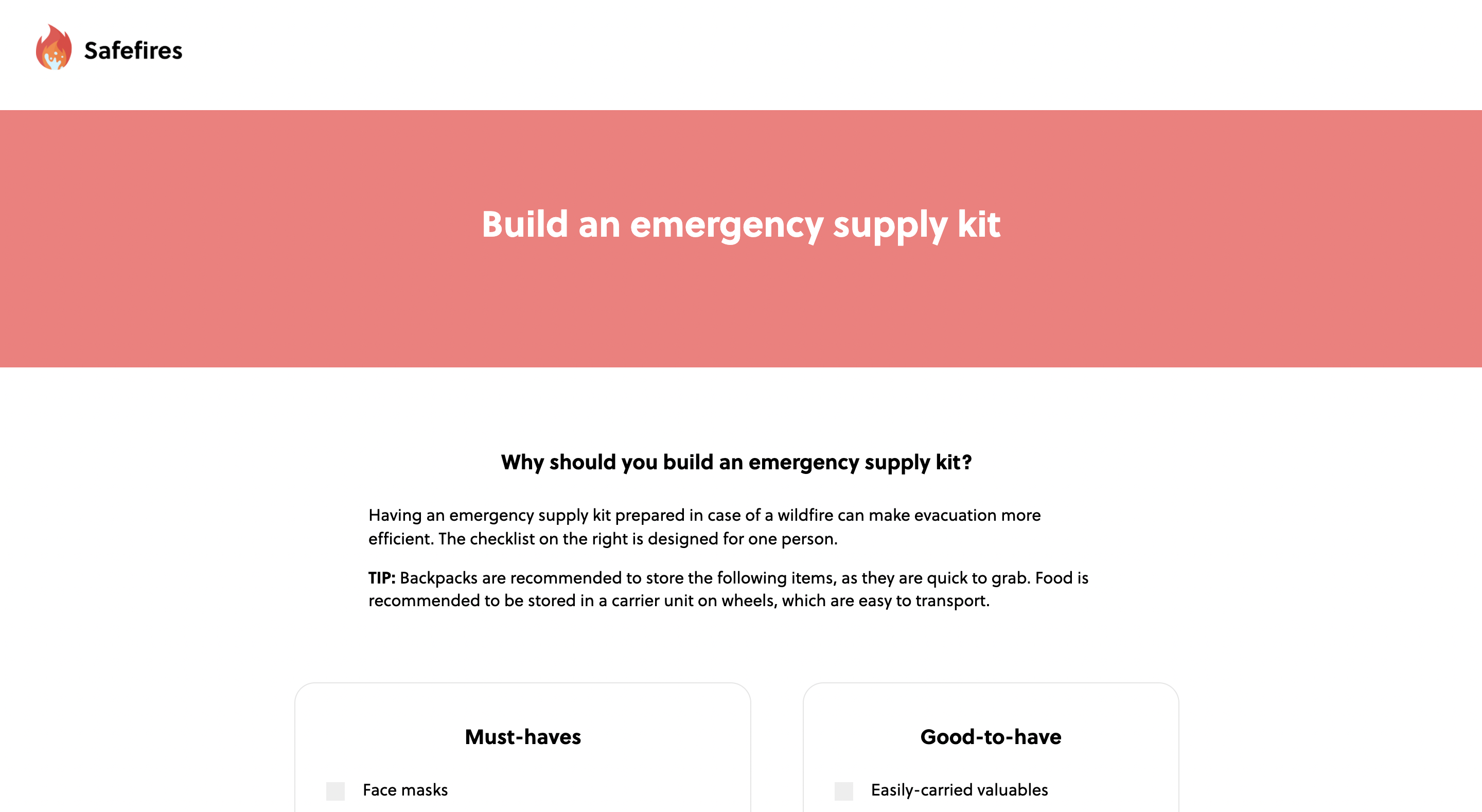
Build an emergency supply kit guide
🔥 Inspiration
Every year, thousands of wildfires devastate entire communities by destroying homes, polluting the air, and displacing families. Disastrous wildfires are becoming increasingly frequent year after year, spreading their catastrophic damage across larger areas. As wildfires spread exceptionally quickly and can wreak havoc on homes in mere minutes, a lack of preparedness and protection will turn to adverse consequences. Residents must be well prepared for future wildfires, and staying equipped with resources and updated information is the key solution to safety.
Growing up in California, I've experienced the devastating impacts of wildfires and witnessed their effects on thousands of families every year. Wildfires leave many regions in bleak hardship from damaging acres of crops, destroying homes, and displacing locals. Thus, I grew inspired to utilize my skills in computer science to create a website for wildfire victims.
🌟 What it does
Safefires provides the latest wildfire updates, predicts wildfire risk based on weather conditions, and informs residents with guides on wildfire prevention and safety.
On the home page, visitors can find a list of active wildfires in the United States to stay updated on the spread of wildfires throughout the country. They can also explore eight available wildfire preparation guides covering a wide range of topics, from building an emergency supply kit to preparing for evacuation. These informative guides include practical tips and checklists to help communities prepare before potential emergencies strike. Lastly, visitors can look up their zip codes. Upon their search, they are taken to a dashboard that reflects updates on nearby wildfires, displays their wildfire risk and air quality measures, and suggests how to proceed. Safefires leverages a machine learning model that compares four weather conditions (temperature, humidity, wind speed, and precipitation) to historical wildfire data to determine wildfire risk (low, moderate, or high). Depending on the level of wildfire risk, Safefires suggests customized steps for safety, accompanied by preparation guides (ex. High risk → Prepare for evacuation and learn how to evacuate safely).
⚒️ How we built it
We built Safefires using HTML and CSS for the front-end design, alongside Figma wireframes for UI design mockups. For the back-end, we programmed in Python with Flask. To create the machine learning model for detecting wildfire risk, I trained a linear regression using the scikit-learn library.
✏️ Challenges we ran into
Coming into this project with little experience in artificial intelligence, I found it extremely challenging to code my machine learning model for detecting wildfire risk. With multiple weather factors influencing the risk of wildfire, I struggled to decide how to best construct my model to accurately reflex complex real-life situations while also compromising its time efficiency. However, after persevering alongside the help of online resources and YouTube tutorials, I was able to train my machine learning model to accurately predict a wildfire's occurrence around 70% of the time.
💫 Accomplishments that we're proud of
I'm proud of having learned so much in such a short amount of time. Entering the hackathon, I had experience in front-end development but would often avoid back-end development due to fearing its technical complexity. Throughout the hackathon, I taught myself how to combine my front-end skills with my newly-acquired skills in Flask and handle API calls to execute so much more than the static pages I would typically create. My experience building Safefires inspires me to continue exploring back-end development to build more websites with dynamic features.
🧠 What we learned
Throughout this hackathon, I gained considerable skills in back-end development, from programming in Flask to requesting API calls on platforms like Google Cloud and OpenWeatherMap. It was incredible to discover a new aspect of web development, as I previously only coded using HTML, CSS, and JS. Although there was a steep learning curve at first, I eventually picked up my pace as I continued my journey with Safefires.
Furthermore, I learned how to create my own linear regression machine learning model using Python's scikit-learn library. Machine learning has always been a field I wanted to dive into, yet I never found the courage to pursue it due to its rigorous technicality. However, being surrounded by dozens of other ambitious hackers, I decided to put myself to the challenge—and I'm so glad I did. After hours of researching articles on artificial intelligence and scikit-learn, it was gratifying to see my model come to life.
✨ What's next for Safefires
In the future, I would like to keep residents informed about wildfires while removing their need to constantly check Safefires's website. Specifically, I plan to code a feature where users complete a form with their email and zip code to be notified by email whenever Safefires detects a high wildfire risk in their area. Essentially, this would provide residents with an early warning sign to begin taking the necessary precautions for wildfire safety when they don't remember to check Safefires's website.
Additionally, as Safefires's machine learning model for detecting wildfire risk nears a 70% accuracy rate, it most definitely has the potential to improve. Thus, I plan to gather more wildfire data and experiment with alternate machine learning models to automate more promising predictions.


Log in or sign up for Devpost to join the conversation.