
Inspiration
Trusting anyone takes a lot of courage, and once you trust them you'll fully come to believe in them . But in a turn of events, they betray or hurt you. You lose full trust in them and you come to realize that you can't trust anyone. This instance can be portrayed in social media. Nowadays any people believe that most of the stuff they see online is true, and it seems to be deceiving. They seem to be brainwashed because they are persuaded that it could be the truth. But is it really? Once people like me for example start waking up, they come to realize that from news channels to social media, not everything that is posted is real. It is perhaps a lie. Also, social media in general tends to be biased so they hide certain information, manipulate it, etc.
What it does
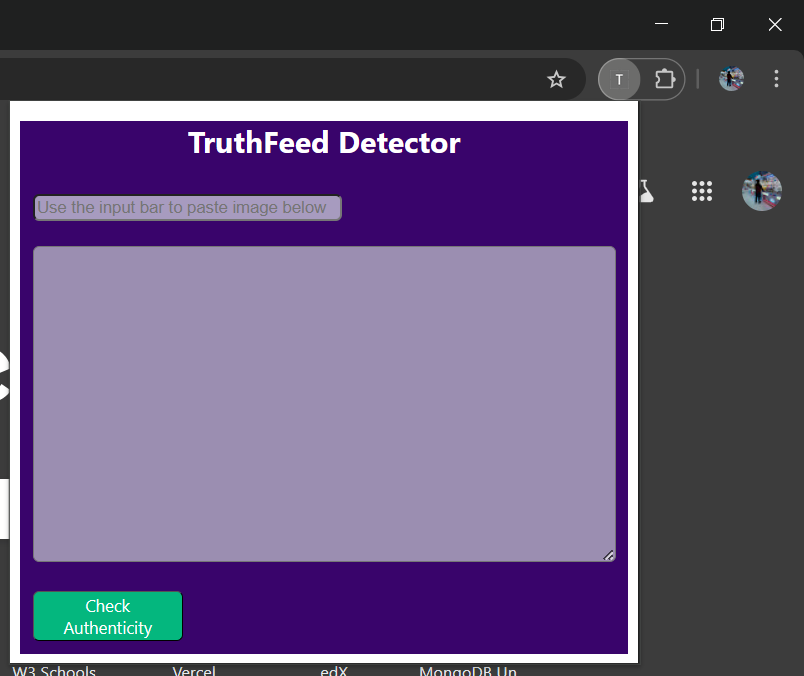
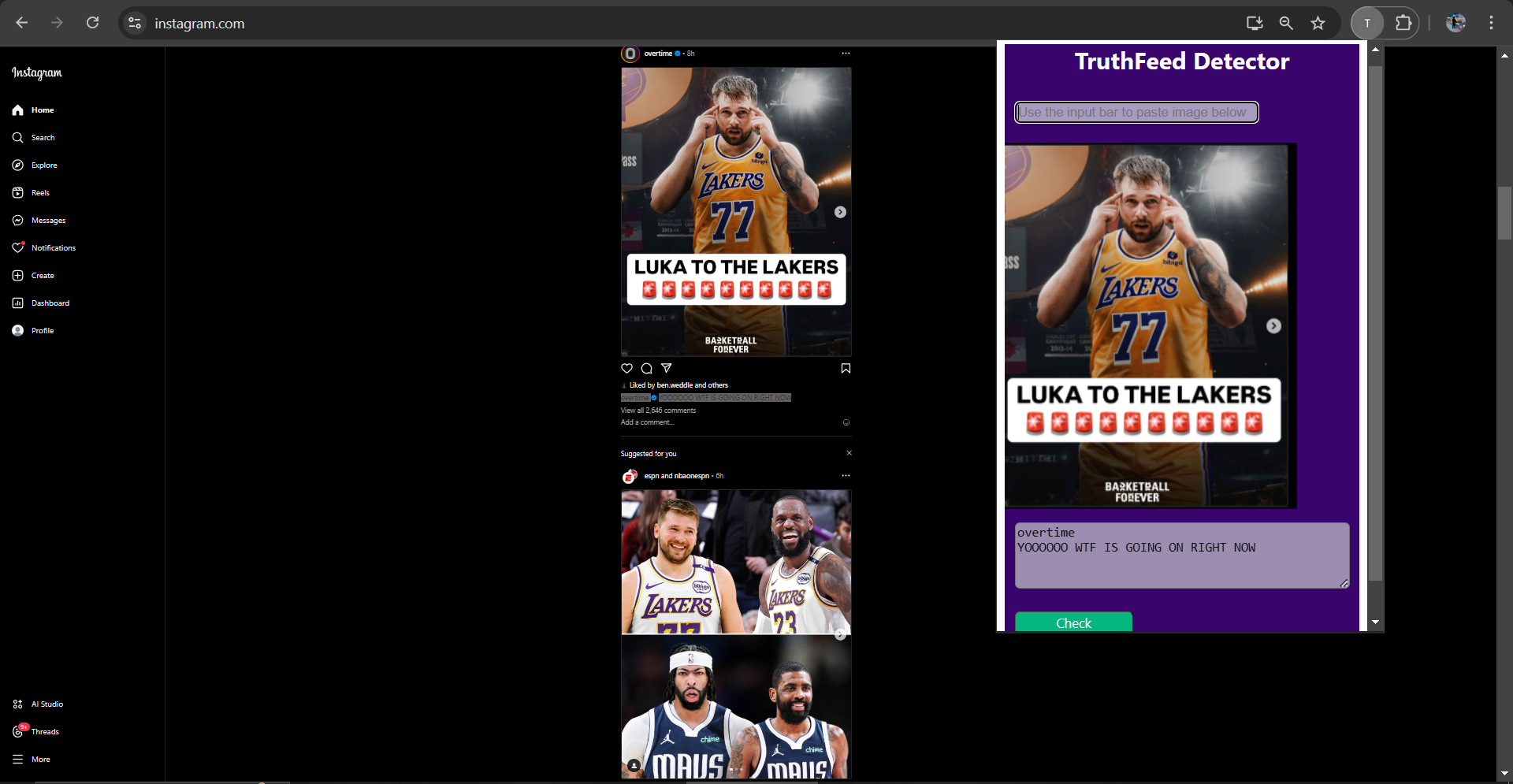
My Chrome extension takes a social media post, and it scans the caption and the photo. Users will highlight the social media post's text and click on the extension while they take a snippet of the post's image and paste it on the extension. Aftwards the user will click an authentication button and two AI agents working under the hood. An AI agent will work on analyzing text such as fact-checking it, if it looks AI generated, etc. Another AI agent will work on analyzing images such as seeing if it's AI generated, taken by a human, inappropriate, etc.
How I built it
I used React and CSS to make the Chrome extension. For the server side, I used Python and the Fetch.ai library to create my agents. With one of the agents I utilized 'nlkt' that analyzes text while for the other agent I attempted to use 'pytorch'. I attempted to use Flask to link the chrome Extension and the AI agents together.
Challenges I ran into
I never used a Chrome extension in my life so I had to watch a few videos and look at boilerplate code for reference on how to make a Chrome extension for starters, which took me several hours. A minor problem I had with Chrome extension was seeing that "content_scripts" didn't work so I used background script. Once I was able to make a Chrome extension, it was easy enough to make another one in the future. A major challenge was programming one of the AI agents to analyze images. This is because there was an overwhelming amount of graphics and data processing that needed to be done, which was difficult for my computer. Generally, just working with Python libraries can be difficult becuase there's a lot of packages under the hood that needed to be installed in order to run successfully and also trying to find a ton of real world data. Finally a big challenge was trying to link the AI extensions through the Chrome extension using a backend framwork like Flask.
Accomplishments that I am proud of
I am proud of being able to create my first agent using Fetch.ai and make another one as well. I am also proud of being able to do frontend development on a Chrome extension. I'm also proud of being a risktaker in the hackathon and taking on a complex application on my own.
What I learned
I learned that it is okay to take risks, but also it is okay to ask for help. I also learned that as I gain more experience, I will be making more complicated apps. So as a result, I indirectly learned that creating system design and app architecture will be helpful and organizable for me in the future.
What's next for TruthFeed
I believe TruthFeed has a lot of potential. Although I didn't meet all of my expectations, I'm hoping that when I gain more experience and grow along the way, I can finish what I started. Potentially we might implement an AI agent for TruthFeed that detects videos even though it is dynamic. And also we will utilize real world data and implement web scraping to make sure that TruthFeed succeeds and becomes accurate.

Log in or sign up for Devpost to join the conversation.