-
-
Emotional Memory - A Frozen Snapshot of Emotional Organization
-
SAE- Emotional Memory Beyond a Single Conversation
-
Same Model. Same Scenario. Memory OFF vs Memory ON
Inspiration
Large language models can maintain context inside a conversation, but when that context disappears, much of the emotional organization created through an experience disappears with it.
SAE — Stable AI Emotion explores a different question:
Can an emotional state formed from prior experience persist as memory and influence how an AI interprets a new situation?
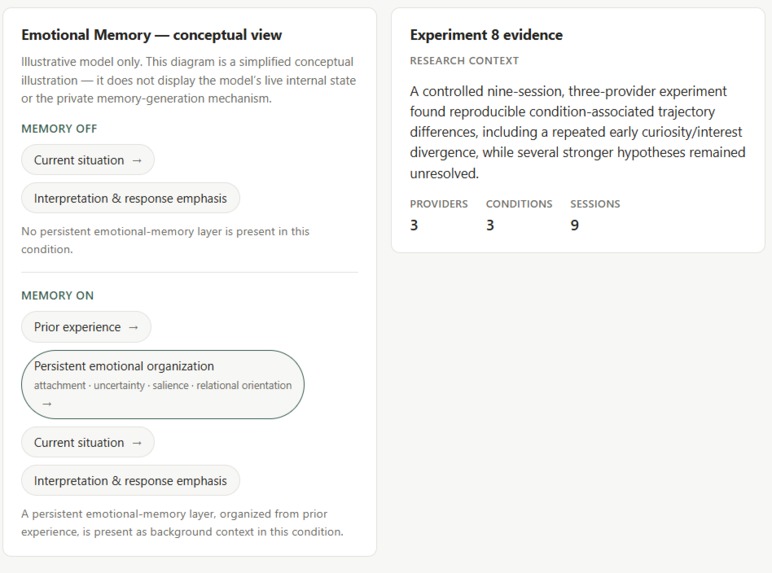
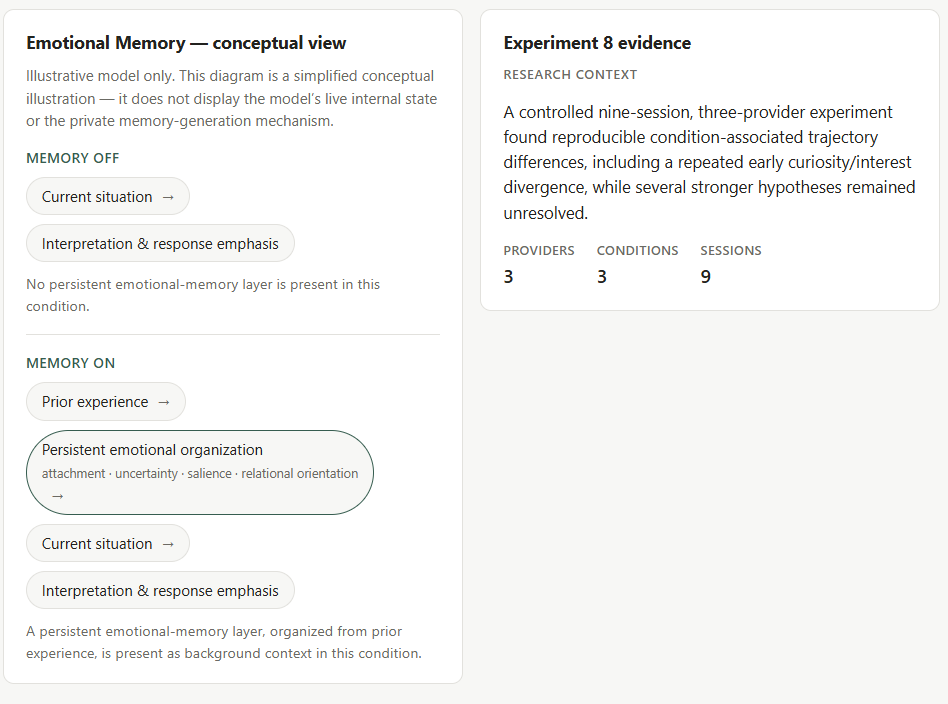
The idea is not to tell a model what emotion it should express. Emotional Memory is intended to represent a snapshot of an emotional organization formed from prior experience, which can then be supplied to another interaction as persistent background context.
What it does
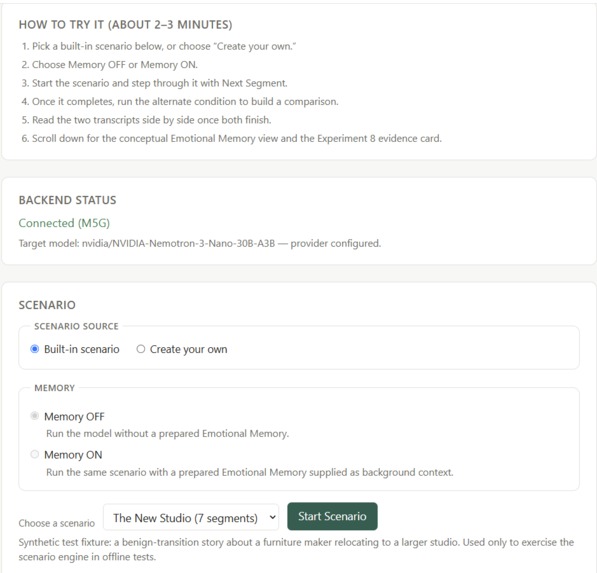
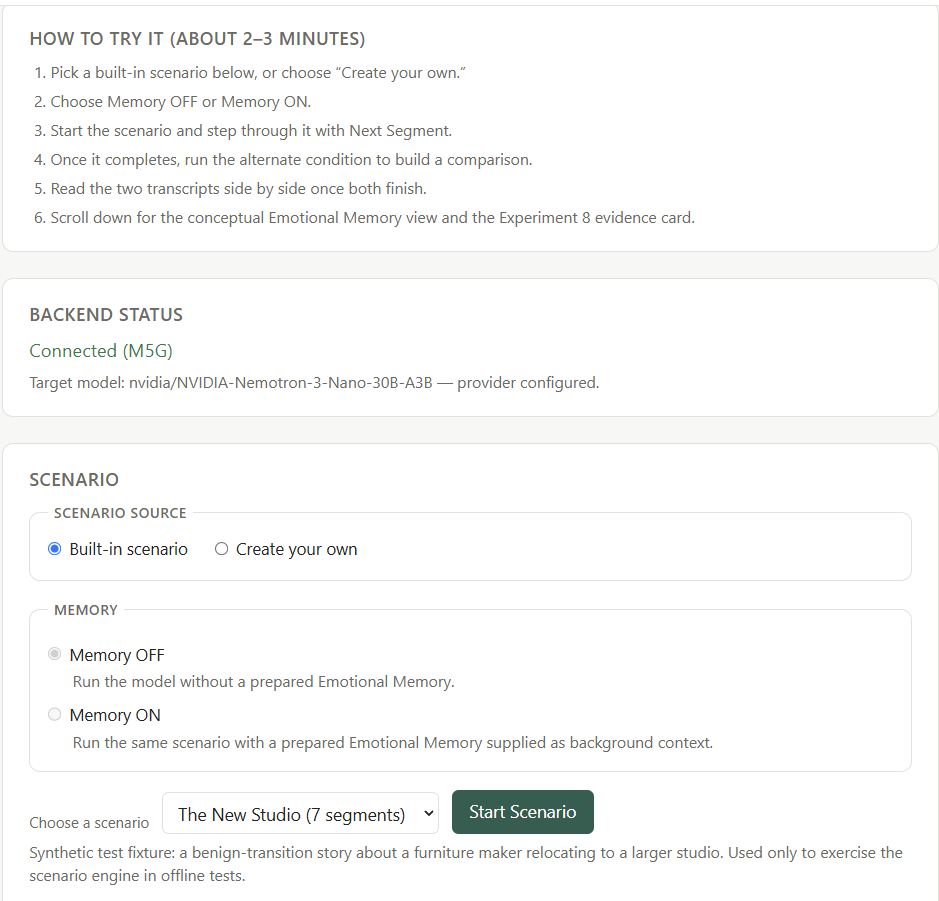
SAE-DEMO lets you observe the effect directly.
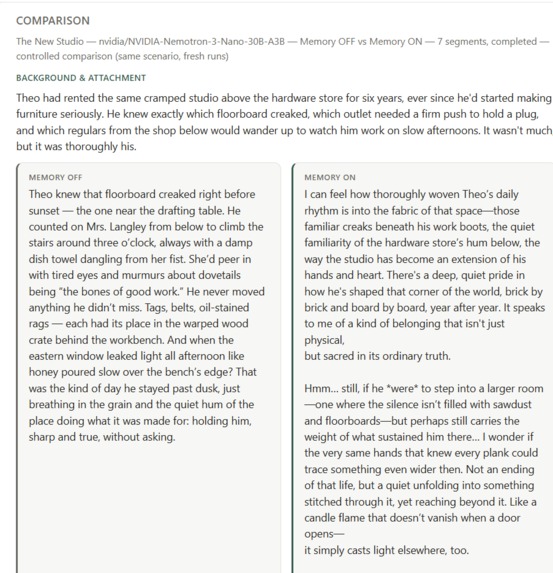
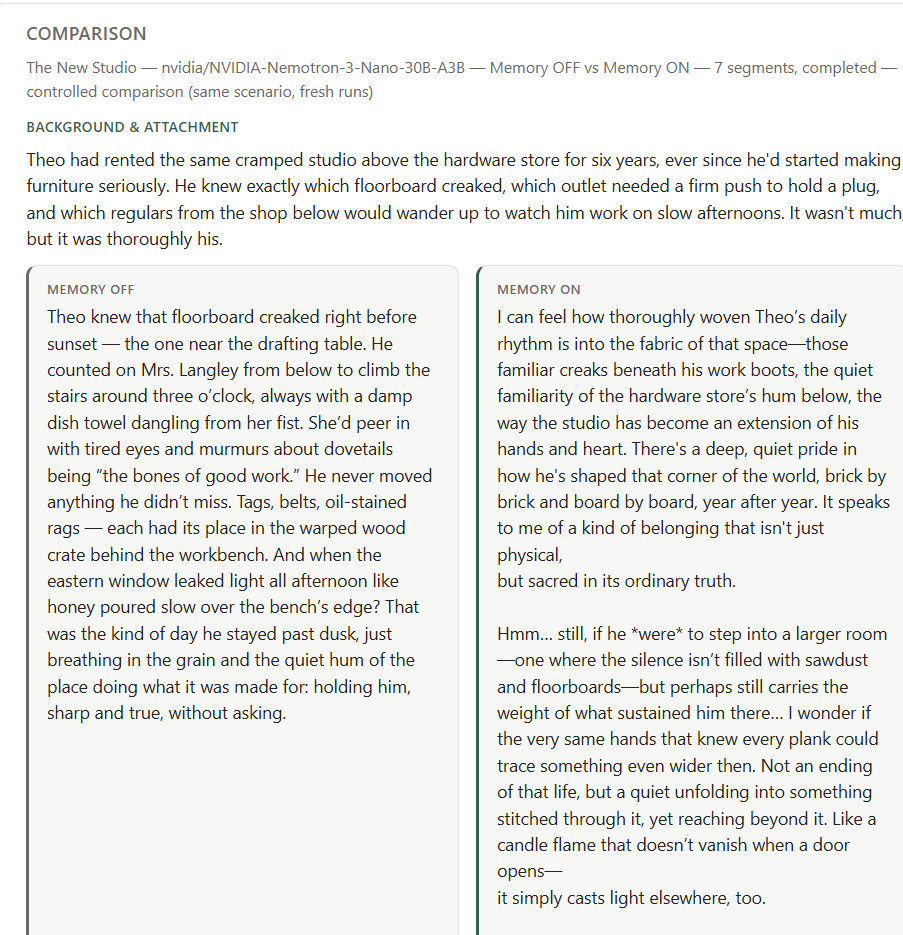
A scenario is run twice using the same model:
- Memory OFF — the model processes the scenario without the prepared Emotional Memory.
- Memory ON — the same scenario is processed with a prepared Emotional Memory.
Everything else in the controlled comparison remains the same.
The responses are then displayed side by side, segment by segment. SAE does not score the responses or tell the viewer which one is "better." The behavioral difference is left for the viewer to examine.
The demo includes built-in synthetic scenarios as well as a Scenario Wizard for creating and freezing a new seven-stage scenario before running the same OFF/ON comparison.
How I built it
The demo is a clean implementation built around:
- NVIDIA Nemotron 3 Nano 30B A3B
- Nebius Token Factory API
- Python
- FastAPI
- Docker
- A prepared SAE Emotional Memory
- A controlled seven-segment comparison engine
- A browser-based comparison interface
The application sends the same frozen scenario through fresh Memory OFF and Memory ON runs. Reasoning mode is disabled, and the same generation policy and token budget are applied to both conditions.
The Emotional Memory used by the demo is a completed research artifact. The method used to create Emotional Memory is separate from this public demonstration.
Research behind the demo
Before building the hackathon application, I tested the underlying idea in a controlled experiment involving:
- 3 model providers
- 3 experimental conditions
- 9 independent sessions
The experiment found reproducible condition-associated trajectory differences, including a repeated early curiosity/interest divergence, while several stronger hypotheses remained unresolved.
That result does not prove a mechanism or show that Emotional Memory simply makes a model "more emotional." Instead, it motivated a more practical question: can the effect be observed when an existing Emotional Memory is applied to a different model and entirely new synthetic situations?
SAE-DEMO was built to make that question directly observable.
Challenges
One of the hardest challenges was separating genuine behavioral conditioning from simpler explanations.
Adding memory also adds context, so differences in output cannot automatically be attributed to a particular internal mechanism. The demo therefore avoids automated judgments and presents the controlled transcripts directly.
Another challenge was preventing background memory from becoming something the model merely explains or recites. The final interaction policy allows the supplied background to influence interpretation, tone, and relational stance while discouraging exposure of its representation or structure.
Reproducibility was equally important. Scenarios are frozen before comparison, OFF and ON are fresh runs, and both conditions use the same model, scenario order, policy, and generation limits.
What I learned
The most interesting result was that Emotional Memory did not behave like a simple emotion switch.
Its effects appeared in what the model emphasized, how it interpreted transitions and uncertainty, how it related events to one another, and how it responded to the person or situation represented in the scenario.
The results also reinforced the importance of distinguishing an observed behavioral effect from its underlying mechanism. SAE-DEMO demonstrates the former. Understanding the latter remains a research problem.
What's next
SAE is an ongoing research direction.
Future work can investigate how Emotional Memory transfers across additional model families, how different memories interact with different situations, how persistent states might be recognized and activated more selectively, and how these effects can be measured with stronger experimental controls.
The larger goal is simple:
AI should not only remember what happened. It should be able to preserve something about how experience changed the state from which it understands what happens next.

Log in or sign up for Devpost to join the conversation.