Inspiration
UPI fraud victims often get only a vague warning or a failed transaction trail, but not a clear recovery path. We were inspired by the gap between fraud detection and actual consumer help: users need to know why a transaction looks suspicious, which RBI guidance applies, and how to file a complaint properly.
What it does
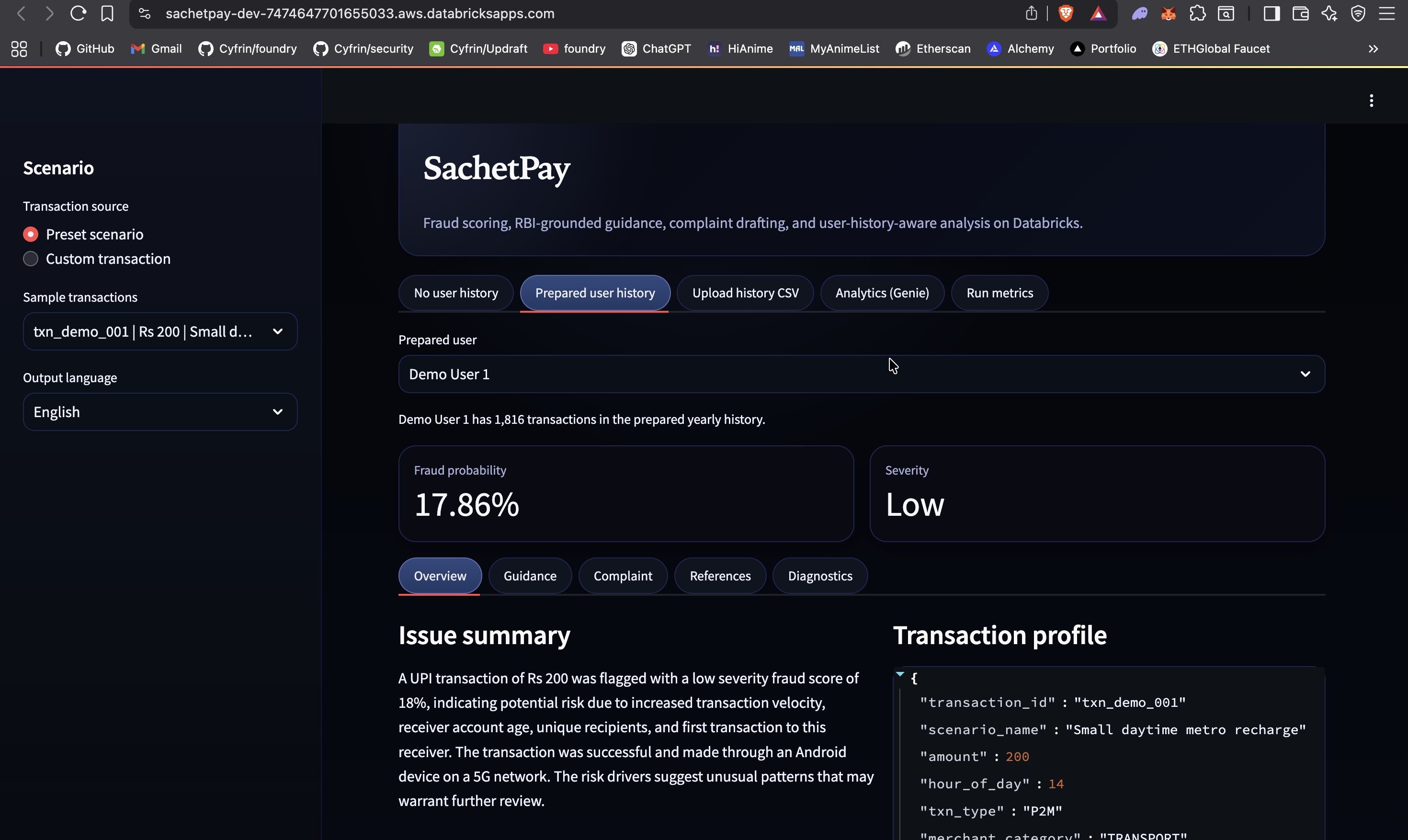
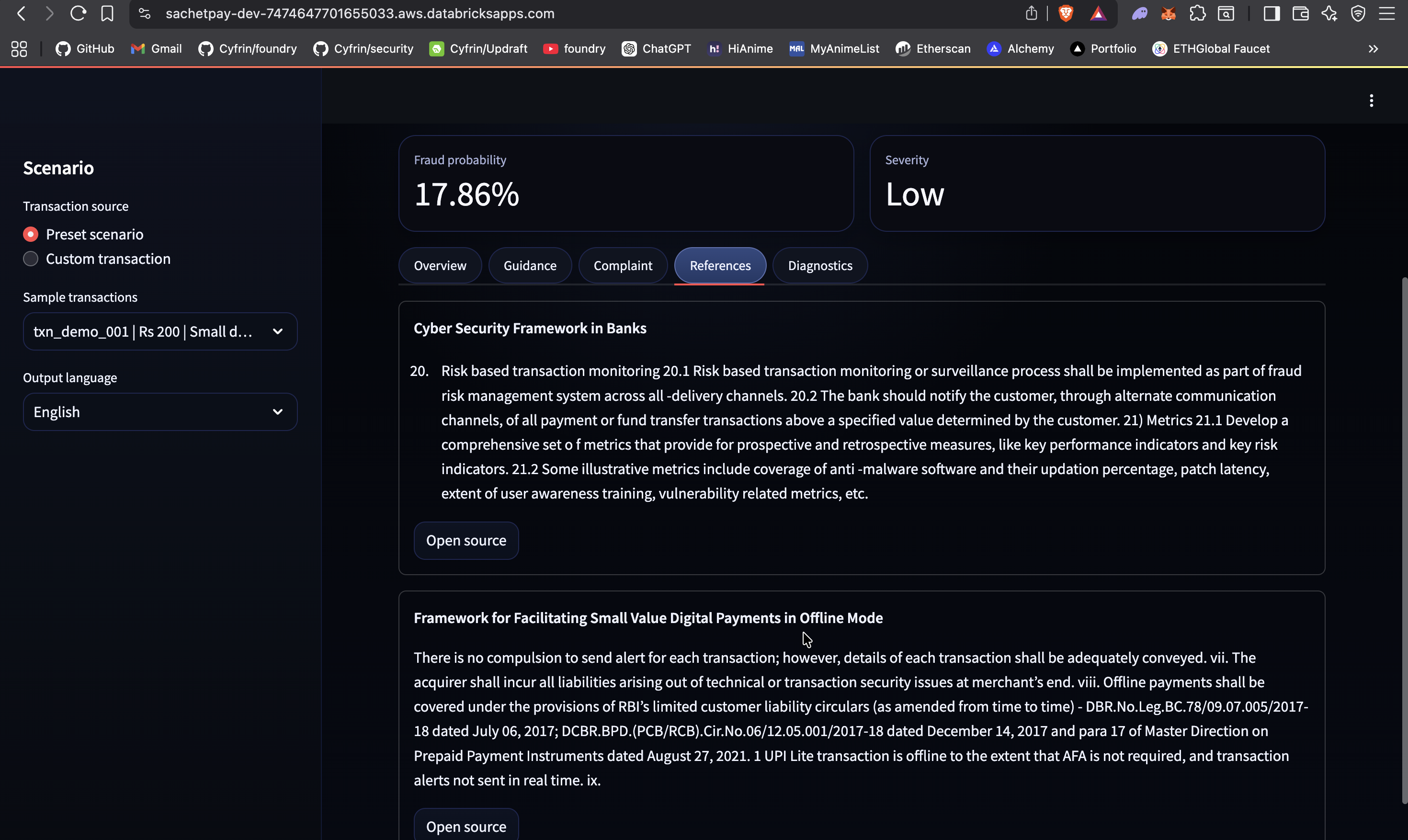
SachetPay detects suspicious UPI transactions, explains the fraud signals with model-driven reasoning, retrieves relevant RBI guidance, and generates a multilingual recovery and complaint workflow. It helps users move from fraud detection to complaint drafting, escalation, and evidence collection in one place.
How we built it
We built SachetPay as an end-to-end Databricks application. A served fraud model scores transactions and returns SHAP-based drivers. Those signals are used to query an RBI document corpus through Databricks Vector Search. The retrieved context is passed into a Databricks-hosted LLM to generate grounded recovery steps, escalation guidance, and complaint drafts. We added multilingual output using Sarvam AI and persisted complaint cases in Delta Lake for later review and analytics.
Challenges we ran into
The hardest part was scraping and building datasets that actually performed well for our use case, especially the RBI corpus and the fraud-oriented transaction data. On top of that, making the whole pipeline coherent was a major challenge. We had to align feature engineering with a live served model, improve retrieval quality so the RBI context stayed relevant, handle multilingual output cleanly, and keep the app usable without breaking the backend flow. Another challenge was balancing realism and demo stability, especially for user-history-aware fraud scoring and complaint generation.
Accomplishments that we're proud of
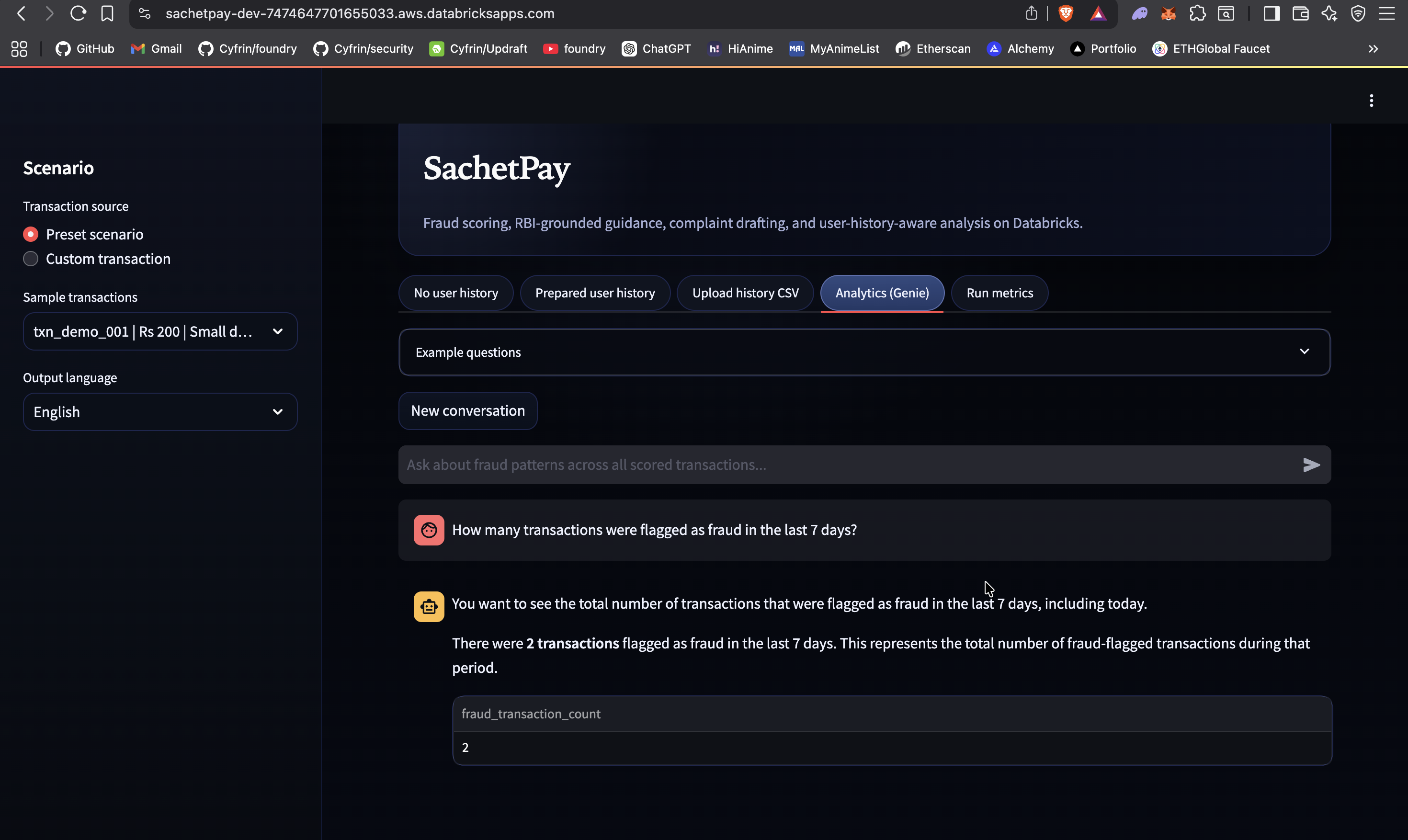
We built a working fraud-to-complaint pipeline instead of just a fraud dashboard. We are especially proud of combining fraud scoring, SHAP explanations, RBI-grounded RAG, multilingual support, and complaint persistence and a genie chatbot into a single Databricks app. The result is a system that is both technically complete and directly useful for consumers.
What we learned
We learned that fraud detection alone is not enough; the real value comes from connecting raw transaction input to a fraud probability score and then turning that into grounded action. We also learned how much product quality depends on retrieval quality, explainability, and workflow design, not only on model performance. Building on Databricks taught us how to unify serving, retrieval, storage, and analytics in one platform.
What's next for SachetPay
Next, we want to improve the fraud model with richer real-world UPI features, expand and refine the RBI corpus, strengthen the complaint workflow with more escalation paths, and add stronger user-data privacy controls.
Built With
- ai
- api
- apps
- databricks
- delta
- genie
- lake
- model
- pandas
- pydantic
- python
- sarvam
- scikit-learn
- search
- serving
- shap
- sql
- streamlit
- translation
- vector
- warehouse

Log in or sign up for Devpost to join the conversation.