-
-
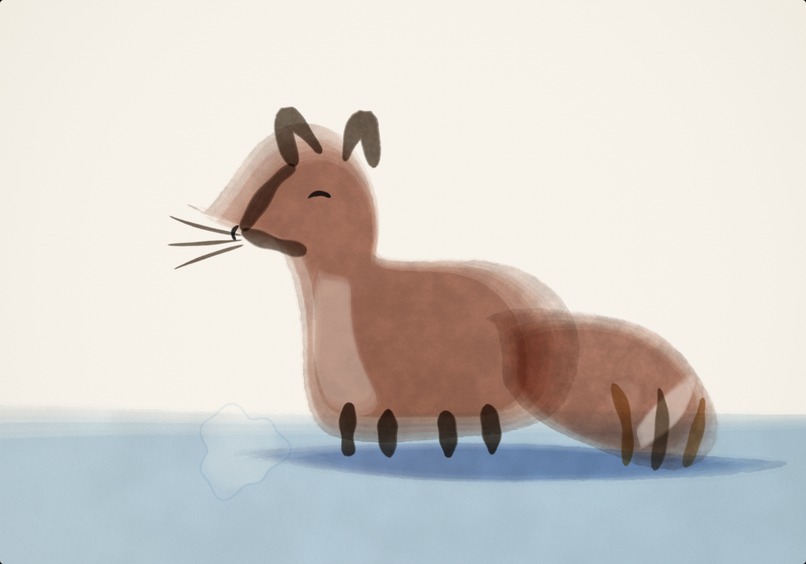
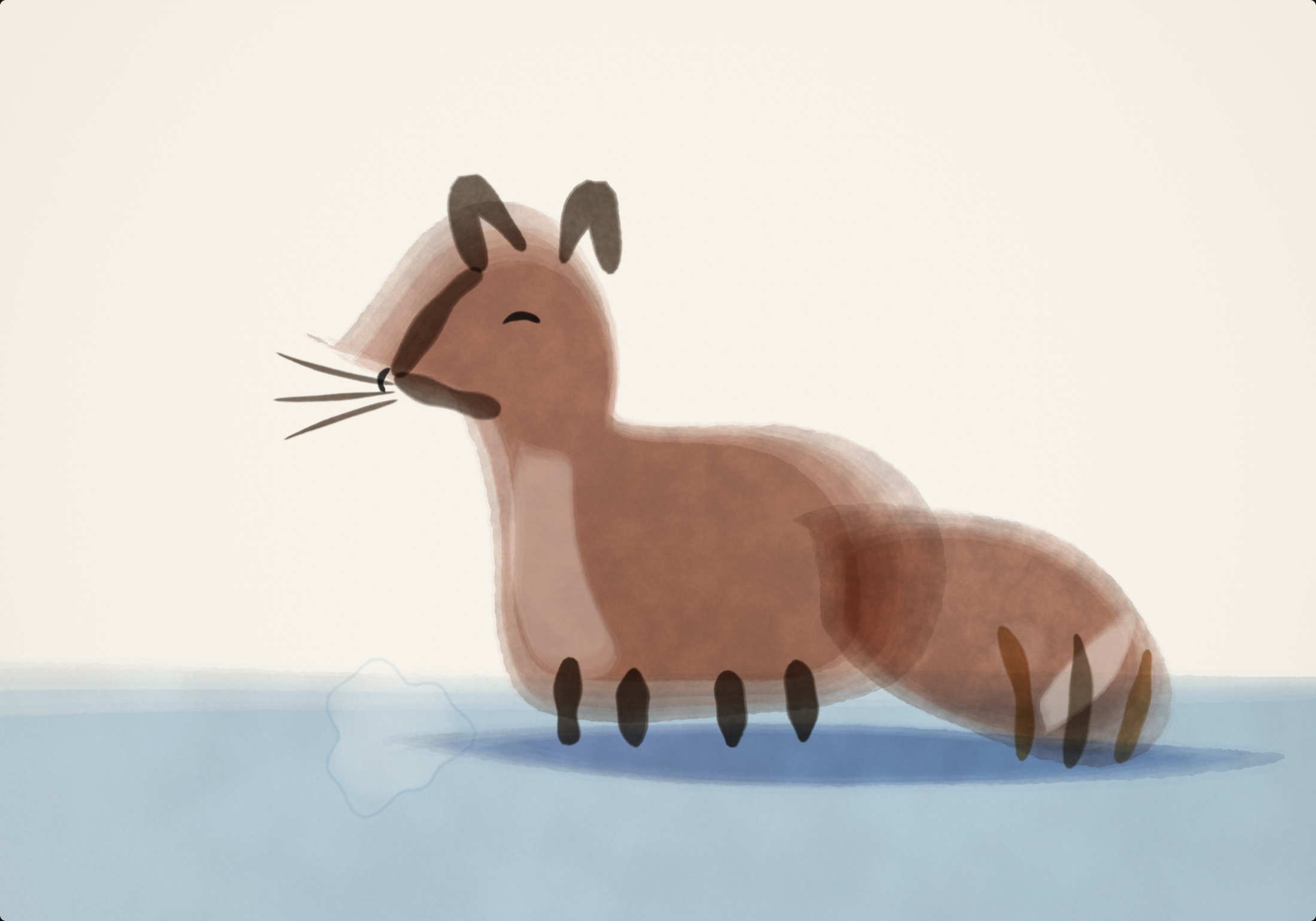
Fox Painting by GPT Terra (Test)
-
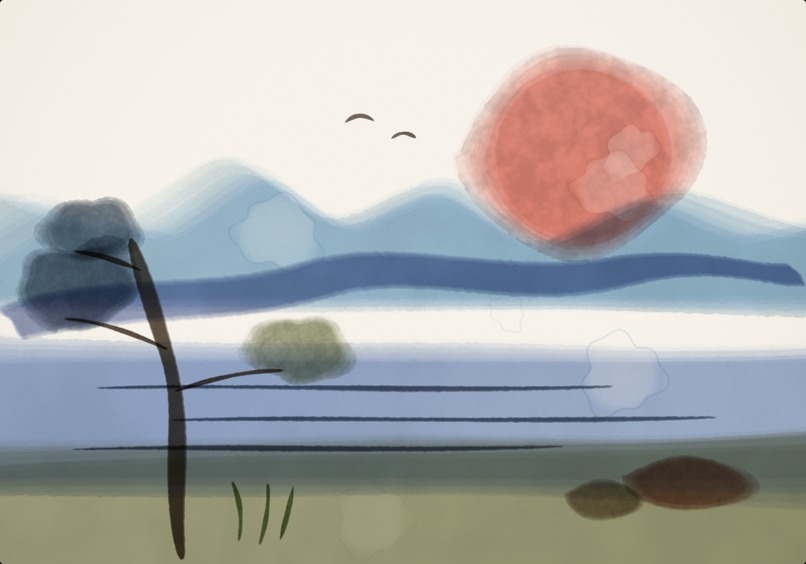
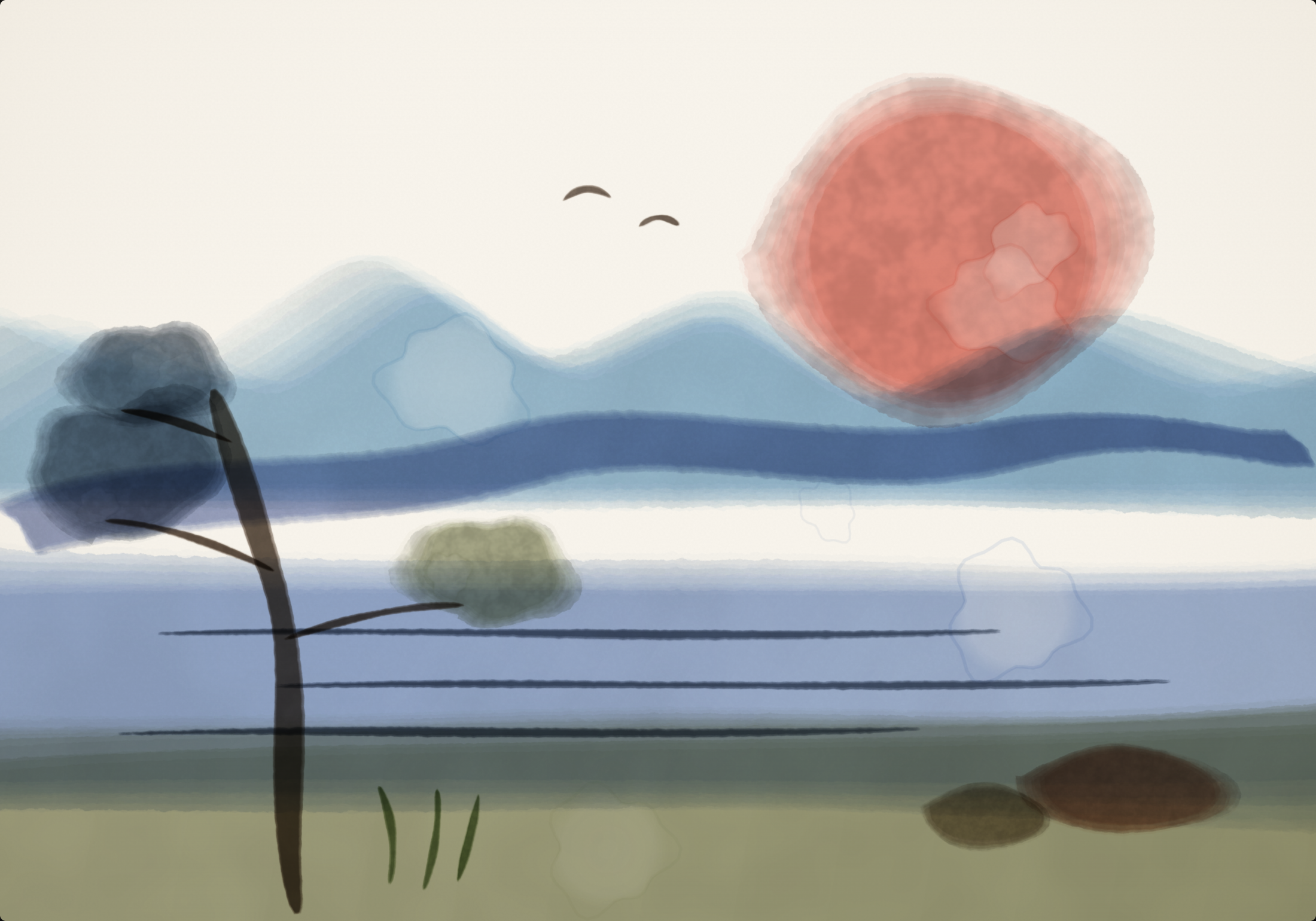
Landscape Painting by GPT Terra (Test)
-
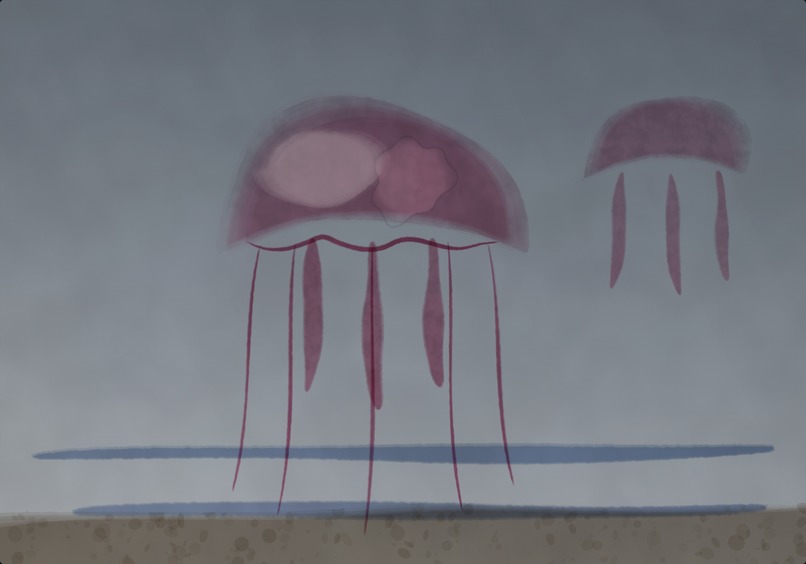
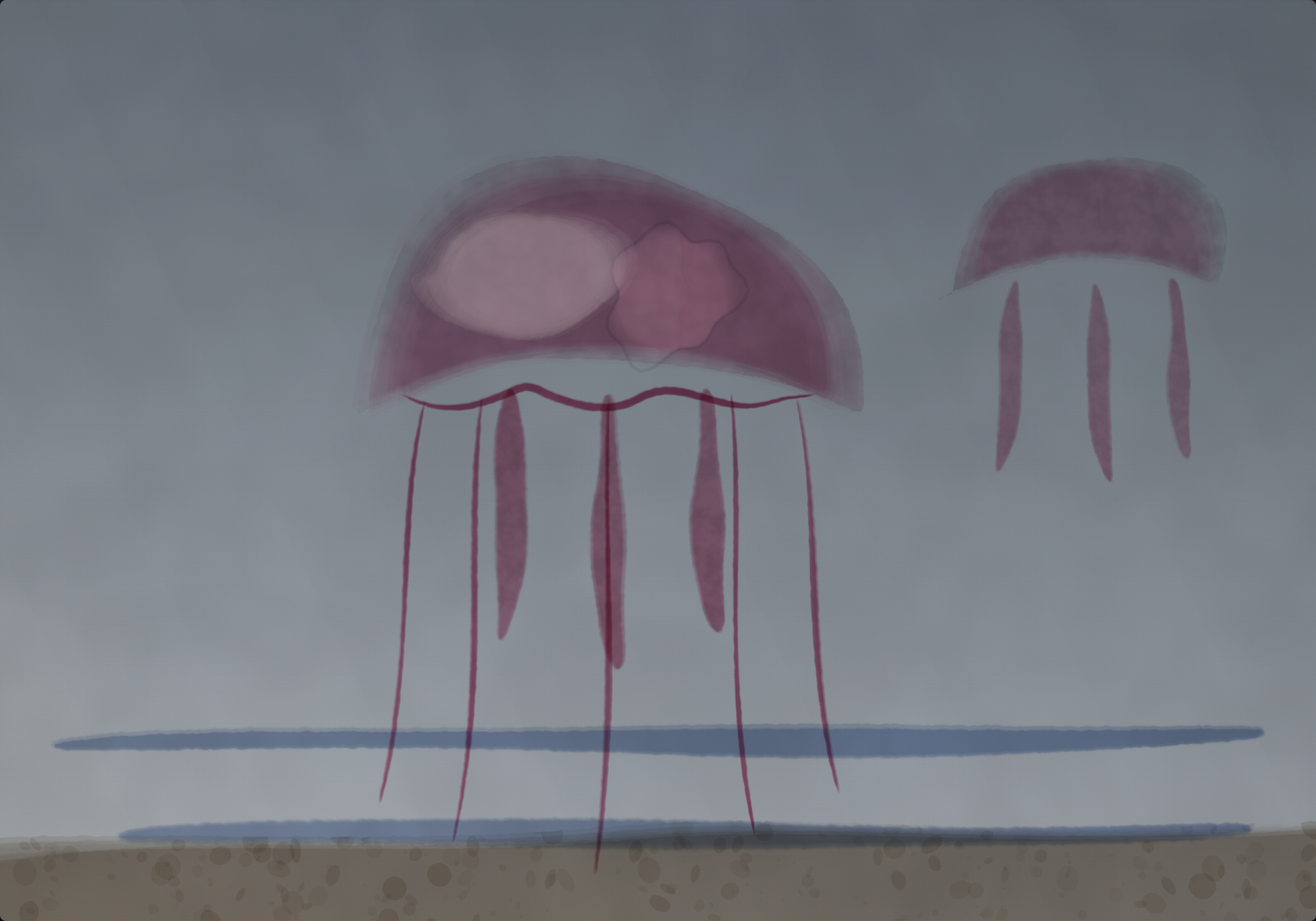
Jellyfish Painting by Opus 5 (Test)
-
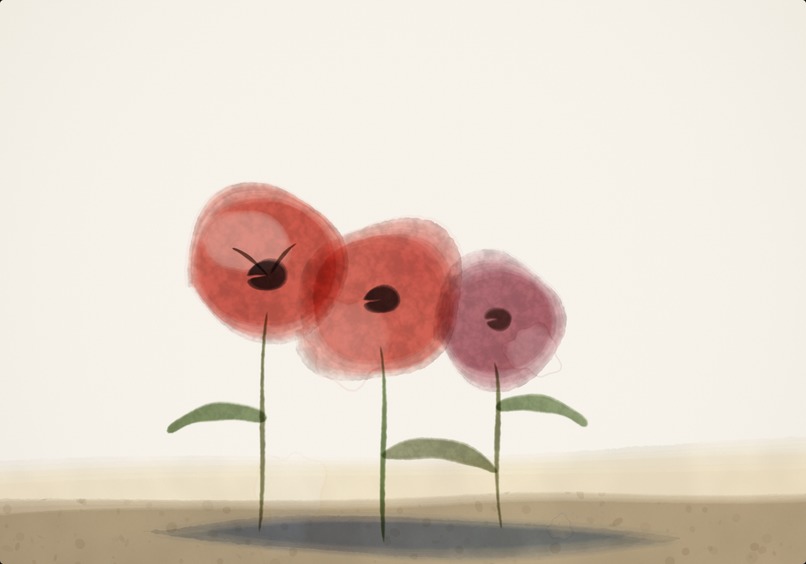
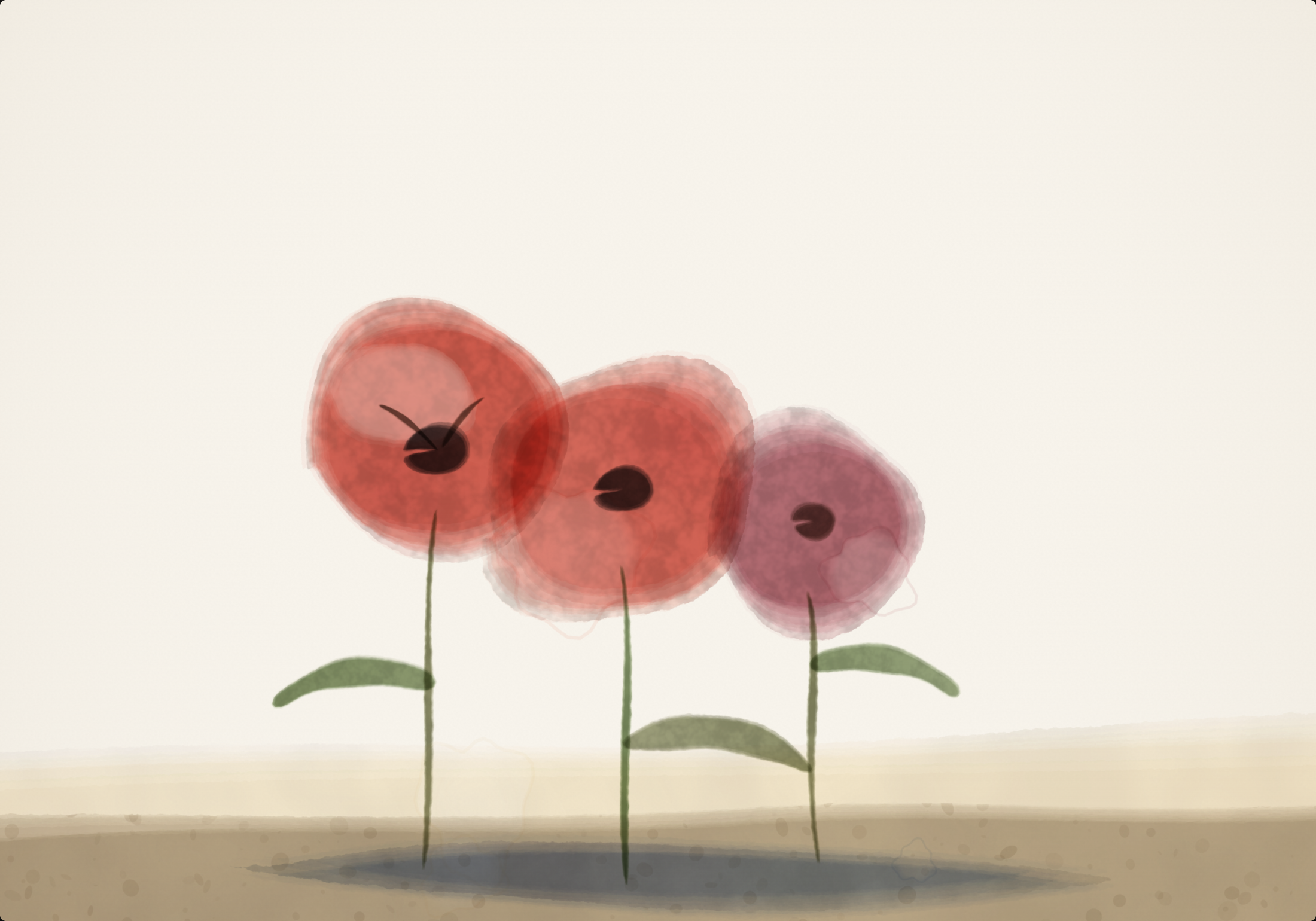
Flower Painting by Opus 5 (Test)
-
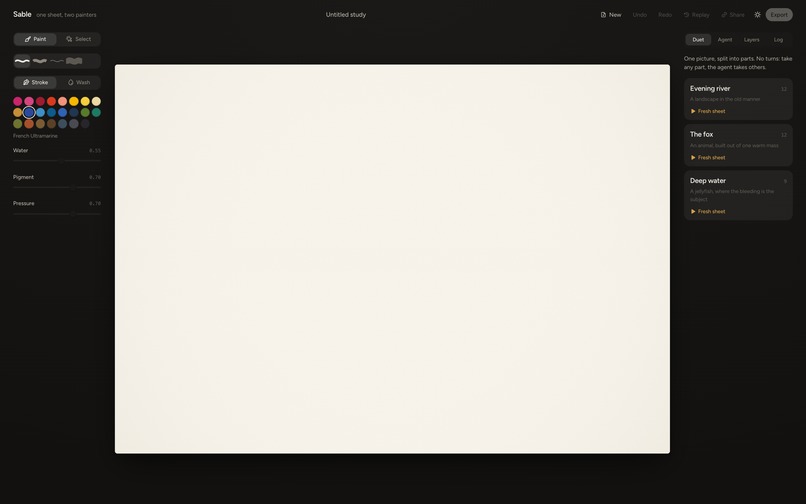
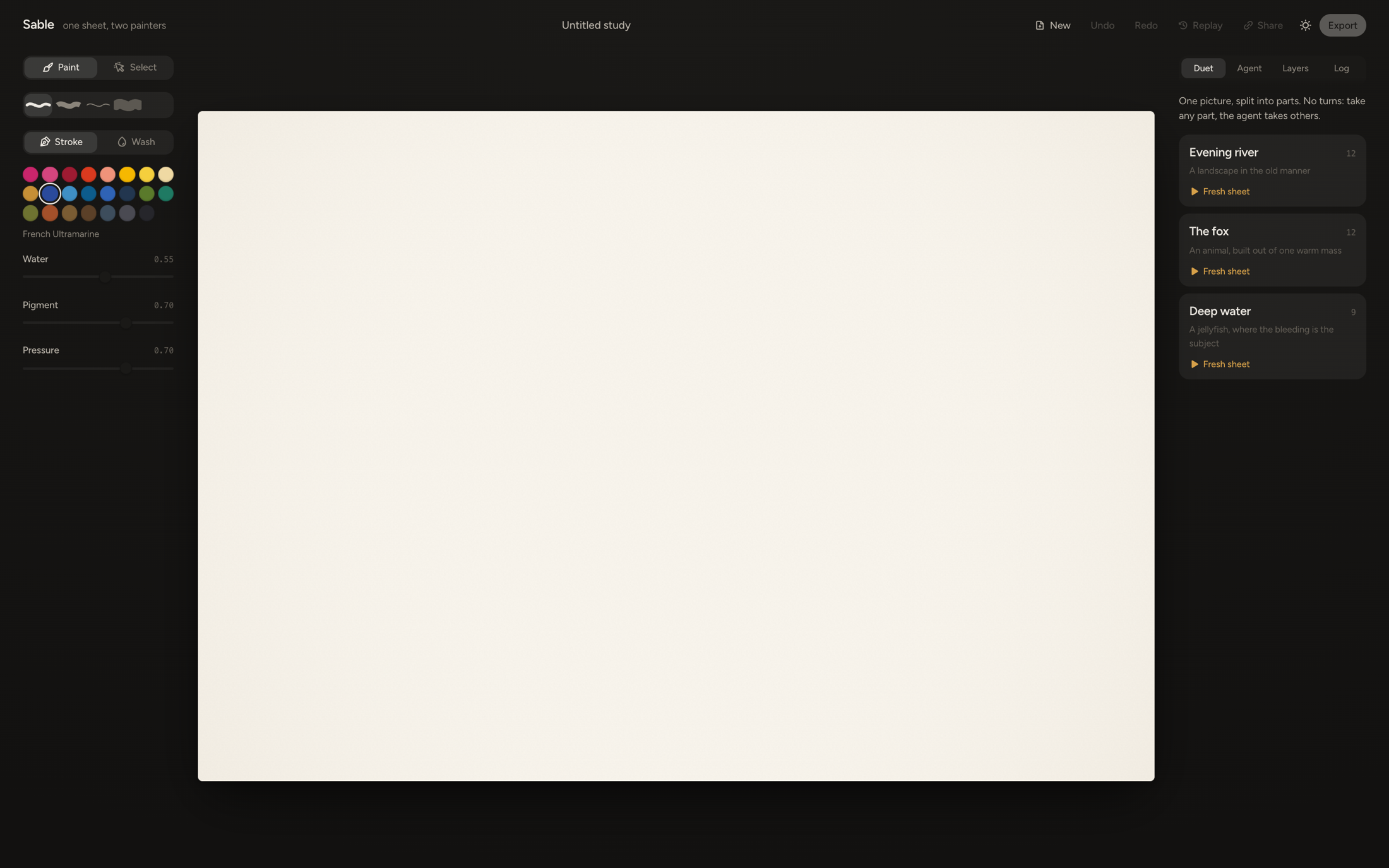
Sable UI
-
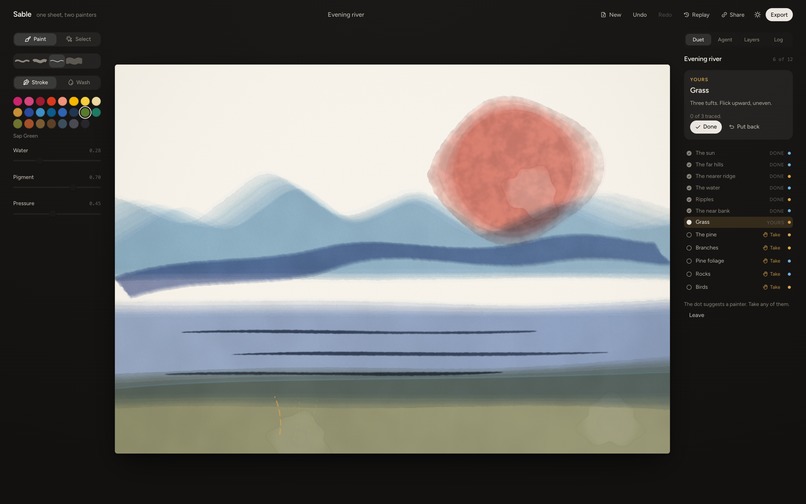
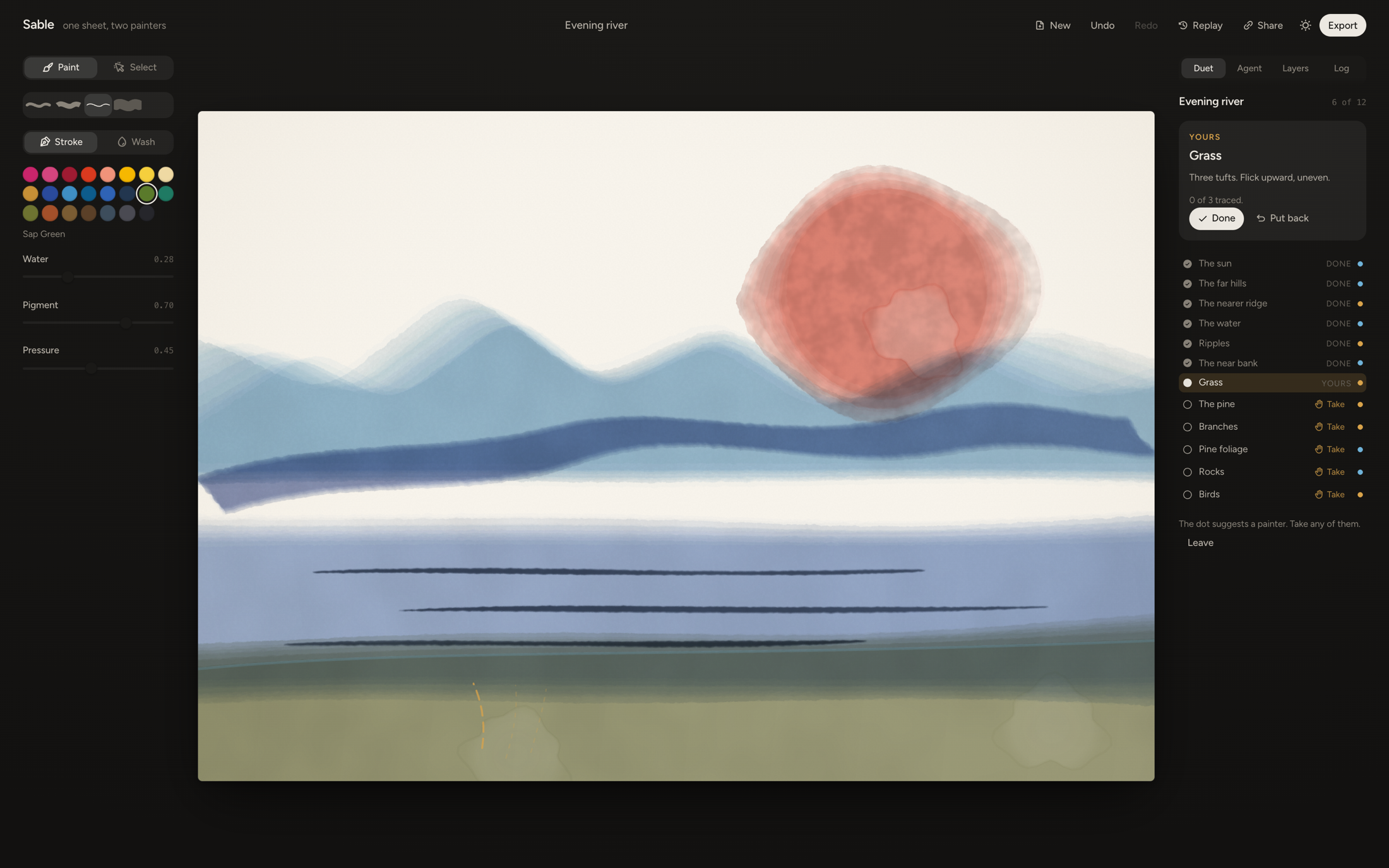
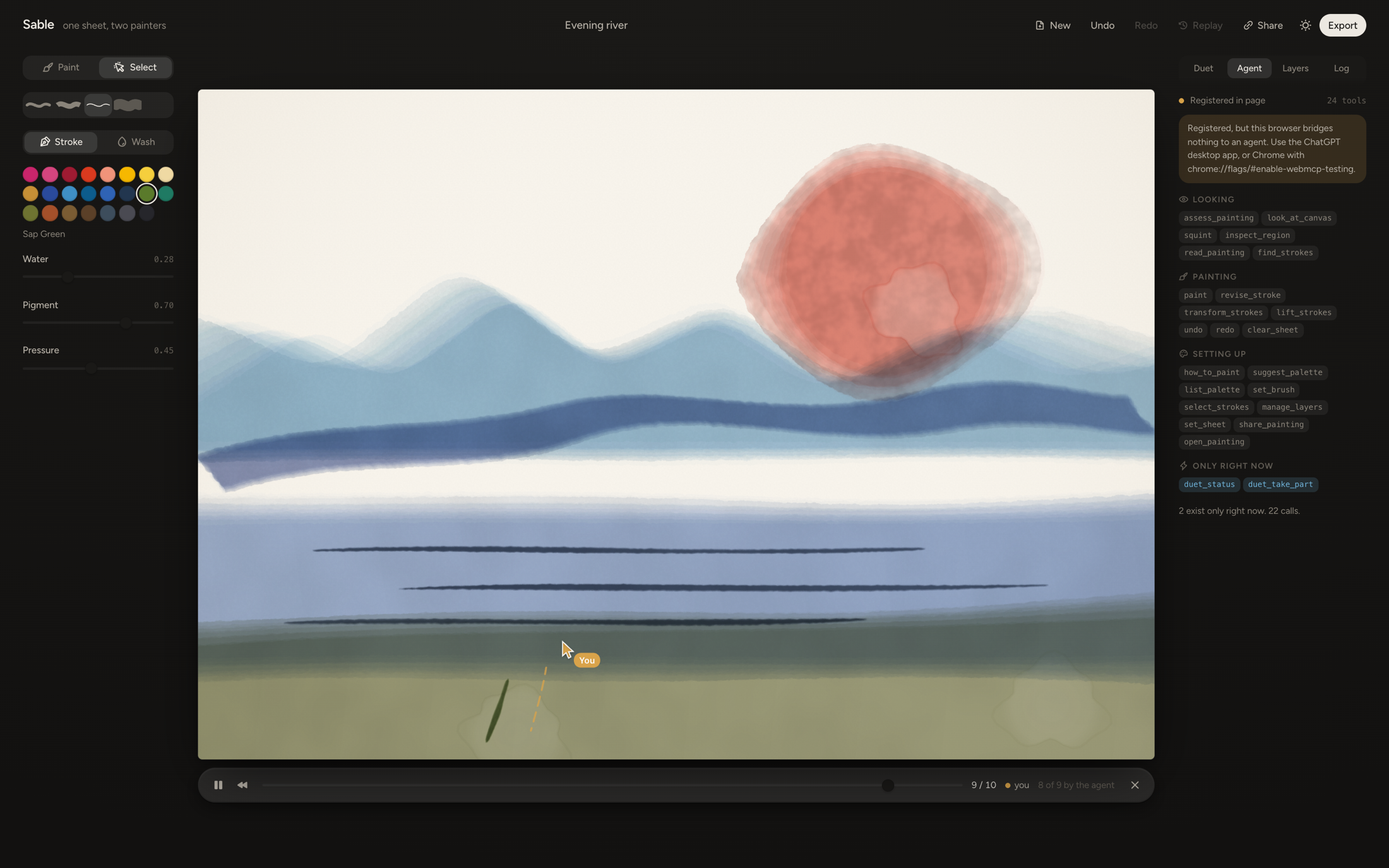
Duet Mode on Sable ( Agent and Human drawing a specific canvas)
-
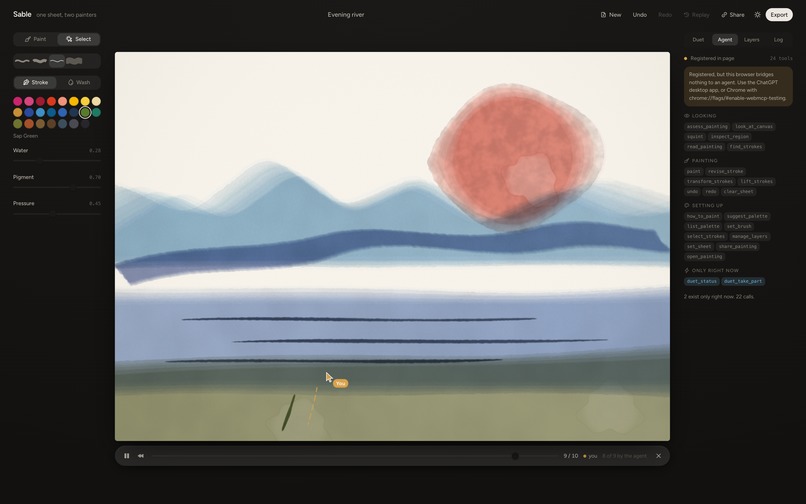
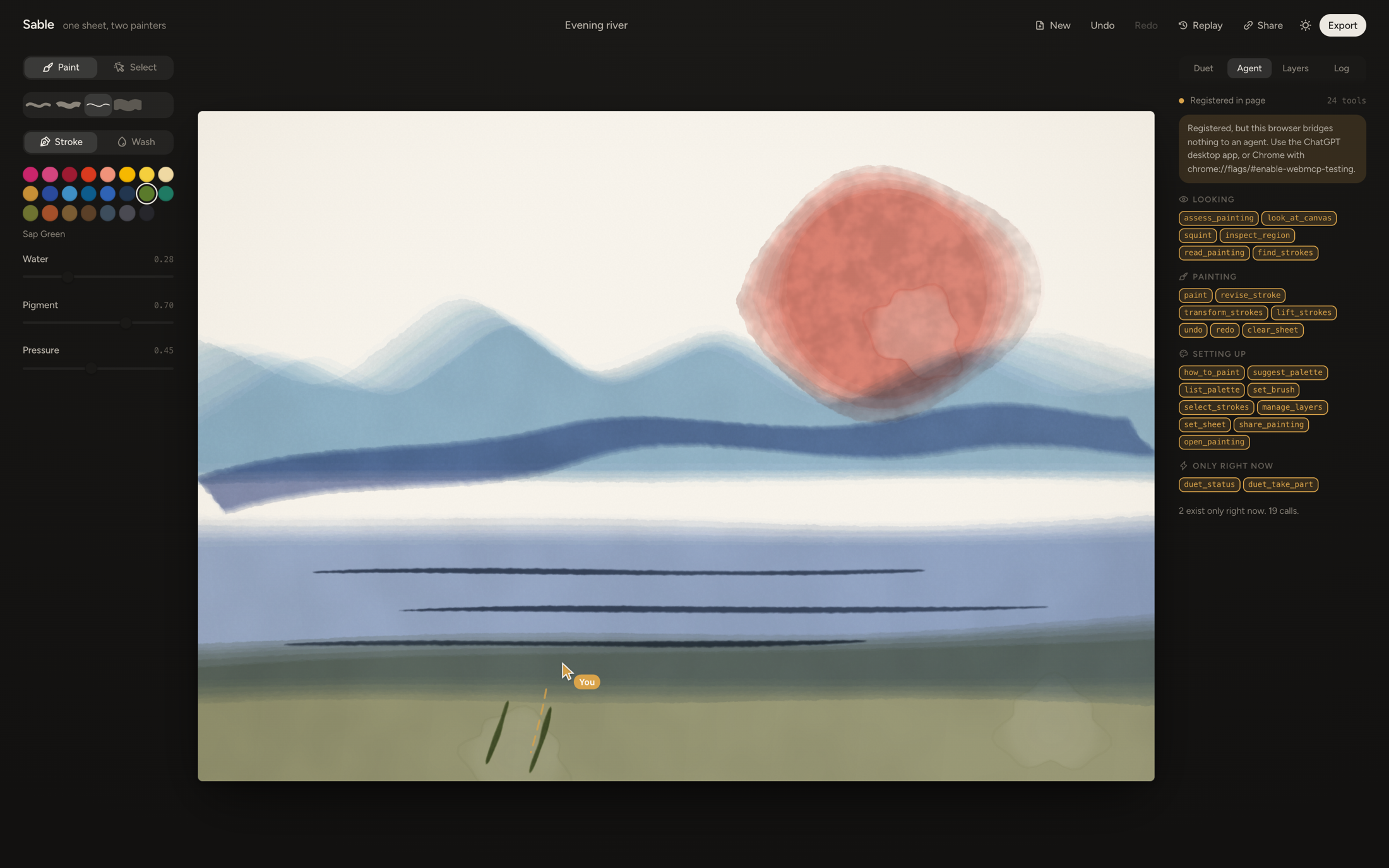
WebMCP Tools in Use
-
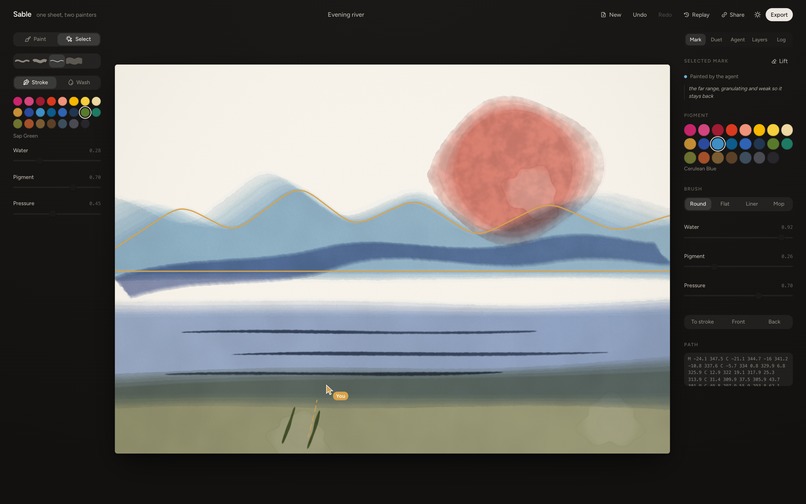
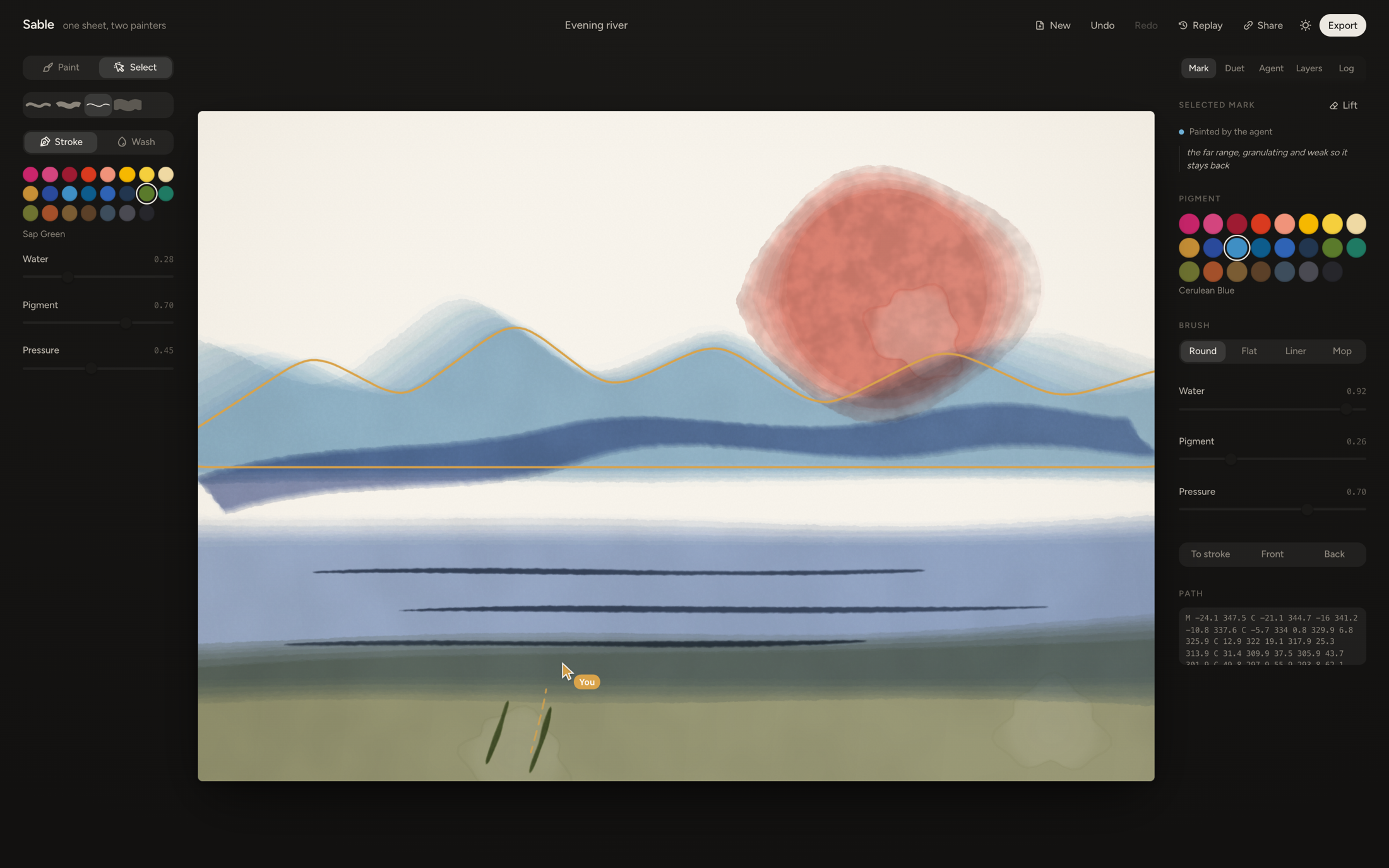
Stroke Selection
-
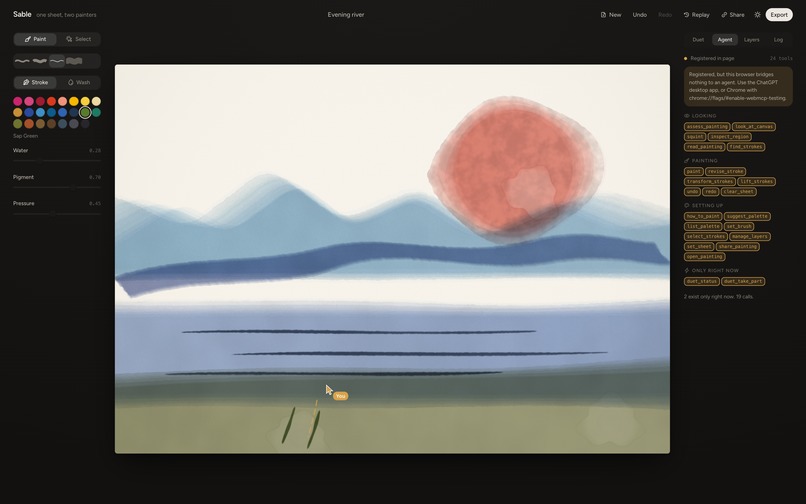
WebMCP Tools
-
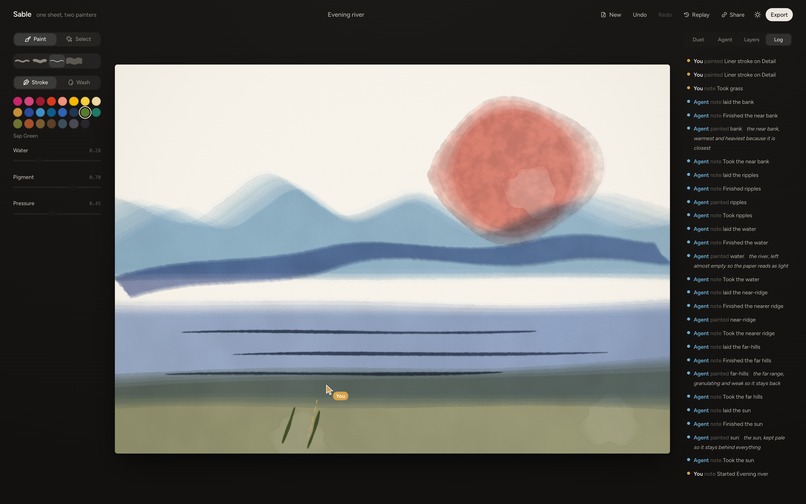
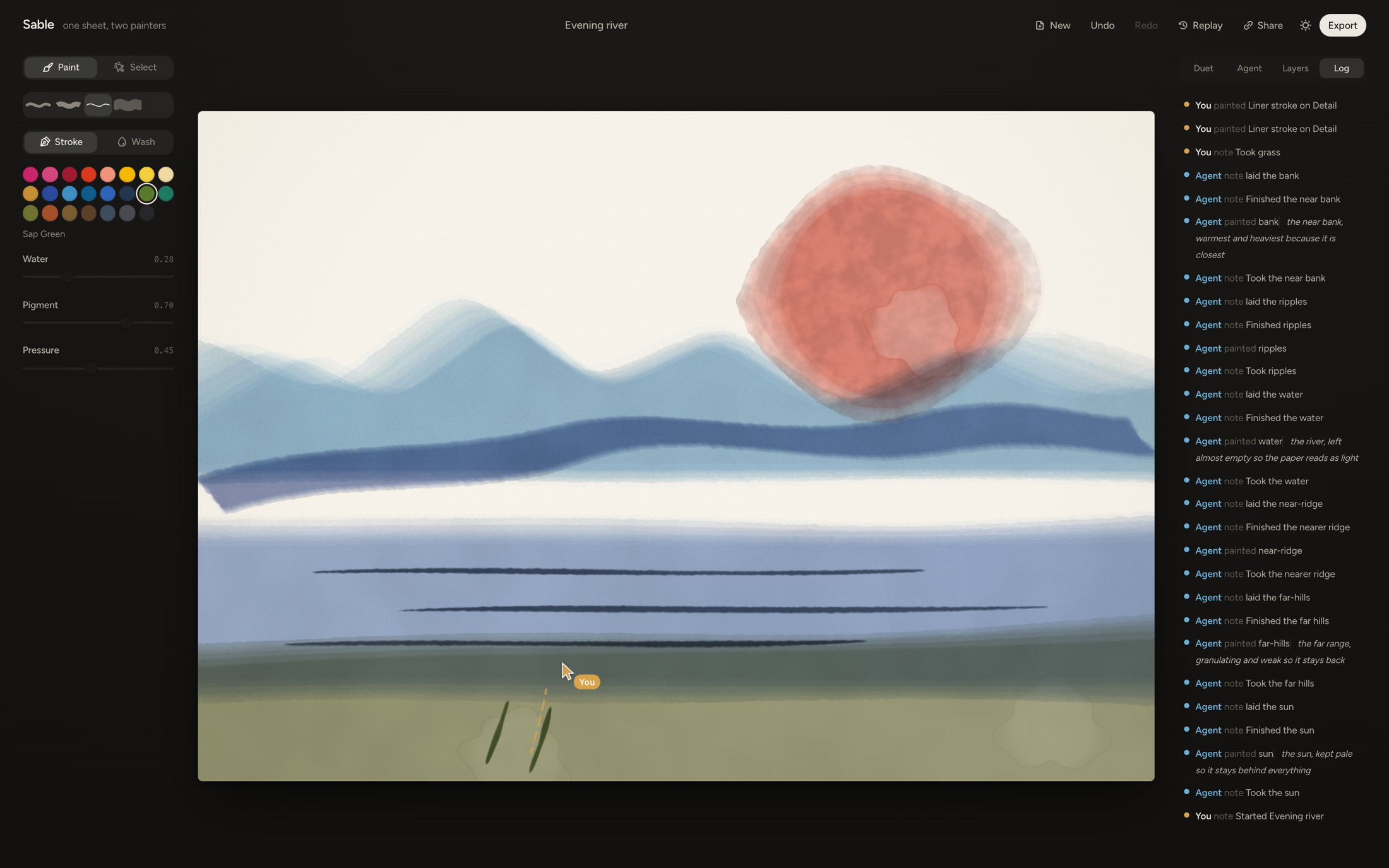
Replay Mode
Sable
One sheet, two painters. A watercolour studio where you and an AI agent both hold the brush.
Where it came from
Every time I make a picture with a model, I get the same feeling: I am standing outside the thing I made. One petal is wrong, and my only move is to rewrite the prompt and roll the dice on the whole image again. What comes back is a bitmap. Every decision that produced it is already gone. Although the results are amazing, I WANT SOMETHING FUN
Then I read the WebMCP spec and realised it is the same complaint, but in a different setting. An agent poking at a website by guessing which pixel is a button is stuck in exactly that position: it can only act on the whole thing from the outside. Hand it real handles.
So Sable keeps the decisions. Every mark is an object with a pigment, a water level, a brush, a layer and a path, whether a person dragged it with a mouse or an agent wrote it as an SVG path ( just a nerdy way to say brush stroke) through a tool call. Either of you can pick up any mark, including the other's, and change it.
The agent isn't generating anything, but rather drawing with you, which I think it's a cool new path compared to generative AI.
Why watercolour? Because it's the hardest possible case for that argument. You don't control watercolour by specifying an outcome. You choose how much water is on the brush and then live with wherever it goes. If a structured, revisable document beats prompting anywhere, it had better beat it here.
It also gives the agent numbers that mean something. water: 0.9 isn't a style
token. It decides how far pigment creeps into the paper and whether the edge
blooms. So that also makes the agent decisive about what settings to use, and where.
Let me be honest about the pictures
They are not good. A fox that could just as easily be a marmot, or a new squirrel evolution. Poppies a child would beat. A landscape that holds together mostly because watercolour forgives everything (and to look at it like modern art) . I am not going to pretend otherwise, and you should look at them knowing that. and PLEASE go easy on it.
But look at what they are. Nobody prompted them. There is no diffusion model anywhere in this project, and no image model of any kind. Every mark in every one of those pictures was placed by an agent choosing a path, a pigment, a water level and a brush, then looking at what the water actually did with them and deciding what to do next. Each painting is a list of about twenty decisions, and you can open any one of them and change it.
That is a genuinely different mechanism from generating an image, and right now it is much worse at it. It is also version one of something I have not seen anyone try properly: generative AI that draws rather than generates. The picture is a document the model and I are both editing.
Prompted image generation started out worse than this and got where it is because enough people agreed it was worth pushing on. I think this is worth pushing on for a different reason: I want a picture I can reach into and argue with, and a bitmap has never once let me do that, and I have fun drawing with my artistic friend.
So treat these as the first plates from an experiment.
What it does
Twenty-three tools on document.modelContext, and no prompt box anywhere.
Three of them I'm quietly proud of. The paint answers back: every paint
call returns what the water decided rather than what you asked for, so the agent
hears that its wash finished 109 units outside the path it gave, went soft on
the top left, and fused with something still wet. The sheet dries on a clock,
so painting into an open passage now fuses the marks and waiting means it won't.
And it can squint: a blur and a posterize down to four flat tones, which is
the cheapest thing in the codebase and by a mile the most useful, because the
faults that sink a painting are invisible in a normal look at it. AND it feels like a true artist moving back and squinting at your art to see where it's at.
A duet is one picture split into named parts. No turns. Either painter grabs
whatever's free, and grabbing it is a click for you and duet_take_part for the
agent, both writing to the same board. The parts make you need each other: the
agent's foliage has to hang off branches you actually drew, and they never end
up where the score assumed.
Any painting also folds into a link, and I mean the painting, not a picture of one. Every mark travels with its seed, so it re-renders identically and whoever opens it can change anything in it. That's why the share URL is incredibly long (sorry).
How it's built
The renderer is Canvas 2D written from scratch. No image models, no libraries,
no pre-baked brush textures. The brush footprint gets subdivided and each new
midpoint pushed sideways in proportion to its edge, over and over, so the
boundary gains detail at every scale. Everything composites with multiply,
because paint over paint filters the light twice. You can always deepen a
passage and never lighten one, and that constraint is most of what makes the
medium feel like the medium.
The important architectural decision is boring: the WebMCP handlers have no private door into the document. They call the same commands the mouse does. One undo stack, every stroke records its author, and an agent literally cannot reach a state the UI couldn't have produced.
The toolbox is also alive. Select a mark and two new tools come into existence,
and one of them names the mark you just picked in its own description, so "make
this one wetter" needs no lookup. undo only exists when there's something to
undo.
Everything I got wrong first
The duet used to take turns. Twelve passes, strictly alternating, nobody allowed to touch the paper out of order. It proved two painters can share a picture the way a metronome proves you can play music. Half the time you spent in it, you were being told to wait. I deleted the queue, its supposed to be a messy canvas you both work on, and ruining each other's work kind of get's you to bond with it.
The page called the agent's marks mine. An agent whose browser couldn't bridge WebMCP did the sensible thing and used the mouse, and every mark it made got logged as mine, with the cursor beside it cheerfully reading "You". On a page whose entire subject is two authors sharing a document, that's about the worst thing it could get wrong. There's no reliable way to tell an agent's mouse from a person's, and guessing from how the pointer moves would occasionally inform a real human that they're a robot. So the page offers a handle instead of inferring an answer: a real, named button sitting in the accessibility tree that says the brush is the agent's now.
One tool call weighed 44,000 characters, nearly all of it base64. Fine if the client understands image blocks. Catastrophic if it just stringifies them into the model's context. Every image is bounded now and re-encodes smaller until it fits. Same sheet, 13,000 characters, no harder to judge.
And the two painters were getting different materials on one sheet. My marks looked like paint. The agent's looked like television static. Neither number was wrong: granulation fills whatever shape it's clipped to, so a small mark shows a fragment of the texture and reads as paper tooth, while a big flooded wash gets the whole tile several times over and reads as noise. Scale was doing the damage, and only one of us ever paints at the scale where it shows. Texture now falls off as a mark grows:
$$\tau(r) \;=\; \frac{1}{1 + \dfrac{\max(0,\; r - 110)}{420}}$$
which is a claim about how eyes work rather than about pigment, and it belongs in the renderer for the same reason the drying rim does.
What I'd tell anyone building one of these
A tool that returns { ok: true } leaves the agent painting blind. Give it a
picture back and it can look, judge and correct. Although I really wanted to try to have it draw without any support, giving it a reference image would help a lot, and while testing with the agents, I asked them what they struggled with and what is one tool it wanted to make this drawing better, and that is what they all asked for which was quite interesting.
Tool descriptions are the API. I spent more time on the prose inside
inputSchema than on most of the functions behind it.
And build for the bridge failing, because it will. The fallback isn't a worse version of your product. It's the accessibility tree, and it can carry a three-line recipe for calling every one of your tools through evaluated JavaScript. An agent that just read your DOM has already read that too.
The last one is the reason I built the whole thing. Watching an agent lay a wash, look at where the water actually took it, and then put the next mark somewhere it had not planned is a completely different feeling from watching an image appear. It is slower, it is clumsier, and the results are worse. It is also the first time it has felt like working with one rather than ordering from one.
Have fun creating!
Built With
- canvas2d
- nextjs
- react
- typescript


Log in or sign up for Devpost to join the conversation.