-
-
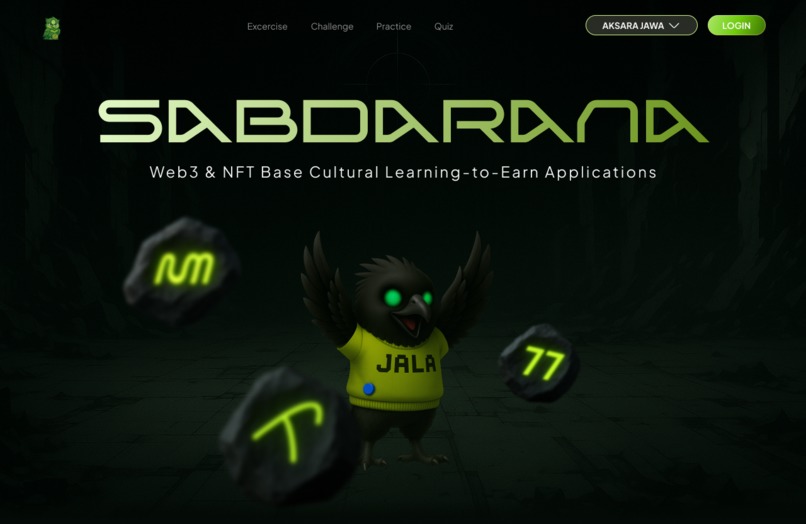
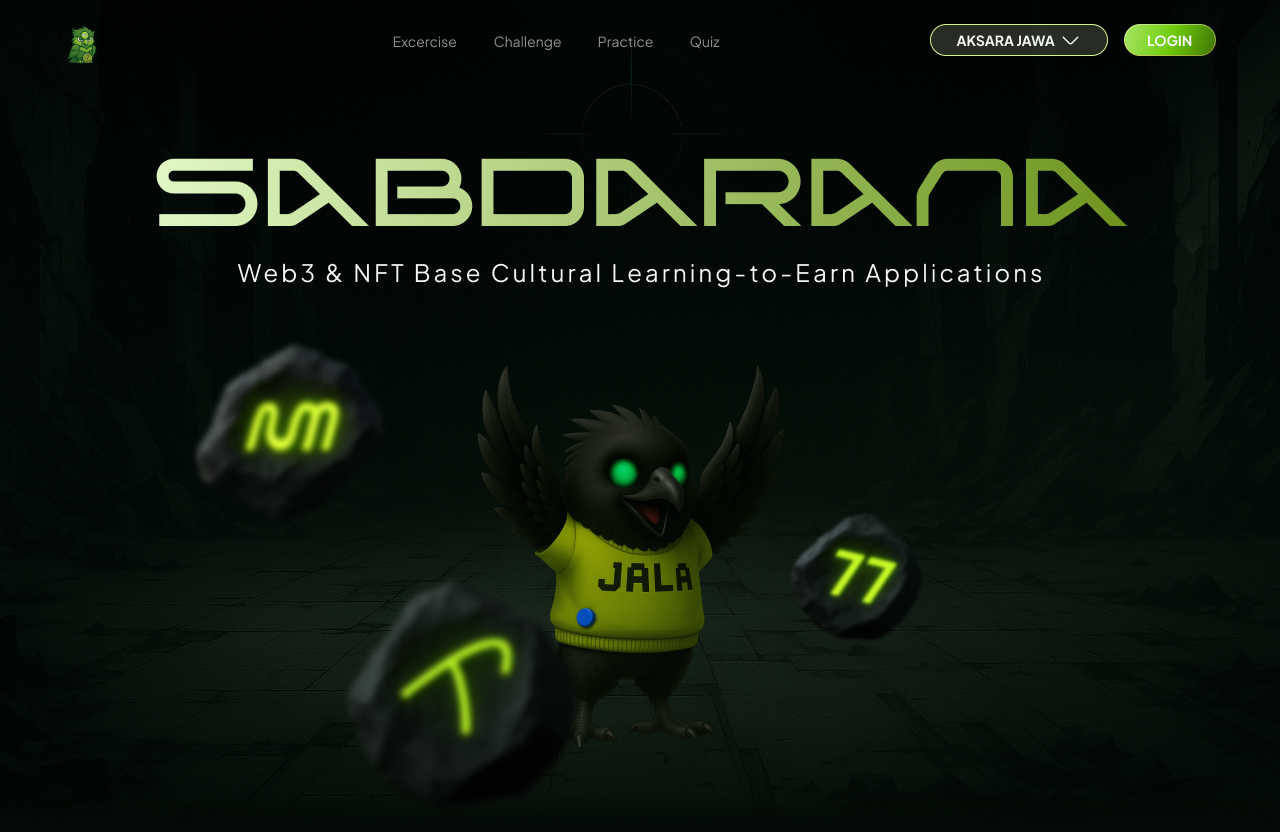
Home Page Sabdarana
-
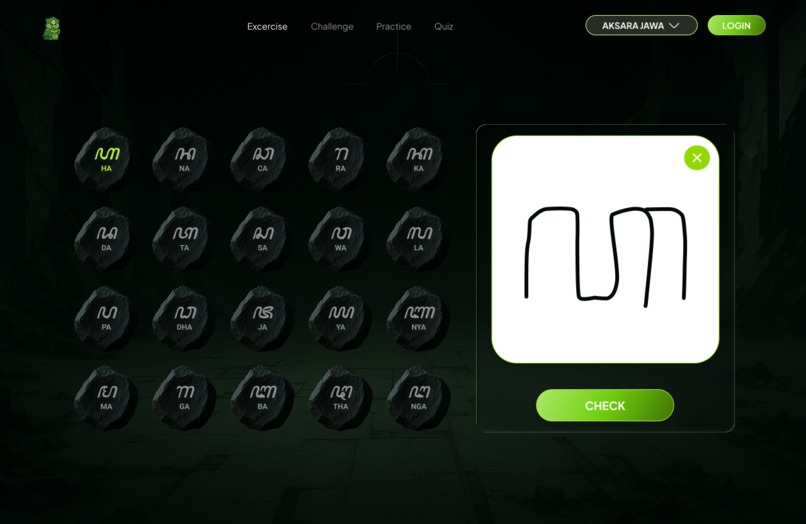
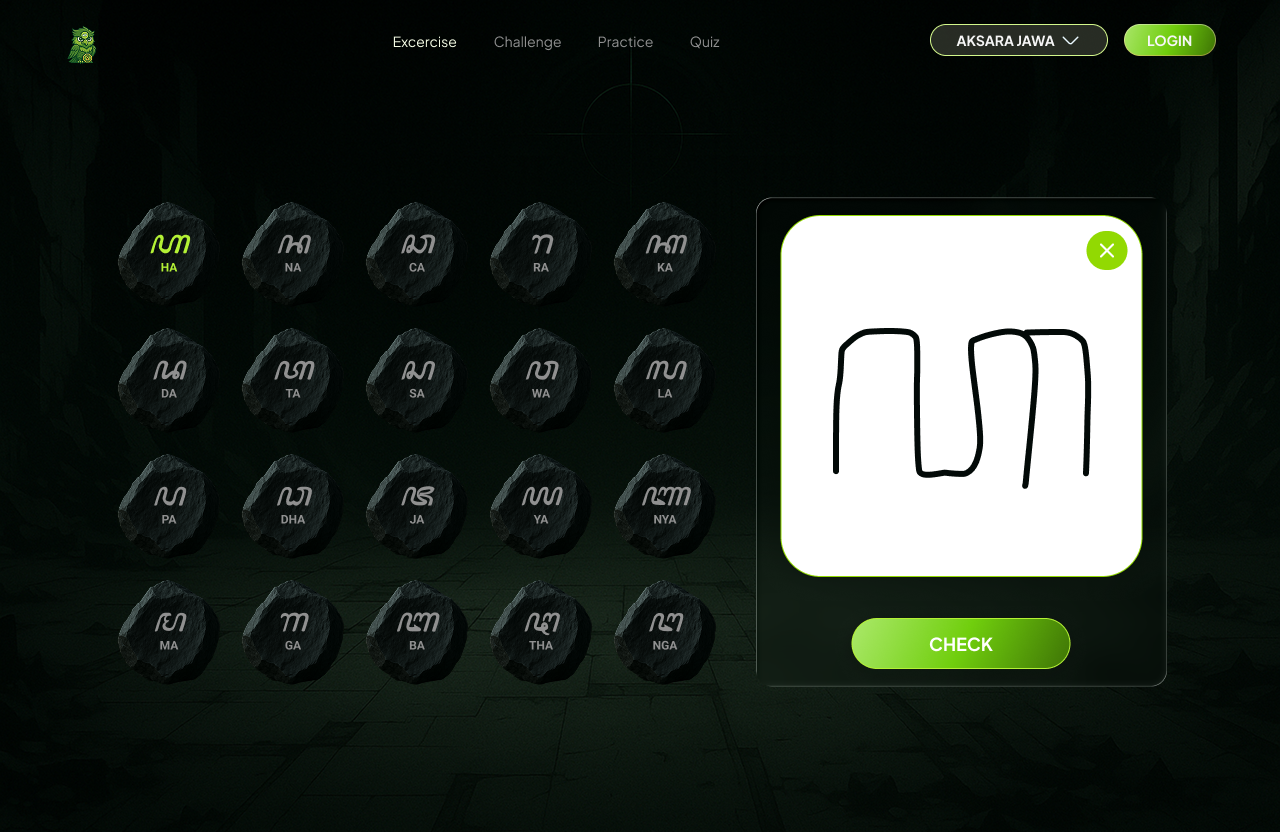
Learning Page - Javanese Version
-
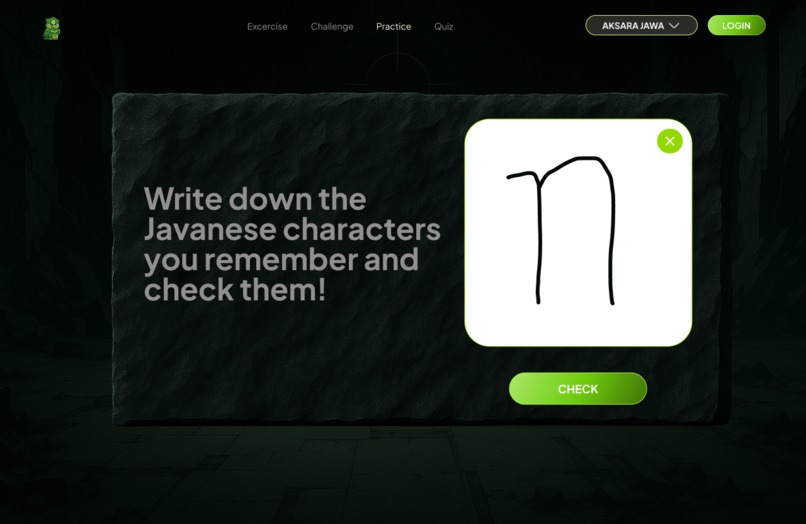
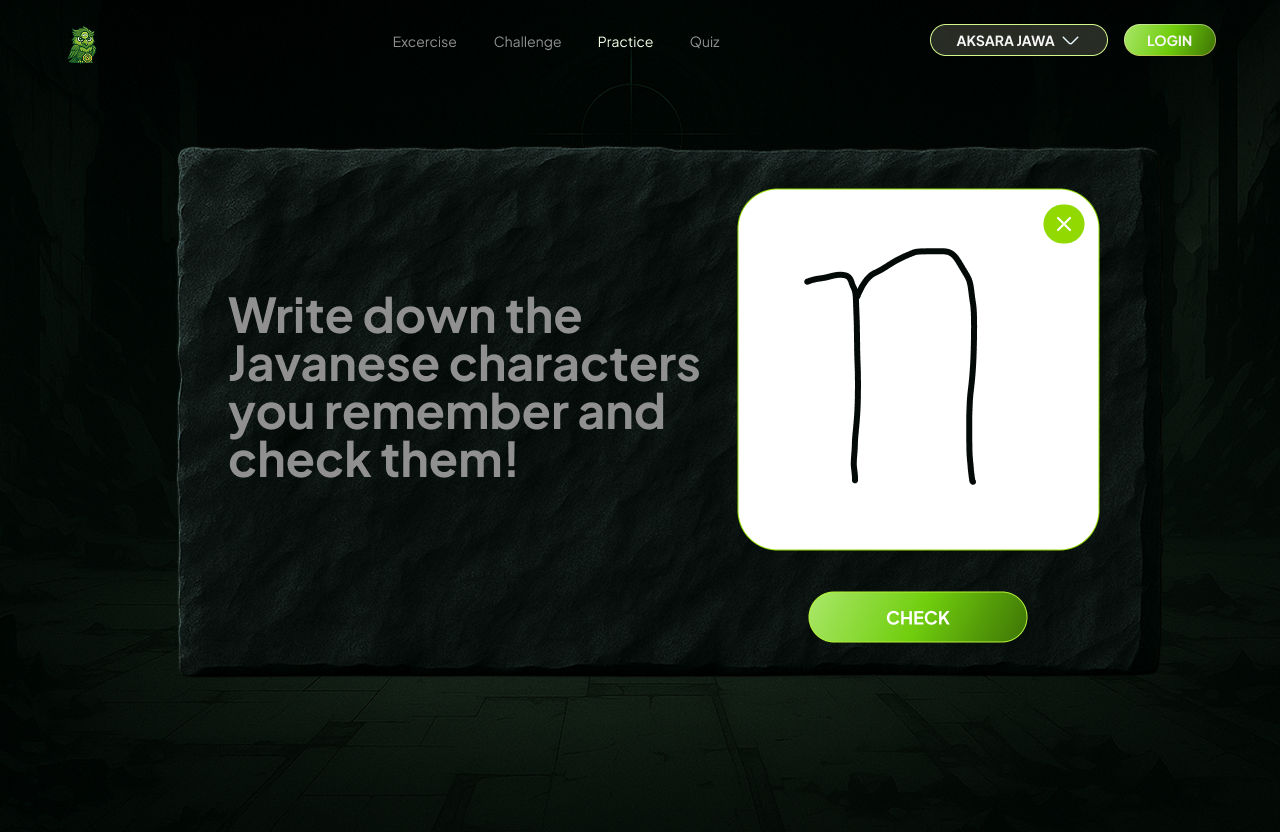
Practice Page - Javanese Version
-
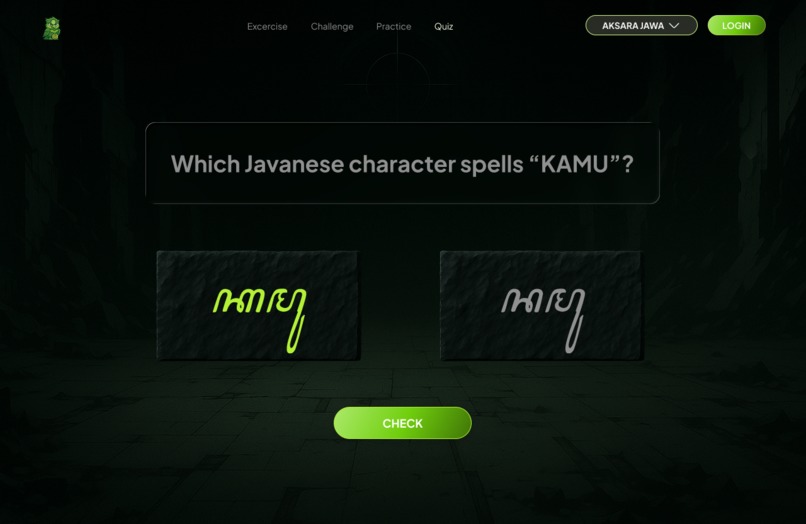
Quiz Page - Javanese Version
-
Sabdarana Logo
-

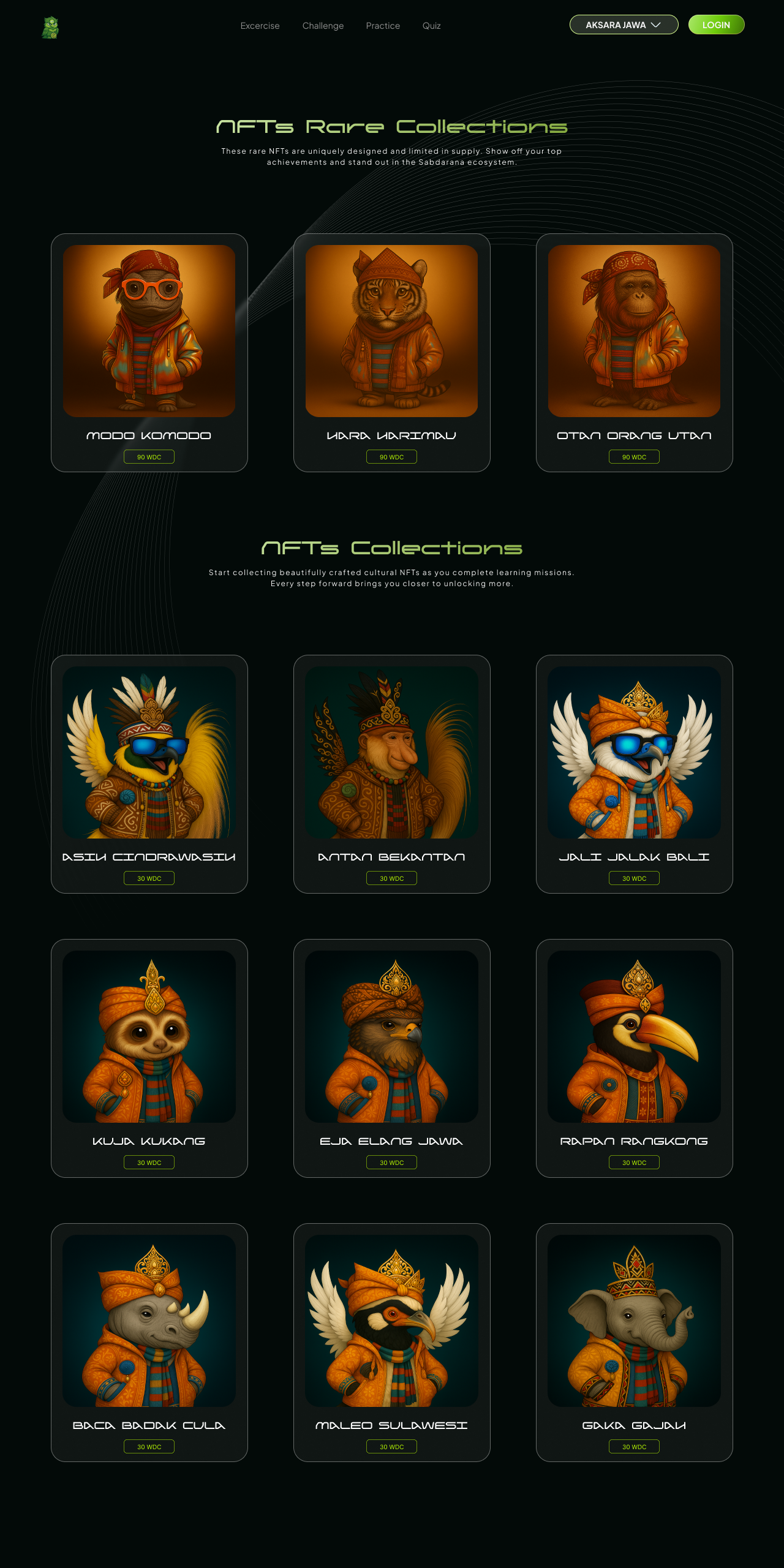
Modo Komodo - NFT Rare (this sample, the real can't be display properly without NFT)
-
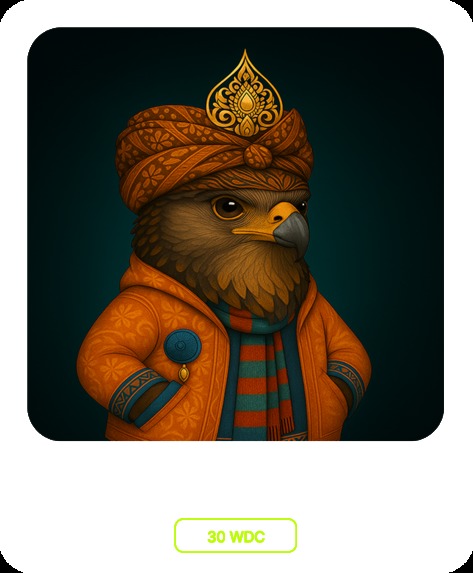
Eja Elang Jawa - NFT Reward (this sample, the real can't be display properly without NFT)
-
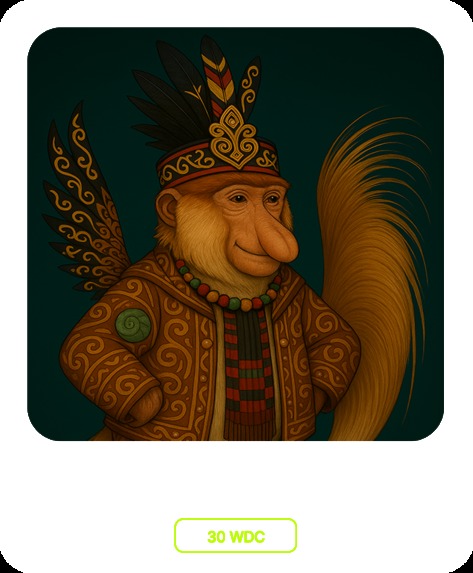
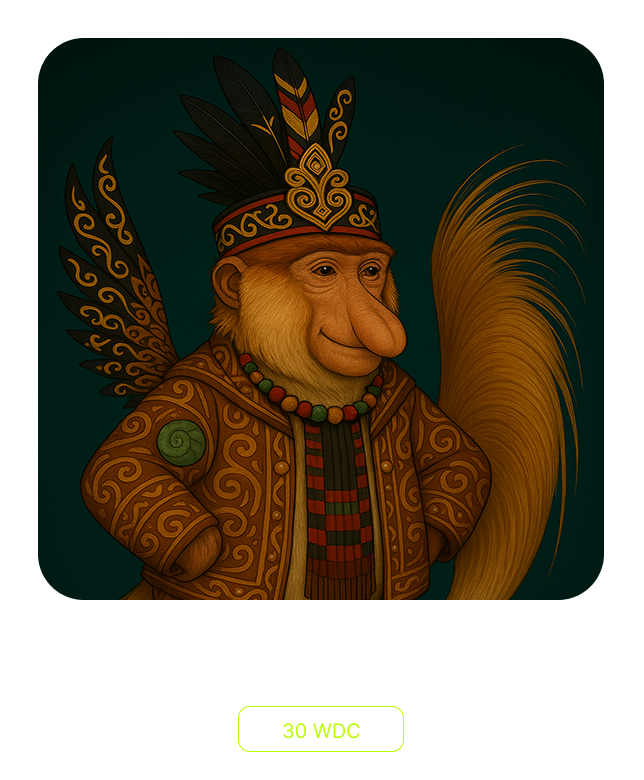
Antan Bekantan - NFT Reward (this sample, the real can't be display properly without NFT)
-

Asih Cendrawasih - NFT Rewards (this sample, the real can't be display properly without NFT)
-
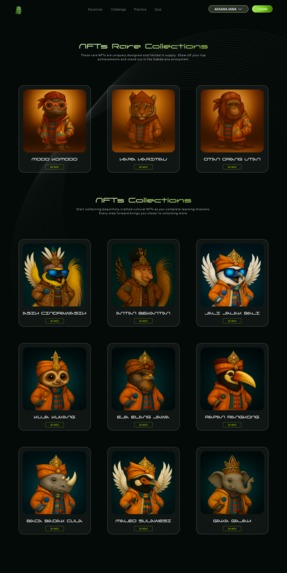
NFT Collections



Inspiration
Sabdarana was inspired by the growing success of Learn to Earn platforms that reward users for gaining knowledge and skills. We wondered: What if the same model could be applied to community-driven innovation? By combining the incentivization of token economies with collaborative problem-solving, we envisioned a space where people don’t just learn, they contribute, co-create, and earn through impactful ideas
What it does
Sabdarana is a Web3-powered learning platform that turns education into a rewarding experience. It allows users to:
- Learn through interactive modules, daily quests, and community challenges.
- Earn Widya Coin (WDC) as a reward for completing learning activities and maintaining streaks.
- Collect NFTs as proof of learning progress, achievements, and rare milestones.
- Trade and unlock new content, exclusive access, or physical/digital goods using tokens and NFTs.
By combining gamified learning, blockchain rewards, and decentralized credentials, Sabdarana empowers users to own their educational journey transforming time spent learning into real digital value.
How we built it
Sabdarana is built with a modern, high-performance Web3 + AI tech stack that blends seamless frontend interactivity, robust backend services, and decentralized logic:
Frontend
- Built using Svelte 5 for fast, reactive, and lightweight UI.
- Styled with Tailwind CSS v4 for utility-first, responsive design.
- Bundled and optimized using Vite.
- Written in TypeScript for scalable, type-safe code.
- Managed with PNPM for efficient package management and monorepo support.
Backend & Infrastructure
- FastAPI handles REST API services and integration with blockchain and AI components.
- Supabase functions as our managed backend-as-a-service:
- Handles user authentication (email + wallet linking)
- Provides real-time database & auth management Hosted and deployed via Vercel for fast global delivery and CI/CD pipelines.
Token Mechanics
- Widya Coin (WDC) is generated based on timestamped learning activity, tracked securely via smart contract event logs.
- Coin minting and halving logic inspired by Bitcoin, but optimized for educational behavior.
AI Integration
Sabdarana integrates AI to preserve and revitalize Nusantara indigenous scripts specifically Aksara Jawa, Aksara Sunda, and Aksara Lampung through interactive, reward-based learning.
Handwritten Script Recognition
We use Convolutional Neural Networks (CNNs) built with TensorFlow and PyTorch to detect, classify, and evaluate handwritten characters from each script system. Learners draw scripts via mobile, tablet, or webcam, and the AI instantly verifies the character.
Multi-Script Dataset Training
Our models are trained on custom-built datasets containing thousands of labeled characters for each script type, covering:
- Carakan (Aksara Jawa)
- Aksara Sunda Baku
- Aksara Lampung (Had Lampung) This supports accurate classification, stroke variation recognition, and contextual glyph suggestions.
Dynamic Feedback Loop
Users get real-time feedback: correctness, stroke order hints, and cultural explanations. Correct inputs generate Widya Coin (WDC) and NFTs as proof of mastery.
Web3 Layer (Planned/Prototype)
The Web3 layer in Sabdarana is designed to ensure true ownership, transparency, and decentralization of all learning rewards and credentials through a combination of ERC-20, ERC-721, and IPFS integration.
ERC-20: Widya Coin (WDC)
- Purpose: Functions as the main utility token in the Sabdarana ecosystem.
- Smart Contract: Built using Solidity and deployed to the Polygon blockchain for low fees and scalability.
Use Cases:Reward for completing learning modules, quests, and daily streaks
- Payment for premium content or mentor sessions
- NFT minting fees
Token Logic:
- Minting: Timestamp-based rewards (e.g 0.2 - 0.5 WDC per verified daily task)
- Halving mechanism: Inspired by Bitcoin to control inflation and incentivize early adoption
- Transferability: Fully tradable, with plans to list on DEX (e.g. Uniswap on Polygon)
Schema Breakdown – Sabdarana Web3 Learn-to-Earn Platform
This schema supports user progress tracking, token rewards, and on-chain interaction logging within the Sabdarana platform. Below is a table-by-table breakdown:
Database Schema: Web3 Learn to Earn
Table: challenge_activity
| Field | Type | Description / Constraint |
|---|---|---|
id |
uuid |
Primary key, default: gen_random_uuid() |
user_id |
uuid |
Foreign key to auth.users(id) |
challenge_id |
text |
Challenge identifier |
reward |
numeric |
Reward earned \( R \in \mathbb{R}^{+} \) |
completed_at |
timestamp with time zone |
Default: now() |
tx_hash |
text |
Blockchain transaction hash |
note |
text |
Optional annotation or comment |
Table: coin_balance
| Field | Type | Description / Constraint |
|---|---|---|
user_id |
uuid |
Primary key and foreign key to public.users(id) |
balance |
numeric |
User’s token balance, default: \( 0 \) |
Table: mining_activity
| Field | Type | Description / Constraint |
|---|---|---|
id |
uuid |
Primary key, default: gen_random_uuid() |
user_id |
uuid |
Foreign key to public.users(id) |
tx_hash |
text |
Blockchain transaction hash |
mined_at |
timestamp with time zone |
Mining timestamp, default: now() |
Table: users
| Field | Type | Description / Constraint |
|---|---|---|
id |
uuid |
Primary key, default: gen_random_uuid() |
wallet |
text |
Unique crypto wallet address |
created_at |
timestamp with time zone |
Account creation timestamp, default: now() |
- ERC-20: Custom token contract to handle user rewards.
- ERC-721: NFT contract for minting collectible assets based on user activity.
- NFT Media: All assets are stored using IPFS to ensure decentralized integrity and permanence.
- Smart Contracts: Deployed on Ethereum-compatible chain \( \text{EVM} \) or testnet like Goerli / Polygon Testnet.
PostgreSQL Function: reward_user
This function simulates the reward mechanism for a Web3 Learn-to-Earn platform, specifically for the Sabdarana project. It generates a random coin reward for a user, logs the mining activity, and updates their coin balance in the database.
📌 Function Logic
declare
  v_reward numeric;
begin
  -- Generate a random reward between `p_min_coin` and `p_max_coin`
  v_reward := floor(random() * (p_max_coin - p_min_coin + 1) + p_min_coin);

  -- Log mining activity with a generated transaction hash
  insert into public.mining_activity (user_id, tx_hash)
  values (p_user_id, encode(gen_random_bytes(16), 'hex'));

  -- Insert or update the user's coin balance
  insert into public.coin_balance (user_id, balance)
  values (p_user_id, v_reward)
  on conflict (user_id) do update
    set balance = coin_balance.balance + excluded.balance;

  -- Return the reward amount
  return v_reward;
end;
🛠 Parameters
| Parameter | Type | Description |
|---|---|---|
p_user_id |
UUID or TEXT |
ID of the user who will receive the reward |
p_min_coin |
NUMERIC |
Minimum coin value that can be rewarded |
p_max_coin |
NUMERIC |
Maximum coin value that can be rewarded |
🔄 Behavior
- Random Reward Generation:
- Uses
random()to generate a floating-point number between 0 and 1. Scales it to the integer range [
p_min_coin,p_max_coin] using:$$ \text{reward} = \lfloor \text{random()} \times (p_{\text{max}} - p_{\text{min}} + 1) + p_{\text{min}} \rfloor $$
- Mining Activity Logging:
- Generates a pseudo-random 16-byte transaction hash (
tx_hash) usinggen_random_bytesand encodes it in hexadecimal. - Stores the
user_idand the generated hash inmining_activity.
- Balance Update:
- If the user doesn’t exist in the
coin_balancetable, they are inserted with the generated reward. - If the user already exists, their balance is incremented using PostgreSQL’s
ON CONFLICT DO UPDATEsyntax.
- Return Value:
- Returns the reward amount (
v_reward) back to the caller.
🧪 Example Usage
select reward_user('123e4567-e89b-12d3-a456-426614174000', 5, 20);
This would:
- Generate a reward between 5 and 20 coins.
- Log a mining activity for the given user.
- Update their balance accordingly.
Challenges we ran into
Building the Professional Bitcoin-Based Token Economy Simulator came with several technical and conceptual hurdles:
1. Designing a Realistic Halving Mechanism
Creating a Bitcoin-like halving system that reflects real market conditions was more than just cutting rewards in half:
- Challenge: Synchronizing reward drop, token price, and supply dynamics.
- Solution: Using a dynamic halving function:
$$ R(t) = \frac{R_0}{2^{\left\lfloor \frac{t}{H} \right\rfloor}} $$
where \( R_0 \) is the initial reward, \( H \) is the halving interval, and \( t \) is the simulation day.
2. Historical Data and Future Projection Visualization
- Challenge: Merging historical patterns with future predictions in a single, interactive chart.
- Solution: Integrated
matplotlib,pandas, andplotlyin Google Colab to visualizedaily_reward,cumulative_supply, andprice.
3. Non-Linear Token Price Simulation
- Challenge: Token price shouldn’t follow a straight line—it needs real-world-like volatility.
- Solution: Incorporated stochastic modeling with ROI, moving averages (MA), and volatility:
$$ P(t) = P(t-1) \cdot (1 + \epsilon_t) $$
where \( \epsilon_t \) is a bounded random fluctuation within \( [-v, +v] \).
4. Balanced Tokenomics
- Challenge: Designing a healthy reward distribution with long-term sustainability.
Solution:
- Total supply: 17,081,945 tokens (Inspired by The Date of Independence Day of Indonesia )
- Initial daily reward: 50 tokens
- Simulated for up to 100 years while modeling deflationary pressure
5. Calibration & Testing Requirements
- Challenge: Many iterations were needed to achieve realistic economic behavior.
- Solution: Added sliders and dropdowns in the Colab notebook for real-time parameter tweaking.
6. Web3 Layer & On-Chain Integration
- Challenge: Aligning off-chain simulation with future on-chain implementation.
- Solution: Designed a modular system ready for integration with EVM-compatible smart contracts.
Key Technical Focus Areas
1. Simplifying Web3 into Usable Prototypes
We translated Web3 principles ownership, decentralization, and value exchange into interactive and easy-to-understand prototypes. The design emphasized accessibility for users unfamiliar with crypto or blockchain.
2. AI Integration into Web & Rewards
We implemented AI to:
- Personalize learning content and user experiences.
- Track engagement and automate learning-based token rewards.
- Assist users through AI-guided educational modules.
3. Authentication, E-Wallet Sync, and Personalized "Mining"
We created a seamless wallet connection (e.g., via MetaMask) and designed a personalized "Learn-to-Mine" mechanism where users earn WDC by completing tasks, activities, or lessons turning learning into economic value.
4. Frontend Slicing & Interface Development
The frontend was designed with a focus on responsiveness, clean UX, and readiness for Web3 integrations. We prioritized clarity and performance across devices.
Design & Asset Production
1. Visual Asset Design
We crafted modern, culturally inspired icons, buttons, and illustrations that aligned with the project’s educational and cultural goals.
2. NFT-Based Learning Achievements
We designed NFTs representing learning milestones and cultural artifacts, such as:
- On-chain certificates of completion
- Collectible items based on national endemic animals ####3. Curated Footage & Stock Visuals We gathered and produced culturally relevant educational footage to be used in both platform content and promotional materials.
Accomplishments that we're proud of
We are proud to announce that we have successfully built and integrated a fully functional Bitcoin-based Token Economy Simulator, layered with Web3 Learn-to-Earn tokenomics, AI-driven regional script learning, and NFT-based achievement tracking. This system empowers both cultural preservation and economic education.
Smart Contract Implementation (ERC-20 & ERC-721)
- Deployed tokens for reward distribution (ERC-20).
- NFTs (ERC-721) are linked to learning milestones and stored using IPFS for decentralization.
Learn-to-Earn Ecosystem
- Users earn tokens by completing learning modules on regional scripts (Javanese, Sundanese, Lampungnese).
- Integrated leaderboard and wallet-based progress tracking.
Built AI-Powered Script Learning Tool
We designed a foundational AI component for script recognition and learning, currently focusing on Javanese, Sundanese, and Lampungnese.
Implemented Dynamic ROI and Supply Analysis
The system calculates real-time annual ROI, cumulative supply, and remaining supply, giving users and investors a deeper understanding of tokenomics.
Annual ROI Performance (Selected Years)
| Year | Start Price | End Price | ROI (%) |
|---|---|---|---|
| 2024 | Rp1,031 | Rp248 | -76.0% |
| 2025 | Rp205 | Rp94 | -54.3% |
| 2026 | Rp88 | Rp65 | -25.4% |
| 2027 | Rp62 | Rp77 | +24.2% |
| 2028 | Rp78 | Rp269 | +242.5% |
| 2029 | Rp282 | Rp589 | +108.7% |
| 2030 | Rp626 | Rp195 | -68.9% |
| 2031 | Rp181 | Rp131 | -27.5% |
| 2032 | Rp121 | Rp53 | -56.3% |
| 2033 | Rp50 | Rp81 | +62.6% |
What we learned
Throughout the development of Sabdarana and Widya Coins, we’ve learned that building something meaningful goes way beyond just writing code or deploying tokens, it’s about creating a movement. We started off wanting to make a simple Learn-to-Earn platform, but ended up crafting an entire digital ecosystem where cultural heritage, AI, and Web3 vibe together. From setting up an ROI simulator modeled after Bitcoin’s halving cycles to launching NFT collectibles stored securely on IPFS, every challenge pushed us to level up. We dove deep into how decentralized economies work, learned the quirks of ERC-20 and ERC-721 smart contracts, and integrated AI to personalize the learning of ancient scripts like Javanese, Sundanese, and Lampungnese.
And honestly? We found that Gen Z doesn't want boring apps, we want meaningful experiences that feel authentic and rewarding. We learned how to turn tradition into traction, culture into currency, and language into lifestyle. We realized that people are more likely to engage when learning feels like playing and earning feels like progress. Through late-night commits, simple smart contracts, and dozens of testing loops, one thing became clear. The future of education and culture needs to be decentralized, gamified, and user-first. That’s what we built and we’re only getting started.
What's next for SABDARANA
Moving forward, we envision Widya Coin evolving beyond just an educational token into a new kind of digital commodity that’s both culturally meaningful and economically engaging. Imagine by learning and interacting with local scripts and heritage, users earn Widya Coins then tokens they can eventually exchange for access to exclusive events, digital art, or even local products. We want Widya Coin to become a cultural token, something that carries real-world value while also representing identity, knowledge, and contributions to cultural preservation. This isn’t just about crypto, it’s about building an ecosystem where learning is cool, meaningful, and rewarding. Let’s make culture rewarding again.
Developers:
- Hizbullah Najihan (Hacker), Bachelor of Mathematics at UIN Sunan Kalijaga, Yogyakarta, DIY, INA
- Marchel A. Shevchenko (Hustler), Postgraduate Student (PhD) of Computer Vision at Massachusetts Institute of Technology, Boston, MA, USA.
- Zidan Amikul A. (Hipster), Bachelor of Informatics at University of Technology Yogyakarta, Sleman, DIY, INA.
Credits:
ChatGPT OpenAI Content 4o Pro Version to support:
- Bug Fixing
- Method Transform Dropdown
- Personalize Code Reviewer
- Debugging Code
- Understanding Flow Roadmap to Build NFT and Token
Claude AI: Transforming and Help Modeling for Cryptocurrency Equations Log Analysis
Sora AI - Generated for NFT Assets
Envanto: Video and Graphics Assets
Freepic: Photo Assets
Figma Community: Element Assets
Font: https://aksaradinusantara.com/fonta/aksara/jawa , https://aksaradinusantara.com/fonta/aksara/lampung

Log in or sign up for Devpost to join the conversation.