
Inspiration
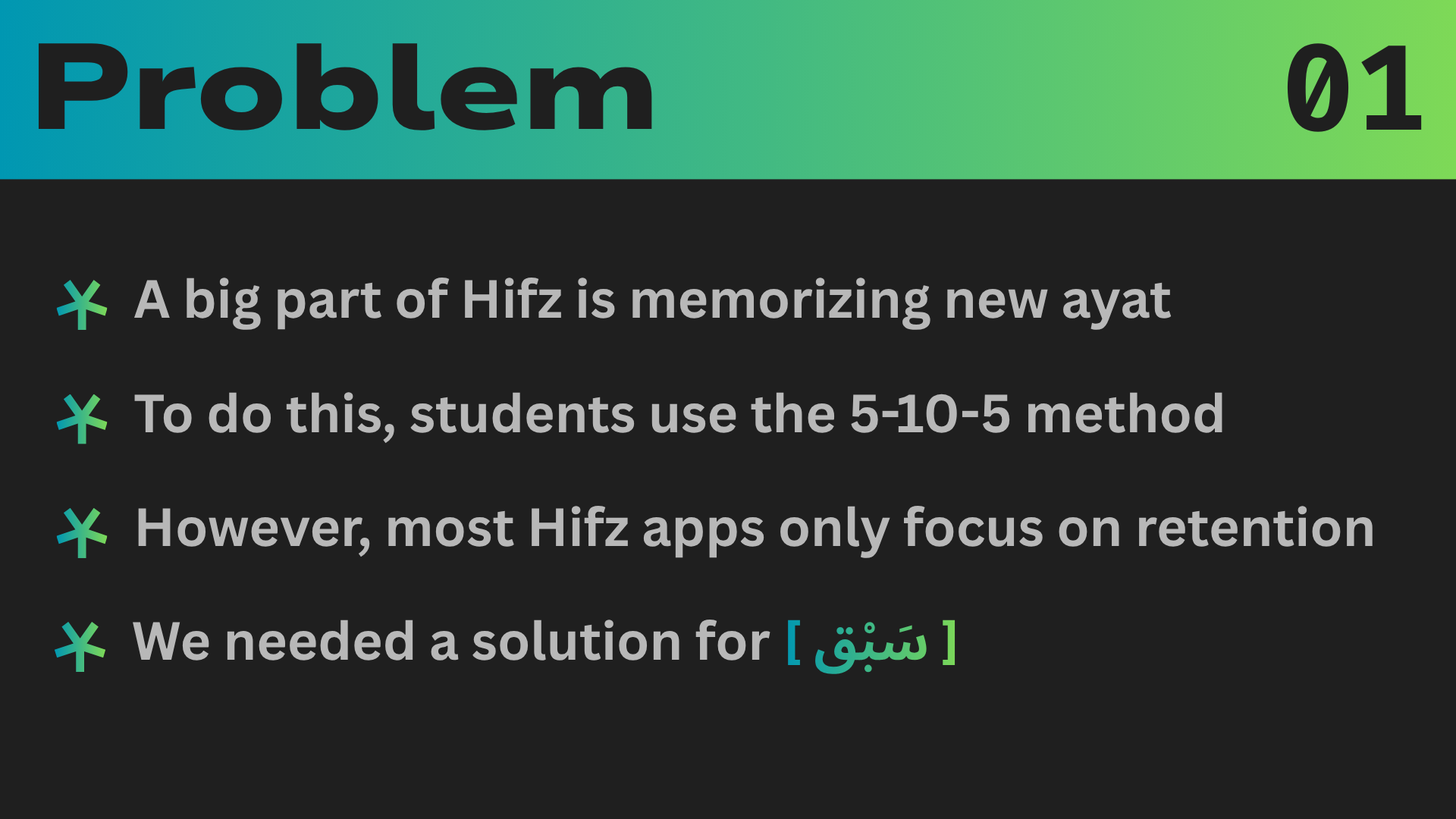
For generations, Qur’an students have relied on the 5-10-5 method — reading a new passage five times while looking, ten times from memory, and five times again while looking — to perfect their memorization (sabaq).
But few digital tools truly replicate this process. Most Qur’an apps focus on retention and review, not on new memorization. As students ourselves, we saw this gap and wanted to create a digital companion that brings teacher-like feedback into the memorization phase — so students can learn accurately, independently, and confidently.
What it does
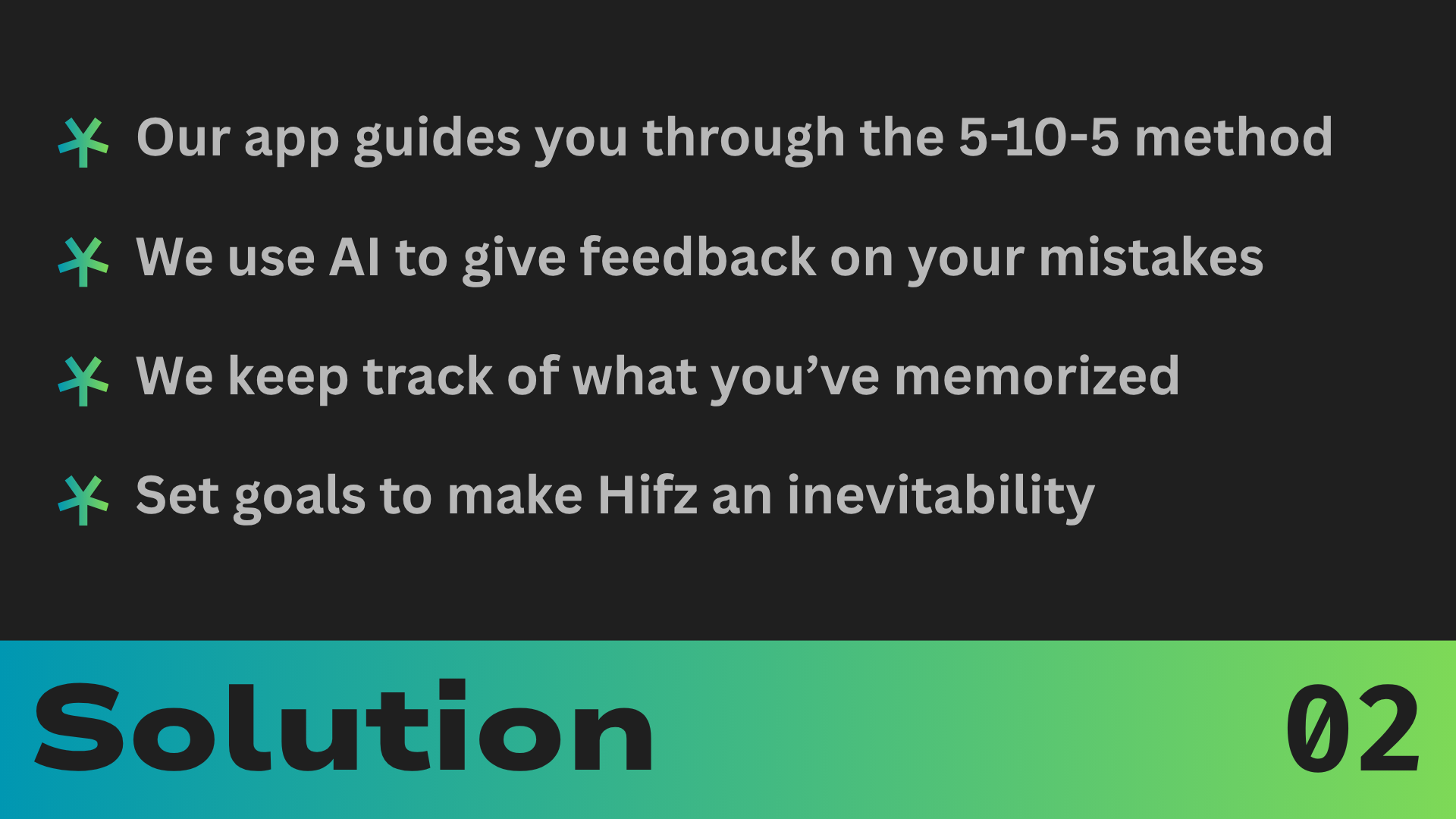
Sabaq helps students memorize new Qur’an passages using the 5-10-5 method, powered by AI feedback. Here’s how it works:
Read while looking (5x): The student reads the selected ayah or passage aloud five times.
Recite from memory (10x): The student recites without looking. The app listens and analyzes the recitation.
Review while looking (5x): The app highlights areas where mistakes occurred — skipped words, mispronunciations, or incorrect ayah transitions — so the student knows exactly what to focus on.
With this approach, Sabaq doesn’t just test memory — it trains it, guiding users toward perfect recitation.
How we built it
Frontend: React.js — for a smooth, minimal, and Arabic-friendly interface
Backend: Python (FastAPI) — for voice processing and AI integration
Database: SQLite — to store user progress, recitation attempts, and lesson data
AI Engine: OpenAI API — for speech-to-text conversion, Arabic phonetic matching, and semantic mistake highlighting
We designed Sabaq’s pipeline to convert live recitation audio into text, align it with the Qur’anic source, and display real-time mistake feedback through color-coded highlights.
Challenges we ran into
Handling Arabic diacritics (tashkeel) and tajweed variations during AI analysis
Calibrating the AI model to distinguish memorization errors from pronunciation differences
Designing a UI that is both modern and reverent to the Qur’an’s presentation standards
Maintaining real-time feedback with minimal latency
Accomplishments that we're proud of
Built an AI-driven memorization loop that mirrors real teacher feedback
Achieved high-accuracy mistake highlighting for Arabic text
Created an end-to-end working prototype combining React, Python, SQLite, and OpenAI
Designed an app that balances technology, tradition, and respect
What we learned
The complexity of Arabic speech processing and its linguistic nuances
How to train AI to handle Qur’anic text alignment responsibly
The importance of preserving cultural and spiritual context in tech innovation
Collaborative problem-solving across frontend, backend, and AI pipelines
What's next for Sabaq
Add tajweed rule detection and phoneme-based pronunciation scoring
Add multiple mushaf layouts
Introduce gamified streaks and milestones for motivation
Create long-term plans of study
Integrate the other 2 stages of Hifz
Launch mobile apps (iOS and Android)
Expand dataset with crowdsourced audio from huffaz for refinement
Built With
- html/css
- javascript
- openai-api
- python(fastapi)
- react.js
- sqlite

Log in or sign up for Devpost to join the conversation.