-
-
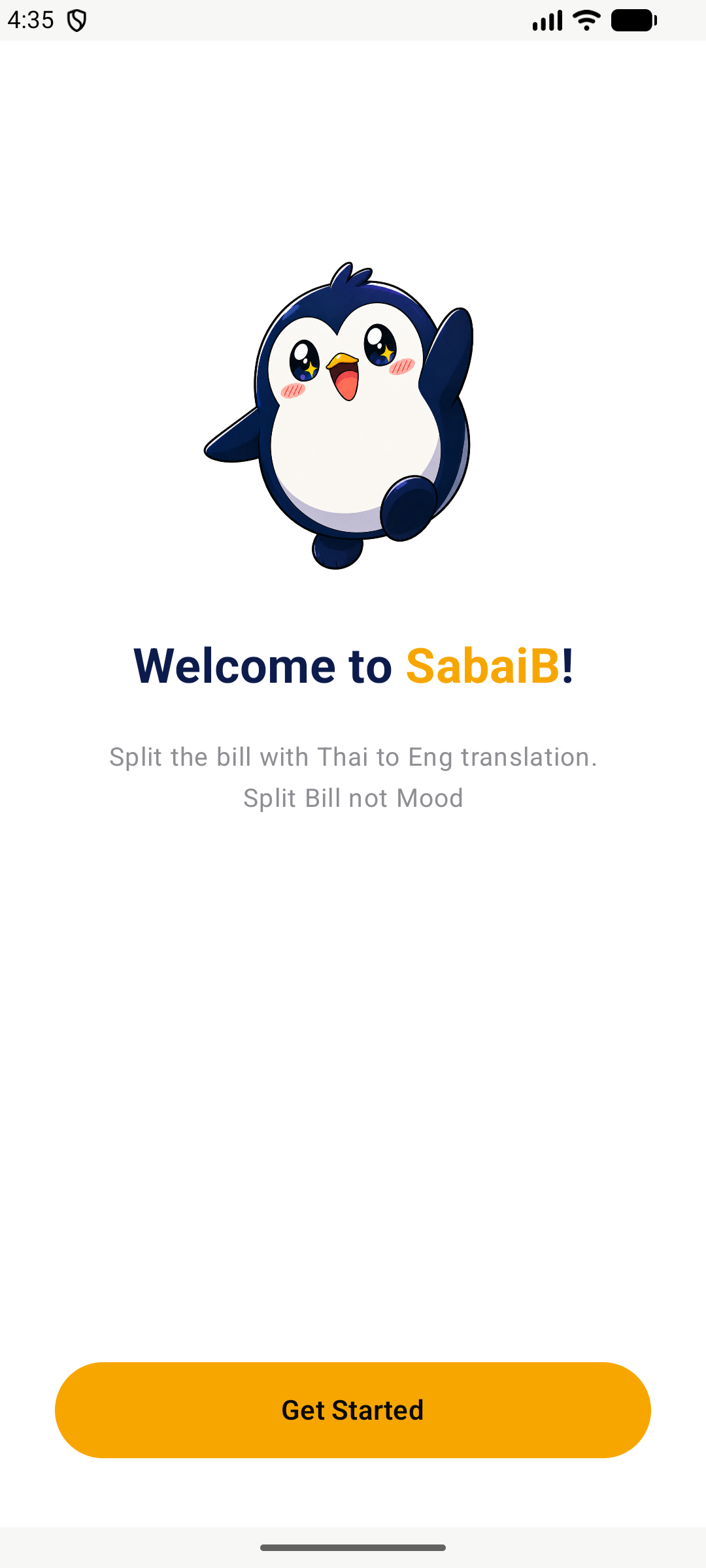
Welcome screen
-
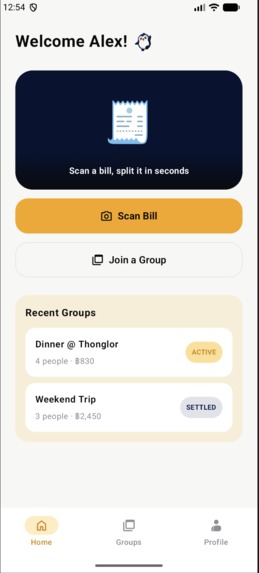
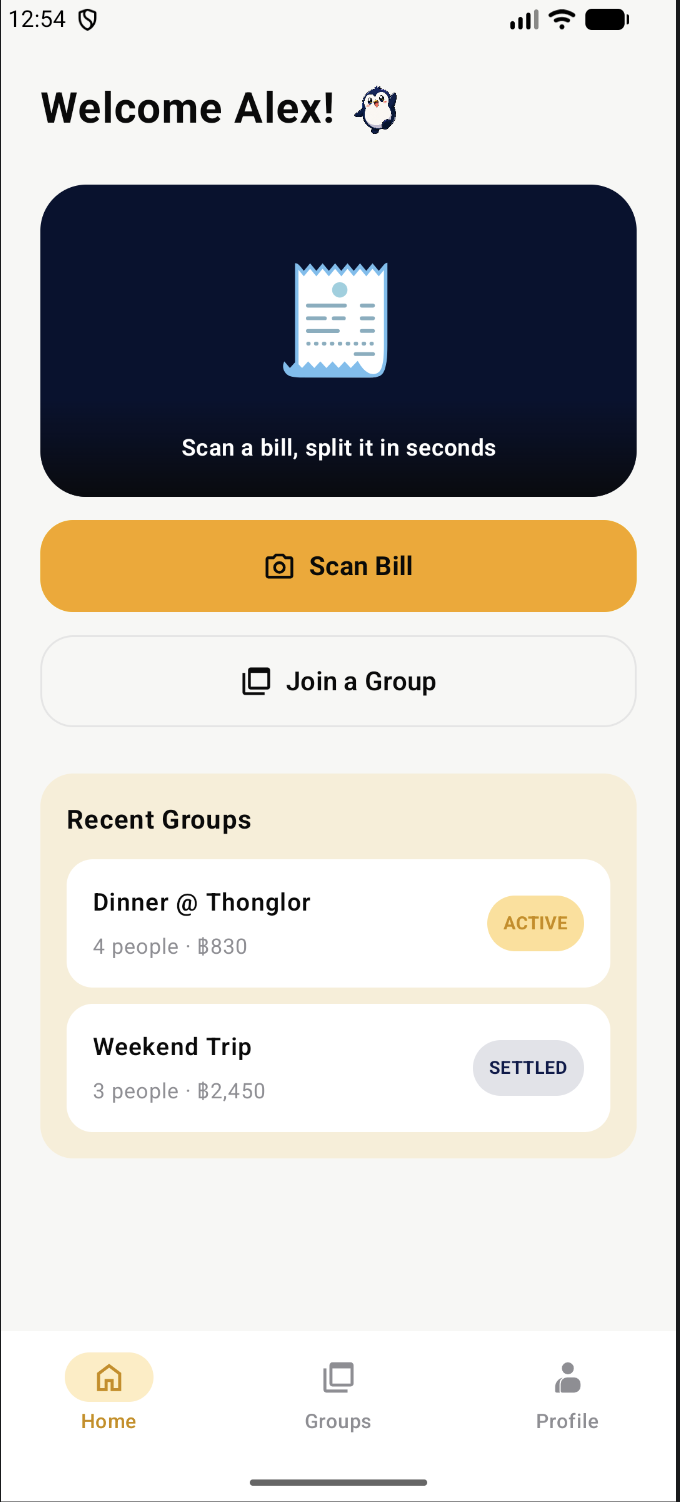
Home screen
-
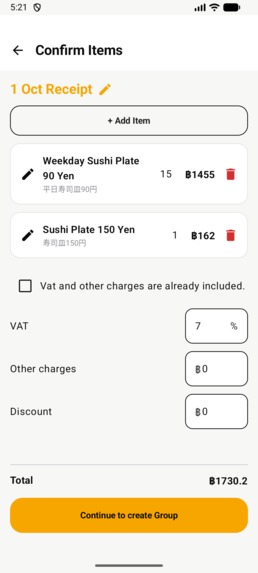
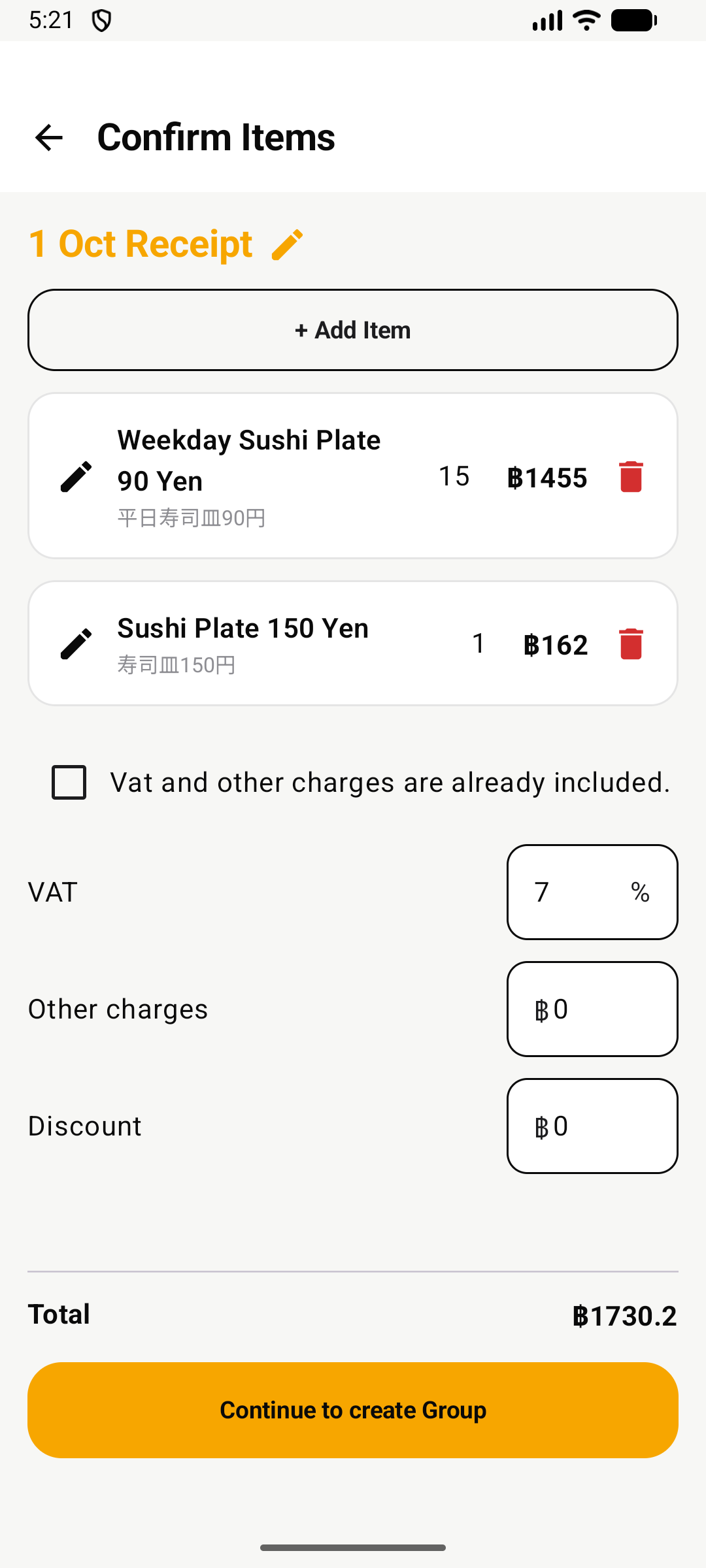
Japanese to English Items Listing
-
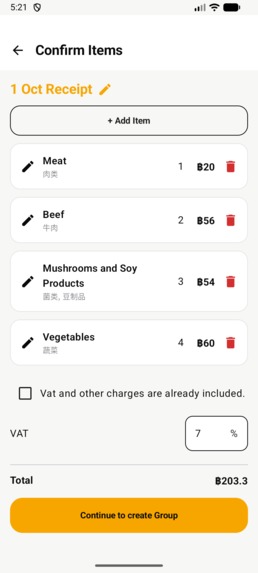
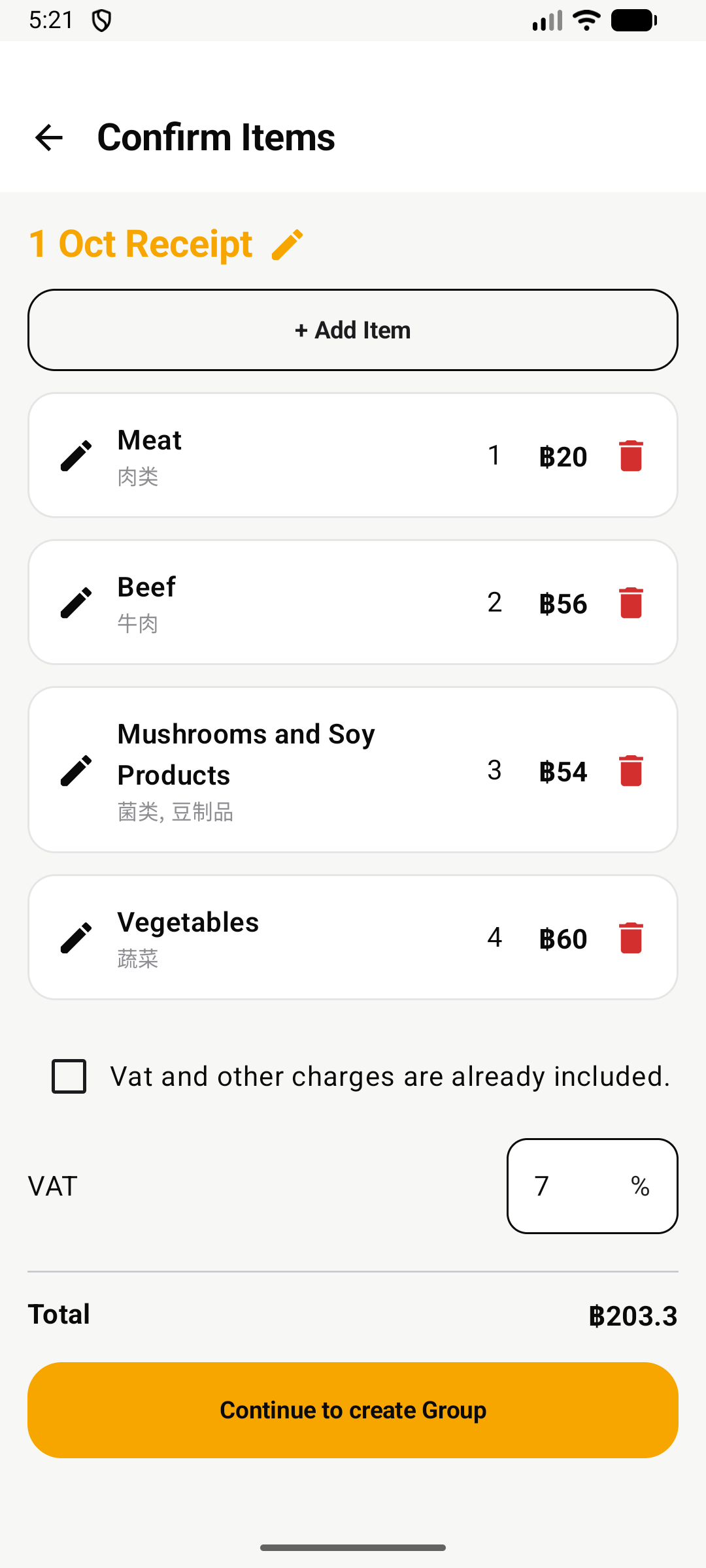
Chinese to English Items Listing
-
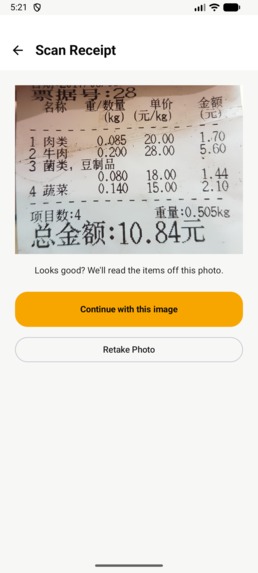
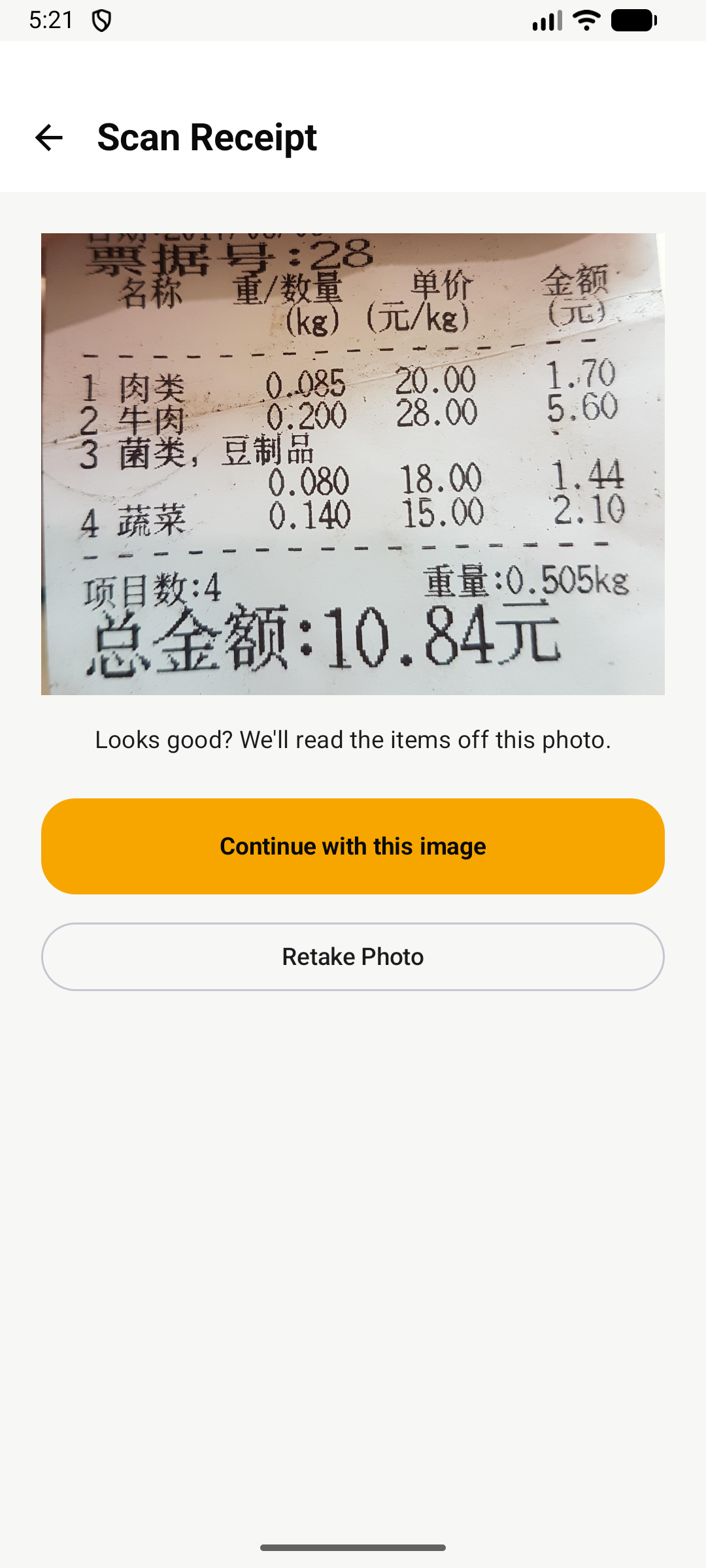
Chinese Receipt
-
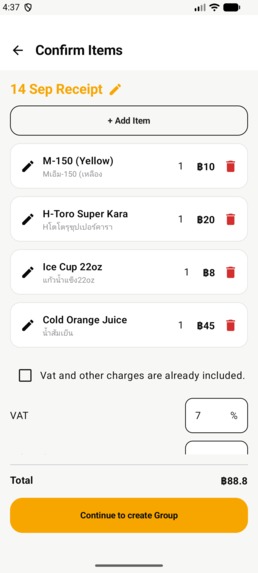
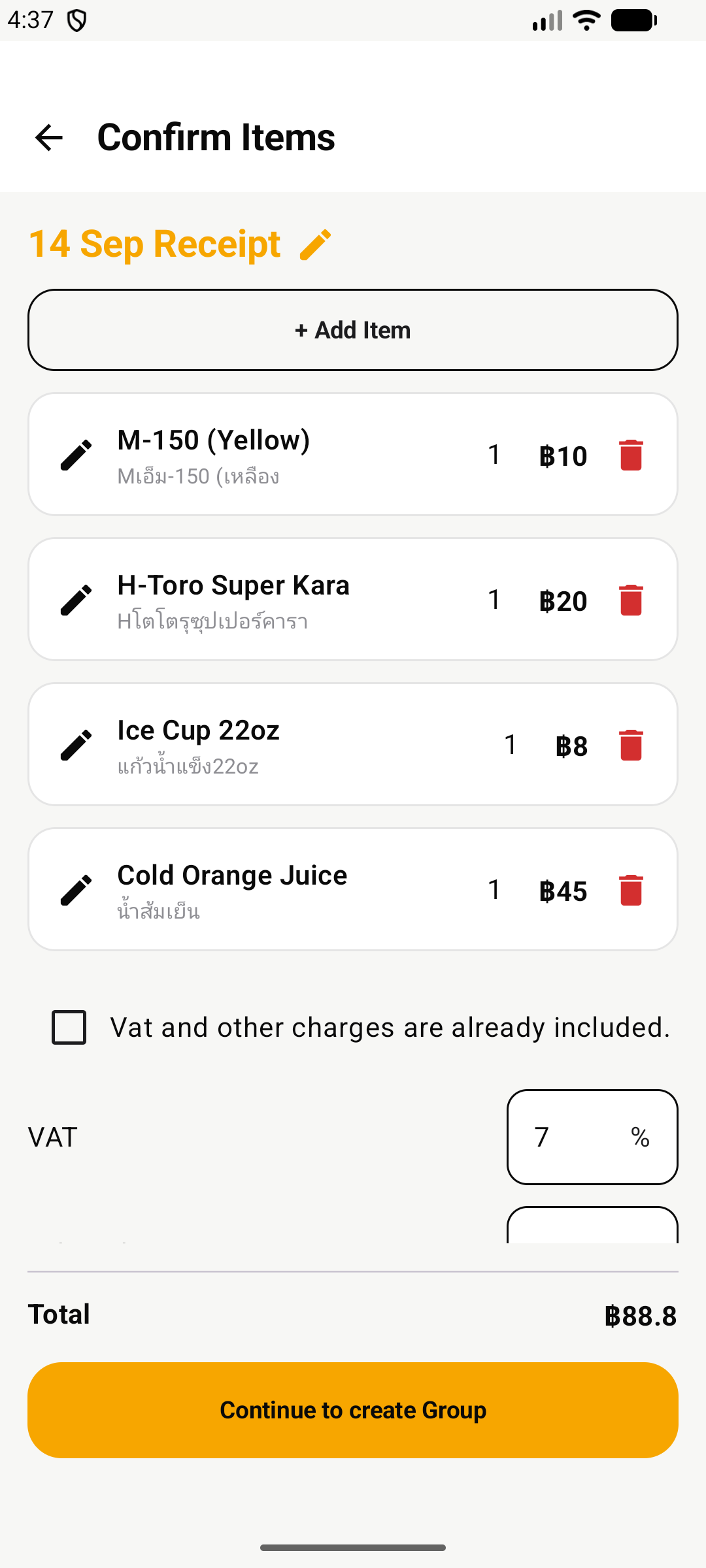
Thai to English Items Listing
Inspiration
In Thailand, eating out with friends almost always ends the same way: one person pays the whole bill, then spends the next 20 minutes typing receipt lines into a group chat, adding the service charge and VAT, and chasing everyone for money. It gets worse when you travel and can't even read the receipt.
Sabai (สบาย) means relaxed or at ease in Thai. I wanted splitting the Bill to feel sabai, so the motto became "Split the bill, not the mood."
What it does
SabaiB turns a photo of a receipt into a fair, itemized split that everyone can pay in seconds.
- Scan a receipt in any language. Gemini reads the photo, pulls out every line item, and translates each one into English while keeping the original name, so travellers and mixed-language groups know exactly what they're paying for.
- Review and fix. Edit names, quantities, and prices, remove lines, and set the service charge, VAT, and discounts.
- Open a bill room. Friends join from their own phones with a group code or QR.
- Claim what you ate. Each person taps their items. Shared dishes split automatically between everyone who claimed them, or the host can split the bill evenly.
- Payment Status Each participant gets their exact total (and optional a PromptPay QR of the host), and the host can see who has paid.
- Groups and history. Recurring friend groups and past payments stay in one place.
- SabaiB+. Free users get 1 AI scan every 30 days. SabaiB+ unlocks unlimited scans as a monthly subscription through RevenueCat.
The math behind a fair split
For an item ( i ) with unit price ( p_i ) and quantity ( q_i ), the service charge rate ( s ) and VAT rate ( v ) are folded into each item (with ( v = 0 ) when VAT is already included):
$$ \tilde{p}_i = p_i \, q_i \,(1 + s)(1 + v) $$
If ( S_i ) is the set of people who claimed item ( i ), then person ( k )'s share before discounts is
$$ F_k = \sum_{i \,:\, k \in S_i} \frac{\tilde{p}_i}{|S_i|} $$
A bill-level discount ( D ) is shared in proportion to each person's raw food cost, so the person who ate more also gets more of the discount:
$$ T_k = F_k - D \cdot \frac{\displaystyle\sum_{i \,:\, k \in S_i} \frac{p_i q_i}{|S_i|}}{\displaystyle\sum_i p_i q_i} $$
That way nobody overpays because they shared a dish or ordered something cheap.
How we built it
- Kotlin and Jetpack Compose for a fully native Android UI, using MVVM with
StateFlow - Supabase (Postgres, Auth, Edge Functions) for accounts, profiles, groups, and the shared bill rooms that sync between the host's and participants' phones
- Gemini vision API with a strict JSON response schema for receipt parsing and translation, plus ML Kit text recognition and a regex parser as an on-device fallback
- RevenueCat with Google Play Billing for the SabaiB+ subscription, with RevenueCat's app user ID aliased to the Supabase user ID so a purchase follows the account
Challenges we ran into
- Real-time sync. Keeping the host's and every participant's view consistent while several people claim items at once took several rounds of fixes to the join, claim, and payment flows.
- Messy receipts. Receipts mix scripts, abbreviations, local number formats (is
1.200one point two or one thousand two hundred?), and metadata lines. Prompting Gemini with a schema, and letting users correct the result instead of trusting it blindly, made scanning reliable. - On-device OCR limits. ML Kit can't read Thai script, so the fallback recovers prices, and the AI path handles names and translation.
- Privacy and trust. I added explicit consent before any image is sent to AI, an age gate, and full in-app account deletion through a Supabase Edge Function.
- Monetization without breaking the social loop. Everyone at the table has to be able to join for free, so only the host-side feature that actually costs money (AI scanning) sits behind the paywall.
Accomplishments that I'm proud of
- Shipping a complete end-to-end flow on my own: scan → translate → claim → pay → subscribe
- A split that is actually fair, including shared dishes, service charge, VAT, and proportional discounts
- Multi-device bill rooms that feel live
- Translating receipts in any language, which makes SabaiB useful for travellers as well as locals
- A working RevenueCat subscription with restore purchases and account-linked entitlements
What I learned
- How to design a backend schema and sync model for multi-user, real-time features with Supabase
- How to make an LLM reliable in production: structured JSON schemas, clear extraction rules, and always letting the user edit the output
- How to integrate RevenueCat and Google Play Billing, and how to think about pricing and paywall placement
- That privacy features like consent screens and account deletion should be designed in from the start, not added at the end
What's next for SabaiB
- An iOS version so whole friend groups can join, whatever phone they use
- Currency conversion for travellers, showing totals in both the local and home currency
- LINE sharing and payment reminders for friends who haven't paid yet
- Multiple receipts in one trip with a running "who owes whom" balance
- Galaxy Store release and more local payment rails beyond PromptPay
Built With
- android-studio
- gemini
- kotlin
- supabase


Log in or sign up for Devpost to join the conversation.