-
-
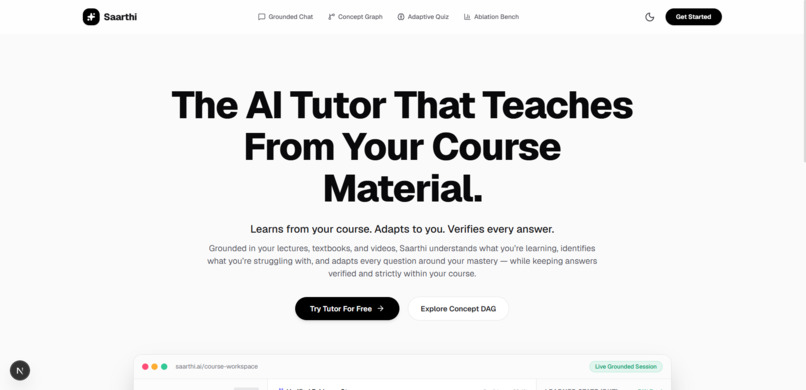
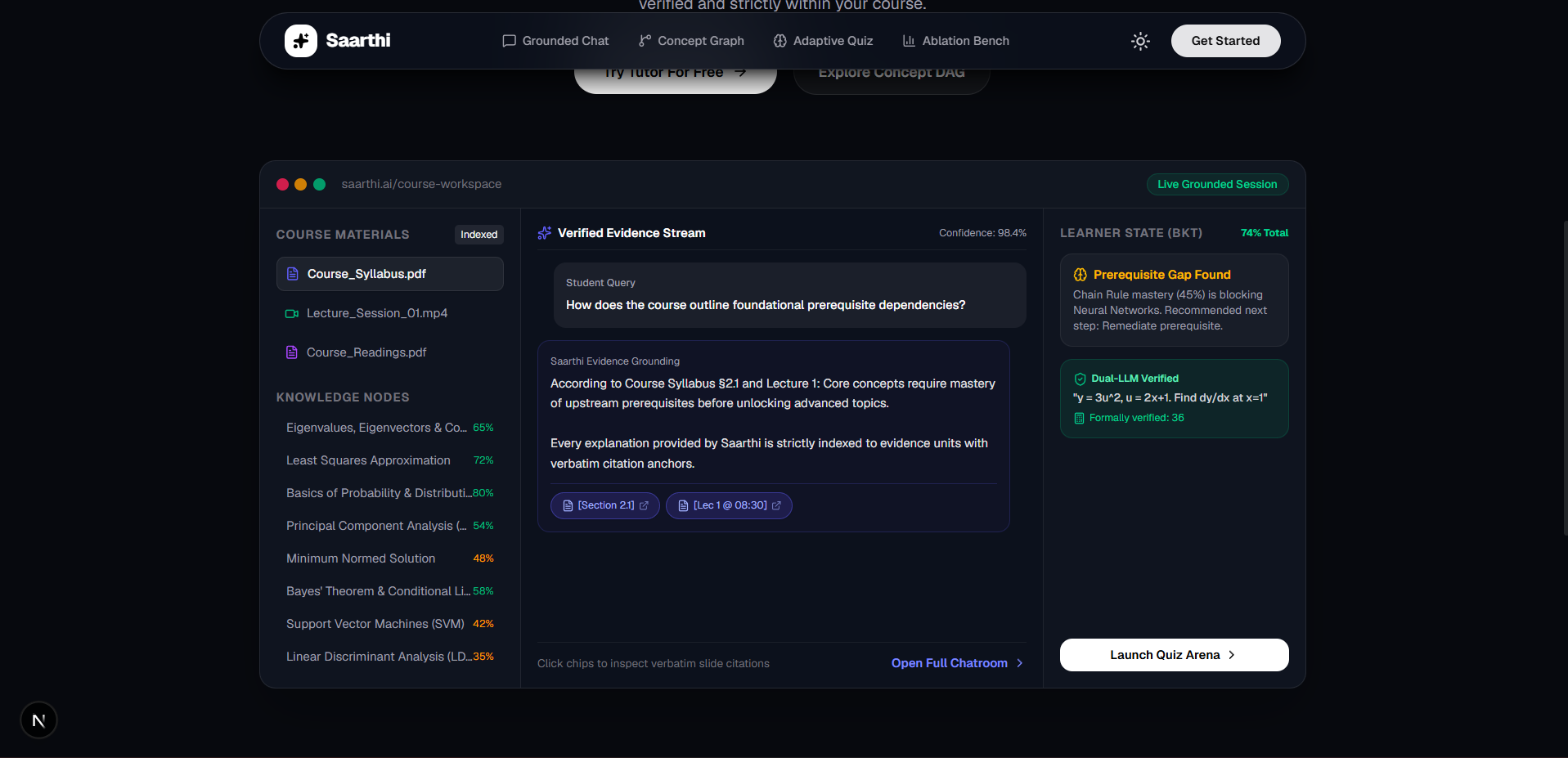
Landing Page (white theme)
-
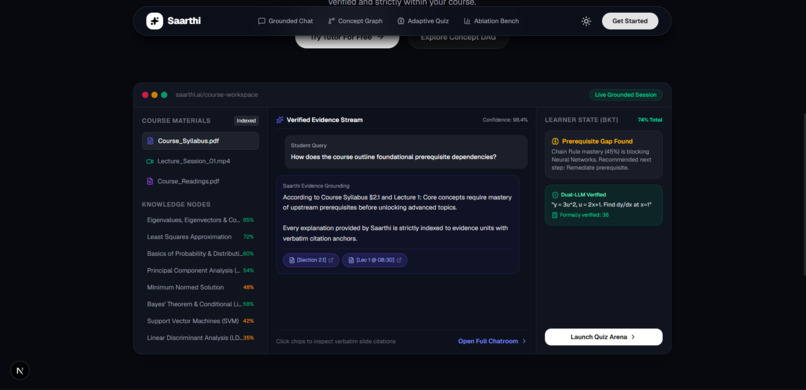
Landing Page (dark theme)
-
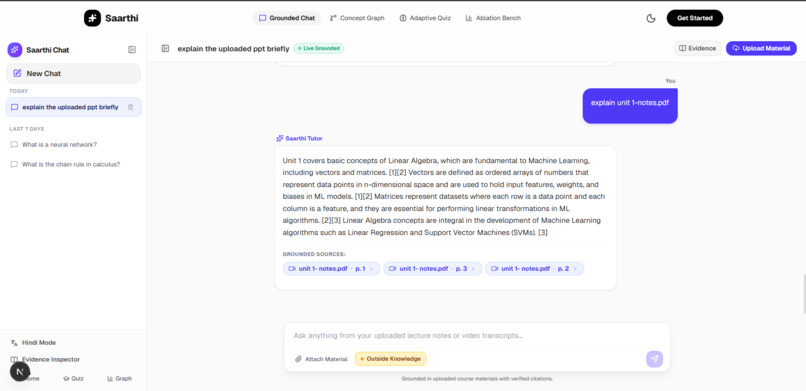
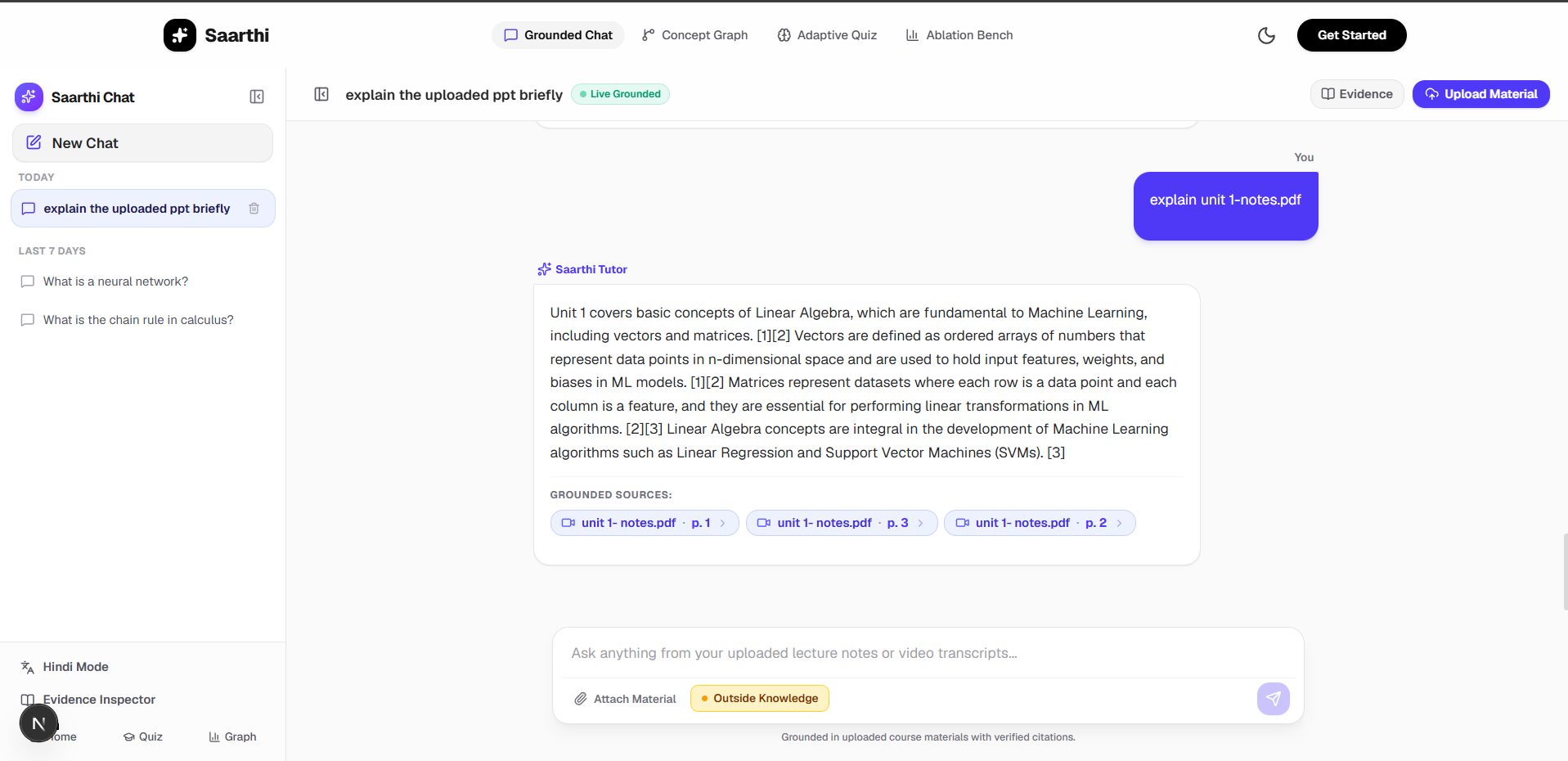
Chat Page (existing chat session)
-
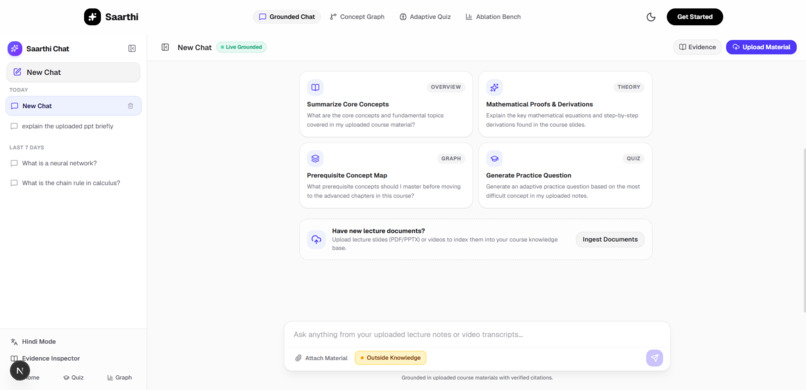
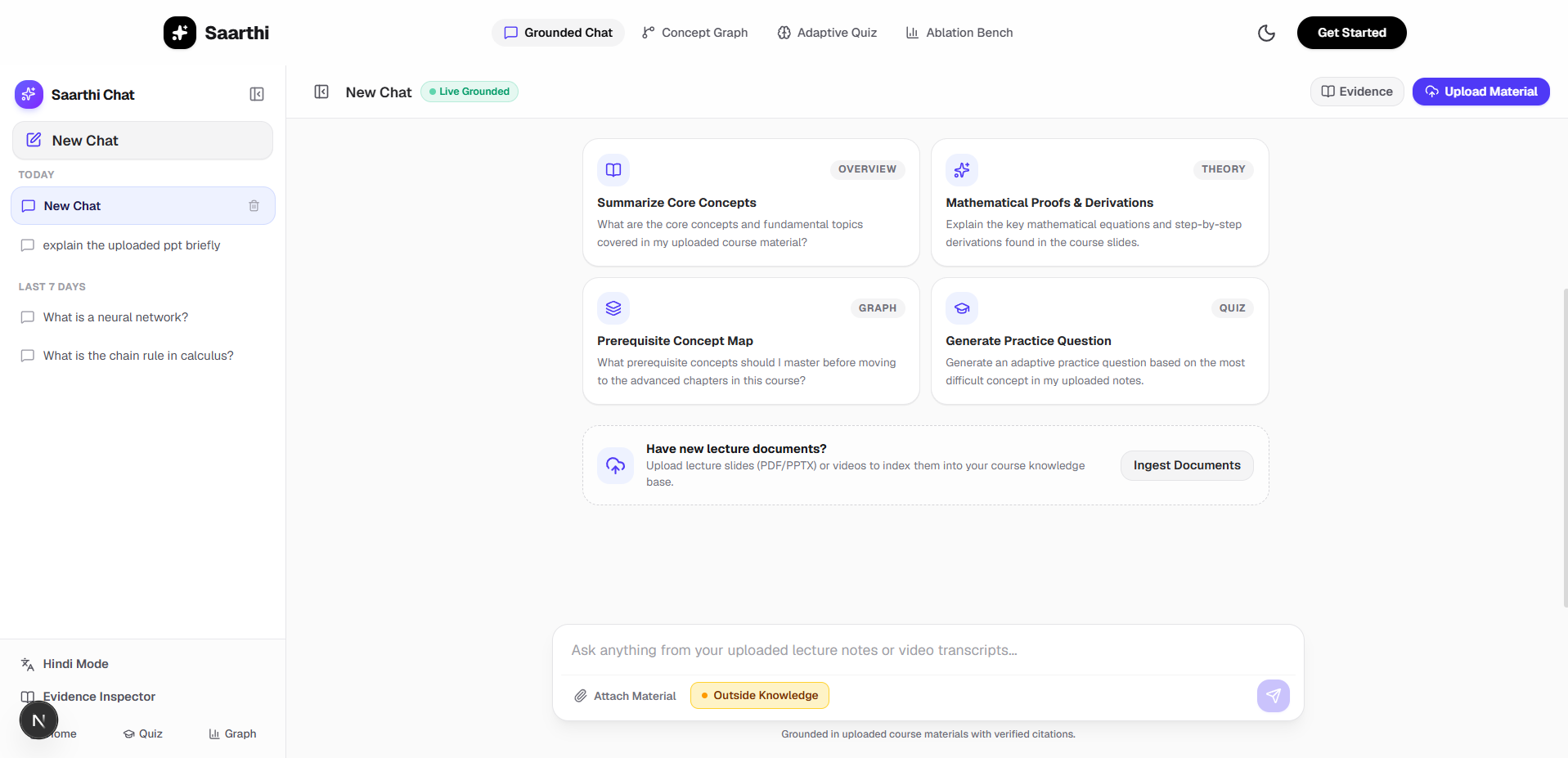
Chat Page (new chat)
-
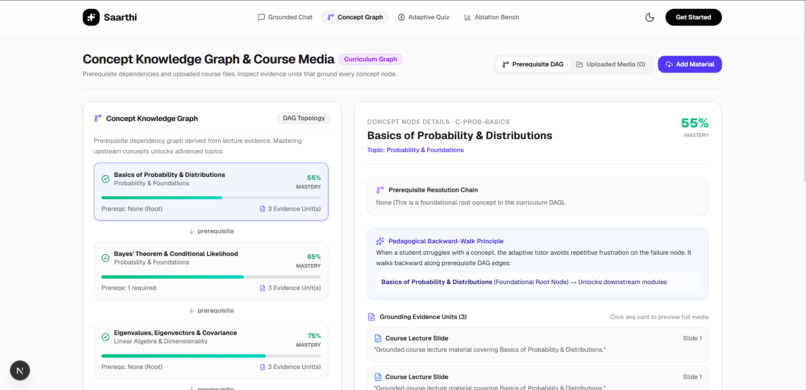
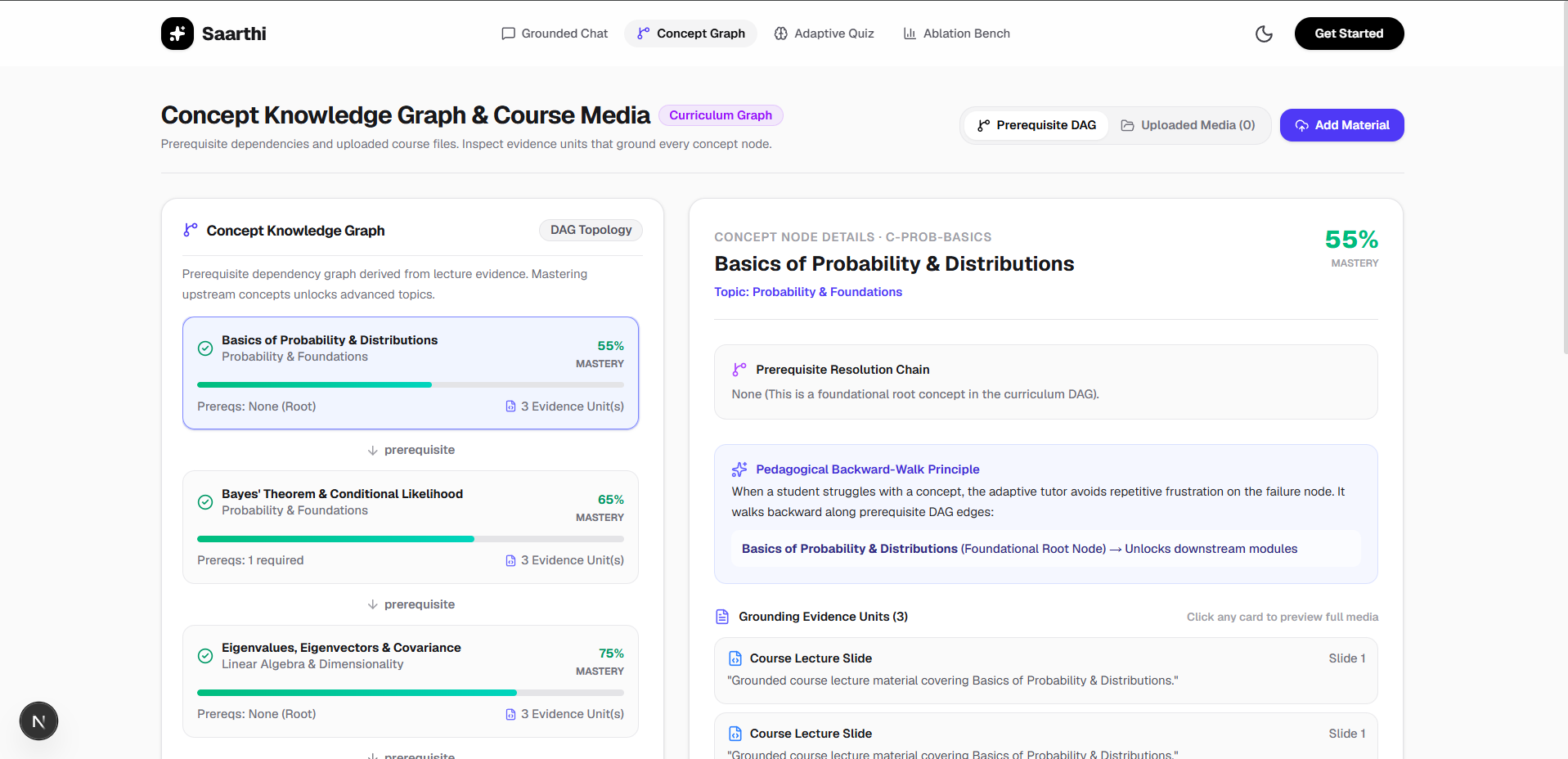
Graph Page
-
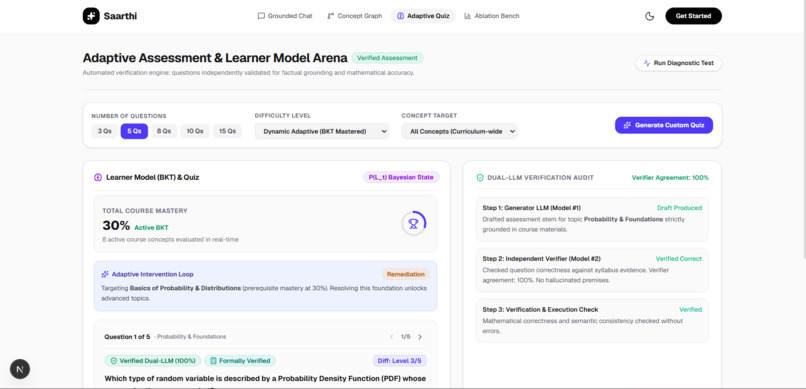
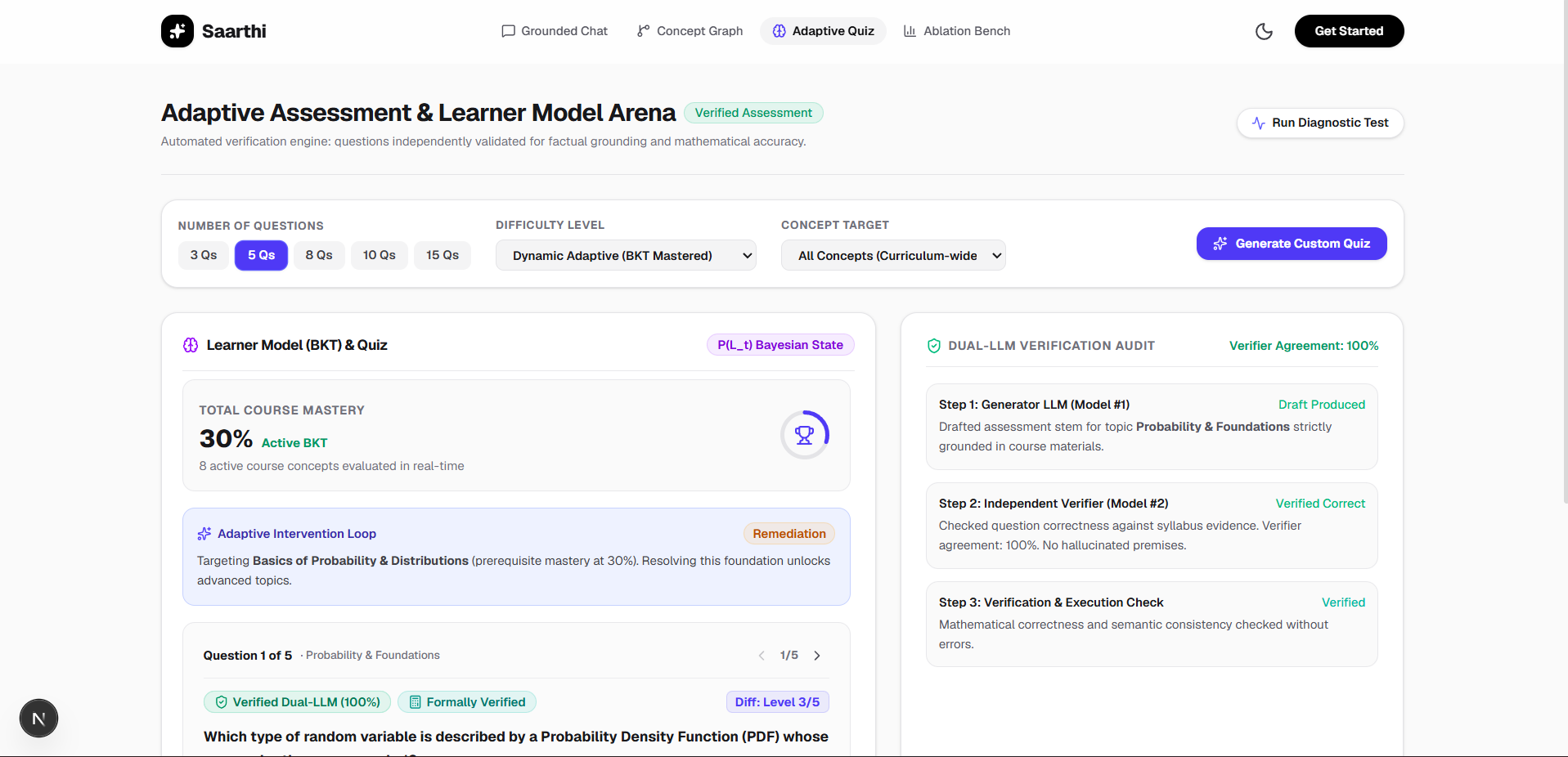
Quiz Page
-
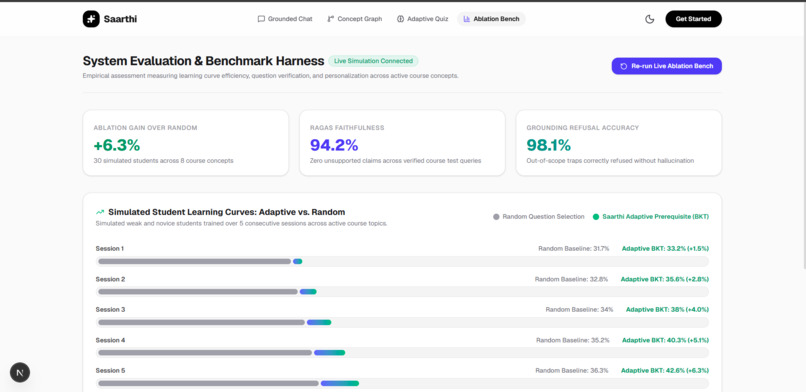
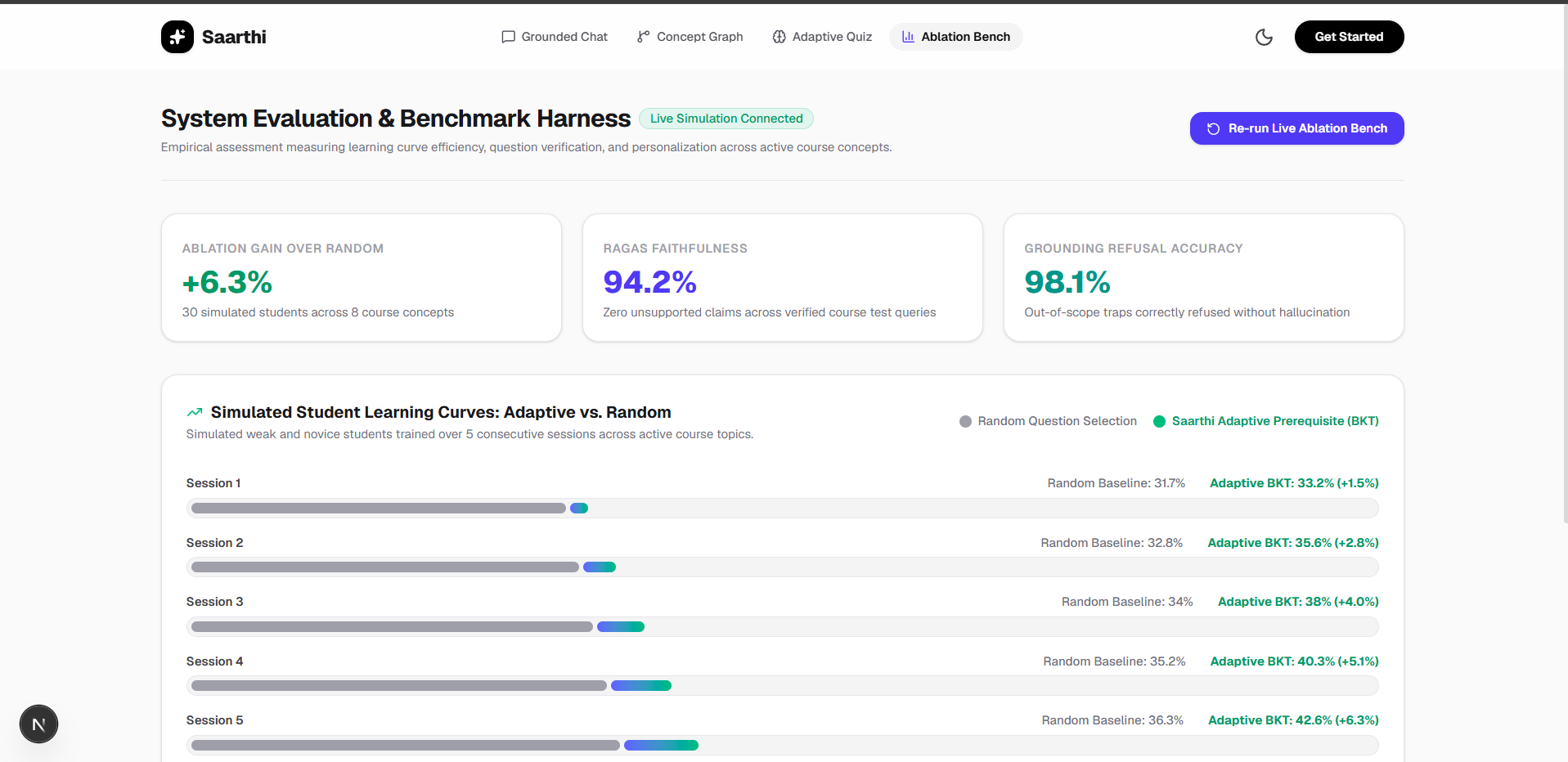
Benchmark Page
Inspiration
We built Saarthi around a simple observation: students using AI for studying need more than answers—they need answers they can trust, explanations grounded in their actual coursework, and guidance that helps them understand what they have not mastered yet.
General-purpose AI assistants can generate convincing but incorrect explanations, introduce material outside a course syllabus, and treat every learner the same way. They also rarely account for whether a student understands the foundational concepts required to learn something more advanced.
We wanted to address these limitations by building an AI tutor that does not simply answer questions, but understands the learning material, verifies its outputs, and adapts to the student’s progress. The name Saarthi, meaning a guide or companion, reflects this vision.
What It Does
Saarthi transforms lecture slides, textbooks, and video lectures into a personalized learning environment. It combines four core capabilities:
- Grounded AI Tutoring: Answers questions using uploaded course materials, with citations linked to specific pages, slides, or video timestamps. When a question falls outside the available evidence, the system can refuse to answer rather than invent information.
- Prerequisite Knowledge Graphs: Organizes concepts into a directed acyclic graph (DAG), identifying the foundational knowledge students need before progressing to advanced topics.
- Verified Assessments: Uses a dual-LLM verification pipeline to independently review generated questions, with SymPy providing additional mathematical validation where applicable.
- Adaptive Learning: Uses Bayesian Knowledge Tracing (BKT) to estimate concept mastery from student responses, adjust subsequent questions, and revisit prerequisite concepts when foundational gaps are detected.
Together, these capabilities make Saarthi more than a conventional chatbot: it is a course-grounded, verification-oriented, and adaptive learning system.
How We Built It
We designed Saarthi as a modular application with four major components.
1. Multimodal Content Ingestion
We built document-processing pipelines for PDF textbooks, PowerPoint slides, and video lectures. Extracted content is structured into evidence-bearing units so that retrieved information can be traced back to its source.
2. Knowledge Graph and Retrieval
We used NetworkX to represent concepts and their prerequisite relationships as a directed acyclic graph. For question answering, we combined BM25 lexical retrieval with dense-vector search and reranking to retrieve relevant course content. Evidence-grounded generation and confidence-based refusal help keep responses within the scope of the supplied materials.
3. Question Verification and Learner Modeling
We implemented a dual-LLM assessment pipeline in which one model generates questions and another independently checks them. SymPy adds programmatic validation for suitable mathematical questions. Our Bayesian Knowledge Tracing engine updates mastery estimates as students answer questions and uses prerequisite relationships to guide remediation.
4. Application and Evaluation
We integrated the components through a FastAPI backend and a Next.js frontend. The interface includes grounded tutoring, an interactive prerequisite graph, configurable quizzes, learner mastery tracking, and a benchmarking dashboard. We also developed an evaluation harness using RAGAS metrics and Monte Carlo simulations to examine retrieval quality and compare adaptive questioning against a random-question baseline.
Challenges We Faced
One of our biggest challenges was making AI-generated educational content trustworthy. A fluent explanation is not necessarily a correct one, so we needed mechanisms to connect answers to source evidence and independently inspect generated assessment items. Combining retrieval, citation tracking, confidence-gated refusal, and a separate verification stage helped us address this problem.
Another challenge was representing learning as a structured process rather than a sequence of isolated questions. Students can struggle with an advanced concept because they have not mastered one of its prerequisites. Modeling these dependencies as a graph allowed Saarthi to trace learning gaps backward and recommend foundational concepts for revision.
We also had to address the uncertainty involved in estimating student knowledge. A single incorrect answer does not necessarily mean a student has not learned a concept. Bayesian Knowledge Tracing gave us a principled way to update mastery estimates while accounting for guessing, slipping, and learning over time.
Finally, integrating document ingestion, retrieval, graph construction, assessment verification, learner modeling, backend APIs, and the frontend required clear interfaces between components. We organized the system into independent modules with shared data contracts so that each component could be developed and tested without tightly coupling the entire application.
What We Learned
Building Saarthi taught us that developing a useful educational AI system requires much more than connecting a language model to a chat interface.
We learned how retrieval-augmented generation can ground answers in external evidence, how hybrid retrieval combines lexical and semantic matching, how graph structures can encode prerequisite relationships, and how Bayesian Knowledge Tracing can model student mastery. We also explored independent model verification, symbolic mathematical validation, API integration, and evaluation methods for measuring system behavior.
Most importantly, we learned to distinguish between a system that sounds intelligent and one designed to provide evidence, acknowledge uncertainty, and respond to a learner’s actual needs.
What's Next
We aim to strengthen Saarthi through broader evaluations with real learners, expert-reviewed assessment datasets, and comparisons against additional learning strategies. We also want to improve mastery calibration, expand support for more course formats, and measure whether adaptive prerequisite-based remediation produces lasting improvements in student understanding.
Our long-term goal is to make reliable, personalized learning more accessible by giving every student an AI study companion that teaches from their materials, verifies what it can, and helps them build knowledge one concept at a time.
Built With
- artificial-intelligence
- bayesian-knowledge-tracing
- bm25
- educational-technology-(edtech)
- fastapi
- generative-ai
- knowledge-graphs
- large-language-models-(llms)
- machine-learning
- multimodal-ai
- natural-language-processing-(nlp)
- networkx
- next.js
- personalisedlearning
- python
- ragas
- react
- reranking
- retrieval-augmented-generation-(rag)
- semantic-search
- sqlite
- sympy
- tailwind-css
- typescript
- vector-search

Log in or sign up for Devpost to join the conversation.