-
-
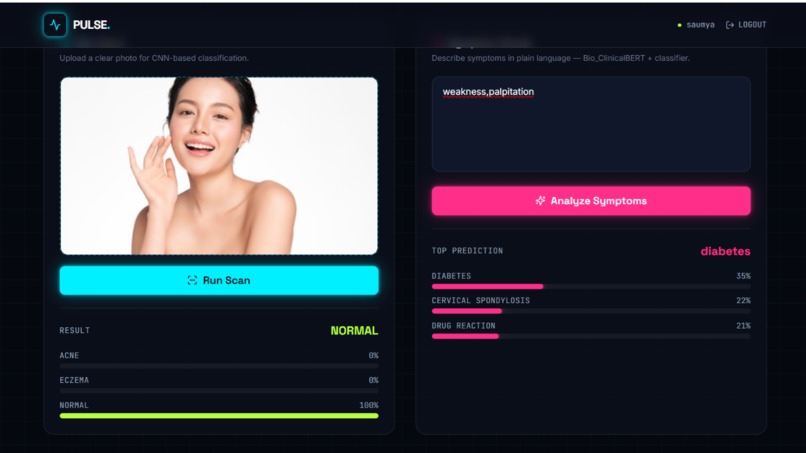
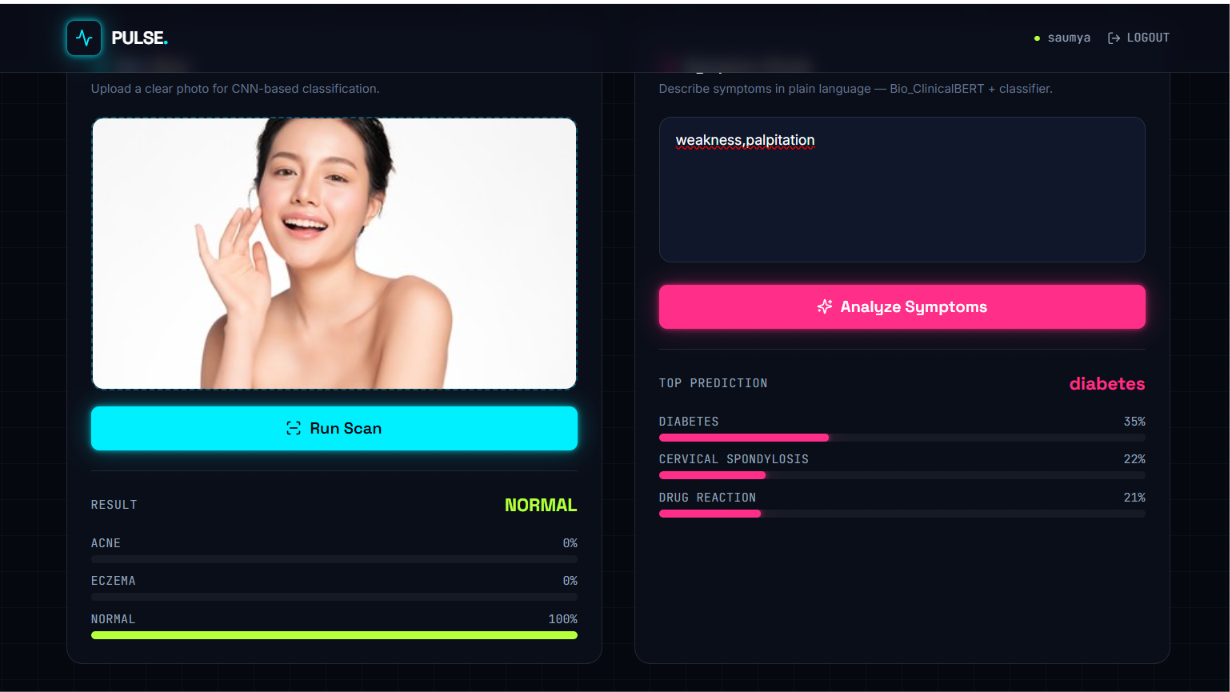
An example of the input
💡 Inspiration
One day, I was searching my symptoms online after having a headache and blurred vision. Within minutes, Google went from suggesting lack of sleep and dehydration to showing serious illnesses like cancer. 😵💫
The experience was overwhelming and anxiety-inducing. I realized that while there is plenty of health information online, there isn't always a simple way for people to describe their symptoms and receive structured, understandable insights.
That's when I decided to build Saarthi 🚑 — an AI-powered health companion that helps users understand their symptoms in a more organized and explainable way.
🩺 What it does
Saarthi allows users to enter symptoms in natural language, just like they would describe them to a friend or a doctor.
✨ Features:
Understands symptom descriptions using Medical NLP. Predicts the most likely diseases and conditions. Shows the Top-3 predictions with confidence scores. Generates easy-to-understand explanations using AI. Encourages users to seek professional medical advice when necessary. 🛠️ How I built it
I built Saarthi using a hybrid AI architecture:
🧠 BioClinicalBERT for medical language understanding 📊 Logistic Regression for disease prediction ⚡ Flask for the backend API 🤖 Groq + Llama for explainable AI responses 💻 HTML, CSS, JavaScript/TypeScript for the frontend interface 🐍 Python, Transformers, PyTorch, Scikit-learn for model development
Workflow User Symptoms ↓ BioClinicalBERT ↓ Disease Prediction ↓ Top Predictions ↓ AI Explanation Layer ↓ Health Insights 🚧 Challenges I ran into
🔹 Finding and working with medical datasets that were limited and sometimes noisy.
🔹 Making predictions accurate while keeping response times fast.
🔹 Integrating traditional machine learning with modern LLMs.
🔹 Handling vague symptom descriptions that could point to multiple conditions.
🔹 Designing the system to provide helpful insights without claiming to be a medical diagnosis tool.
🏆 Accomplishments that I'm proud of
✅ Built a complete end-to-end AI healthcare application as a solo developer.
✅ Successfully integrated BioClinicalBERT for medical NLP.
✅ Added an explainable AI layer instead of showing only raw predictions.
✅ Developed a full backend API and connected it with an interactive frontend.
✅ Created a scalable architecture that can be improved with larger medical datasets and advanced models.
📚 What I learned
🌱 How domain-specific NLP models like BioClinicalBERT differ from general-purpose language models.
🌱 The importance of data quality in machine learning projects.
🌱 How to combine machine learning models with LLMs to create more useful user experiences.
🌱 Building production-style AI pipelines with APIs, inference systems, and frontend integration.
🌱 The importance of responsible AI in healthcare-related applications.
🚀 What's next for Saarthi
🔮 Improve prediction accuracy with larger and more diverse medical datasets.
🩻 Add symptom normalization and medical knowledge graphs.
🎙️ Enable voice-based symptom input for accessibility.
📱 Create a mobile-friendly experience.
🌐 Deploy Saarthi publicly so anyone can access AI-powered symptom insights from anywhere.
🧑⚕️ Add doctor recommendations and healthcare resource integration in the future
Built With
- 3
- api
- bioclinicalbert
- css3
- flask
- git
- groq
- html5
- javascript
- joblib
- llama
- python
- pytorch
- rest
- scikit-learn
- transformers
- typescript


Log in or sign up for Devpost to join the conversation.