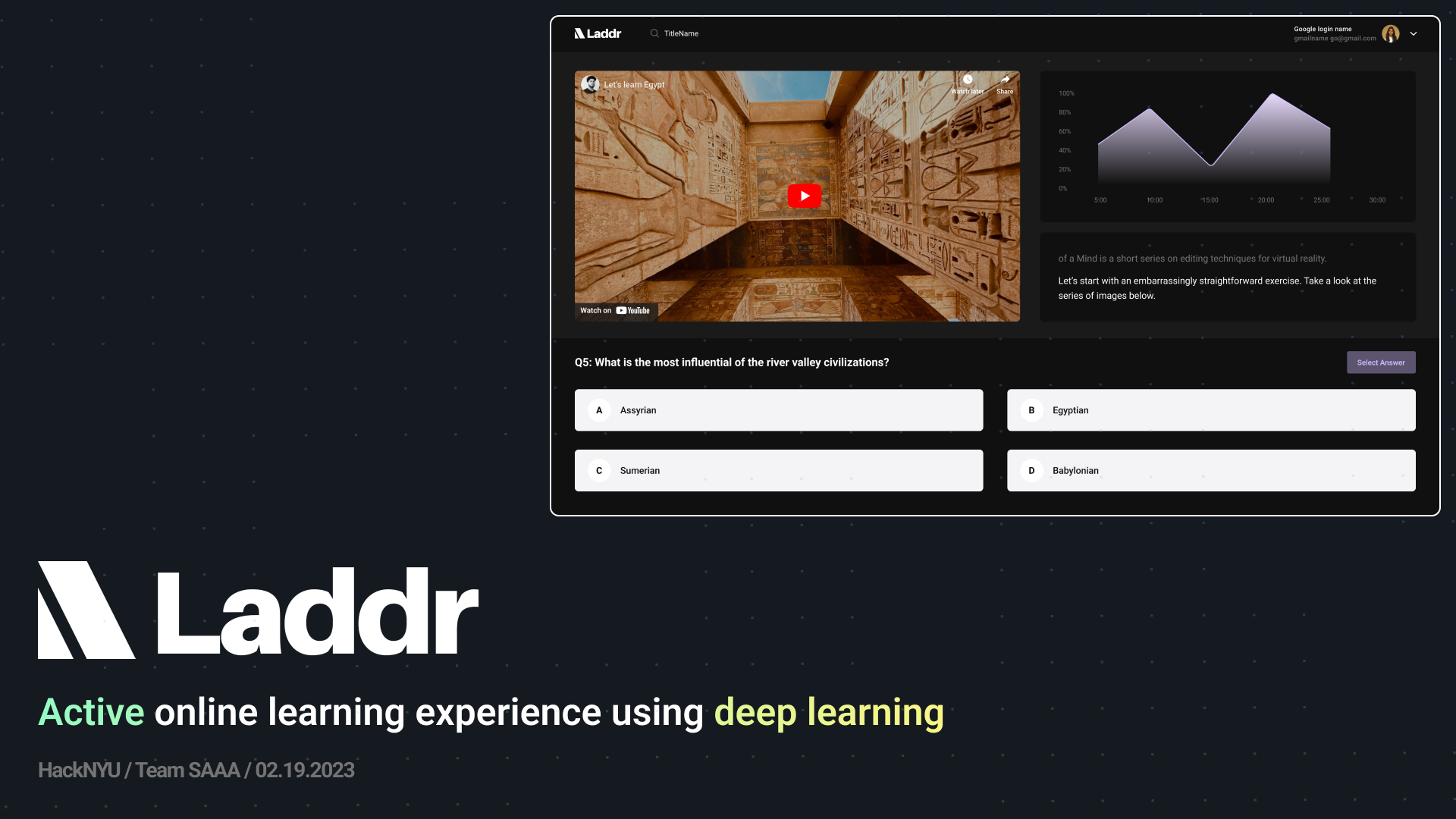
Our project revolutionizes online education by using NLP to generate questions for any videos, promoting active learning.
Inspiration
- There are many online educational resources, but no service transforms these resources into a personalized learning experience.
- To make online education more accessible and engaging, we ideated a service that generates multiple-choice questions for any videos.
What it does
Laddr’s current feature:
- Autogenerates multiple-choice questions based on the transcript of user input (link of the video)
- Allows users to users to leverage any educational video content
- Provides feedback and explanation to user’s answers
What Laddr benefits:
- Provides an inclusive opportunity for learning through utilizing existing video content
- Enhances user’s understanding of video content through interactive questions and feedback

How we built it
Technologies used:
- Django framework for backend architecture development
- Python programming language for both backend and frontend development with Jinja templates
- Google APIs for extracting captions from YouTube videos
- cohere.ai for processing transcript data and generating multiple-choice questions (MCQs)
Future revenue
- Target a wide range of users, from students and educators to online learning platforms
- Transform the service into a Chrome extension
- Develop a proprietary, large language model -These two approaches will enable us to provide our services and API to users on a subscription-based model, ensuring a steady source of income
Challenges we ran into
Time management
- Realistic Project idea within a given time frame
React.js and API usage
- React.js was much more complicated than initially expected. Many custom libraries were hard to work with for our specific use case (i.e., React-multiple-choice quiz option answer buttons didn’t offer the stylistic function we wanted)
- Google Data API integration with React took more time than expected. Spent a lot of time reading the documentation
- Initially wanted to integrate Hume API for facial recognition, but time constraints made that non-realistic.
Accuracy of auto-generated multiple-choice questions
- When converting a video to a transcript, transcript content also includes irrelevant information to the user. (i.e., who created the video, sponsors of the video, etc.)
Combining different skills through collaboration
- Each member was skilled in a specific area so efficiently combining each others skills was difficult
- Formed our team in the afternoon. Thus not everyone understood one another’s strengths/weaknesses Unfamiliarity / completion of tasks/ technical difficulties weren’t clearly communicated at first
Accomplishments that we're proud of
- We take great pride in achieving our goal of completing the minimum viable product (MVP) within the designated 20-hour time frame.
- It was especially rewarding to develop a functioning prototype despite being novice hackers. (Our group is proud of this accomplishment, and we remain optimistic about our chances of winning the iPad prize.)
- We attribute our success to the team's flexibility and ability to overcome challenges, including time constraints.
- We also take pride in our team's success in implementing the Google API despite encountering numerous challenges during the process.
What we learned
Realistic Vision
- Realized that almost all originally proposed features were not implementable
- Worked on a priority basis and implemented more prioritized features
- Eliminated less necessary features to MVP and added them to Laddr
- Completed main features first instead of giving up
Efficient Teamwork/ Collaboration
- Trial and Error allowed all team members to understand each other's strengths and weaknesses better, helping improve teamwork effectiveness
- Clear communication made team members more supportive of each other and willing to help
- Since Google Data API was a big priority for our project, we cooperated to implement this feature despite technical difficulties.
What's next for Laddr
Facial recognition using Hume.ai:
- Detects user distractions during online learning
- Enables live interaction with users by questioning them when distracted
Creating chrome extension for Coursera/khan academy/zoom implementation
- Extending the service into the chrome extension will enhance the accessibility to more resources, such as Coursera, Khan Academy, and Zoom.
Categorizing irrelevant information
- Categorizes transcripts into certain categories to reduce the possibility of generating irrelevant questions (i.e., video introduction)
Polished UI and responsive design for mobile devices
- Update the design based on UI designs on Figma
- Creates responsive design for mobile devices
In-depth analysis of user responses
- utilizing the cutting-edge technology of (RHFL)
Optimizing the latency of data retrieval from the GPT API
- ensuring that information is returned to the user in a timely and efficient manner

Log in or sign up for Devpost to join the conversation.