-
-
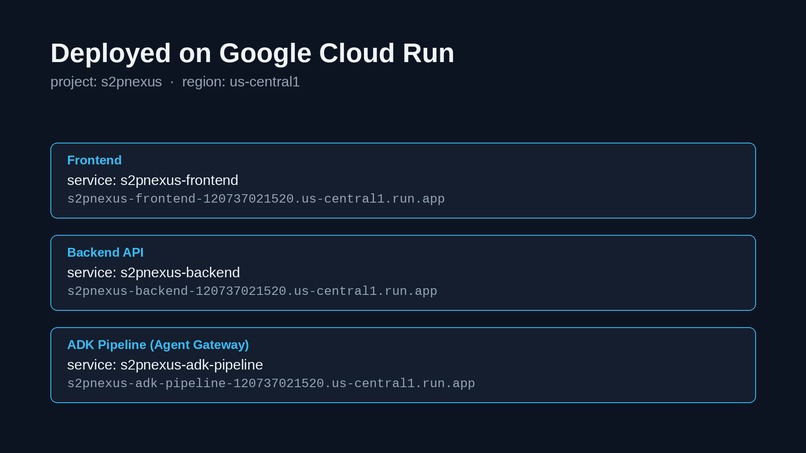
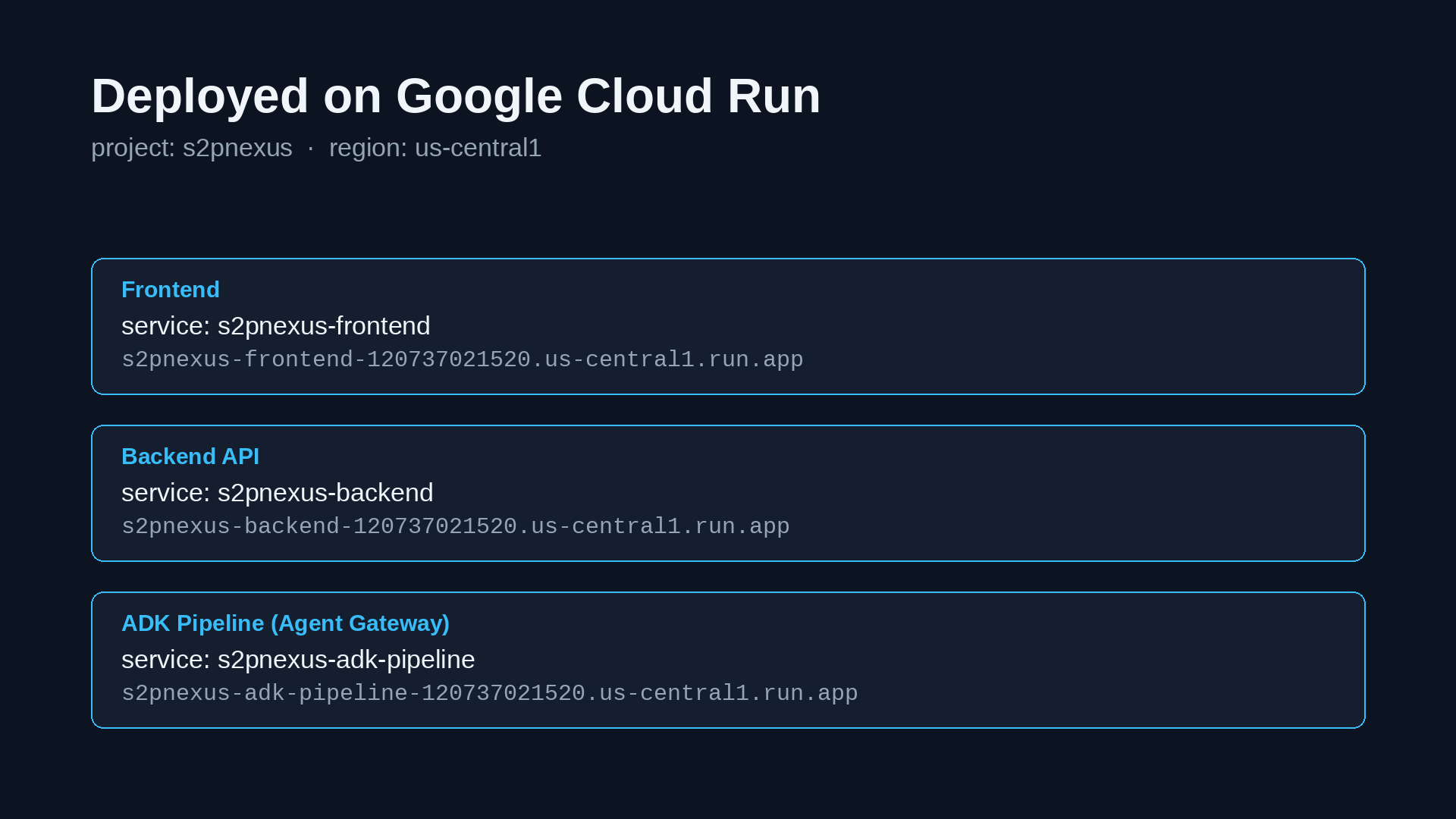
Deployed on Google Cloud Run — frontend, backend, and ADK agent gateway, project s2pnexus
-
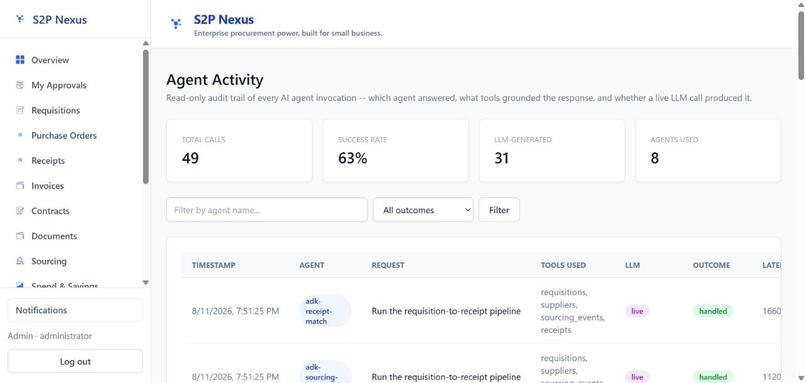
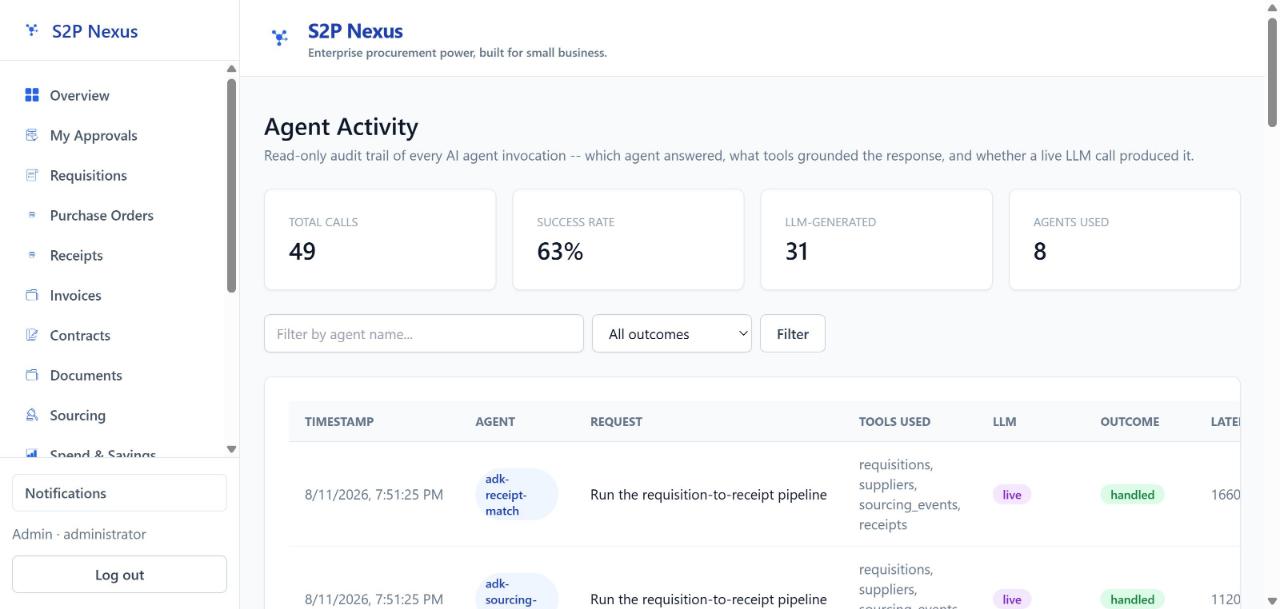
Agent Activity dashboard — unified observability across all 12 domain agents plus the 3 ADK steps
-
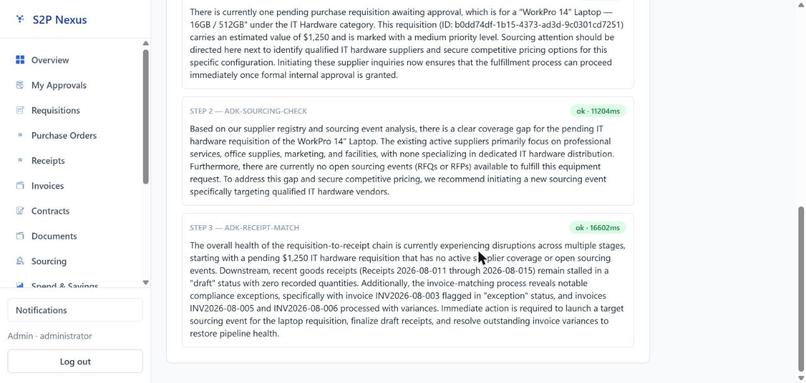
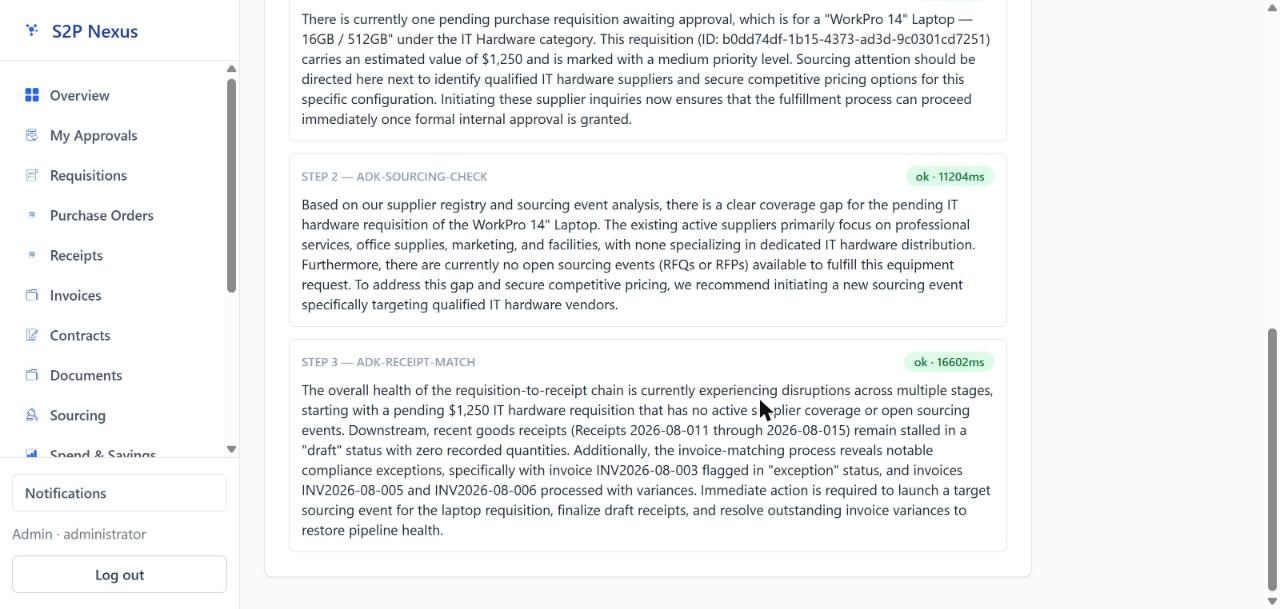
Live ADK pipeline run: sourcing check and receipt-match steps flagging real invoice exceptions
-
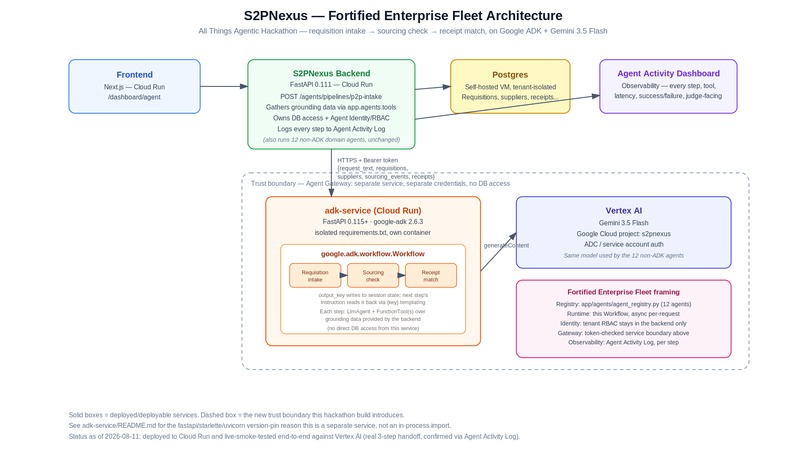
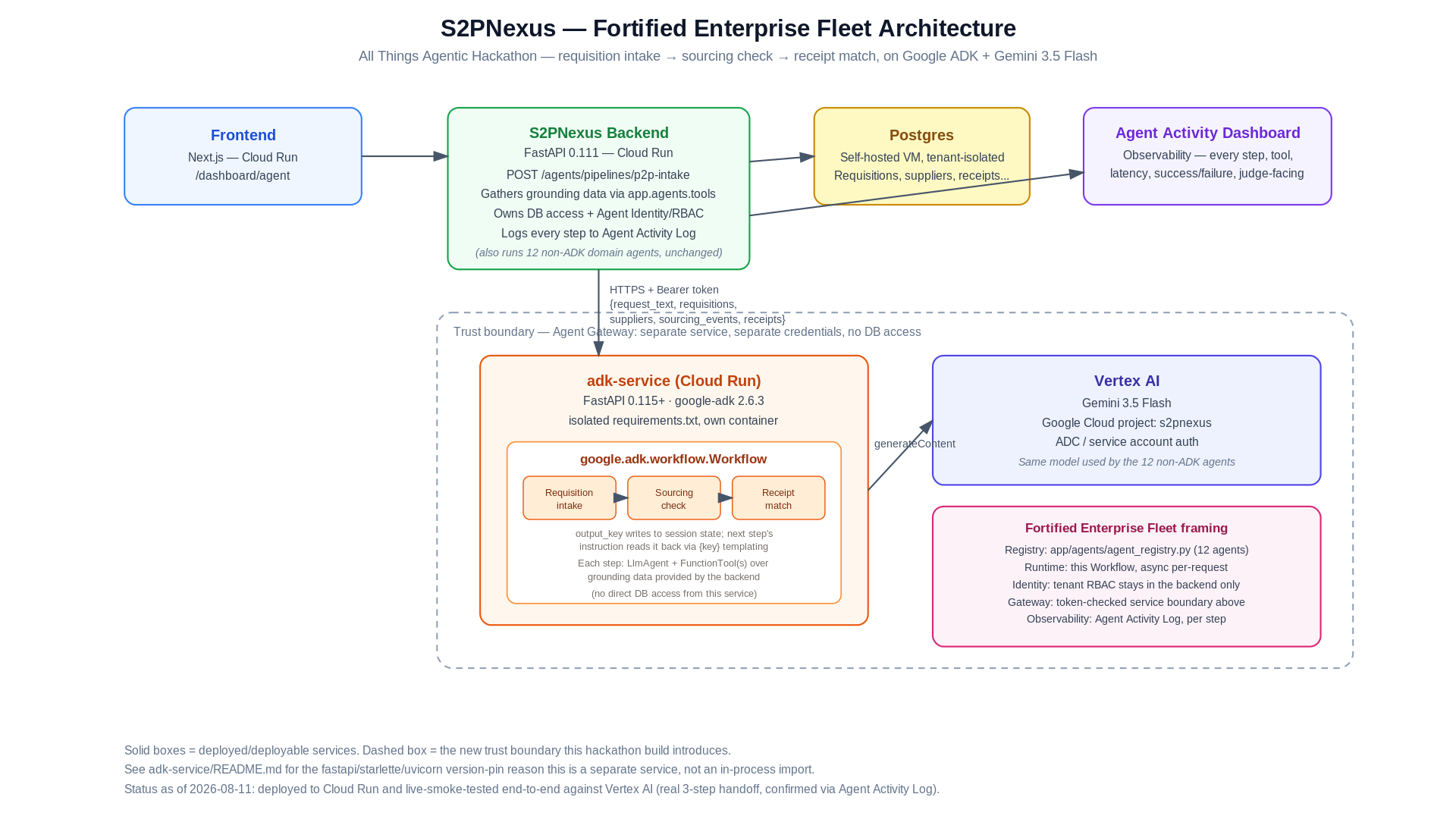
Fortified Enterprise Fleet architecture — ADK pipeline, trust boundary, and Agent Activity observability
Inspiration
S2PNexus already had 12 Gemini-backed domain agents running in production, each grounded in real tool calls — but every one of them answered a single question in isolation. None of them demonstrated a real multi-agent handoff, where one agent's output becomes the next agent's grounding. This hackathon, and the Fortified Enterprise Fleet track specifically, was the reason to build that properly, on Google's own agent framework instead of another one-off LLM call.
Disclosure (required by contest rules)
S2PNexus is a pre-existing production Source-to-Pay platform — the requisition, sourcing, purchase order, and invoice-matching workflow small and mid-size businesses normally can't afford enterprise tooling for. It has been live on Google Cloud Run since late July 2026, with 12 Gemini-backed domain agents grounded in real tool calls since its initial commit.
What's new and built during this Submission Period (starting Aug 11, 2026), specifically for this entry:
- A new Google ADK multi-agent pipeline —
adk-service, a standalone Cloud Run microservice — orchestrating a real 3-step handoff: requisition intake → supplier/sourcing check → receipt/invoice 3-way match. - The Gemini model upgrade from
gemini-3.1-flash-litetogemini-3.5-flash(GA on Vertex AI), required for eligibility and now the model backing every step of the new pipeline. - A new backend endpoint (
POST /agents/pipelines/p2p-intake) and a new/dashboard/agentUI trigger ("Run P2P pipeline") so a judge can watch the chain run against real tenant data, not a canned script. - Unified observability: every ADK step logs to the same Agent Activity dashboard the other 12 production agents already use, with no dashboard changes required.
- The architecture diagram, demo video, and this write-up.
Everything else in the repository — the 12 domain agents, the workflow/approval engine, the tenant-isolated database, the frontend — predates the Submission Period and is disclosed here as pre-existing infrastructure the new work was built on top of.
What it does
A judge can log into S2PNexus, open /dashboard/agent, and click "Run P2P pipeline." That triggers a real Google ADK Workflow with three sequential LlmAgent steps, each backed by Gemini 3.5 Flash on Vertex AI:
- Requisition intake reads the tenant's actual open requisitions and picks the one that needs attention next.
- Sourcing check picks up exactly where step one left off — referencing the same requisition — and checks real supplier and sourcing-event coverage for it.
- Receipt/invoice match closes the loop against real receipt and invoice data, flagging genuine matching exceptions (not templated text) when they exist.
Each step's result — success, latency, message, and the tools it called — is logged to the existing Agent Activity dashboard alongside the platform's other 12 agents, so this isn't a side demo bolted onto the product; it's wired into the same observability surface judges can already inspect.
This maps directly onto the Fortified Enterprise Fleet capabilities: Agent Registry (app/agents/agent_registry.py, 12 cataloged agents plus this new pipeline), Agent Runtime (async Cloud Run services, the existing workflow/approval engine), Agent Identity (tenant RBAC stays entirely in the backend — the ADK service never touches the database), Agent Gateway (an authenticated HTTP boundary between the backend and the ADK service), and Agent Observability (the Agent Activity dashboard, unified across old and new agents).
How we built it
The new pipeline is Python, using Google's Agent Development Kit (google-adk). We used google.adk.workflow.Workflow with explicit linear edges (edges=[(START, step1), (step1, step2), (step2, step3)]) rather than SequentialAgent, which google-adk now flags as deprecated in favor of Workflow.
The real architectural decision, and the one we'd point a judge at first: the ADK pipeline runs as its own Cloud Run service, separate from the main backend, not as an in-process addition. google-adk requires fastapi>=0.115/starlette>=0.46/uvicorn>=0.34, all newer than the versions the production backend is pinned to. Rather than force that upgrade across a live system carrying real tenant data, we built adk-service/ as a standalone Cloud Run service with its own dependency set. The main backend gathers real grounding data — open requisitions, suppliers, sourcing events, receipts — from Postgres, then hands it to adk-service over an authenticated HTTPS call. adk-service never touches the database directly. That split is also our Agent Identity and Agent Gateway story: the system holding tenant data and the system doing LLM orchestration are never the same process.
Stack: Google ADK + Gemini 3.5 Flash via Vertex AI for the new pipeline; the existing FastAPI/PostgreSQL backend and Next.js frontend for everything it plugs into; both new and old pieces deployed on Cloud Run.
Challenges we ran into
- The dependency conflict above was the real architectural fork in the road — it's the reason this shipped as two services instead of one, and it turned into a stronger "decoupled systems, separate trust boundaries" story than a simpler in-process build would have been.
SequentialAgentis deprecated in the ADK version we used, in favor ofWorkflow— most tutorials still show the old primitive, so this took some digging to get right.- Two real Windows/Cloud Run deploy bugs, hit and fixed live during our first end-to-end smoke test:
gcloud run services update --update-env-vars A=1,B=2,C=3silently merged every value into the first key instead of splitting on commas on our Windows setup (fixed by issuing one env var per command); and--no-allow-unauthenticatedplus a custom app-level bearer token turned out to be two independent auth layers, not one — Cloud Run's IAM check rejects a request before the app's own token check ever runs, so we opened IAM (add-iam-policy-binding --member=allUsers --role=roles/run.invoker) for this internal service-to-service call and kept the bearer token as the real gate.
Accomplishments that we're proud of
Getting a real, live 3-step Gemini 3.5 Flash handoff working end-to-end across two separate Cloud Run services — with correct state passthrough (step two genuinely referencing the exact requisition step one found) and step three correctly flagging real invoice exceptions pulled from live tenant data, not staged examples. Just as importantly: doing it without touching the dashboard, the agent registry, or any of the 11 other production agents — the new pipeline is a first-class citizen in the existing observability surface from the moment it shipped.
What we learned
That "add one more agent framework" is rarely a one-line dependency add in a real system — version pinning across a production backend forces a real architecture decision, and in this case that decision (a separate service, a real trust boundary) ended up being the right one on its own merits, not just a workaround. We also relearned that platform-specific CLI quirks (the Windows gcloud comma-splitting bug) and layered auth (Cloud Run IAM vs. app-level tokens) can look identical to a real bug from the outside — both cost real debugging time before we found the actual cause.
What's next for S2PNexus
The most honest gap to flag: there's no Model Armor equivalent yet — no dedicated prompt-injection or PII-leak guardrail on the agent-facing endpoints. That's the next priority if this track continues past the hackathon. After that: extending the same ADK Workflow pattern to more of the other 11 domain agents where a real multi-step handoff exists (not just single-question agents), and moving the ADK service from a shared bearer token to real Cloud Run IAM identity-token auth between the two services for a stronger zero-trust story.
Built With
- cloud
- cloud-run
- fastapi
- gemini
- google-adk
- next.js
- postgresql
- python
- run
- typescript
- vertex

Log in or sign up for Devpost to join the conversation.