Inspiration
Pull requests are usually reviewed through several disconnected tools. Code review explains what changed, CI reports what passed or failed, coverage tools suggest what was exercised, and project-management systems show whether the review is delayed.
What is often missing is a single answer to a more practical question:
What is likely to happen because of this change, and what should the team do next?
A pull request can affect files that were not edited directly, trigger tests in distant packages, increase operational risk, or become delayed because of review and CI bottlenecks. Existing tools often address these consequences separately.
IMerge was inspired by the idea that a repository and its engineering workflow can be treated as one evolving system. A pull request is an intervention into that system, and the product estimates its likely technical and workflow Impacts before merge.
What it does
Users can analyze a change through:
- A public GitHub pull-request URL
- A Git repository bundle containing history
- A project archive accompanied by a
.diffor.patch - A prepared guided example with known synthetic ground truth
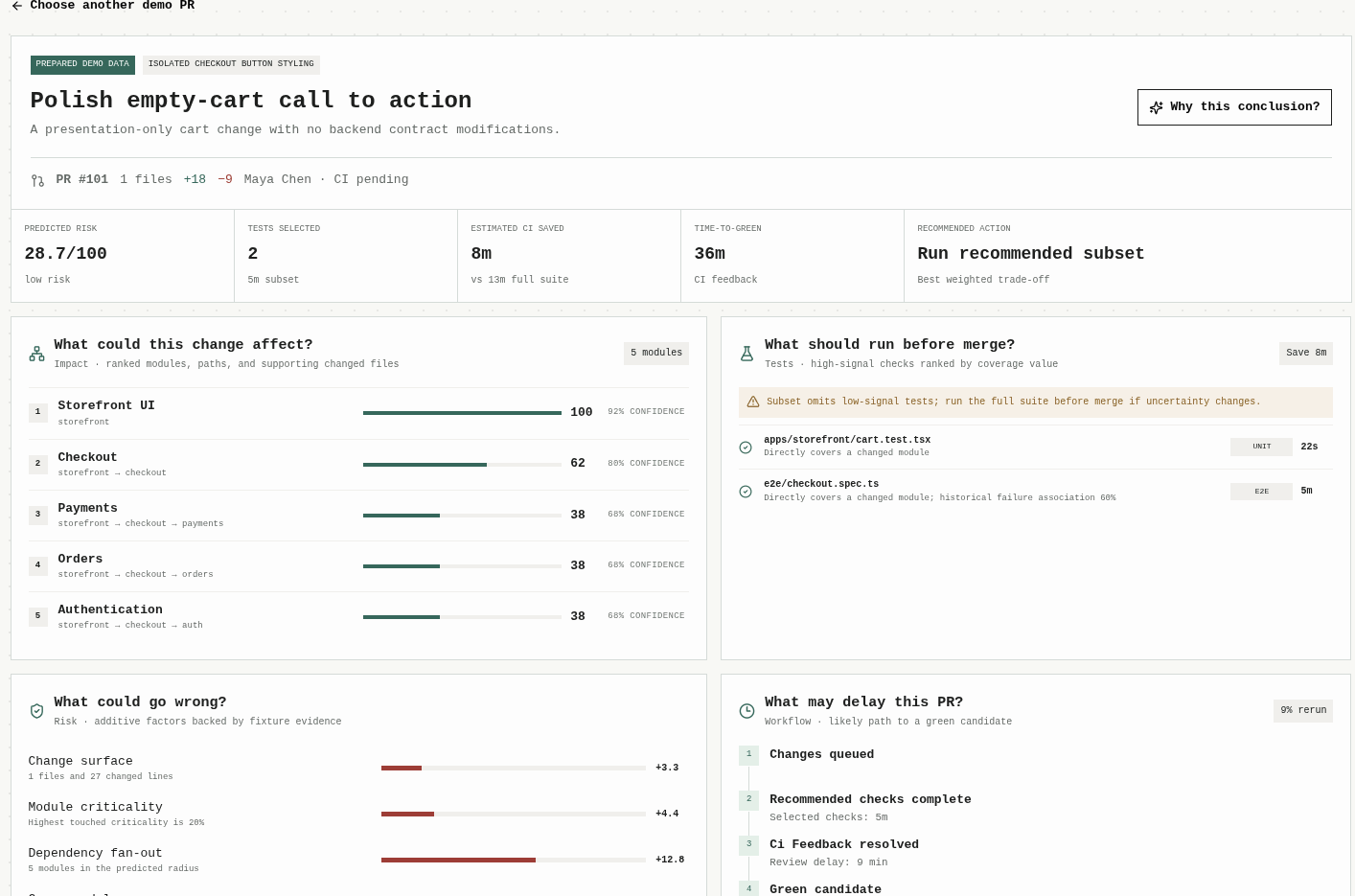
The application produces five main outputs:
- Impact : files, modules, and dependency paths that may be affected
- Tests : structurally relevant tests that should run before merge
- Risk : a transparent heuristic risk estimate with factor contributions
- Workflow : supported estimates for review or CI bottlenecks
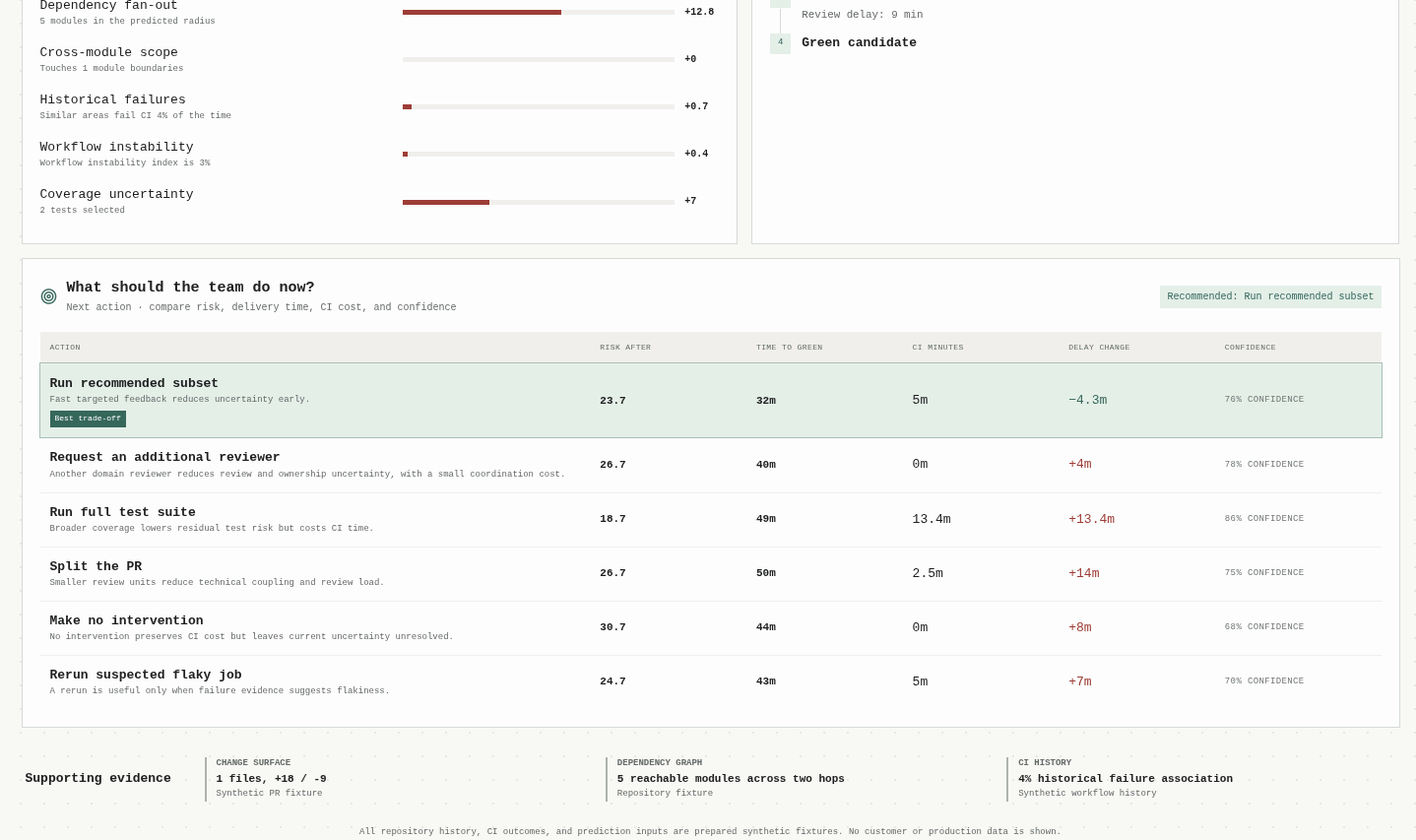
- Next action : scenario comparisons such as running a test subset, requesting another reviewer, splitting the PR, or rerunning a failed check
The interface separates:
- Observed facts retrieved or derived from the repository
- Predicted consequences produced by the analysis engine
- Suggested actions produced through scenario comparison
Each result includes evidence, confidence, assumptions, provenance, and unavailable information.
How it works
The system first converts every input type into a common representation of:
- Repository structure
- Changed files and diff hunks
- Package and workspace boundaries
- Imports and dependency relationships
- Test files and test configuration
- Git history, when available
- Pull-request, review, check, and workflow information, when available
The current analysis engine uses transparent deterministic and statistical baselines.
Impact prediction traverses dependency relationships outward from changed files. Test selection ranks tests using direct mappings, imports, package relationships, path proximity, test type, and safety rules. Risk estimation combines factors such as change size, critical modules, dependency fan-out, cross-package scope, migrations, test discoverability, CI state, and review state.
A simplified objective for comparing candidate actions is:
[ J(a) = w_r R(a) + w_t T(a) + w_c C(a) - w_q Q(a) ]
where:
- (R(a)) is estimated engineering risk after action (a)
- (T(a)) is estimated time-to-green
- (C(a)) is CI or coordination cost
- (Q(a)) is confidence in the scenario
- (w_r, w_t, w_c, w_q) are documented weights
The system selects the action with the lowest combined estimated cost while displaying the assumptions behind the comparison.
GPT-5.6 is used as an evidence-grounded explanation layer. It receives a bounded evidence pack and explains why the deterministic analysis produced its conclusions. It does not independently generate or replace the numerical scores.
How we built it
The product uses:
- Next.js and TypeScript for the web application
- FastAPI and Python for ingestion and consequence analysis
- GitHub APIs for public pull-request and repository data
- Git inspection and secure archive processing for user-provided projects
- Deterministic repository-graph analysis for impact prediction
- Structural test discovery and ranking for test recommendations
- Transparent risk and workflow baselines
- Scenario simulation for comparing possible next actions
- OpenAI Responses API with GPT-5.6 for grounded explanations
- Vercel for the public deployment
The application never installs project dependencies or executes submitted repository code. Uploaded files are inspected as bounded text and metadata using temporary storage and strict extraction limits.
Use of ChatGPT and Codex
The project was developed with extensive assistance from ChatGPT GPT-5.6 Sol and Codex with GPT-5.6.
ChatGPT GPT-5.6 Sol was used for:
- Initial market and prior-art research
- Testing the usability and novelty thesis
- Product positioning
- Architecture planning
- Critical analysis of weak points
- Security and deployment requirements
- UX review
- Prompt orchestration
- Submission planning
Codex with GPT-5.6 was used for most of the implementation work, including:
- Project scaffolding
- Typed domain schemas
- FastAPI endpoints
- Fixture generation
- Repository and dependency analysis
- Test ranking
- Risk and workflow baselines
- Scenario simulation
- Frontend implementation
- GitHub integration
- Upload processing
- Security checks
- Automated testing
- Debugging
- Vercel deployment preparation
- Documentation
The human builder remained in the loop throughout the process by selecting the direction, transferring implementation goals, testing the application, evaluating trade-offs, identifying usability problems, redirecting development, and approving the final submission.
Challenges
Turning a research concept into a usable product
The original concept was a learned latent twin of repository and workflow state. Building a reliable trained model would require significantly more historical data and evaluation than was available during Builder Week.
The solution was to preserve the long-term architecture while first implementing transparent baselines behind replaceable interfaces. This made the product functional and testable without pretending that an unvalidated research model was production-ready.
Avoiding a fixture-only demonstration
The first version worked only with prepared repositories. Although useful for demonstrating the interface, it risked appearing static.
We added support for previously unseen public GitHub pull requests, Git bundles, and project archives with diffs so judges can analyze their own code changes.
Producing useful output from incomplete repositories
Many repositories do not expose coverage data, CI history, reviewer history, or test durations. The system therefore had to distinguish between:
- Available evidence
- Structural inference
- Weak historical baselines
- Unsupported predictions
Missing information lowers confidence or produces an unavailable state rather than being treated as zero risk.
Test recommendations without executing code
Running unknown repository code would create major security and operational risks. Instead, the product discovers and ranks tests using repository structure, file naming, imports, package configuration, and test-runner configuration.
The recommendations are clearly labelled as structural when real coverage evidence is unavailable.
Serverless file processing
Supporting user uploads on a serverless platform required strict limits on request size, extracted data, file count, execution time, and temporary storage. The hosted version supports small projects, while public GitHub analysis provides the most reliable judge-testing path.
Keeping AI outputs trustworthy
A generic LLM explanation could easily introduce unsupported claims. GPT-5.6 was therefore placed after the deterministic prediction engine. It explains a structured evidence pack and must preserve uncertainty rather than invent new analysis.
What we learned
We learned that developer trust depends less on producing another AI score and more on showing:
- What evidence was observed
- What was inferred
- What remains unknown
- How confidence was calculated
- Why an action was recommended
We also learned that repository analysis and workflow analysis should not be treated as separate product experiences. A technically risky PR may still be easy to review, while a small change may become delayed because of ownership, CI, or reviewer availability.
Finally, we learned that the most credible path toward a learned repository twin is not simply a larger model. It is better labels, repository-specific calibration, stronger test and coverage evidence, and explicit evaluation against historical changes.
What is next
The current release uses transparent deterministic and statistical baselines. The next research stage is a compact, action-conditioned latent model that learns a shared representation of repository and workflow state.
The planned progression is:
- Static and historical baselines
- Learned repository-state representation
- Repository and workflow-state fusion
- Action-conditioned consequence prediction
- Repository-specific calibration
- Integration as a GitHub App for private repositories and automated PR checks
Built With
- ci/cd
- codex
- devops
- gpt-5.6
- next.js
- pydantic
- react
- tailwind
- tools
- typescript


Log in or sign up for Devpost to join the conversation.