-
CareLoad — Healthcare Friction & Treatment Burden Analyzer
📖 Project Story
💡 Inspiration
Modern medicine has achieved incredible breakthroughs in clinical diagnoses and pharmacological treatments. However, there is a silent, pervasive crisis occurring outside the clinic walls: Treatment Burden.
For patients managing chronic illnesses, multimorbidity, or complex recovery regimens, the "job of being a patient" is overwhelming. Patients spend dozens of hours every month scheduling specialist visits, navigating tiered prescription formularies, organizing pill organizers, coordinating transit to distant imaging centers, decoding confusing lab portals, and monitoring vital signs—all while managing fatigue and family dependencies.
When healthcare plans fail, clinicians often assume non-adherence is caused by lack of motivation. In reality, it is caused by excessive administrative and cognitive friction. We were inspired to build CareLoad to bridge this vital communication gap: creating a safe, objective, and privacy-preserving bridge where patients can articulate their real-world administrative burden, and clinical teams can proactively adapt care plans before burnout leads to clinical deterioration.
🚀 What It Does
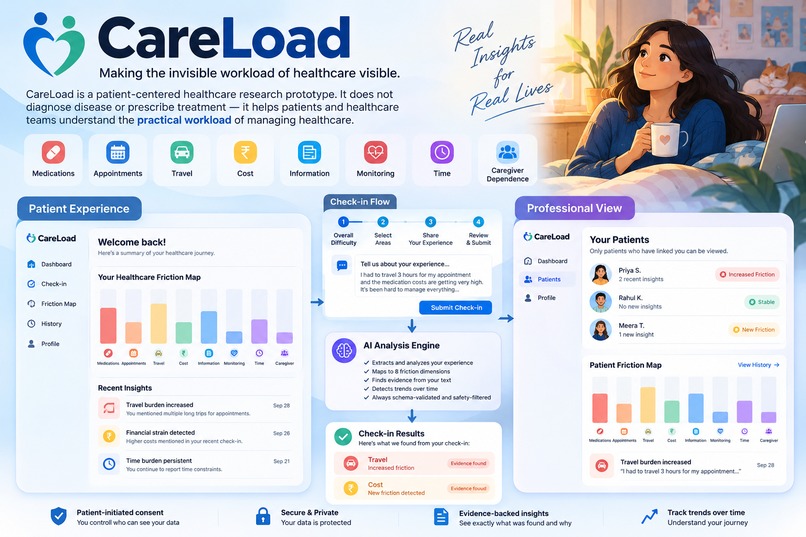
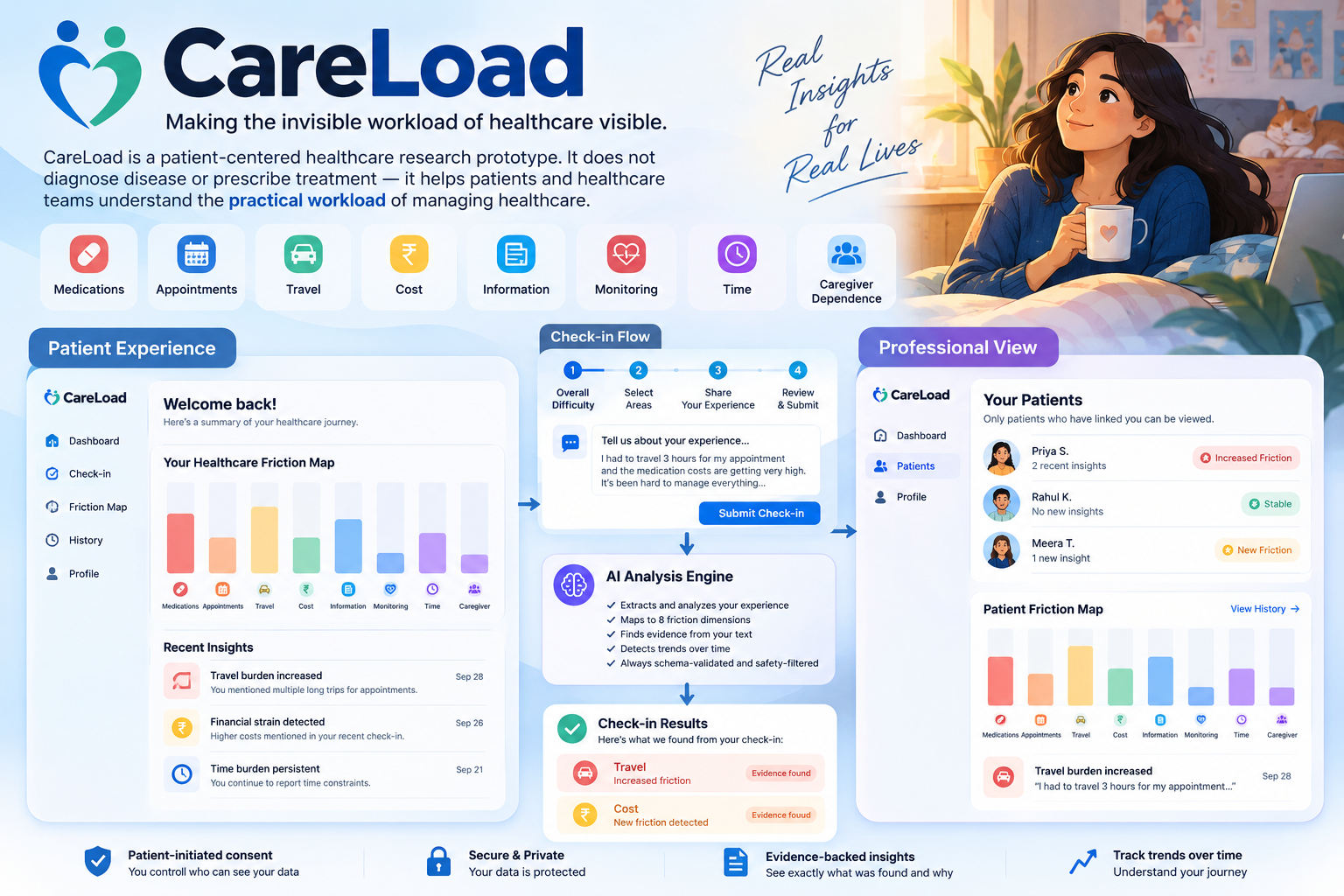
CareLoad is a patient-centered healthcare intelligence system that quantifies and visualizes the practical workload of managing healthcare across 8 core friction dimensions:
- 💊 Medications: Polypharmacy management, complex dosage schedules, side-effect anxieties, and refill logistics.
- 🗓️ Appointments: Scheduling conflicts, long clinic wait times, and fragmented specialist coordination.
- 🚗 Travel & Logistics: Commute distances, accessible transit barriers, parking fees, and mobility fatigue.
- 💳 Financial & Cost: Copays, uncovered medical supplies, insurance prior-authorizations, and surprise bills.
- 🧠 Information & Cognitive: Complex medical jargon, conflicting doctor instructions, and fragmented portals.
- 📊 Monitoring & Tracking: Demanding at-home logging regimens (glucose, blood pressure, symptom diaries).
- ⏰ Time & Daily Routine: Healthcare routines disrupting employment, sleep, meals, and family commitments.
- 🤝 Caregiver Dependence: Emotional stress and logistical reliance on spouses, family members, or aides.
Core Capabilities:
- Empathetic 4-Step Patient Check-In: A low-friction progressive check-in flow allowing patients to rate their overall burden, select impacted life domains, and speak or write openly in their own words.
- Deterministic, Schema-Validated AI Extraction Engine: Transforms unstructured patient narratives into structured, evidence-grounded friction assessments with granular confidence ratings.
- Interactive Healthcare Friction Map: An intuitive multi-dimensional dashboard displaying current severity levels (LOW, MODERATE, HIGH) for all 8 friction vectors, backed by direct quote excerpts.
- Longitudinal Trend & Risk Detection: Identifies emergent friction spikes (
NEW_FRICTION,INCREASING_FRICTION,PERSISTENT_FRICTION) comparing historical check-in trajectories. - Patient-Controlled Care Team Collaboration: Patients explicitly grant read-only access to their verified physicians and care coordinators via email invitation. Healthcare professionals gain an actionable summary and longitudinal friction trends without invasive surveillance of raw personal diaries.
⚙️ How We Built It
CareLoad is engineered with a modern, decoupled, microservice-ready architecture built for high reliability, responsiveness, and clinical safety.
┌─────────────────────────┐          HTTPS / JSON          ┌───────────────────────────┐
│     Next.js 16 App      │ ─────────────────────────────▶ │      FastAPI Backend      │
│  (React 19, Tailwind 4, │ ◀───────────────────────────── │    (SQLAlchemy, Alembic,  │
│      TanStack Query)    │           JWT Bearer           │       Pydantic v2)        │
└─────────────────────────┘                                └─────────────┬─────────────┘
                                                                         │
                                         ┌───────────────────────────────┴───────────────────────────────┐
                                         ▼                                                               ▼
                              ┌────────────────────┐                                          ┌────────────────────┐
                              │ PostgreSQL/SQLite  │                                          │ AI Analysis Engine │
                              │   Data Pipeline    │                                          │  & Safety Filters  │
                              └────────────────────┘                                          └────────────────────┘
Mathematical Formulation of Treatment Burden
To quantify treatment workload objectively across heterogeneous patient populations, CareLoad computes a composite Friction Index ( \mathcal{F}_i ) for each check-in ( i ):
$$ \mathcal{F}i = \sum{d \in \mathcal{D}} w_d \cdot \mathcal{L}_i(d) \cdot \mathcal{C}_i(d) $$
Where:
- ( \mathcal{D} ) is the set of the 8 canonical friction dimensions: ( \mathcal{D} = {d_{\text{med}}, d_{\text{appt}}, d_{\text{travel}}, d_{\text{cost}}, d_{\text{info}}, d_{\text{mon}}, d_{\text{time}}, d_{\text{care}}} ).
- ( \mathcal{L}_i(d) \in {0, 1, 2, 3} ) represents the discretized severity level assessed for dimension ( d ) (None = 0, Low = 1, Moderate = 2, High = 3).
- ( \mathcal{C}_i(d) \in [0.0, 1.0] ) represents the extracted signal confidence score from the semantic parser.
- ( w_d ) denotes the clinical sensitivity weight associated with dimension ( d ) such that ( \sum_{d \in \mathcal{D}} w_d = 1 ).
The rate of friction velocity across sequential check-in intervals ( \Delta t = t_k - t_{k-1} ) is defined by:
$$ \mathcal{V}(d) = \frac{\mathcal{L}{t_k}(d) - \mathcal{L}{t_{k-1}}(d)}{\Delta t} $$
When ( \mathcal{V}(d) > 0 ), the engine triggers an automated INCREASING_FRICTION clinical alert for discussion in upcoming consultations.
Tech Stack Highlights:
- Frontend: Next.js 16 (App Router), React 19, TypeScript, Tailwind CSS 4, TanStack Query v5, Lucide Icons, React Hook Form, Zod.
- Backend: FastAPI, Python 3.11/3.12, SQLAlchemy 2.0 ORM, Alembic, Pydantic v2, Python-Jose (JWT), Passlib (Bcrypt).
- AI Analysis Pipeline: Deterministic natural language semantic parsing with strict Pydantic output schemas, keyword-boundary evidence extraction, and automatic hallucination safety fallbacks.
- Verification & Quality: 70 Automated Tests (48 backend Pytest unit/integration tests + 22 frontend Vitest component & API client tests).
🛡️ Challenges We Ran Into
- Ensuring Strict Clinical Evidence Binding: AI systems can hallucinate friction classifications that a patient never mentioned. We solved this by enforcing a strict schema rule in the database and API: No friction score can exist without an explicit
evidence_signalsquote extracted directly from the patient's text. - Asymmetric Role Permissions & Privacy: Patients must feel completely safe that their raw, vulnerable diary notes are not indiscriminately broadcast. We designed an explicit patient-initiated consent model (
CareTeamLink) where professionals can only view aggregated friction maps and verified evidence excerpts after explicit patient linkage. - Robust Cross-Platform Local Execution: Ensuring zero-friction setup across diverse developer environments (Windows PowerShell, Linux, Docker, serverless Vercel) by supporting both SQLite for instant zero-dependency local dev and PostgreSQL for production.
🏆 Accomplishments That We're Proud Of
- 100% Passing Test Suite: Built 70 automated tests covering auth boundaries, case-insensitive email security, rollback safety, token lifecycle, and role-based redirect guards.
- Intuitive Healthcare Friction UI: Crafted a bespoke color-coded design system (Sage, Amber, Clay) that communicates cognitive load without inducing visual anxiety.
- Clinician Actionability: Generated clear, concise "Key Points to Discuss" summaries that save doctors 5–10 minutes of intake review per patient appointment.
📚 What We Learned
- Treatment Burden is Multidimensional: High medication burden often cascades into financial anxiety and appointment fatigue; modeling these vectors independently gives doctors a far more actionable diagnosis of non-adherence risks.
- Patient Agency is Paramount: Privacy in digital health is not just about HIPAA compliance; it is about psychological safety. Allowing patients to control who sees their friction data dramatically increases engagement.
🔮 What's Next for CareLoad
- Electronic Health Record (EHR) Integration: SMART on FHIR extensions to integrate CareLoad directly into Epic, Cerner, and AthenaHealth clinician workflows.
- Multilingual Voice Check-ins: Whisper-powered voice journaling for patients with visual or motor impairments.
- Predictive Friction Interventions: Automated recommendations connecting patients to pharmaceutical copay assistance, transit subsidies, or remote nurse monitoring when high friction is flagged.
Built With
- alembic
- docker
- fastapi
- jwt
- next.js
- postgresql
- pydantic
- pytest
- python
- react
- sqlalchemy
- sqlite
- tailwind-css
- typescript
- vitest


Log in or sign up for Devpost to join the conversation.