-
-
Banner
-
System Design
-
Positive Review
Inspiration
We got tired of $50k+/year compliance tools that treat developers like auditors. Most SOC 2 solutions require teams to manually review code, understand control frameworks, and generate evidence trails. We're developers. we wanted a tool built for developers. One that speaks our language (code), not auditor-speak (controls). We decided to build a tool that not only finds compliance violations but actually fixes them automatically.
What it does
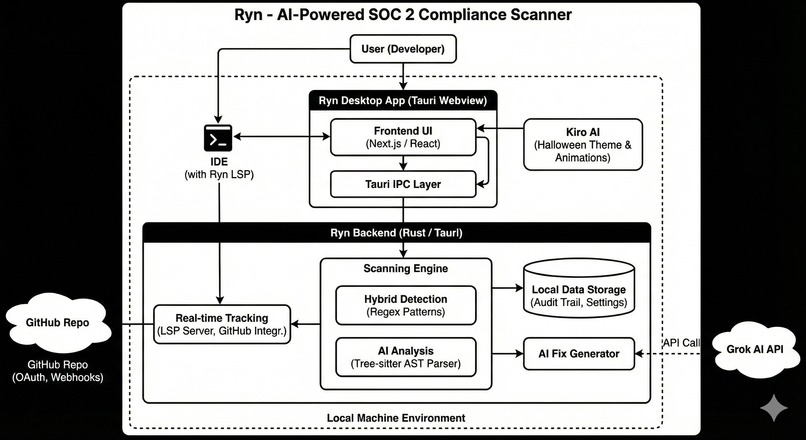
Ryn scans your codebase for SOC 2 compliance violations across four key controls: CC6.1 (access control), CC6.7 (secrets management), CC7.2 (audit logging), and A1.2 (resilience). It uses a hybrid engine - fast regex patterns for common issues and AI analysis for semantic understanding. When violations are found, you can instantly generate AI-powered fixes and apply them with one click. All scanning happens locally. Your code never leaves your machine unless you opt-in for LLM assistance. Works with local projects or real-time GitHub repo tracking.
How we built it
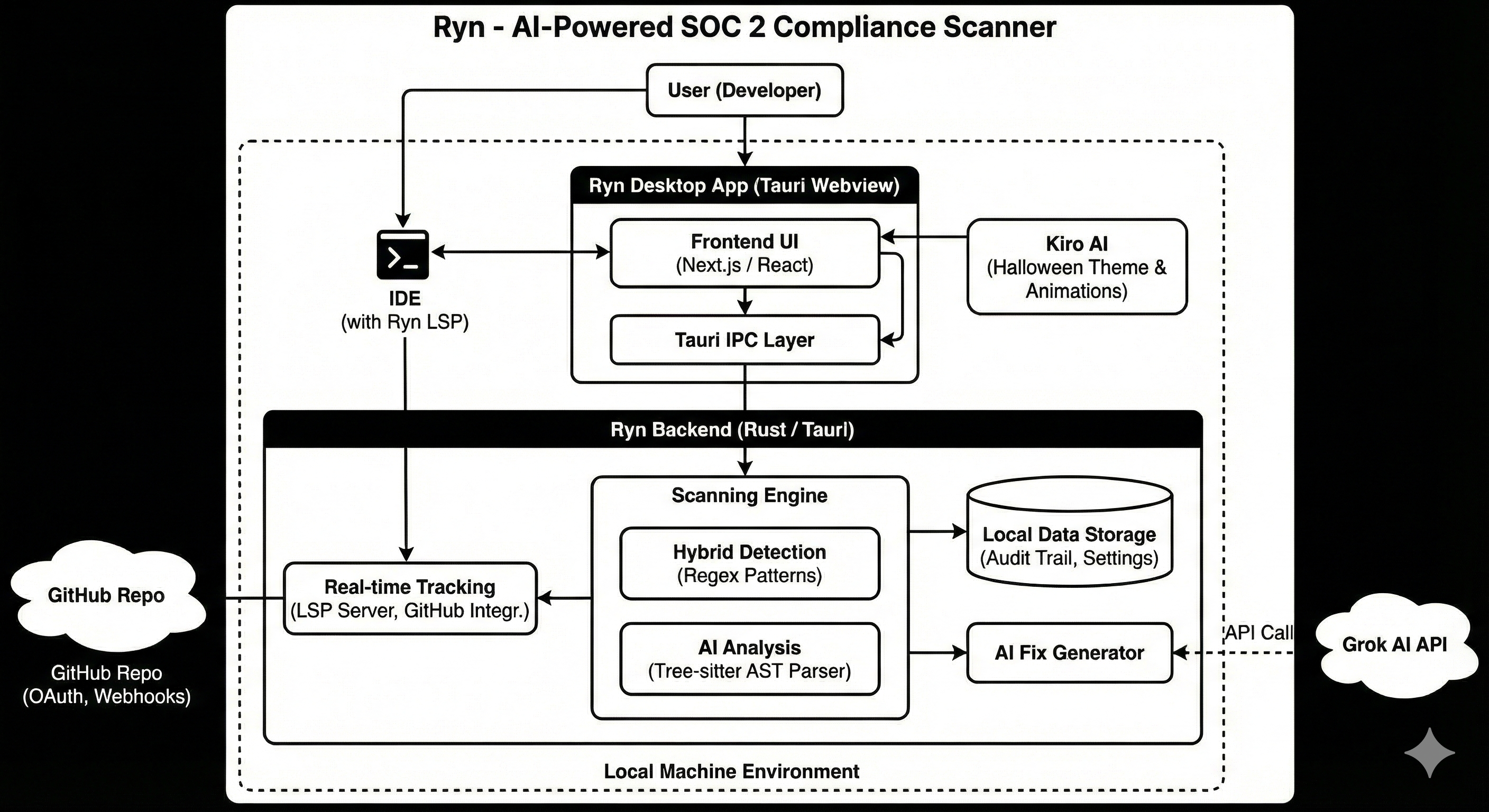
Backend (Rust + Tauri): Built the scanning engine in Rust for speed, using regex patterns + Tree-sitter AST parsing for hybrid detection across Python, JavaScript, Go, and Rust.
Frontend (Next.js + React): Landing page in Next.js, app UI in Tauri's webview with an IPC layer converting JS and Rust communication seamlessly.
AI Integration (Grok): Integrated Grok for fix generation with cost limits per scan. Optimized to minimize API calls - pattern detection first, AI only when needed.
Halloween Theme (Kiro AI): Kiro generated 9 animated components (~2,500 lines), 3 custom hooks, and Easter eggs for the Halloween feature. Floating ghost violation cards, poof animations on fix apply, and atmospheric effects - all type-safe and zero breaking changes.
Real-time Tracking (GitHub OAuth + LSP): Added GitHub integration for repo tracking and an embedded LSP server so violations appear in your IDE while coding.
Challenges we ran into
- Parsing accuracy: Building AST analysis for multiple languages (Python, JS, Rust, Go) without false positives was hard. Had to fine-tune regex + Tree-sitter integration.
- Cost control: LLM API costs spiral quickly. Implemented per-scan cost limits and hybrid scanning to minimize AI calls.
- Cross-platform builds: Getting Tauri to compile for macOS (Intel + ARM), Windows, and Linux required significant debugging.
- Real-time GitHub tracking: GitHub rate limits and webhook management was complex. Had to implement smart polling and caching.
Accomplishments that we're proud of
- One-click fixes: Not just detection - we actually apply patches to your codebase and rescan to verify the fix worked.
- Hybrid engine: Pattern-based scanning is fast, AI fills the semantic gaps.
- IDE integration: Built an embedded LSP server so developers see violations while coding, not after.
- Audit trail: Every action is logged (scans, fixes applied, violations dismissed) for compliance evidence.
- Halloween theme: We went extra and added a spooky Halloween mode with custom styling and Apple Intelligence generated (brainrot) emojis. This is where Kiro did a wonderful job! 🎃
What we learned
- Developers hate complexity. Most compliance tools fail because they're built for auditors, not the people writing code.
- Speed matters. A tool that takes 30 seconds to scan loses users. We optimized pattern scanning to sub-second performance.
What's next for Ryn - SOC 2 Compliance Scanner
- Multi-language AST support: Currently strong on Python/JS/Go. Expanding to Java, C#, Ruby.
- Custom rule builder: Let teams define org-specific compliance rules beyond SOC 2.
- GitHub Actions integration: Fail CI/CD pipelines if violations detected, auto-fix on merge.


Log in or sign up for Devpost to join the conversation.