-
-
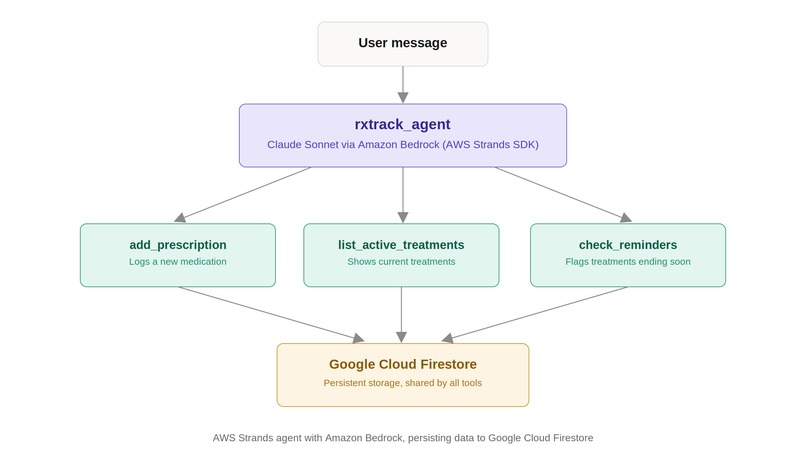
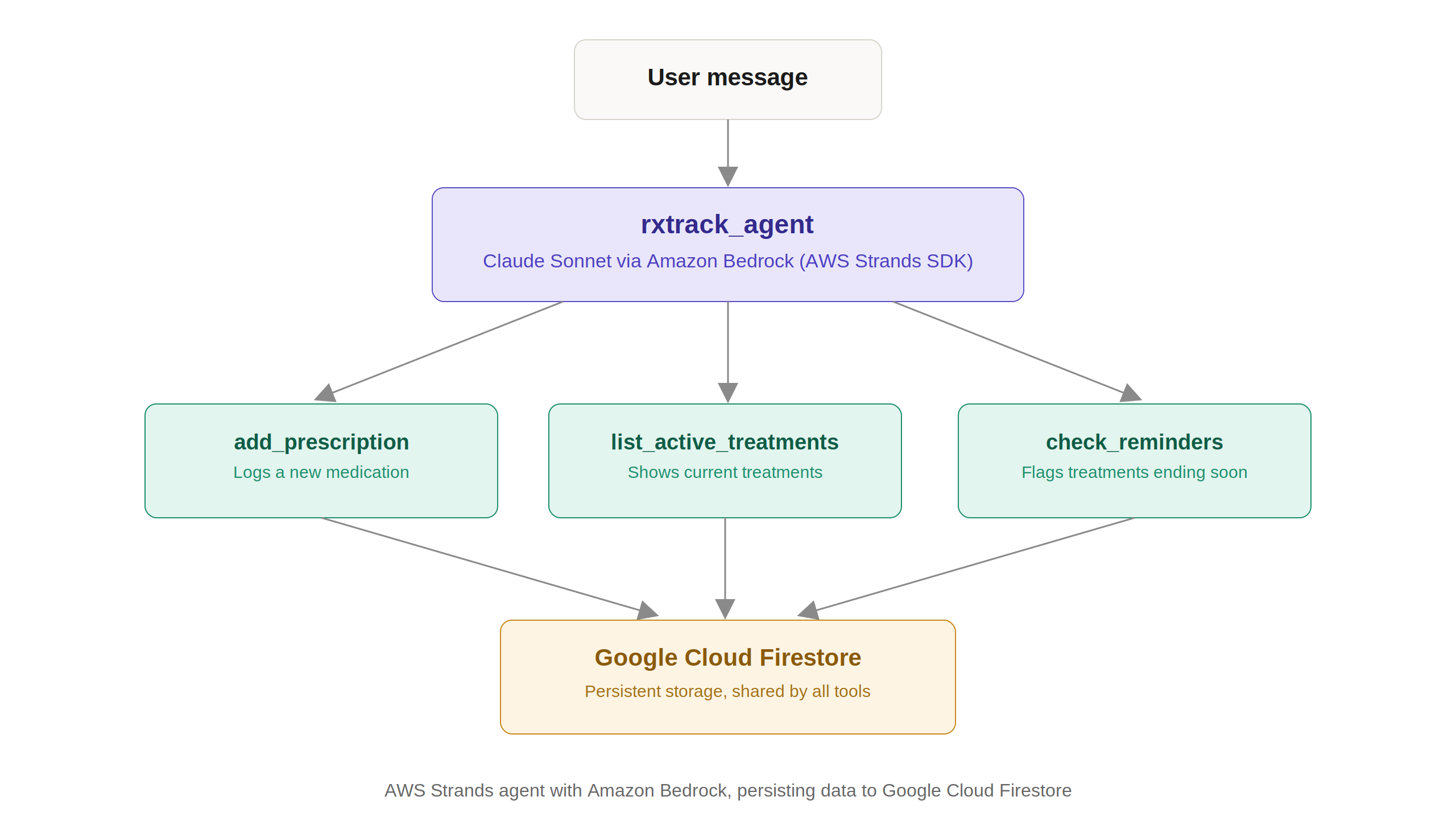
Architecture diagram — AWS Strands agent with Bedrock, persisting to Google Cloud Firestore
## Inspiration
I spent 20 years working as a pharmacy technician before moving into medical device regulatory writing. One thing I saw constantly, from behind the counter, was patients losing track of their prescriptions — especially people managing chronic conditions with multiple medications at once. A missed renewal doesn't just mean an inconvenience. It means an interrupted treatment. I wanted to build something that actually solves this everyday problem, quietly, in the background.
What it does
RxTrack Agent helps patients manage their prescriptions in three ways:
- Add a prescription — tell it the medication, dose, and how many days the treatment lasts. It calculates the exact end date automatically.
- List active treatments — see everything you're currently taking, at a glance.
- Check reminders — the agent flags any treatment ending within 3 days, so you know when it's time to contact your doctor or pharmacy for a renewal.
The agent also uses its own judgment. During testing, it noticed on its own that the same medication had been entered twice and flagged it as a possible duplicate — without being asked to check for that.
How I built it
RxTrack Agent is built with the AWS Strands Agents SDK, running on Claude Sonnet via Amazon Bedrock. I defined three custom tools — add_prescription, list_active_treatments, and check_reminders —backed by Google Cloud Firestore for persistent storage. The agent decides on its own which tool to call based on what the patient asks.
This was my first time building with Strands, and my first time writing Python code directly rather than working through no-code tools, which is what I normally use for my other AI projects.
Challenges I ran into
Coming from a no-code background (I usually build with Lovable, v0, and Base44), setting up a proper development environment — AWS credentials, Bedrock model access, the Strands SDK itself — was new territory for me. I worked through it step by step: setting up a GitHub Codespace to avoid local terminal issues, requesting Bedrock model access, and debugging configuration errors one at a time until the agent ran successfully.
What I learned
I learned that building an AI agent with a real SDK, instead of a no-code platform, is very achievable even without a software engineering background — it just takes patience and working through errors methodically. I also confirmed something from my pharmacy years: the small, repetitive administrative tasks are exactly where AI agents can quietly make the biggest difference for patients.
What's next for RxTrack Agent
Next steps would include deploying the agent on Amazon Bedrock AgentCore for a live, always-on demo, adding real notification channels (SMS or email reminders instead of just chat responses), and allowing photo upload of a prescription so the agent can extract the details automatically instead of requiring manual entry.
Built With
- firestore
- google-cloud

Log in or sign up for Devpost to join the conversation.