Inspiration
Medication information does not stop evolving once a drug reaches the market.
Healthcare professionals may work with the same medications every day, while the safety information, warnings, contraindications, adverse reactions, or other labeling associated with those medications can change over time. The information exists through trusted sources such as the FDA, but identifying what changed, whether it deserves attention, and what evidence supports that change can require significant manual review.
That led us to one question:
What if healthcare professionals could monitor the medications they care about and immediately understand when important information changes?
That became RxSignal — Never miss what changed.
What it does
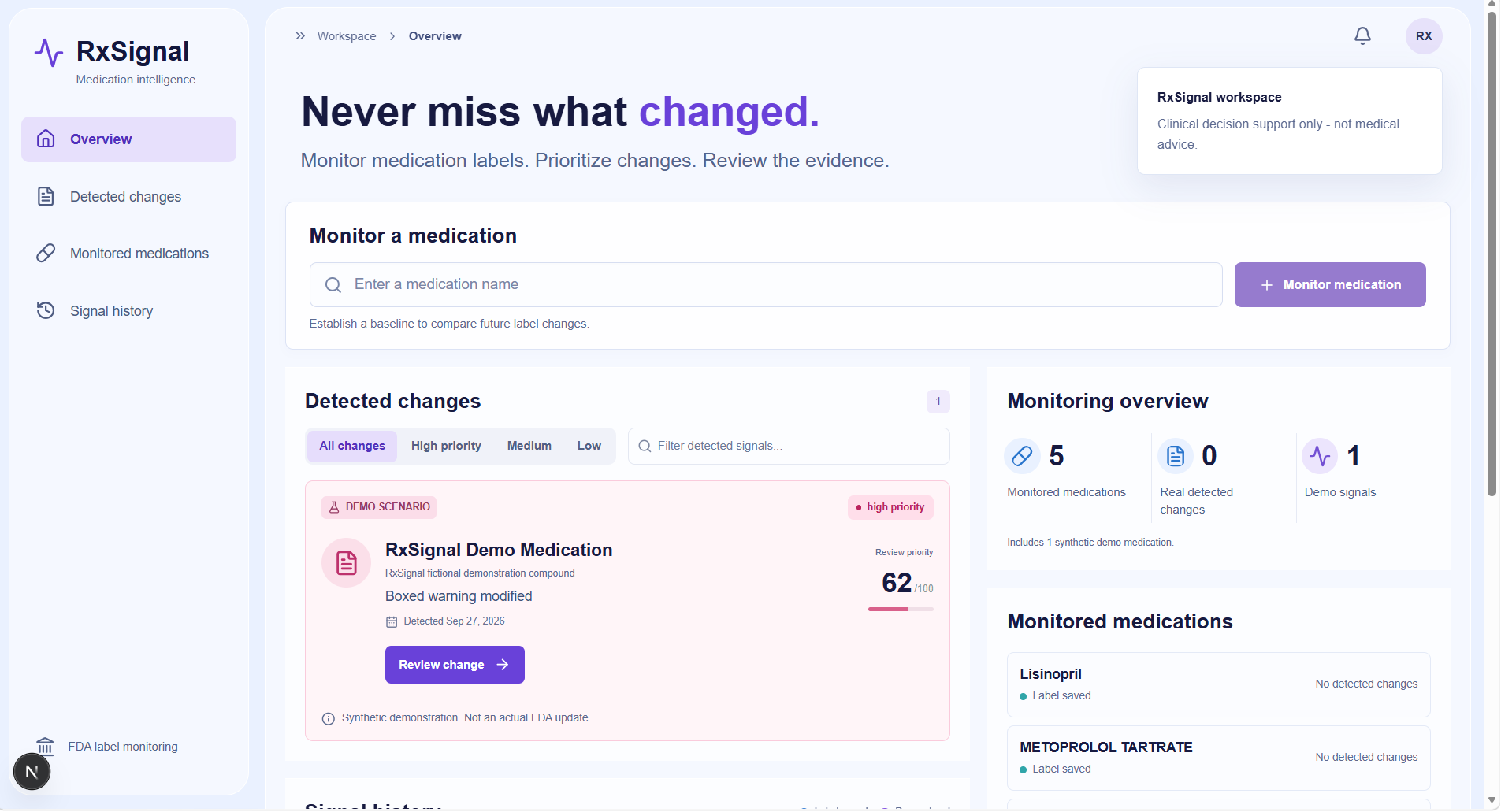
RxSignal is a medication intelligence and change-monitoring platform designed to help healthcare professionals identify and review changes in medication labeling information.
A user can monitor a medication, and RxSignal establishes a baseline using current FDA drug-label information. When the medication is checked again, RxSignal compares the new information with the previous snapshot across important sections such as:
- Boxed warnings
- Warnings
- Contraindications
- Adverse reactions
- Indications and usage
If something changes, RxSignal creates a structured signal showing exactly what changed.
Instead of simply generating an alert, RxSignal also assigns an explainable review priority score using deterministic rules based on the section affected, the type of change, and the magnitude of the change.
Healthcare professionals can then review the old and new evidence, see the medication's signal history, and receive an AI-generated intelligence brief explaining the verified change in concise language.
The AI explains the evidence. It does not establish the evidence.
How we built it
We designed RxSignal as an evidence-first pipeline:
openFDA → Change Detection → Priority Engine → Tiger Data → Meta Intelligence → RxSignal Dashboard
FDA data
Our FastAPI backend retrieves medication labeling information from the openFDA Drug Label API and normalizes the sections that matter to our monitoring system.
Deterministic change detection
Rather than asking an AI model whether something changed, we built our own deterministic comparison engine.
It compares the latest medication information against the previously stored snapshot and classifies monitored sections as:
- Added
- Modified
- Removed
- Unchanged
This gives RxSignal a verifiable source of truth before AI enters the workflow.
Explainable prioritization
Detected changes are processed through a deterministic priority engine. Higher-impact labeling sections receive greater weight, while the type and magnitude of a change also contribute to the final score.
The result is an explainable review priority rather than an opaque AI-generated risk assessment.
Historical intelligence with Tiger Data
We use Tiger Data / TimescaleDB to persist medication snapshots, detected changes, priority information, timestamps, and signal history.
This gives RxSignal a historical record of how monitored medication information evolves over time and allows the interface to present evidence-backed timelines rather than only the latest state.
AI intelligence with Meta
Once a change has already been verified and prioritized, we send only the structured evidence to a Meta model.
The model returns a structured intelligence brief containing:
- What changed
- Why it may matter
- Suggested review
- Evidence summary
The model is deliberately separated from change detection and prioritization. It cannot create the underlying evidence or modify the deterministic priority score.
Frontend
We built the interface with Next.js, React, TypeScript, Tailwind CSS, and Recharts.
The dashboard gives healthcare professionals a single place to:
- Monitor medications
- Review detected changes
- See priority signals
- Receive in-app notifications
- Inspect historical trends
- Compare evidence
- Read grounded intelligence briefs
Demo scenario
A real FDA label may not change during the few hours of a hackathon, so demonstrating a complete monitoring lifecycle presents an unusual challenge.
To solve this without pretending that a real-world event occurred, we built a clearly labeled synthetic demo scenario.
The scenario passes through the same RxSignal change-detection, prioritization, persistence, notification, evidence, and intelligence pipeline as a real detected change. It is prominently marked as synthetic and is not presented as an actual FDA update.
This allows us to demonstrate the full system while preserving the distinction between real evidence and demonstration data.
Challenges we ran into
One of our biggest challenges was deciding where AI should — and should not — be used.
It would have been much easier to send two medication labels to an LLM and ask, "What changed?" But for a healthcare-oriented system, we wanted the underlying change to remain independently verifiable.
We therefore separated deterministic evidence generation from AI interpretation.
Another challenge was building a useful demonstration around events that are inherently unpredictable. Medication labels do not conveniently change during a hackathon. Our synthetic scenario allowed us to demonstrate the complete workflow while being transparent about what was real and what was simulated.
We also had to integrate several independent systems — openFDA, FastAPI, Tiger Data, Meta's model API, and a Next.js frontend — into one reliable end-to-end workflow.
What we learned
RxSignal taught us that applying AI effectively is not always about giving the model more responsibility.
Sometimes the stronger architecture is to establish facts using deterministic systems and use AI where it performs best: helping people understand those facts.
We also learned how time-series infrastructure can turn individual API responses into longitudinal intelligence. Instead of asking only, "What does the label say today?" RxSignal can ask the more useful question:
"What changed since the last time we looked?"
What's next for RxSignal
With more time, we would expand RxSignal beyond hackathon-scale monitoring by adding scheduled background monitoring, authenticated healthcare-professional workspaces, configurable medication watchlists, richer notification channels, and larger-scale historical analysis.
We would also explore additional trusted regulatory and safety data sources while maintaining the same evidence-first architecture.
Our goal is simple:
Help healthcare professionals spend less time searching for what changed and more time reviewing the changes that deserve their attention.
RxSignal — Never miss what changed.
Built With
- fastapi
- meta
- next.js
- openai-python-sdk
- openfda
- postgresql
- pydantic
- python
- react
- tailwind-css
- tiger-data
- timescaledb
- typescript


Log in or sign up for Devpost to join the conversation.