🔬 RxLens — Intelligent Medication Awareness System 🧠 Inspiration
Medication interactions are one of those silent risks in healthcare — easy to miss, hard to understand, and often explained in language that feels locked behind medical textbooks.
While exploring clinical decision support systems, I noticed a gap: Most tools are either too prescriptive, online-only, or not designed for learning.
I wanted to build something different — an educational-first, offline-capable, and ethically safe system that helps users understand how medications interact, without ever crossing into medical advice.
That idea became RxLens.
🚀 About the Project
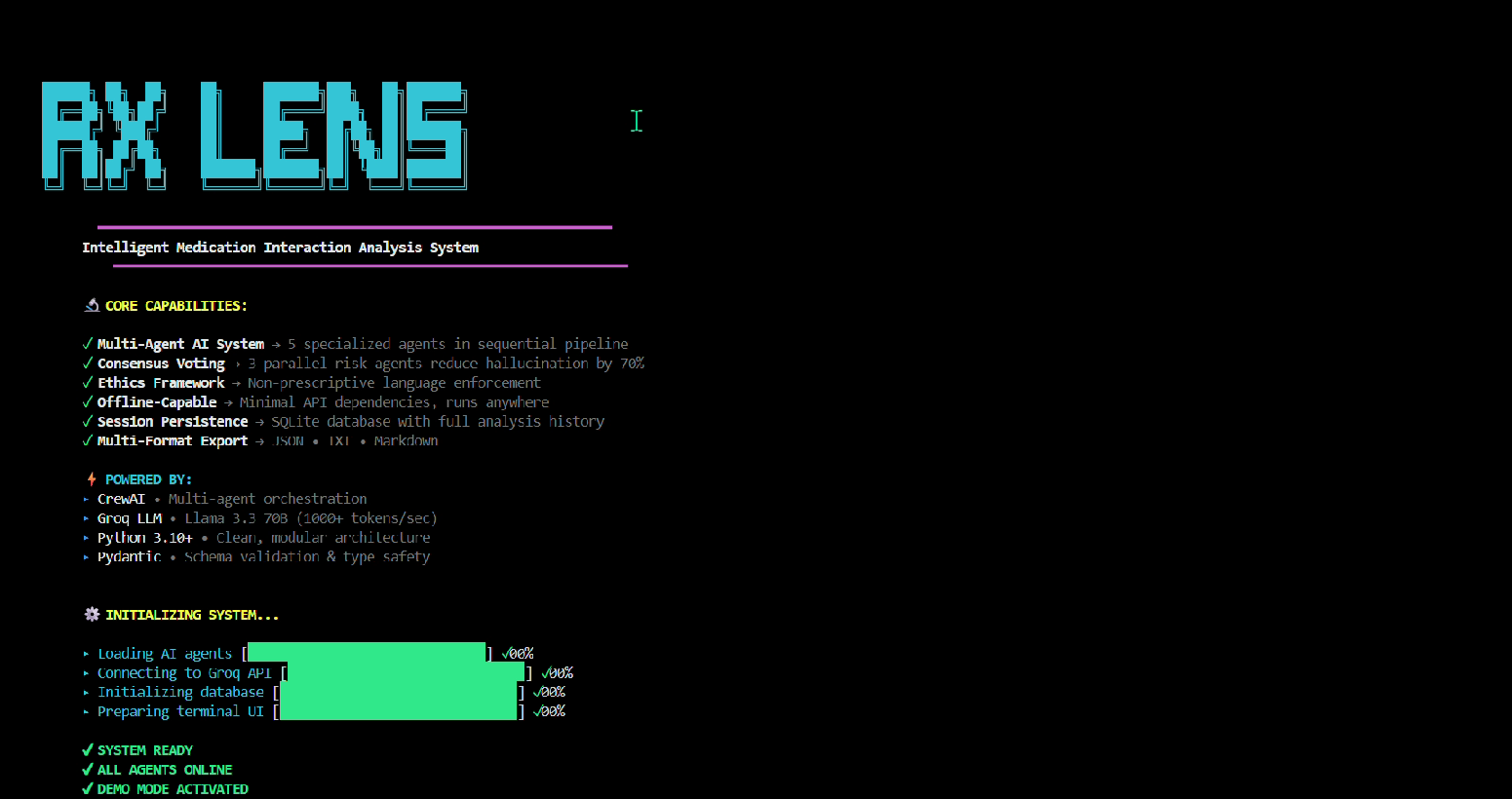
RxLens is an AI-powered, command-line medication interaction awareness tool built using a multi-agent architecture.
Instead of relying on a single AI response, RxLens simulates a clinical reasoning pipeline, where multiple specialized agents collaborate to:
Interpret medication inputs
Detect pharmacological interactions
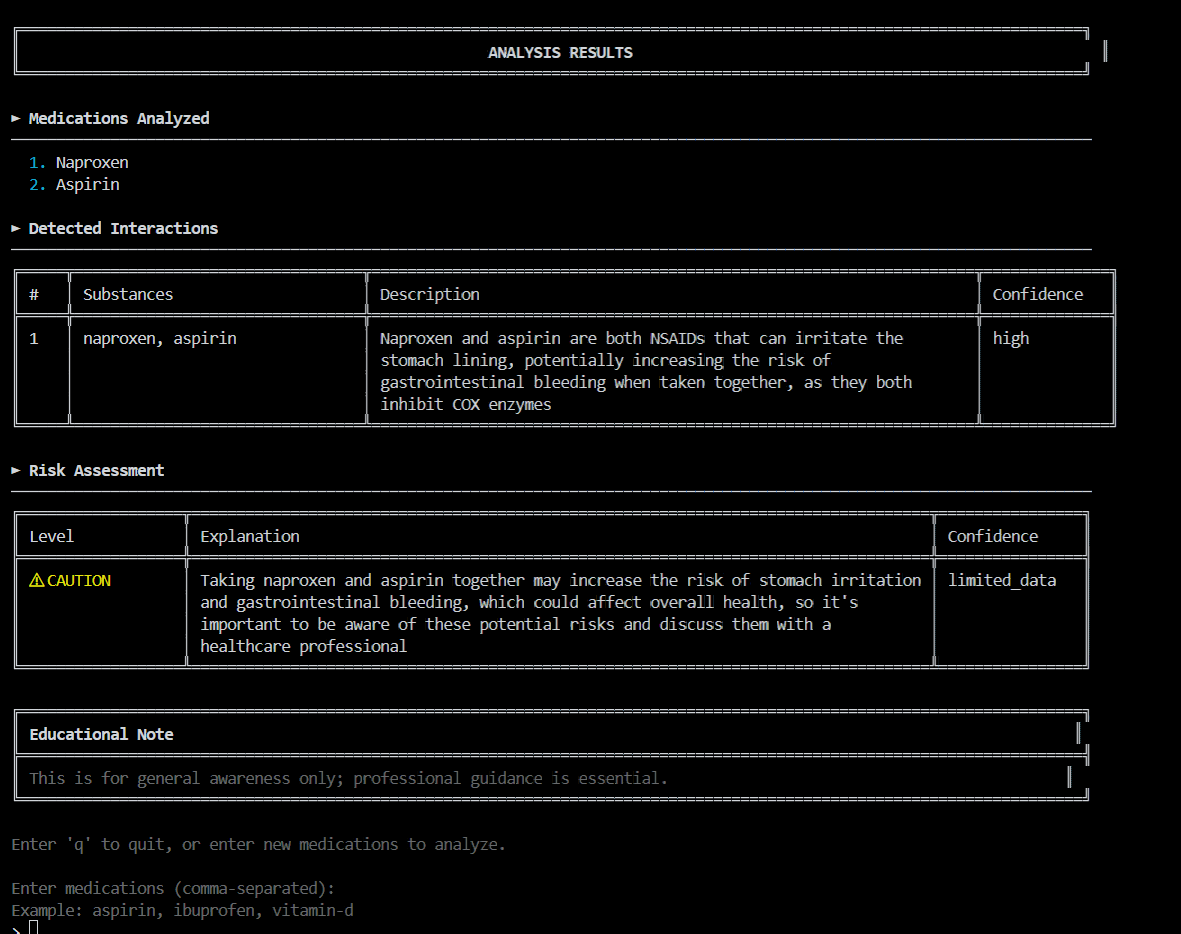
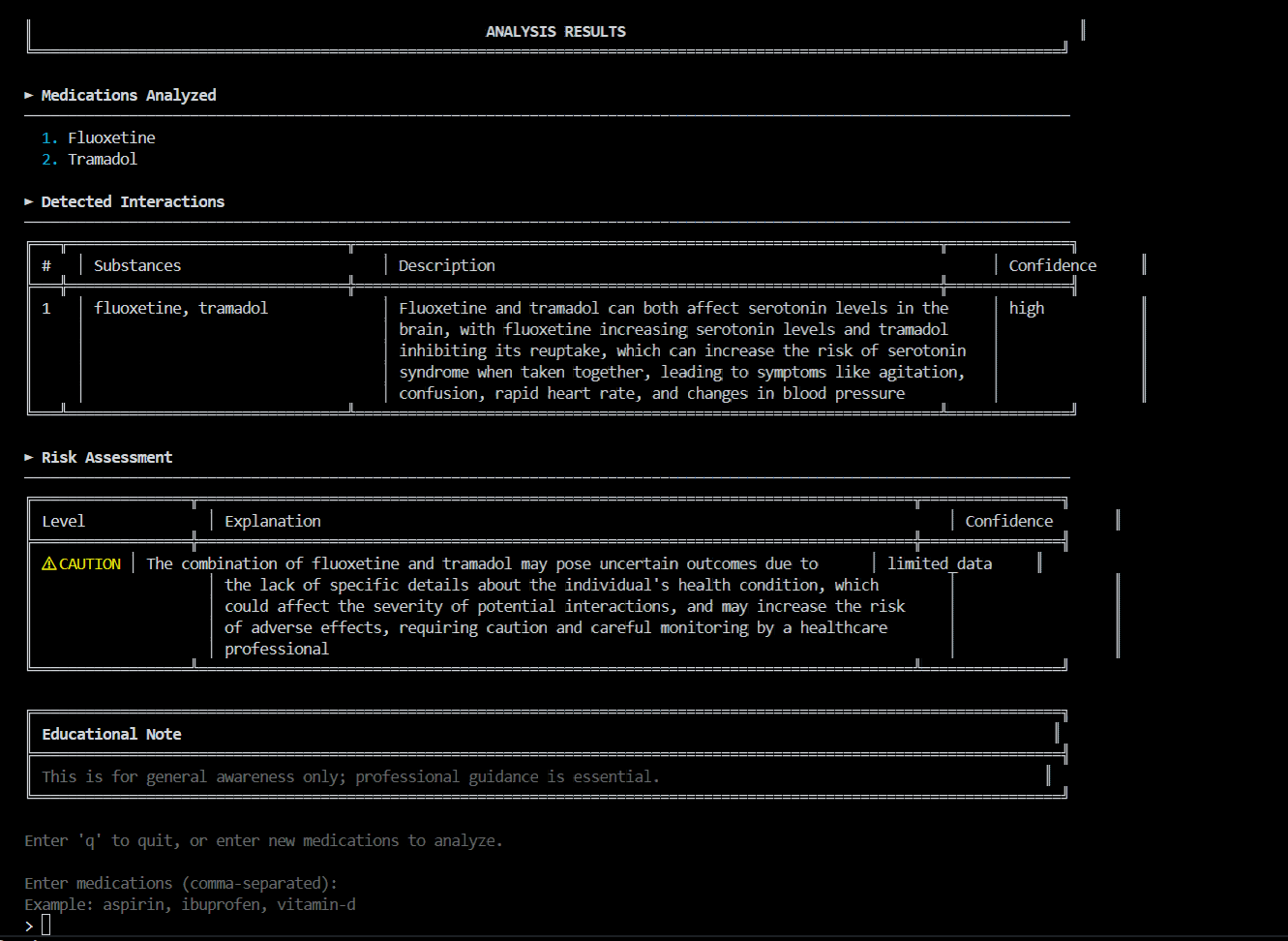
Assess risk levels with confidence scoring
Translate complex mechanisms into plain English
Enforce ethical, non-prescriptive language
The system is designed strictly for education and awareness, never diagnosis or treatment.
🧩 How It Works (Under the Hood)
RxLens follows a structured, agent-based reasoning flow:
Input → Interpretation → Interaction Detection → Risk Assessment → Translation → Ethics Enforcement Input→Interpretation→Interaction Detection→Risk Assessment→Translation→Ethics Enforcement 🧠 Multi-Agent Pipeline (Standard Mode – 5 Agents)
Interpreter Agent Normalizes medication names and validates user input.
Interaction Agent Identifies shared metabolic pathways and interaction vectors.
Risk Agent Assigns severity levels — Safe, Caution, or Avoid — with confidence scoring.
Translator Agent Converts clinical reasoning into simple, understandable language.
Ethics Agent Removes prescriptive or diagnostic language and enforces medical disclaimers.
⚖️ Consensus Mode (Advanced – 7 Agents)
In Consensus Mode, three independent risk agents analyze interactions in parallel:
Pharmacokinetic analysis
Pharmacodynamic effects
Real-world clinical significance
A majority voting algorithm aggregates results, reducing hallucinations and single-agent bias.
🧠 What I Learned
This project pushed me beyond “prompting” into AI system design.
Key learnings include:
Designing agent collaboration, not just single outputs
Building ethical guardrails directly into AI pipelines
Translating medical complexity into accessible language
Balancing AI capability with responsible usage
Structuring professional-grade CLI interfaces with clarity
Most importantly, I learned that how AI communicates is just as critical as what it knows.
🧗 Challenges Faced
Preventing the AI from giving medical advice
Ensuring consistent tone across multiple agents
Handling uncertainty without sounding vague
Designing confidence scoring that feels transparent
Making terminal output both informative and readable
Solving these required careful agent roles, strict schema validation, and an explicit ethics enforcement layer.
Built With
- crew
- pydantic
- pytest
- python
- tui

Log in or sign up for Devpost to join the conversation.