-
RutaAI
Inspiration
In September 2017, Hurricane Maria devastated Puerto Rico, leaving millions without electricity and disrupting essential infrastructure, including access to financial services. For our co-founder Xavier, the disaster fundamentally reshaped how he thought about money and financial security.
What happens when traditional financial systems become inaccessible? When you can't reach a bank, withdraw cash, or send money to your family, what options do you have?
Hurricane Maria exposed a vulnerability that extends far beyond natural disasters: millions of people are excluded from financial systems that most of us take for granted.
Today, both of us work in financial services and technology, where we've gained firsthand insight into the enormous variety of financial products available to consumers. Yet we've also recognized a frustrating disconnect: the people who could benefit most from these products are often the least equipped to discover, understand, or access them.
For Latino and immigrant communities, the barriers can be particularly significant. Someone without a Social Security number might not realize they can qualify for certain financial products using an Individual Taxpayer Identification Number (ITIN). Families sending money internationally may lose substantial amounts to hidden fees. People with limited credit histories may not know where to begin building credit.
Meanwhile, AI promises to democratize financial knowledge, but today's general-purpose AI assistants aren't necessarily designed for these communities. They can require users to navigate unfamiliar interfaces, lack personalized financial context, and raise legitimate concerns about sharing sensitive financial information with centralized platforms.
We wanted to change that.
Ruta AI was born from a simple idea: financial opportunity shouldn't depend on where you were born, what documentation you have, or how much you know about banking.
Rather than asking underserved communities to adapt to another financial application, we decided to bring financial intelligence directly to a platform millions already use: WhatsApp.
What it does
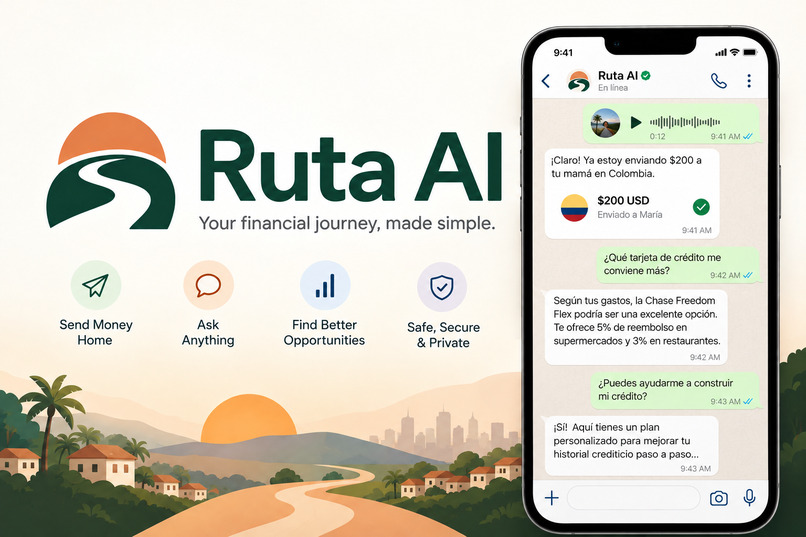
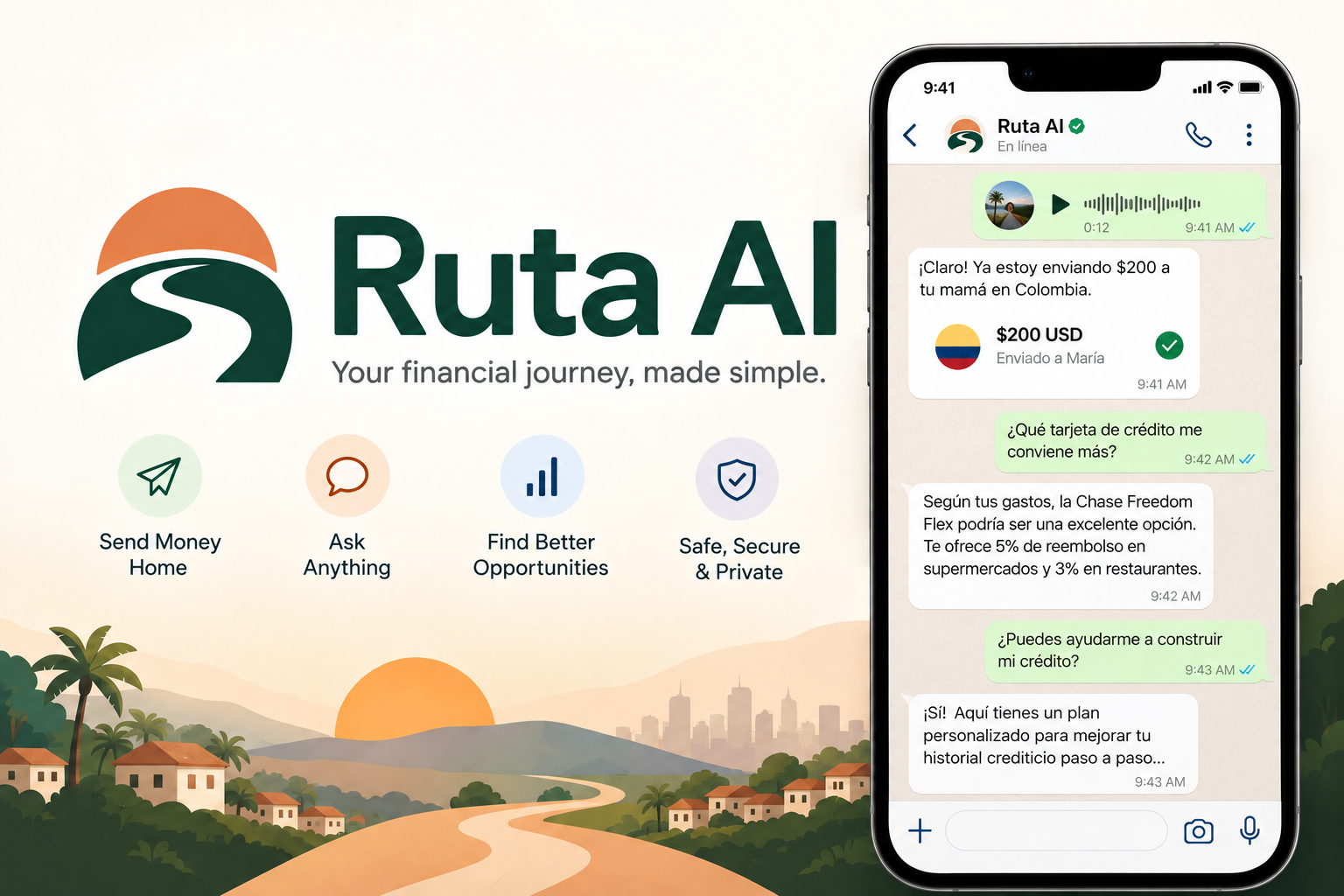
Ruta AI is a multilingual, AI-powered financial assistant that helps Latino families navigate their finances through WhatsApp using text messages, voice notes, and images.
Think of Ruta as a personal financial guide that understands your circumstances, remembers your goals, and helps you identify opportunities you might otherwise miss.
Ruta is designed around four core capabilities:
1. Financial access and discovery
Ruta helps users discover financial products that fit their unique circumstances, including checking accounts, credit cards, lending options, and savings products. Instead of generic recommendations, Ruta considers factors like documentation status, credit history, income, and financial goals.
2. Smarter cross-border payments
Need to send $200 to your mother in Puerto Rico? Ruta aims to help users identify cost-effective remittance options, understand fees and exchange rates, and eventually initiate transfers directly from a conversation through secure, authorized integrations.
3. Financial guidance in your own language
Users can ask questions in Spanish or English, send a voice message explaining their situation, or share a photo of a financial document. Ruta is designed to make financial information understandable without requiring specialized knowledge or complicated terminology.
4. Personalized financial intelligence
As users interact with Ruta, the assistant can build a better understanding of their financial circumstances and identify relevant opportunities, whether that's establishing credit, reducing remittance costs, or discovering a better bank account.
Our long-term vision goes beyond answering questions. We want to build an AI agent that doesn't just explain financial opportunities but helps people act on them.
How we built it
We approached Ruta with one guiding design principle: complex financial intelligence should feel as simple as sending a message.
We used Base44 to prototype the product experience, combining a conversational AI interface with an underlying financial dashboard designed to organize user information, financial products, and personalized recommendations.
Our architecture centers on three interconnected components:
The conversational layer: A natural-language interface designed for WhatsApp that allows users to communicate through everyday messages rather than complicated forms. We designed the experience around multilingual interactions, with support for text, voice, and image-based communication as a core goal.
The financial intelligence layer: A structured approach to matching users with relevant financial products based on eligibility, financial circumstances, and individual goals. Instead of treating every user identically, Ruta is designed to consider real-world constraints such as ITIN eligibility, limited credit histories, and cross-border financial needs.
The user dashboard: An interface that organizes financial information, product recommendations, and opportunities in one place. While WhatsApp serves as the primary conversational experience, the dashboard provides a structured foundation for managing financial profiles and eventually connecting external services.
We also designed Ruta with a distinction between providing financial guidance and executing financial transactions. Real money movement requires secure integrations, user authorization, and appropriate financial partners, making it a future capability rather than something we want to simulate as a live service.
Ultimately, we're building toward an architecture that combines the accessibility of conversational AI with the reliability and accountability required for financial services.
Challenges we ran into
Building for trust, not just convenience.
Financial information is deeply personal, particularly for immigrant communities that may already feel excluded from traditional institutions. We had to think carefully about how an AI assistant could provide personalized guidance without asking users to surrender unnecessary sensitive information.
Making financial recommendations genuinely relevant.
A credit card recommendation means little if the user cannot qualify for it. Financial products have complicated eligibility requirements, and those requirements can differ significantly depending on documentation, income, geography, and credit history.
Designing an assistant that accounts for these distinctions, rather than simply generating generic financial advice, became one of our most important challenges.
Bridging conversation and execution.
It's relatively straightforward to build an AI chatbot that discusses money. It's considerably harder to build one that can securely help users move money, evaluate products, and take financial actions.
We had to distinguish between what could be demonstrated in a prototype and what would require production-grade integrations, compliance safeguards, and partnerships with regulated financial institutions.
Making AI accessible across languages and financial literacy levels.
Financial terminology can be confusing even for native English speakers. Building an experience for users with different linguistic backgrounds, financial knowledge, and levels of digital literacy required us to rethink how financial guidance should be communicated.
Accomplishments that we're proud of
Our biggest accomplishment was translating a broad problem—financial exclusion—into a concrete, accessible product concept with a path toward real-world implementation.
We're particularly proud of three decisions.
First, we built around an existing behavior instead of trying to create a new one. WhatsApp is already an important communication platform for many Latino families. We wanted accessing financial guidance to feel just as natural as messaging a relative.
Second, we focused on financial opportunity rather than simply financial education. Many existing solutions explain budgeting, savings, or credit. Ruta goes further by aiming to connect that knowledge with specific financial products and actionable next steps.
Third, we placed underserved communities at the center of our product design from day one. ITIN holders, immigrants with limited credit histories, and families navigating international finances aren't edge cases for Ruta. They're the reason we're building it.
We're proud to be working toward a future where sophisticated financial assistance isn't reserved for people who already have access to sophisticated financial institutions.
What we learned
Working on Ruta reinforced an important realization: financial exclusion isn't always caused by a lack of financial products. Sometimes, it's caused by a lack of access to information, guidance, and trust.
There are financial institutions that serve ITIN holders, products designed to help establish credit, and services that can make international transfers more affordable. But finding the right option can be confusing, time-consuming, or intimidating.
We also learned that accessibility is about more than translation.
A genuinely inclusive financial assistant must understand how people communicate, the constraints they face, and why they may distrust existing financial systems.
Perhaps most importantly, we learned that the next generation of financial AI needs to move beyond answering questions toward helping people achieve outcomes.
The real opportunity isn't to build another chatbot. It's to create a trusted financial companion that can connect people with the financial system on their own terms.
What's next for Ruta AI
Our vision is to make Ruta the financial companion for Latino families across the United States and Latin America.
Our next steps include:
- Deeper WhatsApp integration: Bringing the conversational experience directly into WhatsApp, including voice notes, images, and eventually family group-chat functionality with appropriate privacy controls.
- Expanding financial product discovery: Building a comprehensive, regularly updated database of banking, credit, lending, and remittance products, including options for ITIN holders and people with limited credit histories.
- Enabling financial actions: Partnering with regulated financial providers to enable secure, user-authorized transfers, account applications, and other financial transactions directly through Ruta.
- Privacy-first personalization: Developing robust consent, data minimization, and security controls so users can receive personalized assistance without unnecessarily exposing sensitive information.
- Community testing: Working directly with Latino and immigrant communities to understand their financial challenges and refine Ruta around their actual needs.
Longer term, we envision Ruta evolving into a comprehensive financial agent capable of identifying opportunities, proactively helping users save money, and supporting financial decisions throughout their lives.
Our ambition isn't to replace banks. It's to make the entire financial ecosystem more accessible to people who have historically been left out of it.
Hurricane Maria raised a question that stayed with Xavier: What happens when the financial system isn't there for you?
With Ruta, we're working toward a world where financial assistance is always within reach, regardless of your background, language, or circumstances.
Because everyone deserves a ruta, a path, to financial opportunity.
Built With
- base44
- claude
- codex
- google-drive

Log in or sign up for Devpost to join the conversation.