-
-
RuralShield
About RuralShield
Inspiration
Every 2 minutes, a woman dies from preventable pregnancy-related causes, and nearly 90% of infectious disease deaths occur in low-resource settings.
What stood out to us was that these deaths are not due to lack of medical knowledge — but due to system failures, especially the Three Delays:
- Delay in seeking care
- Delay in reaching the right facility
- Delay in receiving treatment
We were inspired to build a solution that directly supports frontline health workers, who often operate with limited tools, no real-time data, and poor connectivity.
What We Built
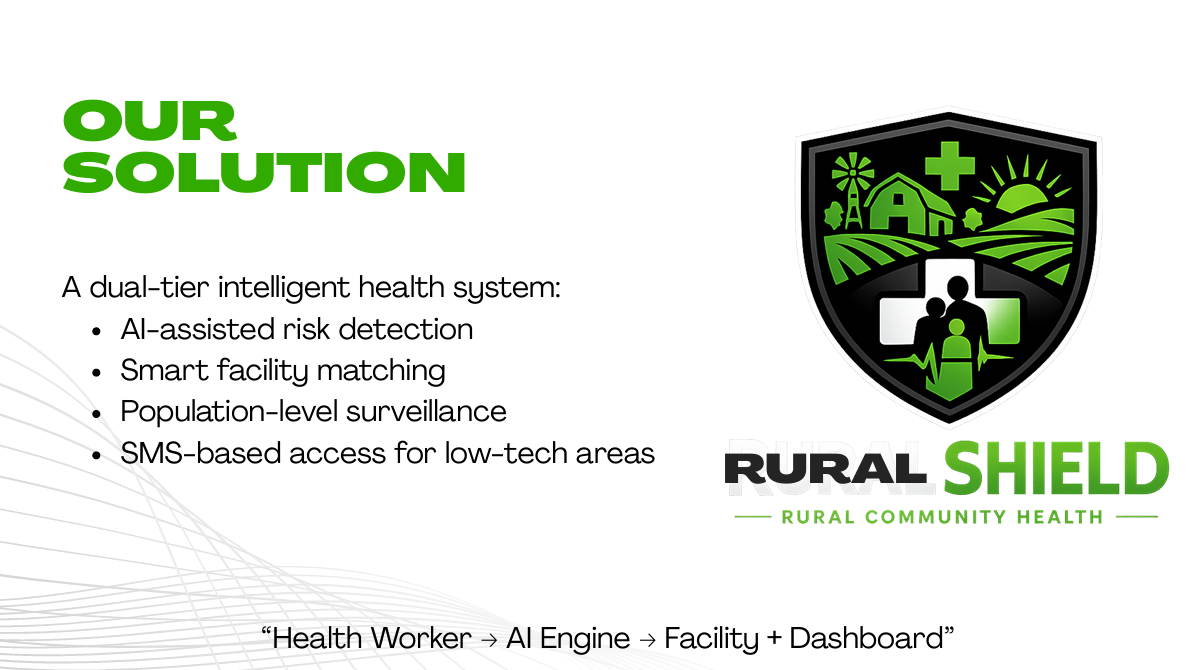
RuralShield is a dual-tier public health intelligence system designed specifically for low-resource environments.
It combines:
- 🧠 AI-powered maternal risk prediction
- 🚑 Facility capability matching
- 🌍 Population-level surveillance dashboards
- 📱 SMS-based accessibility for offline regions
⚙️ How We Built It
1. Machine Learning (Maternal Risk Prediction)
We trained an XGBoost classifier on maternal health data with features such as:
- Age
- Blood Pressure (Systolic & Diastolic)
- Blood Sugar (BS)
- Body Temperature
- Heart Rate
The model predicts risk levels:
- Low Risk (0)
- Mid Risk (1)
- High Risk (2)
We optimized the model using hyperparameter tuning
2. Explainable Action Engine
Instead of just predicting risk, we built a rule + ML hybrid layer that:
- Identifies key contributing factors
- Generates personalized clinical recommendations
- Produces a referral slip instantly
3. Facility Matching System
We created a dataset of healthcare facilities with capabilities like:
- ICU, NICU, Blood Bank, C-section
The system:
- Filters facilities based on required services
- Estimates travel time
- Prevents misdirected referrals
4. Public Health Dashboard
We designed an interactive dashboard using Streamlit to:
- Detect malnutrition, anemia, and food insecurity
- Identify high-risk rural regions
- Track infectious diseases (Malaria, Dengue, TB, COVID)
- Simulate transmission networks using graph models
5. Low-Resource Design
To ensure real-world usability:
- The system runs locally (no cloud dependency)
- Designed to support SMS-based triage
- Works in areas with limited or no internet connectivity
What We Learned
- How to integrate machine learning with real-world healthcare workflows
- The importance of Explainable AI (XAI) in clinical decision-making
- Designing for low-resource environments requires simplicity, not complexity
- Combining individual-level prediction with population-level insights creates stronger impact
Challenges We Faced
1. 🔌 Low-Resource Constraints
Designing a system that works without internet forced us to rethink:
- Deployment strategies
- Data access
- User interaction
2. Balancing ML and Interpretability
We needed predictions to be:
- Accurate and
- Understandable for health workers
This led us to combine ML with rule-based explanations.
3. Data Limitations
- Limited real-world datasets for rural health scenarios
- Needed to simulate realistic conditions for testing
4. Time Constraints (Hackathon)
Building an end-to-end system (ML + dashboard + matching + UX) within limited time required:
- Prioritization of high-impact features
- Rapid prototyping
Impact
RuralShield transforms fragmented healthcare into a connected decision system:
- Faster triage decisions
- Smarter referrals
- Early outbreak detection
- Data-driven policy planning
🌱 Why It Matters
This project is not just about technology —
it’s about reducing inequality in healthcare access.
By empowering frontline workers and improving system-level visibility,
RuralShield helps ensure that no life is lost due to delays in care.

Log in or sign up for Devpost to join the conversation.