Inspiration
Imagine an Indian traveler landing in the US, then flying on to Germany. Every country means a new currency, and every currency conversion quietly takes a bite out of their money.
PayPal's own India page says that using PayPal is free for purchases unless a currency conversion is involved, and that the exchange rate used includes a fee charged above the base rate. Third-party breakdowns put the receiving side at about 4.4% plus a fixed fee, with a currency conversion markup of roughly 2.5% to 4% on top, which adds up to around 8% in total for some payments. In India, PayPal accounts can't hold foreign currency, so everything is converted to rupees.
The real problem is not just that the fees are high. It is that they are hidden inside the exchange rate. RupeeBridge was inspired by one simple idea: people should see the true cost before they pay.
What it does
RupeeBridge is a two-way currency bridge for Indian users:
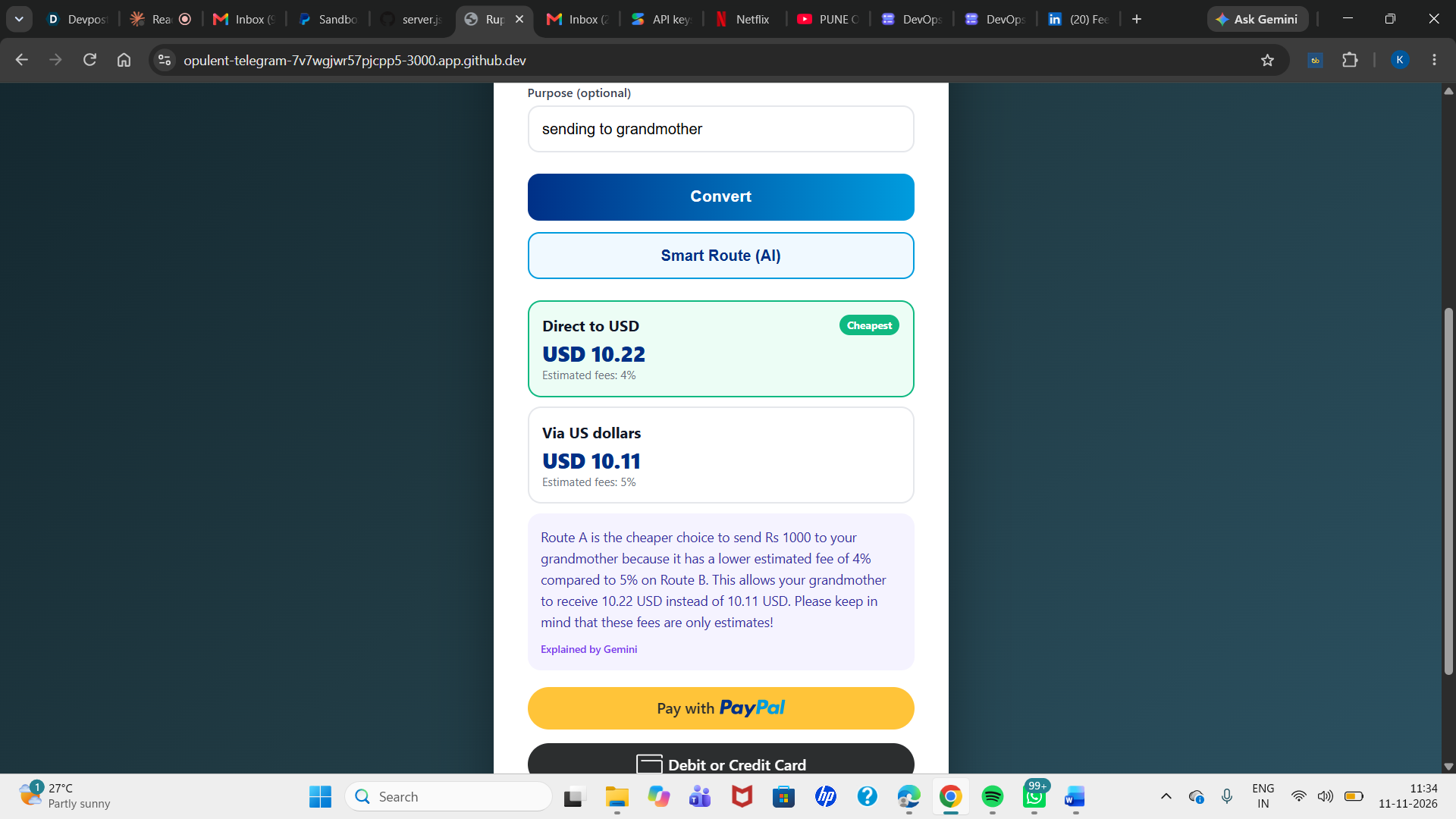
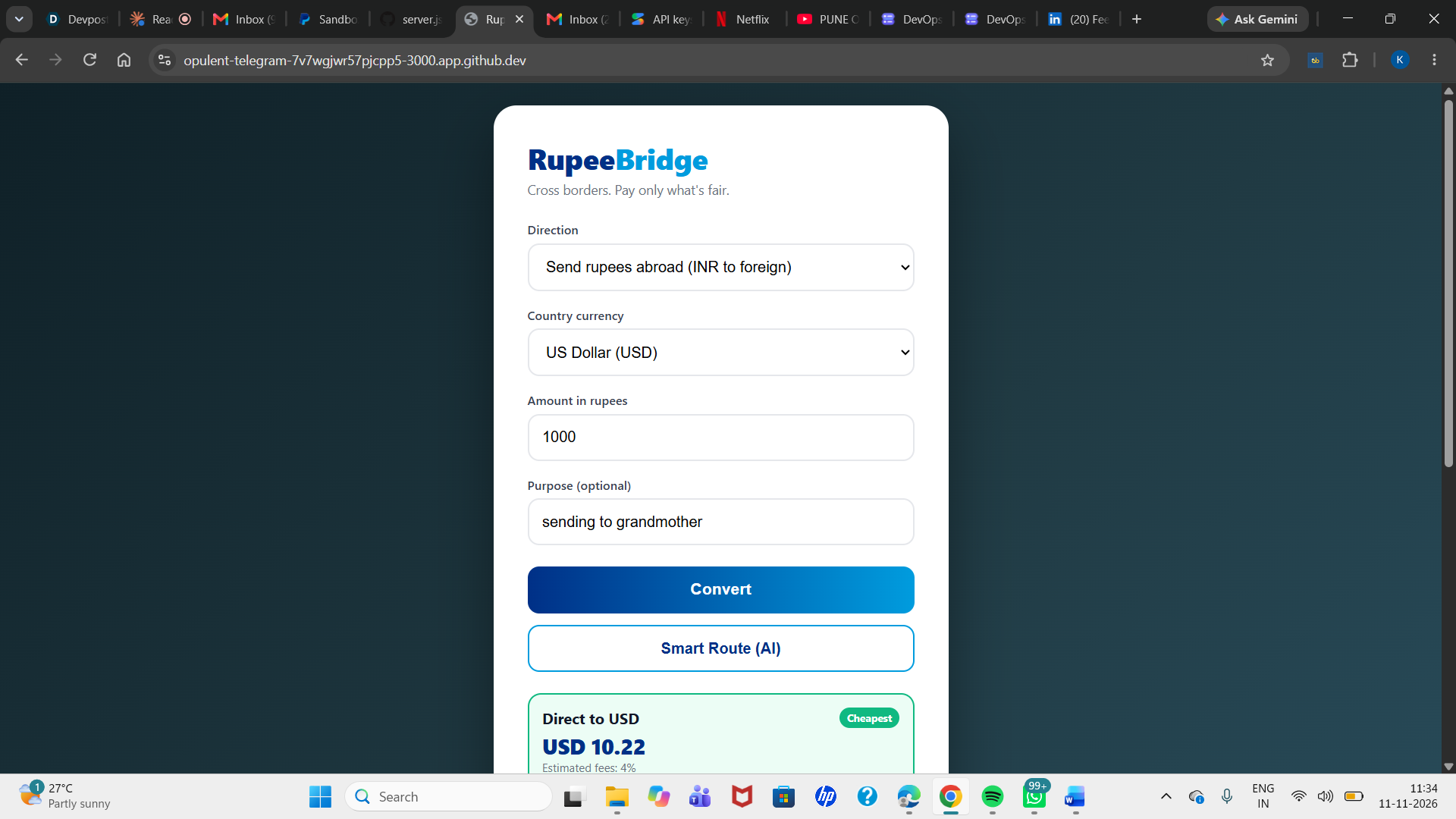
Send rupees abroad: pick a destination currency, enter an amount in rupees, and see exactly how much the traveler or recipient gets, with every fee itemised. Receive from abroad: enter an amount in a foreign currency and see what lands in rupees after fees. Live exchange rates from the Frankfurter API, which serves European Central Bank reference rates with no API key, with a backup set of sample rates if the service is unreachable. A clear fee breakdown showing the conversion markup, the transaction fee where it applies, the total, and the rate source. A PayPal sandbox checkout that creates a real sandbox order in the chosen currency. The math is simple and transparent. Let (A) be the amount in rupees, (m) the conversion markup in percent, and (r) the exchange rate in units of foreign currency per rupee. When sending rupees abroad, the amount received is:
$$\text{received} = A \left(1 - \frac{m}{100}\right) \cdot r$$
When receiving money from abroad, let (B) be the foreign amount and (t) the transaction fee in percent. The rupees received are:
$$\text{rupees} = \frac{B \left(1 - \frac{t + m}{100}\right)}{r}$$
In our model, (m = 4) and (t = 4.4) for receiving, so the total cost when receiving is (t + m = 8.4\%). These rates are estimates from third-party sources, not official PayPal figures, and the app labels them that way.
How we built it
I built RupeeBridge solo in about a week, entirely in the browser using GitHub Codespaces.
Backend: Node.js with Express. The server keeps the PayPal sandbox credentials in a hidden .env file, which is excluded from the public repository. PayPal: the PayPal REST API in the sandbox. The server gets an access token, creates an order in the buyer's chosen currency, and captures it after approval. Exchange rates: the free Frankfurter API for live rates, with a fallback table. Frontend: a single HTML page with a gradient card design, a country currency dropdown, the fee breakdown, and the PayPal Smart Payment Button. AI-assisted development: I used an AI assistant throughout to plan the architecture, generate code, and debug, while learning each step myself.
Challenges we ran into
Learning from scratch. I knew Java and C but not JavaScript, Node, or PayPal's APIs. I had to learn the tooling, the terminal, and Git in the same week as building. The PayPal sandbox popup. The server successfully created sandbox orders every time, but the approval popup often showed a generic message that PayPal wasn't working at that moment. Debug logging confirmed the access token and order creation succeeded, which points to the sandbox popup stage, but I could not fully resolve it before submitting. Currency limits. PayPal supports only a limited set of currencies, and some, such as the Chinese yuan, are supported only for in-country accounts. So I limited the dropdown to eight widely supported currencies instead of promising every country. Honest fees. PayPal's real cost depends on the account and the exchange rate it sets, so I kept the fee numbers clearly labelled as estimates. RBI and regulation. Real outbound rupee payments involve Indian regulations, so RupeeBridge is a sandbox prototype, and no real money moves.
Accomplishments that we're proud of
Going from zero knowledge of Node and PayPal's developer platform to a working two-way, multi-currency app. A fee breakdown that makes a hidden cost visible and easy to understand. Keeping secrets out of the public repository, and being transparent about what is an estimate.
What we learned
How OAuth tokens and the PayPal Orders API work, including creating and capturing orders. That PayPal checkout depends on supported currencies and account types, not just on a country having PayPal. How to debug by logging each step, so you can tell which part of a flow is failing. That clear communication about cost builds more trust than a polished interface alone.
What's next for RupeeBridge
An AI advisor that explains each fee in plain language and gives a convert-now-or-wait hint based on recent rate trends. A trip planner that shows the total cost across several countries on one itinerary. Support for more currencies, and a clear message where PayPal cannot pay in a country's own currency. Resolving the sandbox approval flow, and comparing PayPal's cost against alternatives.
Built With
- api
- claude
- codespaces
- css
- dotenv
- exchange
- express.js
- frankfurter
- frankfurter-exchange-rate-api
- git
- github
- html
- javascript
- node.js
- packages
- paypal
- paypal-javascript-sdk
- paypal-rest-api-(sandbox)
- plus
- rate
- sdk
- server
- the

