Inspiration
RunwayPilot came from a very real startup problem: most early-stage teams do not fail because they lack ambition, they fail because they see financial risk too late.
Student founders, indie hackers, startup operators, and small business owners often manage cash with fragmented spreadsheets, bank exports, and delayed reporting. That means rising burn, duplicate tools, vendor concentration, slowing collections, or one-off infra spikes get noticed only after runway is already compressed.
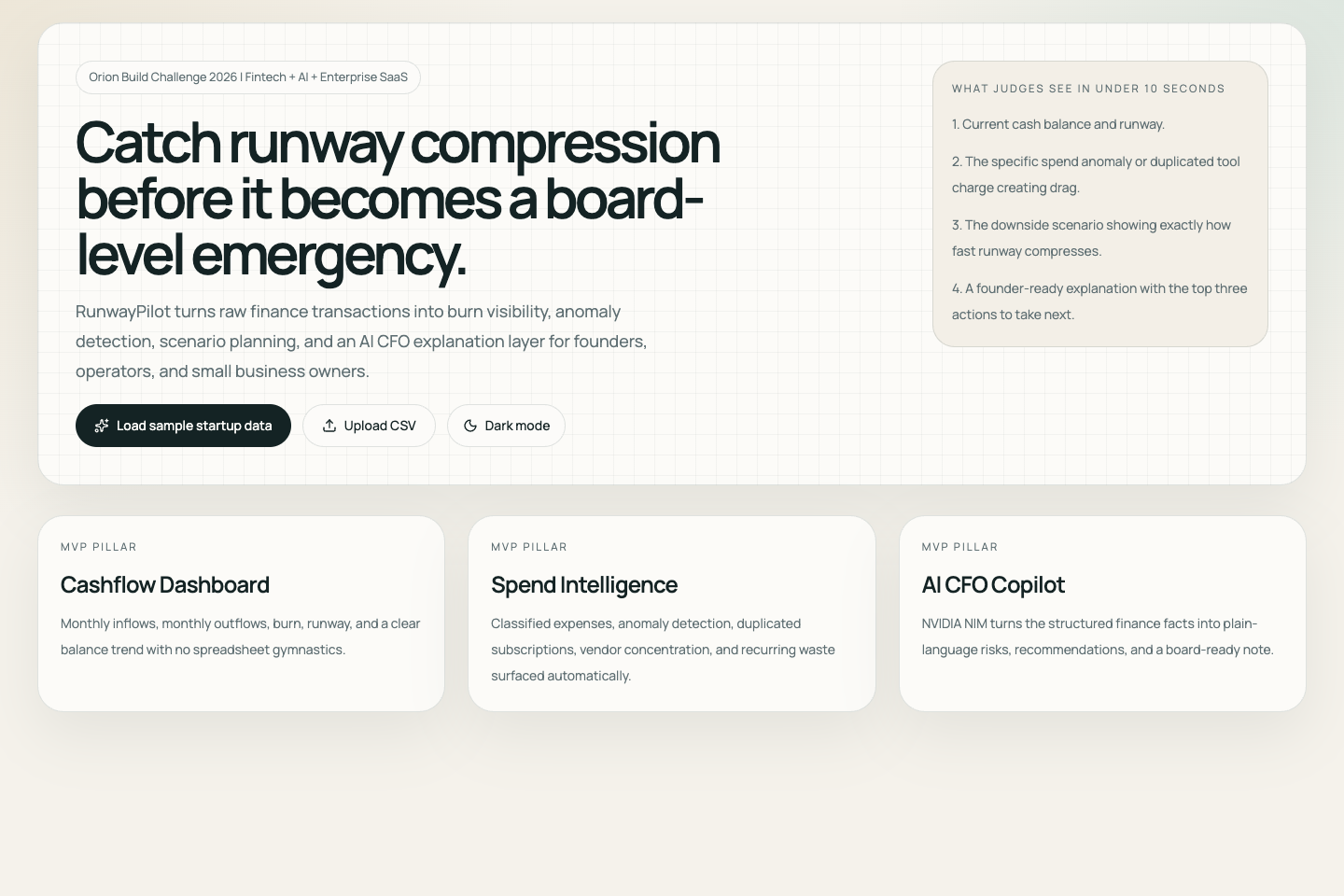
I wanted to build something that feels like a credible AI CFO copilot, not a toy dashboard. The goal was simple: make the financial reality of a business obvious within 10 seconds, then help the founder decide what to do next.
What it does
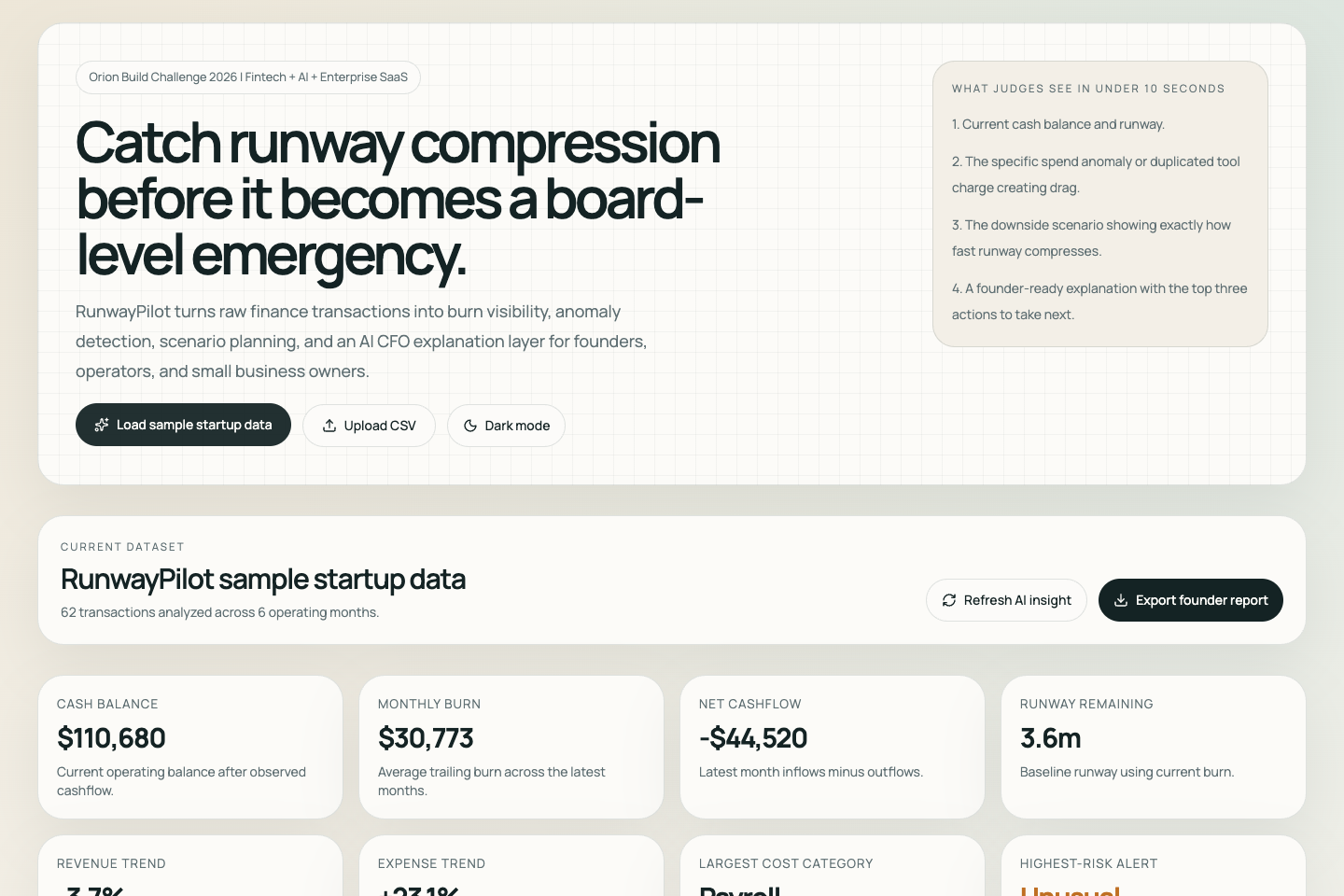
RunwayPilot turns raw transaction data into a founder-ready operating view:
- cash balance, burn, net cashflow, and runway
- spend classification across payroll, software, infra, marketing, operations, revenue, and other
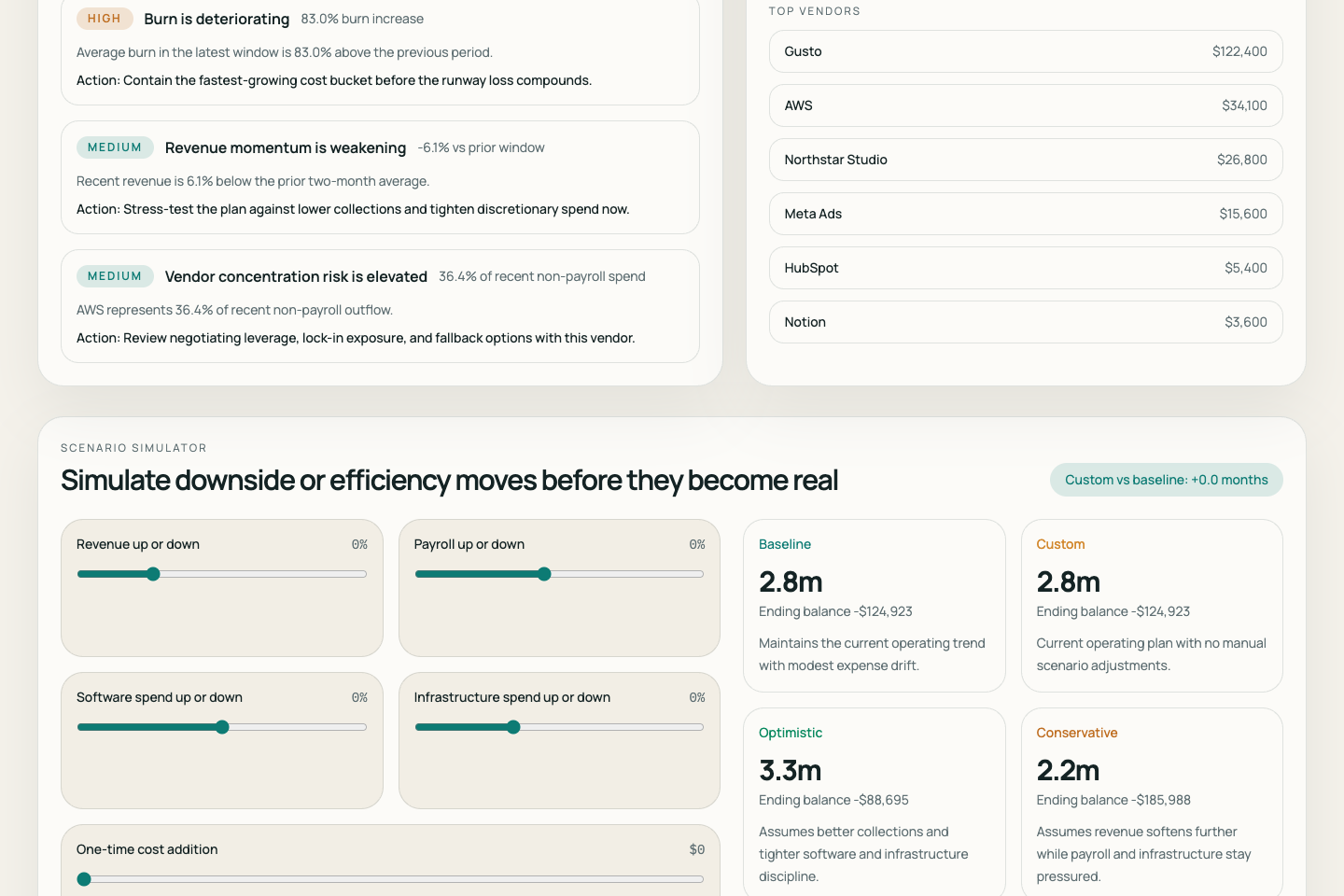
- anomaly detection for unusual spikes, duplicated subscriptions, and vendor concentration
- scenario planning for revenue drops, payroll changes, software cuts, infra changes, and one-time costs
- an AI CFO explanation layer that summarizes the situation in plain business language and recommends the next actions
The product is intentionally practical: it helps a founder answer questions like Why did runway shrink this month?, Which costs should we investigate first?, and What happens if revenue drops 20%?
How we built it
We built RunwayPilot as a Next.js + TypeScript web app with a clean enterprise-fintech UI, deterministic financial logic, and an AI reasoning layer powered by NVIDIA NIM.
The architecture is organized into five agents:
- Intake Agent to ingest demo or CSV data, validate fields, and standardize dates and amounts
- Classification Agent to bucket transactions and identify recurring vs one-time activity
- Forecast Agent to compute burn, runway, and baseline / optimistic / conservative scenarios
- Risk Agent to flag anomalies, deteriorating cashflow, recurring waste, vendor concentration, and revenue weakness
- Strategy Agent to use NVIDIA NIM to convert the structured analysis into a concise, board-ready explanation and recommended actions
A key design decision was to keep the financial core deterministic and explainable. The AI does not invent metrics or drive the math. Instead, it interprets structured outputs from the analytics layer.
At the core of the runway logic is a simple but important operating formula:
$$ \text{Runway Months} = \frac{\text{Current Cash Balance}}{\text{Average Monthly Burn}} $$
That baseline is then stress-tested through scenario controls so founders can see how quickly operating decisions change survival time.
Challenges we ran into
The hardest challenge was making the AI layer useful without letting it become vague or untrustworthy.
Financial tools are high-consequence products. If the model overstates certainty, invents causes, or misreads noisy data, the product stops being credible immediately. To address that, we separated deterministic analytics from AI explanation, enforced structured JSON responses, validated inputs server-side, normalized model output, and added explicit fallback behavior.
Another challenge was building a hackathon demo that still feels like a real product. A lot of finance demos look clever but collapse under scrutiny. We spent time on seeded data realism, enterprise-style information hierarchy, scenario usability, and making the dashboard tell a clear story from problem to action.
What we learned
This project reinforced a useful product lesson: founders do not want more dashboards, they want earlier intervention.
We learned that the strongest AI workflows in fintech are not fully autonomous. They combine:
- reliable calculations
- structured risk detection
- plain-language explanation
- actionable next steps
We also learned how important demo narrative is. A strong hackathon project is not just functional code; it is a clear story: here is the problem, here is the signal, here is the decision, and here is the impact.

Log in or sign up for Devpost to join the conversation.