-
-
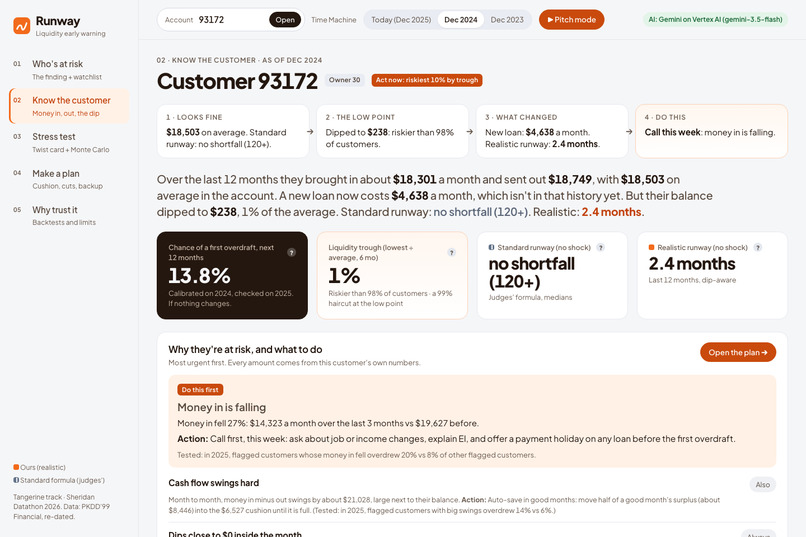
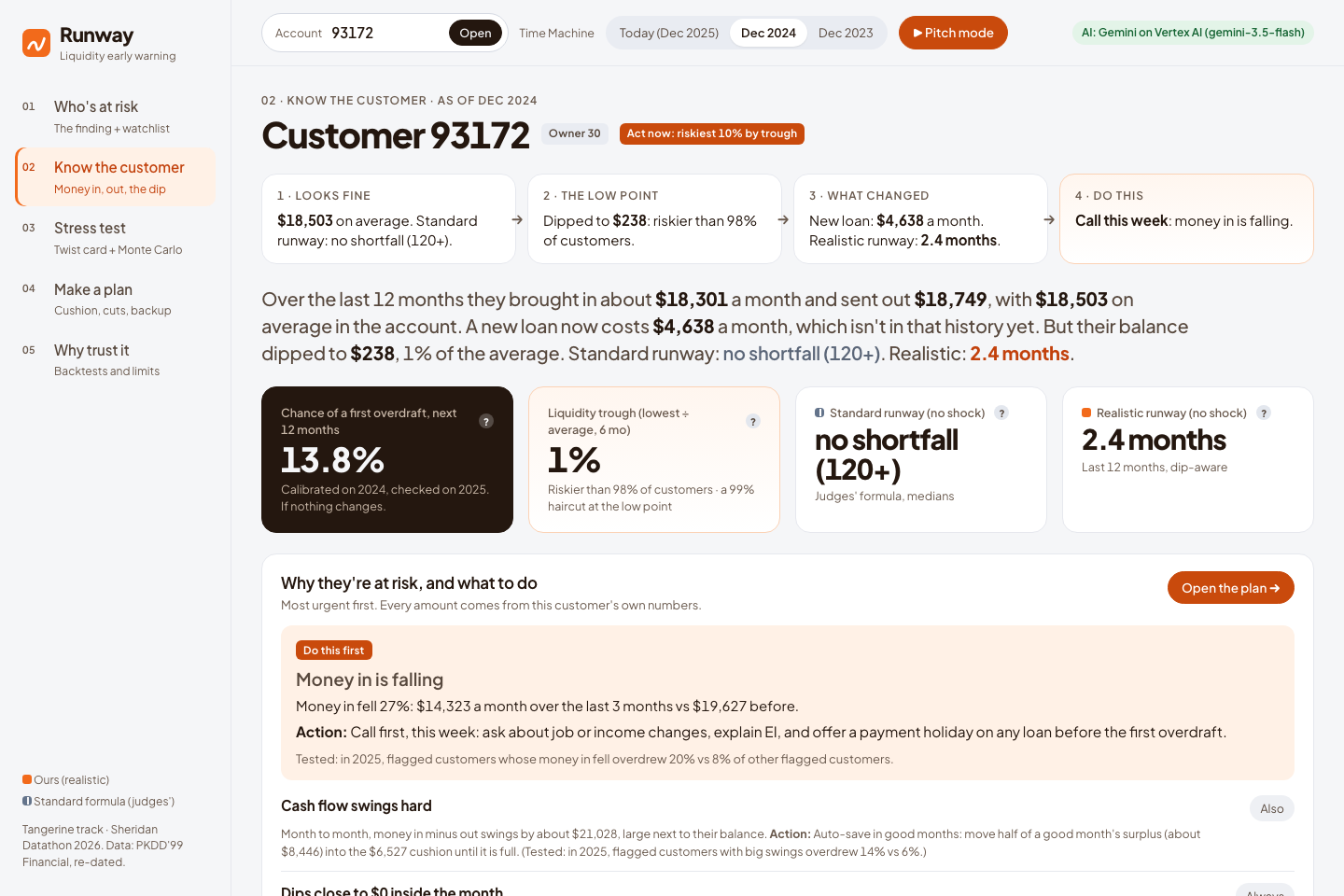
Customer 93172 looks fine on average ($18,503, “no shortfall”) but dips to $238; with a new $4,638/month loan the real runway is 2.4 months
-
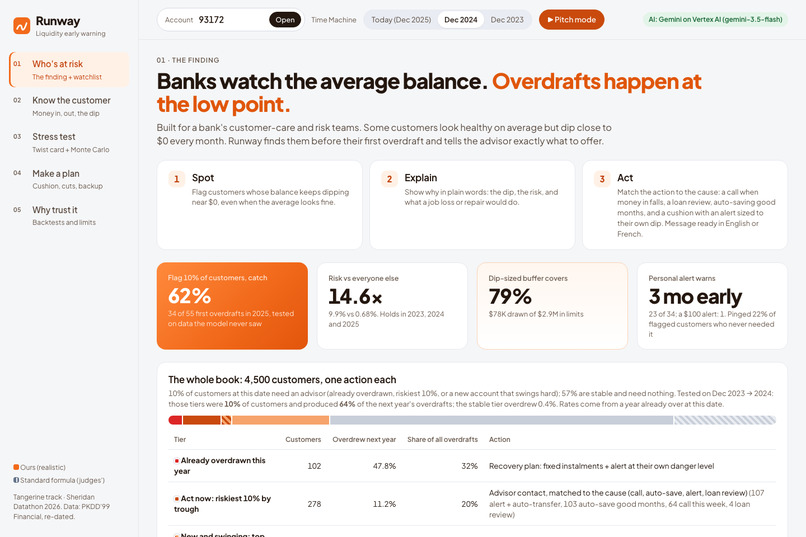
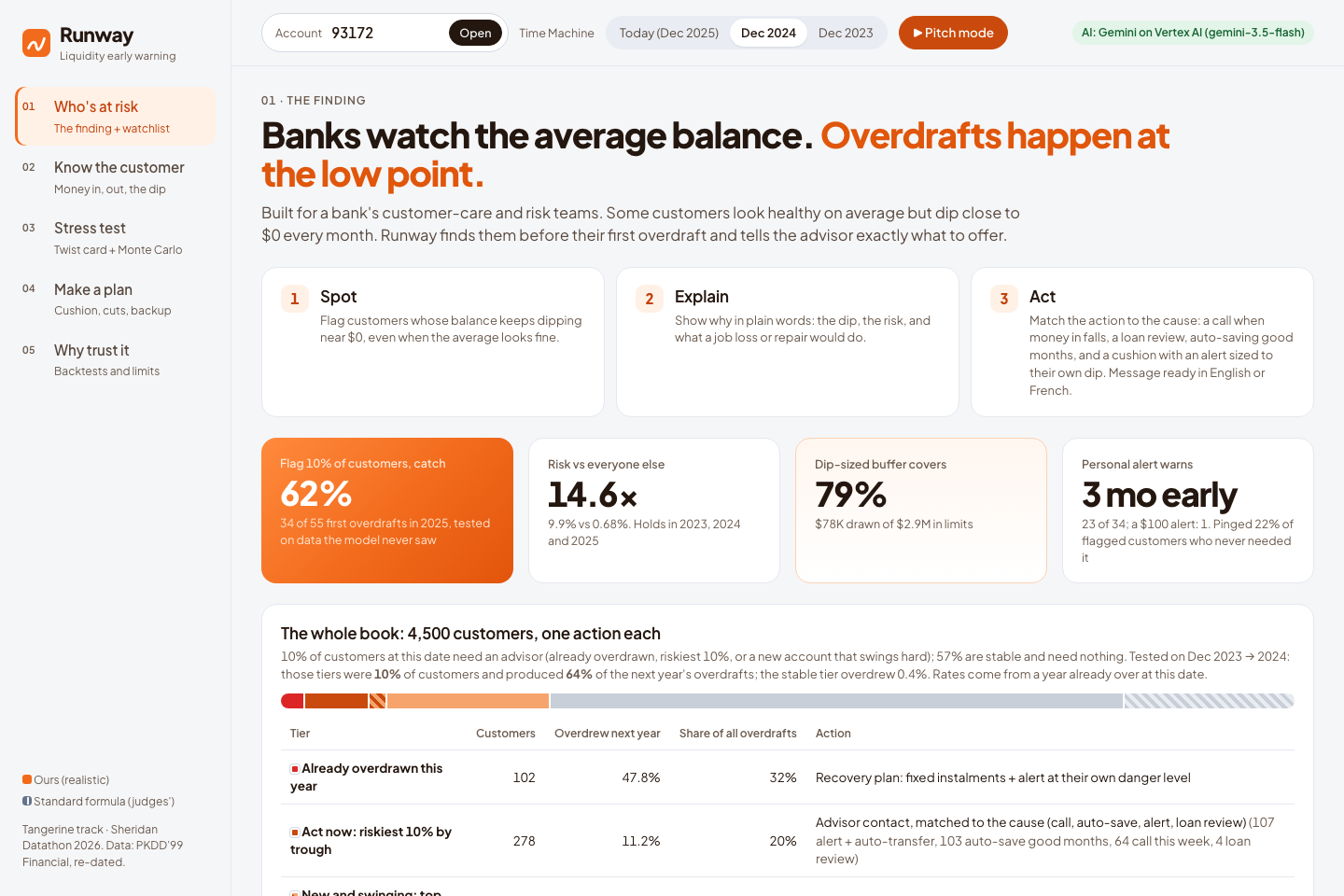
Flag 10% of customers by their low point and catch 62% of next year’s first overdrafts, tested on years the model never saw.
-
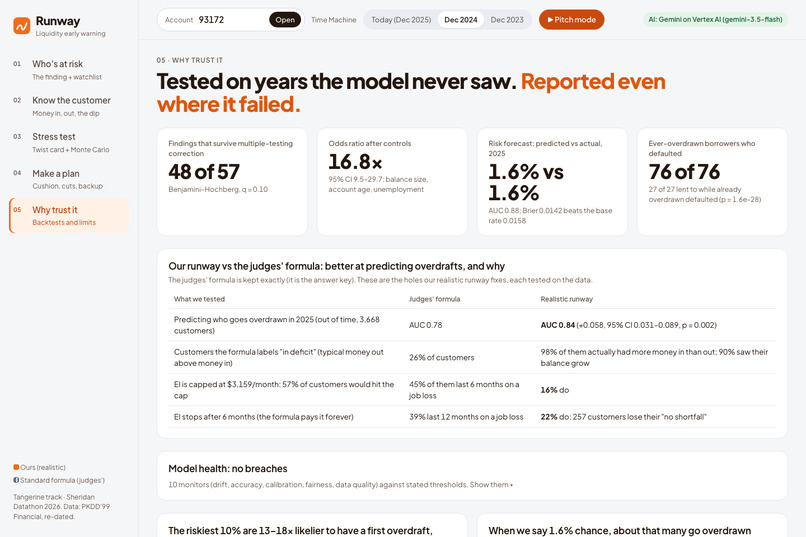
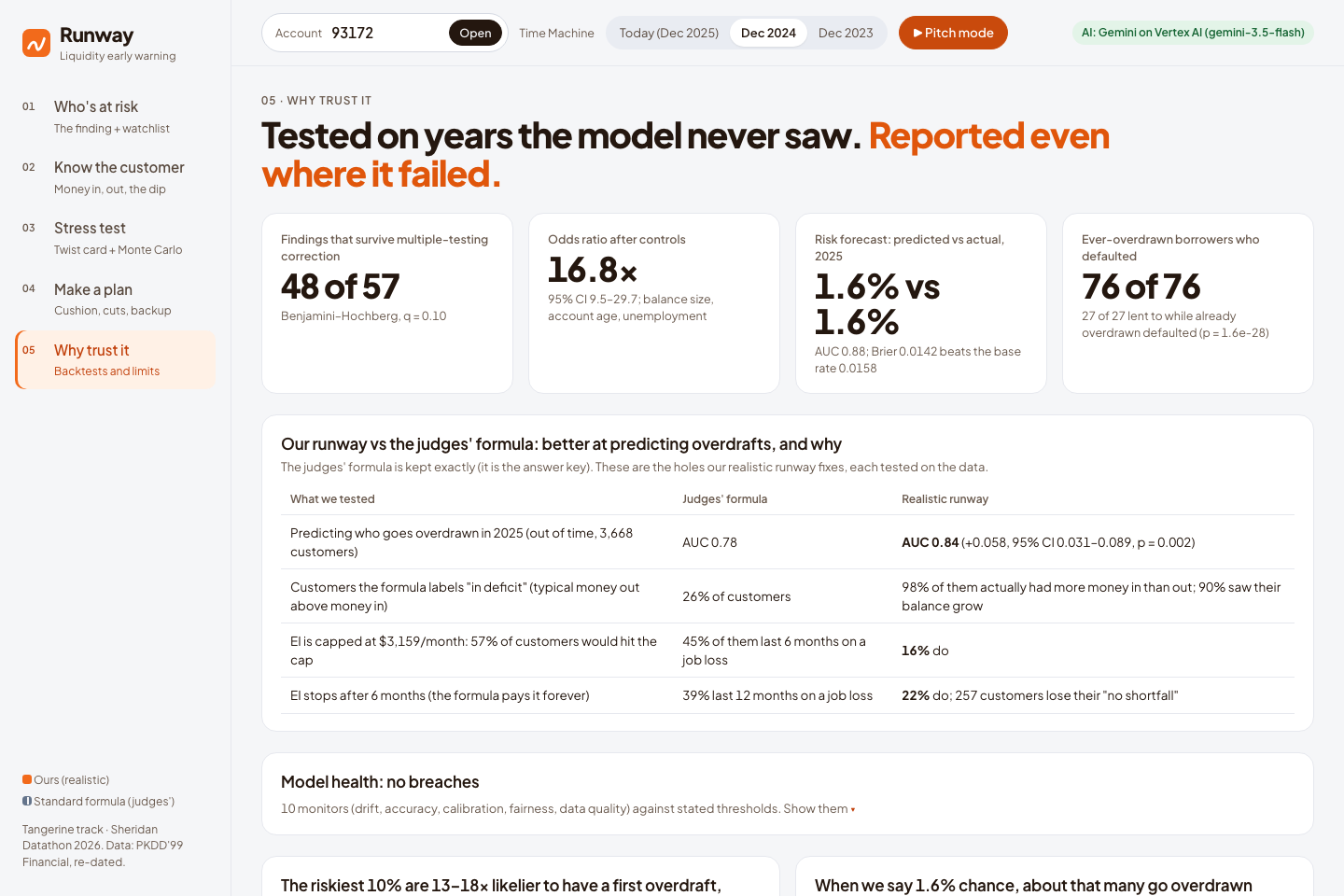
Our realistic runway predicts overdrafts better than the judges’ formula (AUC 0.84 vs 0.78), with calibration, fairness and monitoring.
-
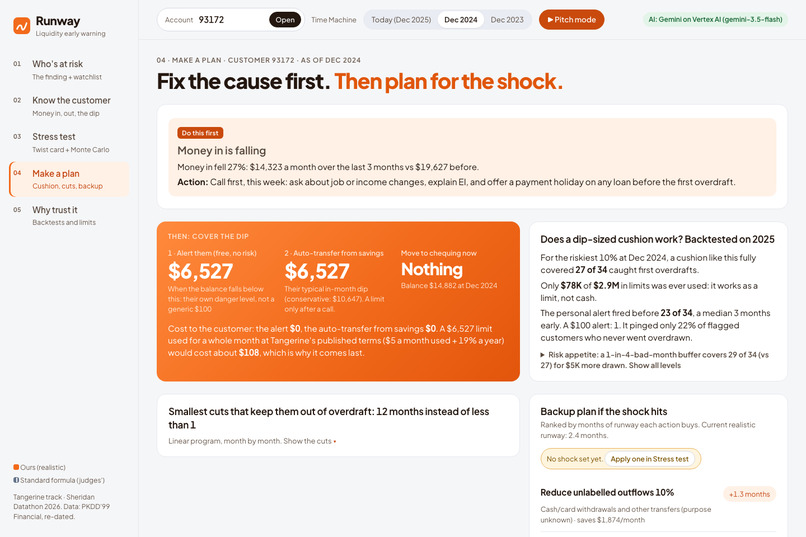
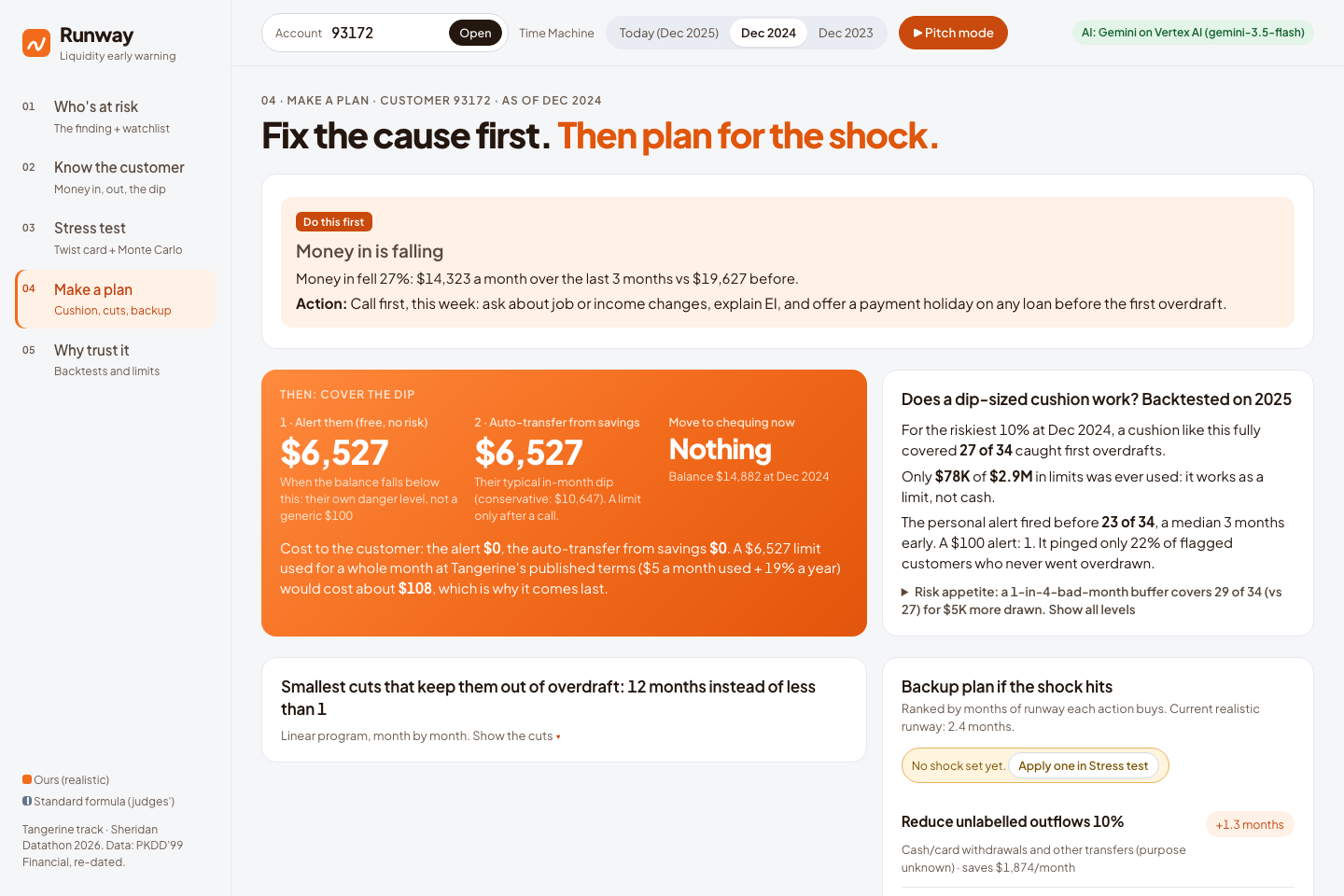
Fix the cause first, then free steps (an alert, a transfer from savings); a credit limit comes last because it costs about $108.
Inspiration
Banks judge customers by their average balance. But overdrafts don't happen on average: they happen at the low point of the month. In the Tangerine data, every one of the 76 borrowers who was ever overdrawn defaulted on their loan.
What it does
Runway spots customers who look healthy on average but keep dipping toward $0, explains why, and recommends the safest help first.
- Spot: the liquidity trough (lowest ÷ average balance, 6 months). Flagging the riskiest 10% catches 34 of 55 (62%) of next year's first overdrafts, 13–18× everyone else, tested on 2023, 2024 and 2025.
- Explain: a realistic runway (EI capped and ending, pensions kept, the in-month dip, new loan payments). Customer 93172 averaged $18,503 and the standard formula said "no shortfall", but they dipped to $238, got a $166,958 loan that month, and their real runway was 2.4 months. Overdrawn in January.
- Act: call about the cause, a free alert at their own danger level, a free transfer from savings; a limit last (about $108/month at Tangerine's terms). A loan check at approval holds 17% of loans, which default 34.7% vs 6.2%.
- Live twist: Gemini reads any twist card into settings you can check; the engine does all the maths.
How we built it
Python engine (pandas, NumPy, SciPy, statsmodels, scikit-learn), FastAPI, a React dashboard, Gemini on Vertex AI, Docker and Google Cloud Run. All maths lives in one engine; the AI never calculates, and every number it writes is checked.
Proof
Out-of-time backtests on three years, calibration (1.6% predicted vs 1.6% actual), multiple-testing correction (48 of 57 tests survive), a confounder check, survival analysis, a machine-learning challenger (it didn't beat the simple ratio), fairness by gender and age, and 10 monitors with no breaches.
Challenges and what we learned
The raw simulation was 8× too pessimistic: customers steer back after a bad month, so we calibrated it. We caught and tested every way the model could see the future. Simple, tested and explainable beat complex.
Limits
1990s Czech bank data (re-dated), mostly cash income; it's an early warning, not proof of cause, so a real rollout starts in shadow mode.
