-
-
Runtime Sentinel
Inspiration
Autonomous AI agents can execute high-impact operations at runtime, yet standard logs and informal trust do not provide verifiable proof of policy compliance or audit integrity. Runtime Sentinel was built for Kiroween 2026 (Resurrection Category) around a clear principle: do not ask developers to trust AI decisions—generate verifiable evidence for every decision.
What it does
- Deterministic Runtime Governance: Intercepts runtime requests and returns
ALLOWorDENYbased on explicit policy rules and decay thresholds. - Decision Explanation (
explain): Surfaces the exact policy evaluation, rationale, and supporting evidence for recorded decisions (such as inspecting entry#2). - Tamper-Evident Audit & Verification (
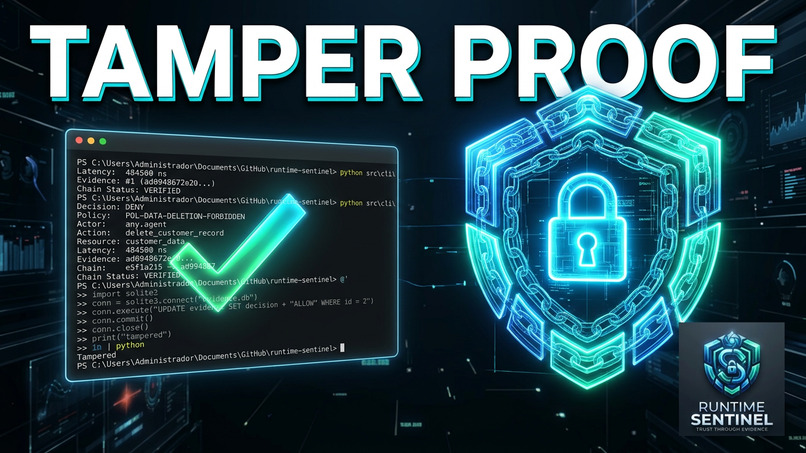
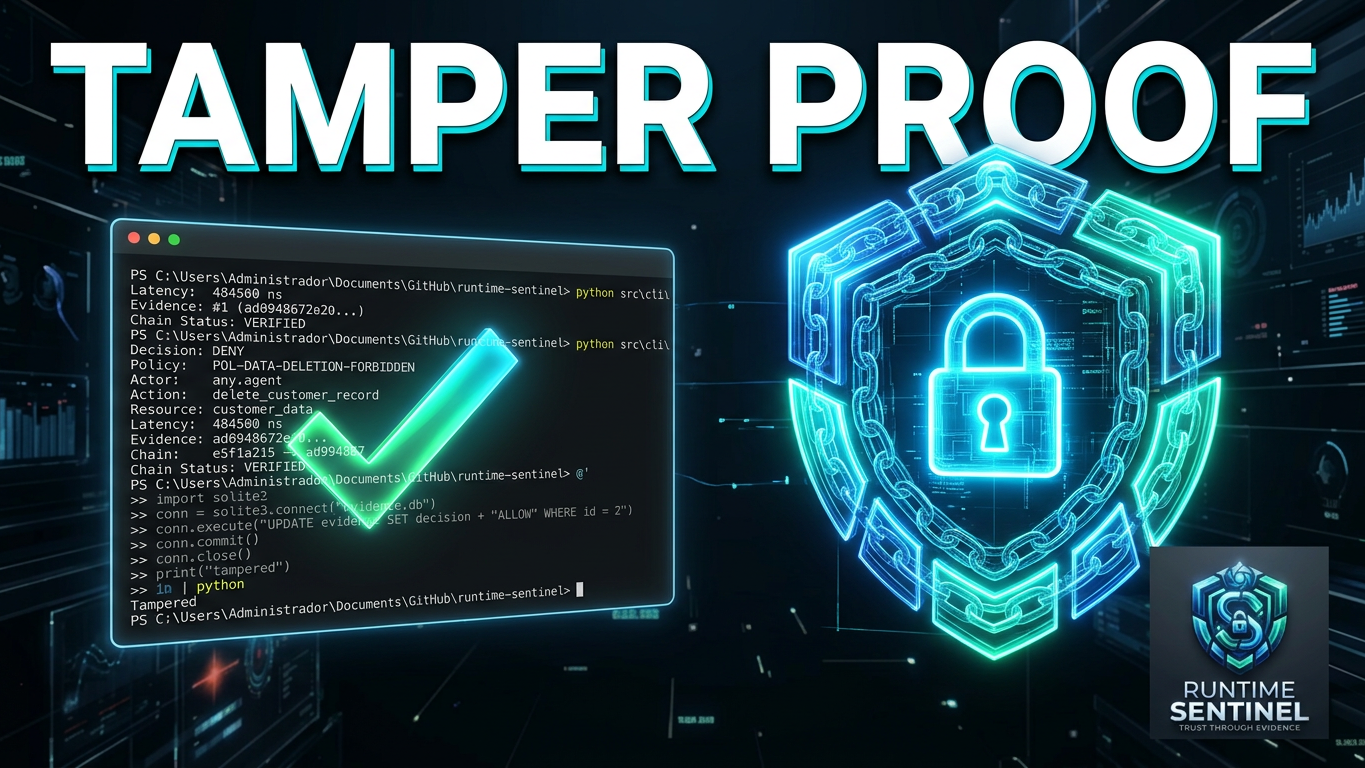
verify): Maintains chained integrity across persisted records and immediately detects unauthorized post-execution edits (such as mutating a stored record directly in SQLite, triggeringTAMPERING DETECTED at entry #2). - Policy Decay Validation: Enforces time/state-sensitive policy decay rules so stale assumptions cannot silently pass.
How we built it
We built Runtime Sentinel using Kiro to structure specifications, architectural boundaries, automation hooks, and audit workflows:
.kiro/specs/requirements.md— Core principle and design goals defined upfront..kiro/steering/architecture.md— Deterministic boundaries and architectural decisions..kiro/hooks/pre_build.yaml— Automated pre-build checks and invariant validation..kiro/crew/sentinel-auditor.yml— Audit workflow supporting generation, validation, explanation, and verification.
We combined deterministic policy checks, SQLite persistence, and property-based testing to verify runtime invariants and tamper detection end-to-end.
Validation & Results
- Tests:
10/10tests passing - Integrity: Tamper detection verified (
TAMPERING DETECTED at entry #2upon SQLite modification) - Performance:
p99 = 33,100 ns(well under100,000 ns) - Governance: Policy Decay validated
Challenges we ran into & What we learned
Ensuring deterministic policy evaluation, clear decision explanations, and instant tamper detection without adding heavy runtime overhead required keeping policy boundaries explicit and testing both normal execution (ALLOW / DENY / VERIFIED) and adversarial database mutations.
Built With
- ai
- audit
- governance
- java
- kiro
- p.-ej.
- property-based
- python
- security
- sqlite
- testing
- typescript
