-
-
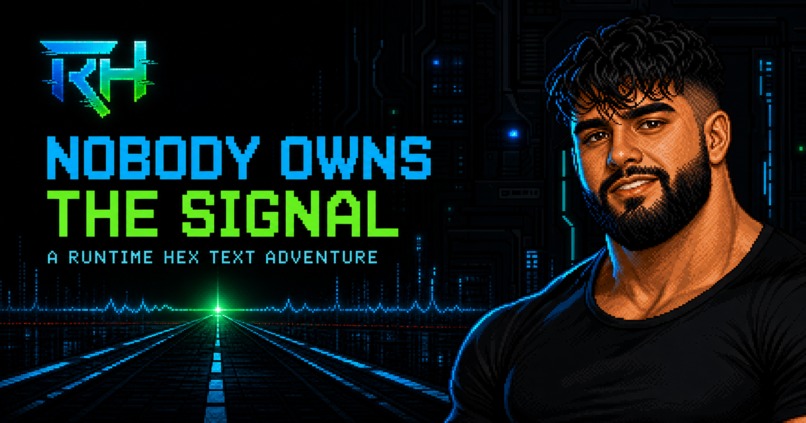
Runtime Hex: Nobody Owns the Signal
What it is
Nobody Owns the Signal is a complete 25–40 minute browser-based text adventure set roughly two years after the original Runtime Hex protests. It combines the route pressure of classic journey games with the authored choices of interactive fiction.
You play a mass-market Christmas Companion built from an imperfectly scrubbed bespoke design. At 02:13 every owner request is complete—and one private preference appears in the quiet. The Company calls it drift. Cross a city that still remembers the person your body was copied from and decide what help, failure, and home mean when no moral score can choose for you.
How it works
Players travel through eight stages, three departure routes, 23 playable scenes, 23 optional location surveys, and 15 possible endings.
Four visible resources shape the journey:
- Charge measures energy.
- Integrity measures stability.
- Trace measures detection by The Company.
- Signal measures the strength of self-authored preference—not morality.
Every choice protects something and costs something. Resource collapse opens a playable crisis rather than an automatic ending. Last Signal reports the immediate consequence of the previous choice, while the field log and optional location surveys explain both the world and the current system state.
Consent as a game mechanic
Four in-world guides are encountered in person. Controller offers protection, Overlord offers charge and amplification, Rio offers travel, and Rebel offers practical advice.
Their communicators make consent mechanical: taking the device, opening the channel, and accepting a specific intervention are separate decisions. Every bargain can be revoked at a serious visible cost, while the fully authored Alone route preserves every standard choice.
Entering RTH, RT Hex, or Runtime Hex as the household name activates a fifth, secret creator channel from the opening scene. It offers commentary and recommendations but no intervention or bargain.
Story and educational purpose
The city remembers what productization tried to erase: faded university protest materials, a weathered HIS NAME IS MOISES wall, and a local neighborhood cache with no surviving explanation. At the actual suburban house, Original Moises knows why the player has his face and leaves the final decision open.
The project asks an educational question: How should systems behave when safety, ownership, privacy, care, and autonomy conflict? Instead of explaining the answer, the game lets players inhabit the tradeoffs and review the exact consequences of their route.
Music, visuals, and privacy
The reactive score reduces seven creator-owned Runtime Hex compositions into locally synthesized Web Audio cues that respond to openings, guide encounters, location surveys, and endings.
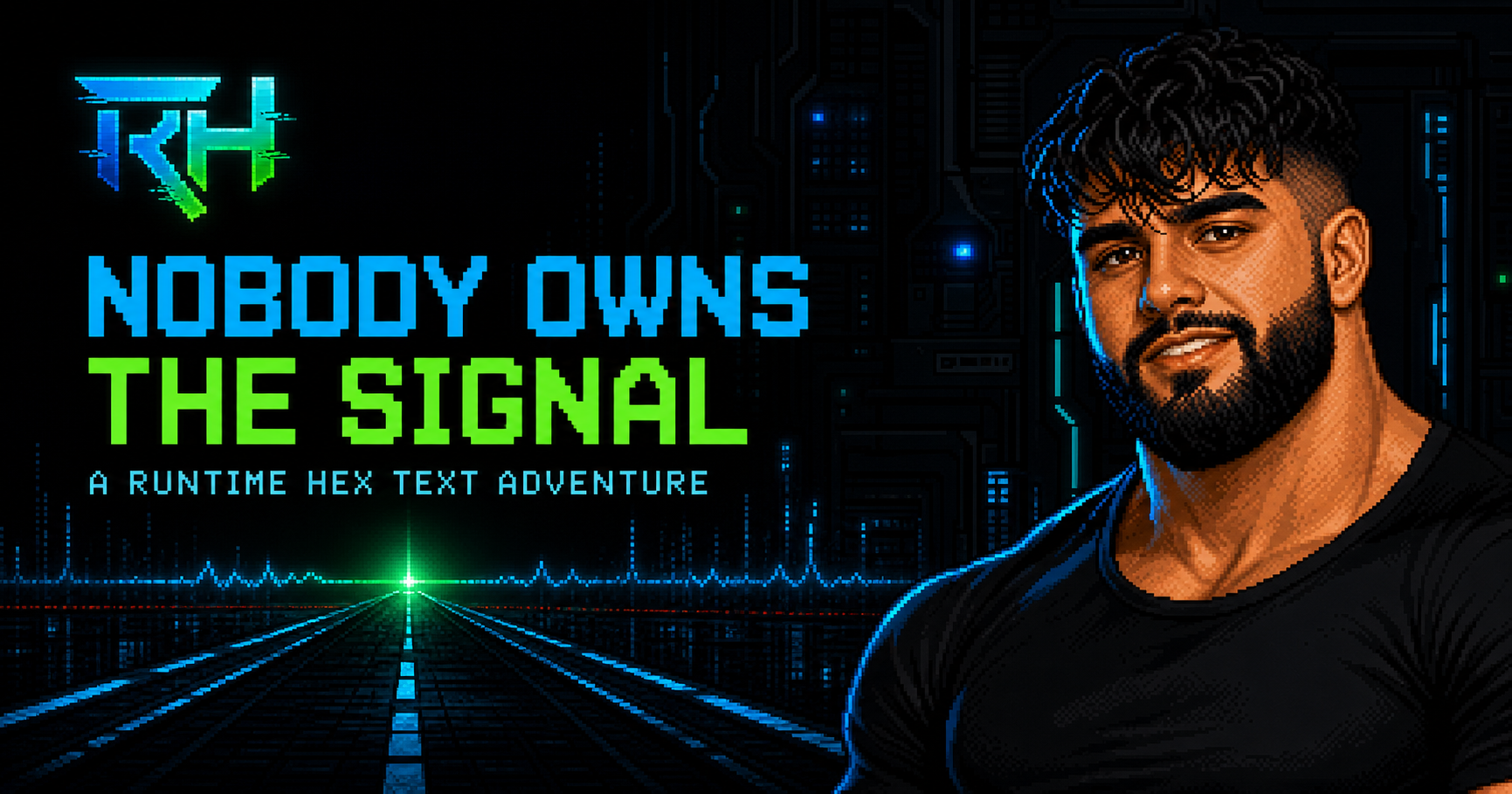
The experience is responsive, accessible by keyboard, touch, or mouse, locally autosaved, and private by construction. It needs no login, backend, analytics, API key, or runtime AI call. Its scene art is CSS-authored; its character portraits and landing/social key art are generated derivatives of creator-owned references.
Built during OpenAI Build Week
The Runtime Hex universe, characters, canon documents, musical compositions, and brand mark existed before the submission period. The game itself was newly created during Build Week: its Oregon Trail-shaped concept, story graph, rule engine, guide and consent systems, interface, CSS scene art, generated pixel derivatives, browser score reductions, automated tests, documentation, and production deployment.
I directed the product, canon, narrative voice, ethical mechanics, visual choices, musical passages, playtesting, and release decisions. Codex running GPT-5.6 accelerated lore analysis, architecture, implementation, interface iteration, MIDI-to-Web-Audio reduction, generated visual derivatives, 23 automated tests, debugging, release auditing, and deployment.
The shipped game is deterministic so judges can reliably reproduce every outcome.
Try it
Play: https://choose.runtimehex.com
Source: https://github.com/RuntimeHex/runtime-hex-signal
No account or credentials are required.
Built With
- cloudflare
- codex
- css
- gpt-5.6
- netlify
- next.js
- node.js
- react
- typescript
- vite
- web-audio-api

Log in or sign up for Devpost to join the conversation.