
The problem
Sixty-seven million young people are unemployed and roughly a quarter of a billion are not in education, employment or training (ILO, 2026). The barrier is not only jobs — nobody tells a 17-year-old the exact gap between them and a specific role, or how to close it this week. Career quizzes stop at a personality label. School counsellors have hundreds of students each.
What Rungly does
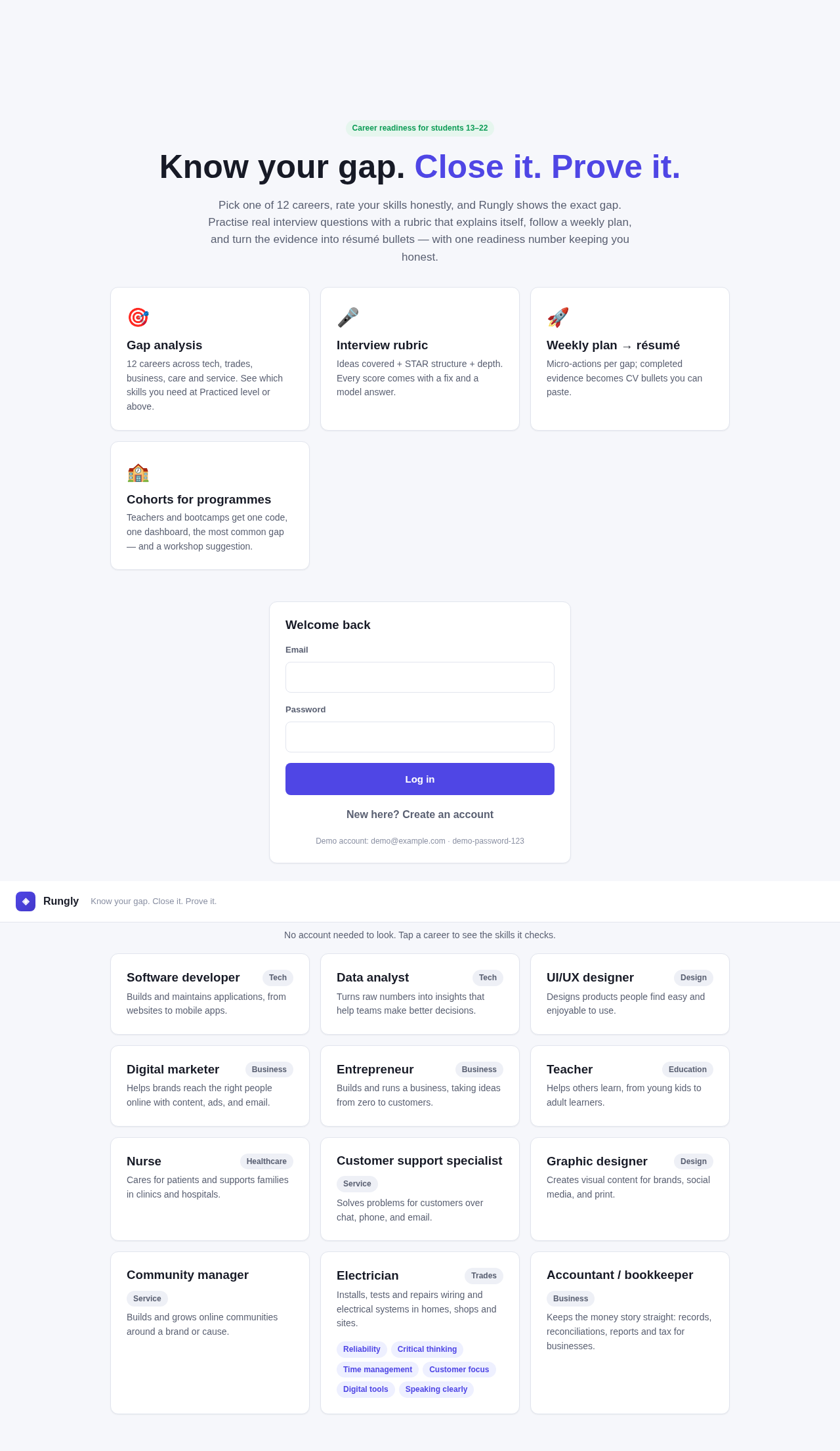
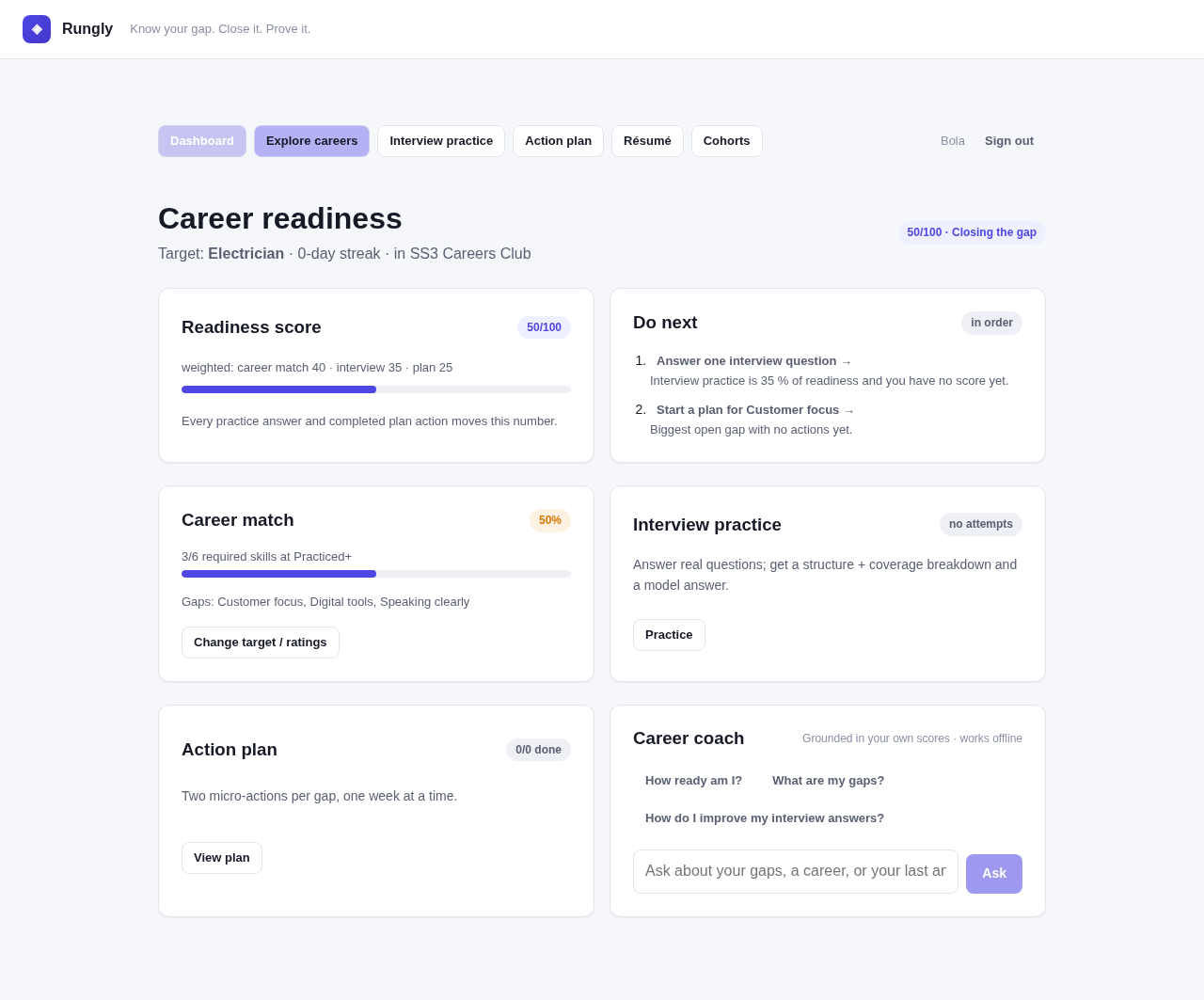
Rungly turns career readiness into one number a student can move — and gives the people running programmes a dashboard for it.
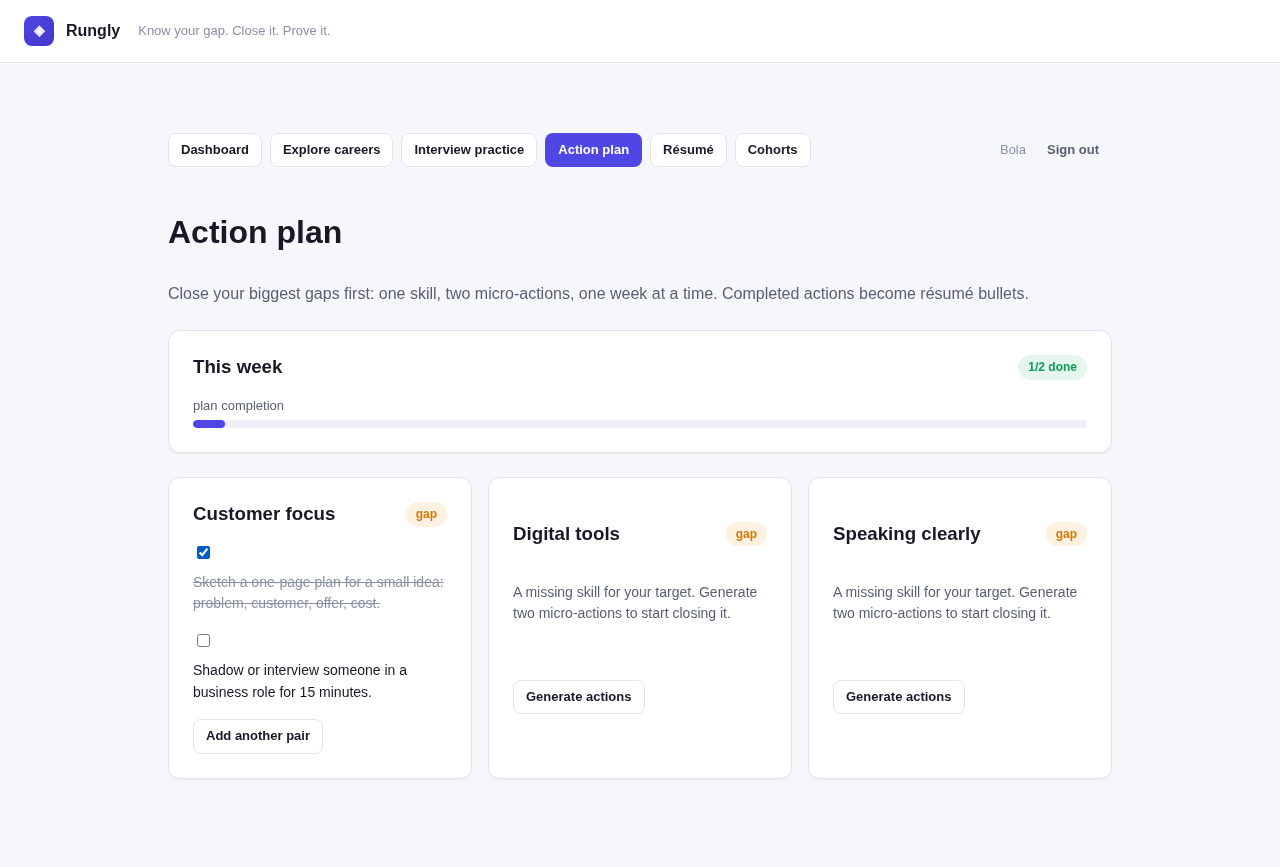
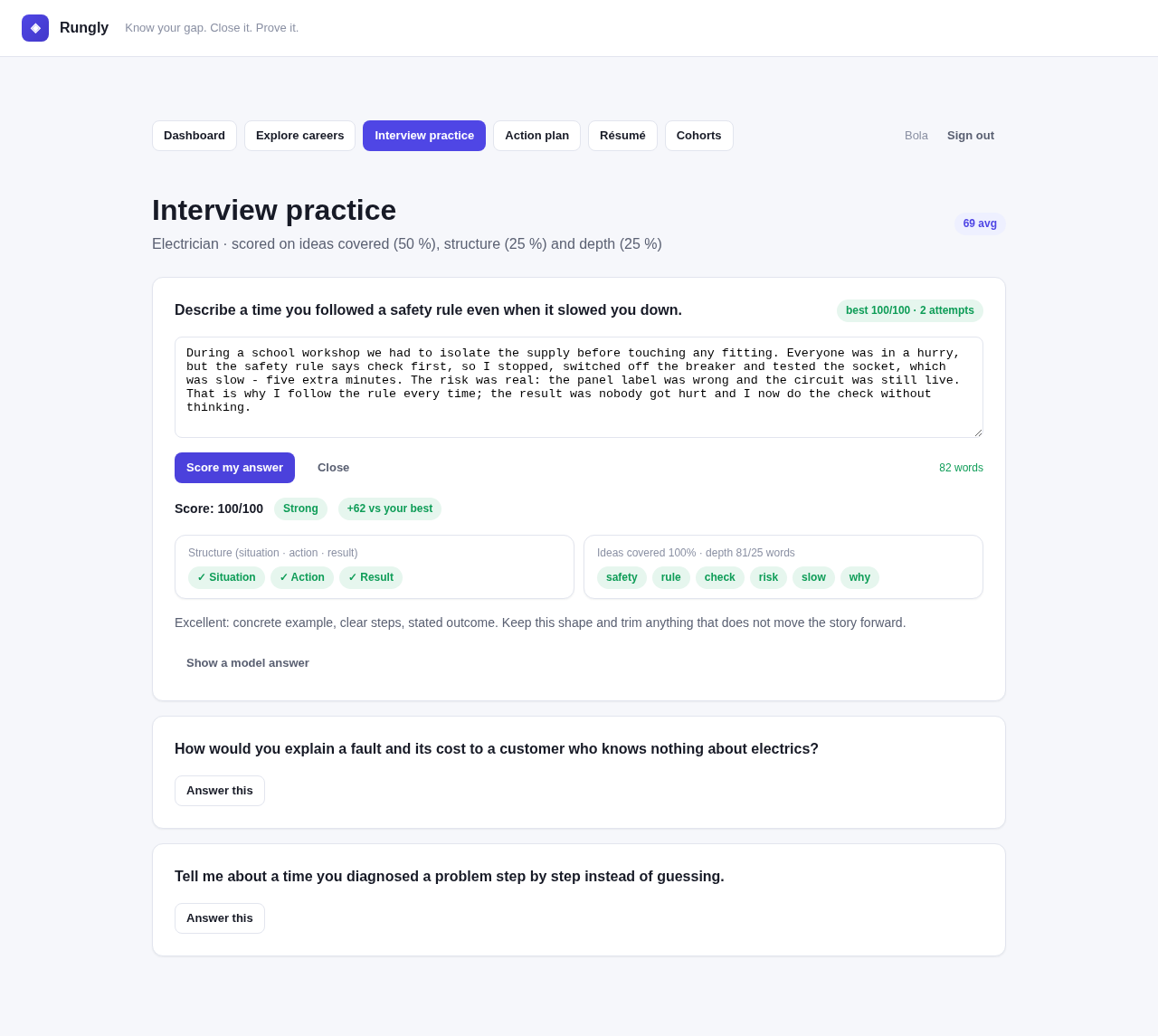
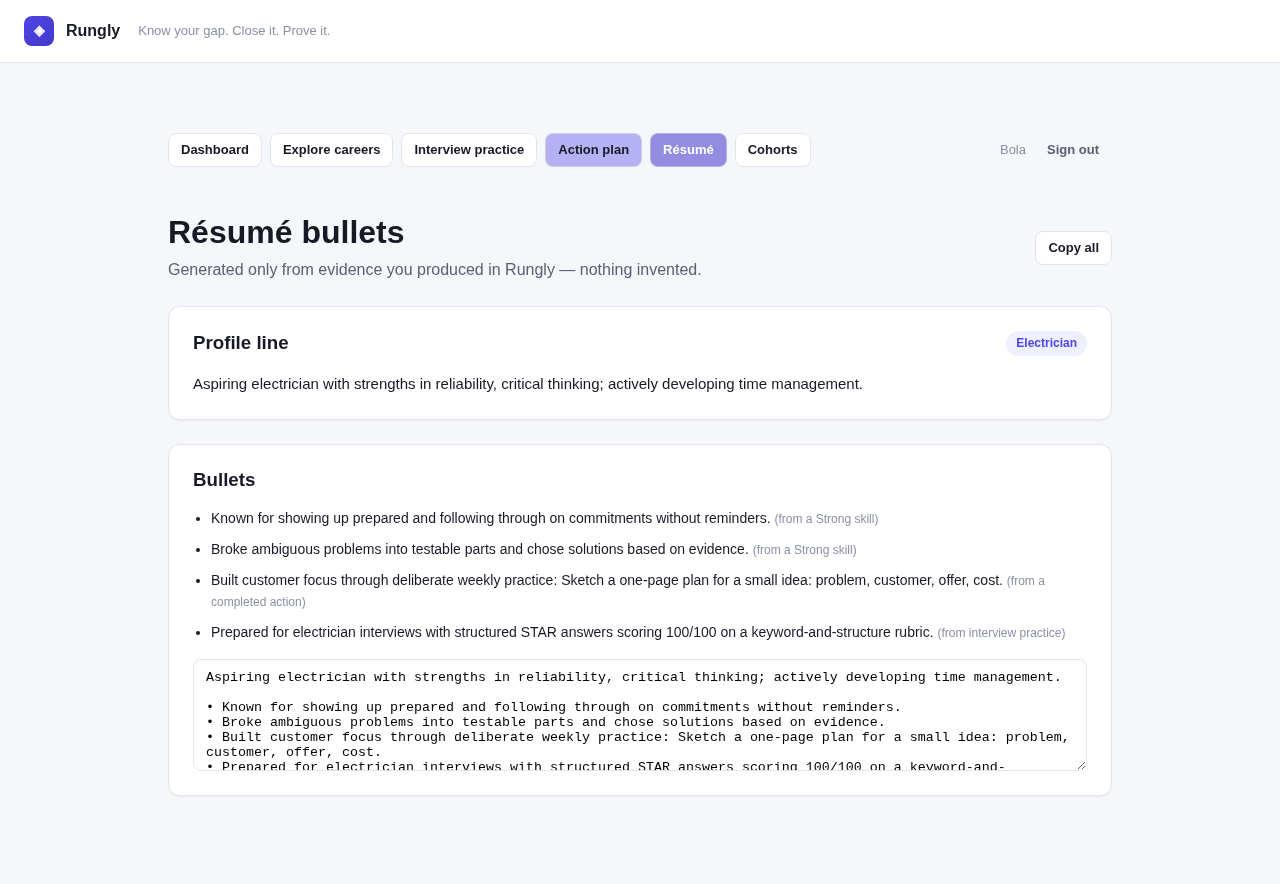
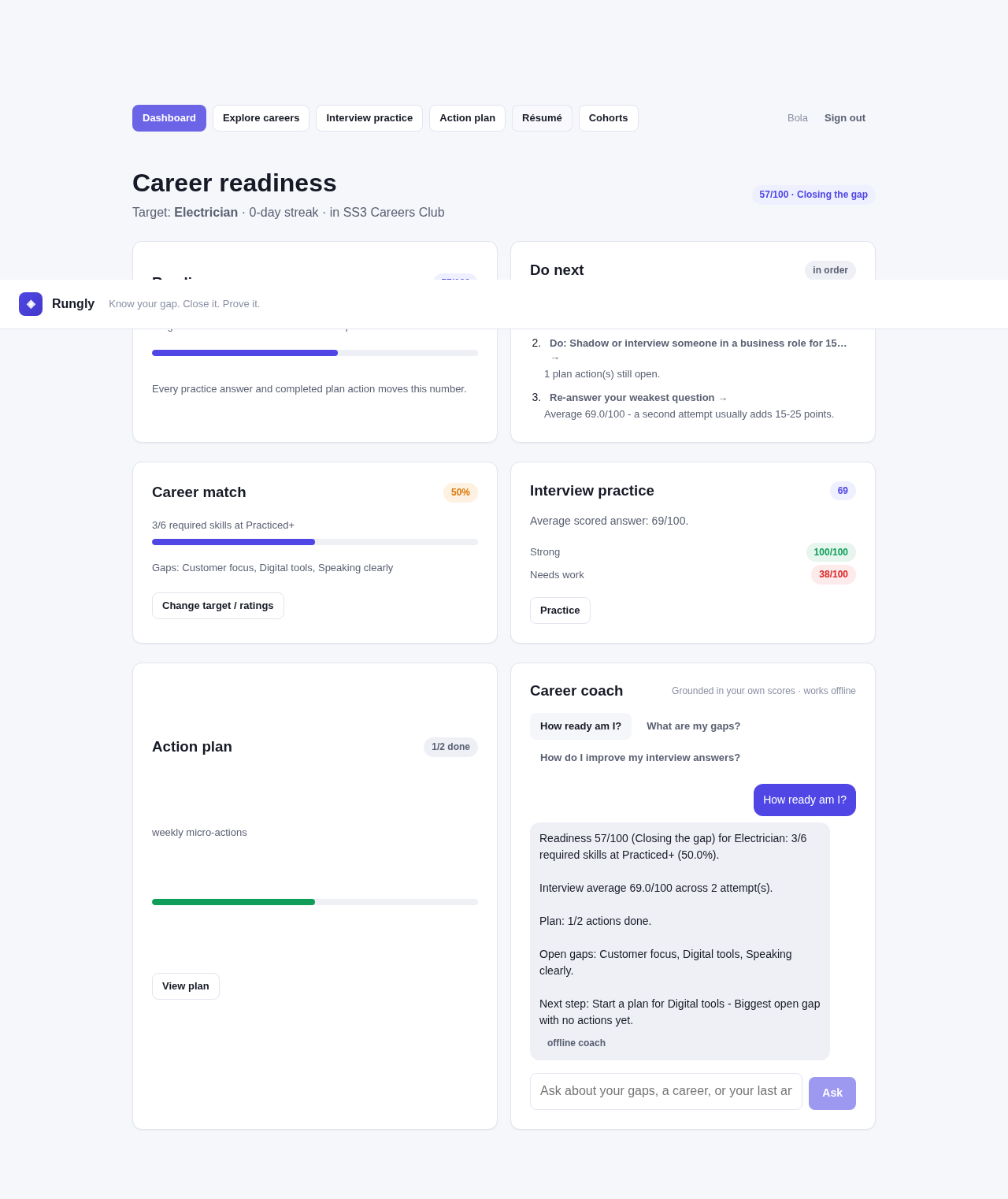
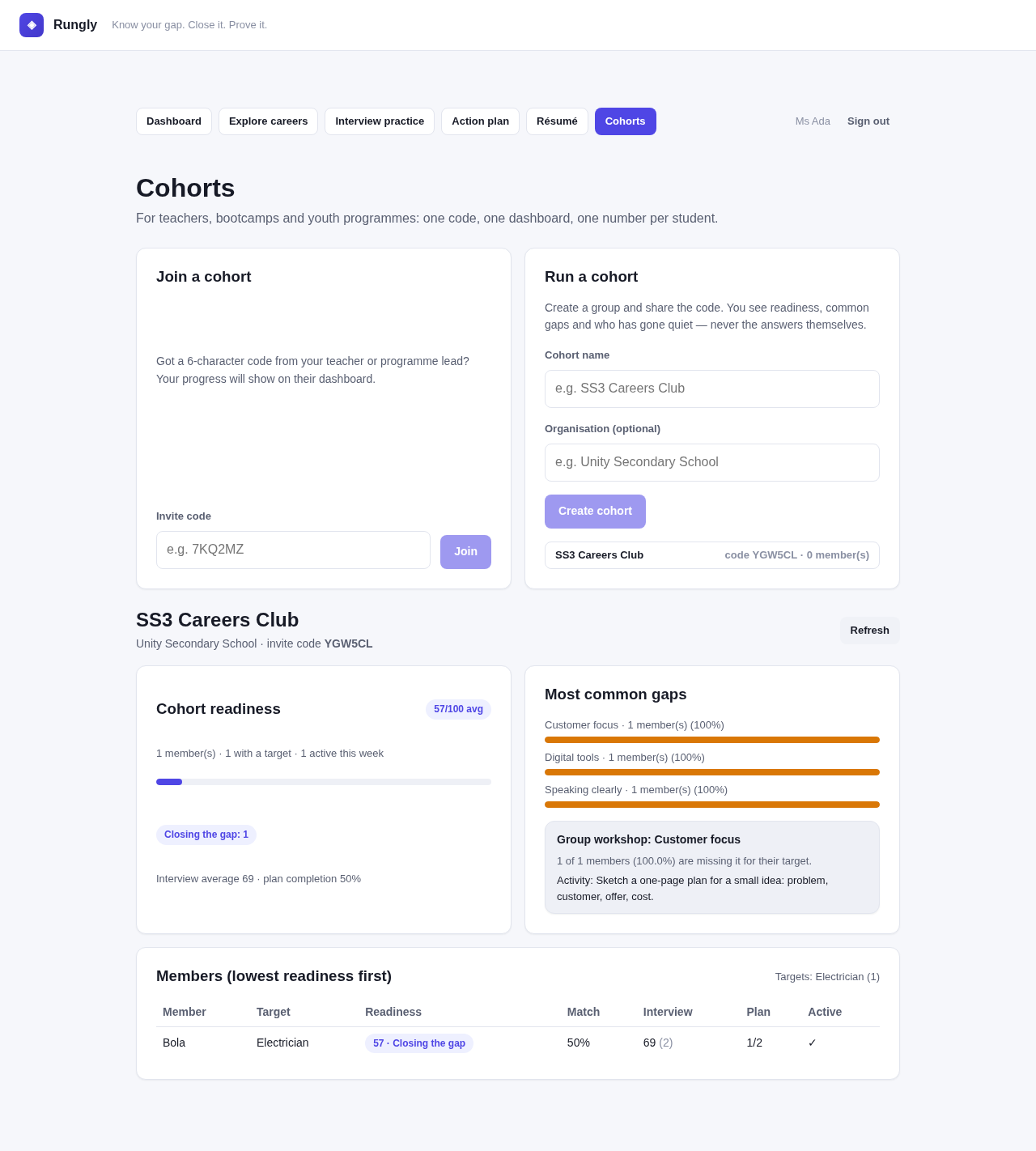
Pick a target from 12 careers — electrician, bookkeeper and nurse sit next to software developer; built for the students most career apps ignore. Rate 26 skills honestly → instant gap map. Match percentage, readiness score (weighted: career match 40 · interview 35 · plan 25) and a band from Starting out to Ready. Interview practice with a transparent rubric. A weak answer scores 38/100 with the why on screen: structure badges (situation · action · result), ideas covered, depth. A model answer is one click away; the same student then scores 100 — "+62 vs your best". Improvement is learnable, not luck. Weekly micro-actions. Each gap becomes two small actions a week; ticking one moves readiness. Completed actions become résumé bullets — every line labelled with the evidence it came from. Nothing is invented. Grounded coach. Quotes the student's actual numbers ("You're at 57 in readiness, in the 'Closing the gap' band…") and ends with one next step. Works offline by default; an OpenAI-compatible LLM (Groq) can be enabled by config. Cohorts for programmes. One six-character code. The teacher sees average readiness, the group's most common gaps, who has gone quiet — and the one workshop that would move the most students. Numbers, never the students' answers.
Everything runs with zero API keys: scoring is deterministic pure Python, fully unit-tested (15 tests, CI green on every push).
Business & finance
Students are free forever — that's the acquisition engine. Programmes pay: $1–3 per student per year for schools (priced by country) and $2,000–5,000/year for bootcamps and NGOs that need funder-ready outcome reports. Compute is deterministic Python (~1 ms CPU per answer, no per-seat AI cost), so gross margin on seats is above 85%. Fifty programmes at $2,000 = $100,000 ARR — a sustainable two-person company in Nigeria, Kenya, India or the Philippines, exactly where the problem is largest and career services are thinnest.
Scaling
Stateless FastAPI in front of a relational store (SQLite → Postgres swap, already wired via Neon). Cohort dashboards are three indexed queries; at thousands of members they become a nightly materialised table with no API change. The LLM path is optional, cached and rate-limited. Docker image and CI are in the repo.
Built With
- arena.ai
- claude
- docker
- fastapi
- github-actions
- groq
- neon
- postgresql
- pydantic
- pytest
- python-3.11
- react-18
- render
- sqlalchemy-2
- sqlite
- typescript
- vite

Log in or sign up for Devpost to join the conversation.