-
-
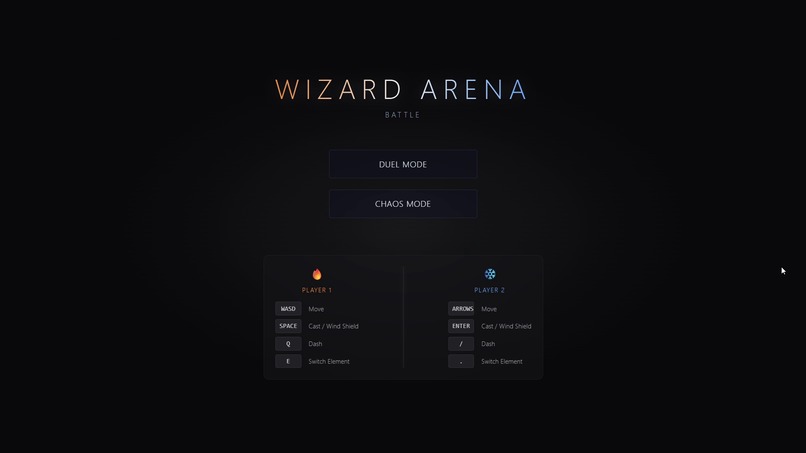
Home Screen
-
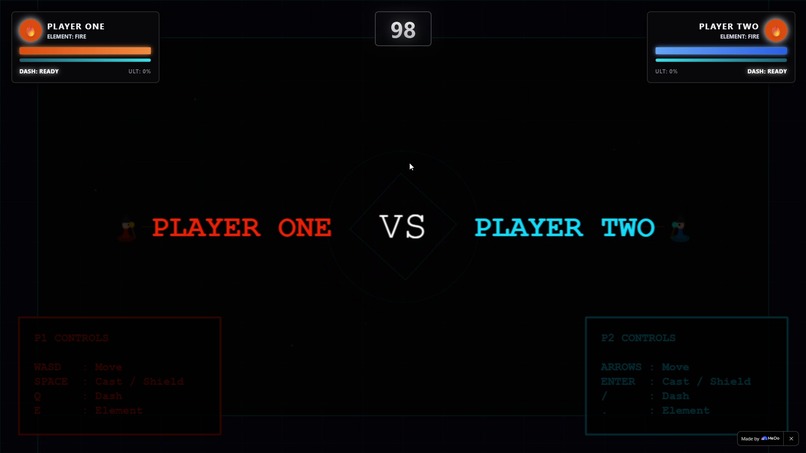
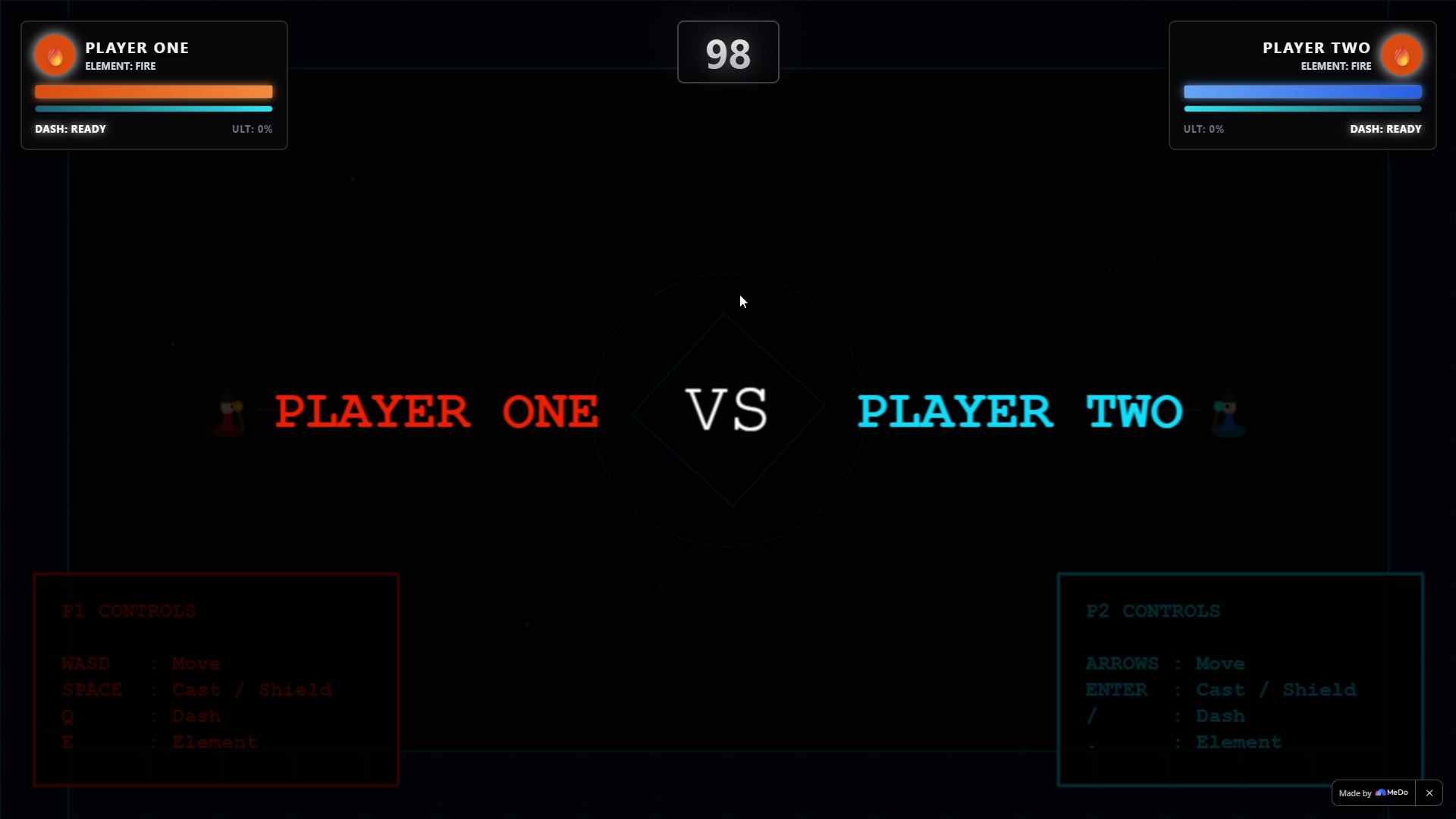
Title scene
-
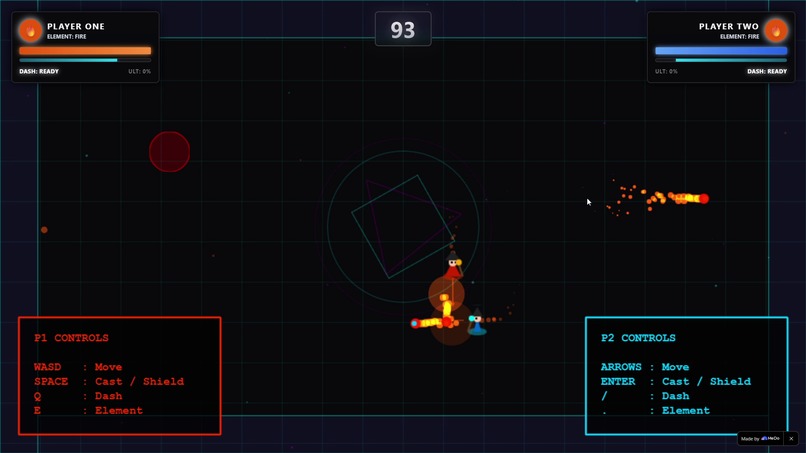
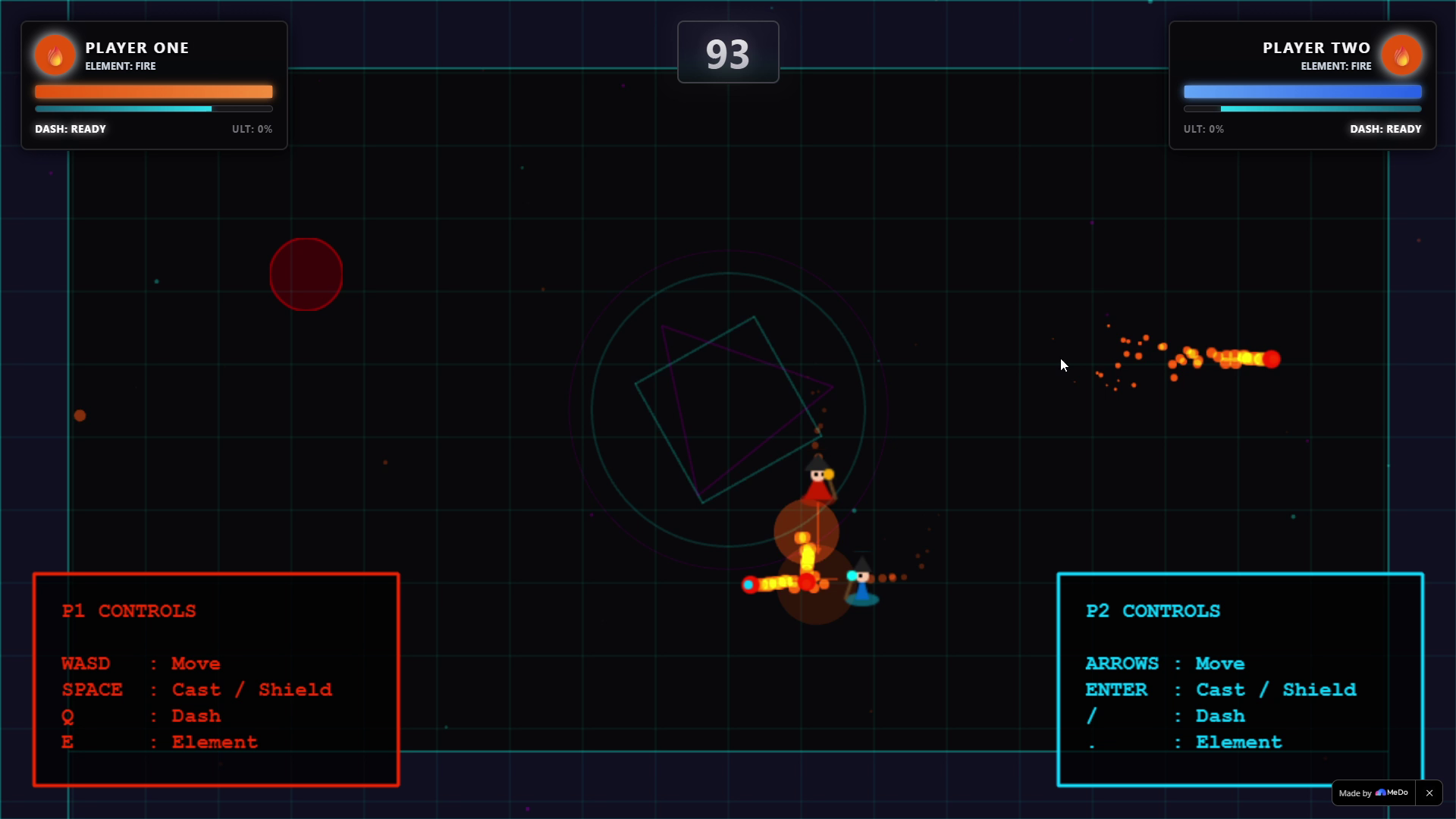
Duel Scene
About the Project
Headline
Wizard Arena is a fast-paced retro local multiplayer wizard battler where two players duel inside a neon magical arena using elemental powers, arcade-style combat, and strategic movement inspired by classic pixel-art games.
Inspiration
Wizard Arena was inspired by classic arcade and couch multiplayer games that focus on simple controls but highly competitive gameplay. We loved the fast-paced energy of retro arena battlers and wanted to combine that with magical combat, elemental powers, and a neon pixel-art aesthetic.
Games with top-down combat and quick reaction-based gameplay inspired the core mechanics. We wanted players to instantly understand the controls while still having room for skill expression through dodging, dashing, deflecting, timing, and element switching.
The idea was to create a game that feels nostalgic like old-school arcade PvP games while still looking modern and stylish with glowing magical visuals and responsive combat.
What it does
Wizard Arena is a 2-player local PvP wizard battle game where players fight each other using elemental magic inside a retro neon arena.
Each player can:
- Move freely around the arena
- Dash to dodge attacks
- Cast elemental magic
- Switch between elements during combat
- Use defensive wind shields strategically
The game currently includes:
- Fire, Ice, Lightning, and Wind elements
- local multiplayer controls
- Health and mana systems
- Retro pixel-art wizard characters
- Neon magical arena visuals
- Dash mechanics
- Match restart system
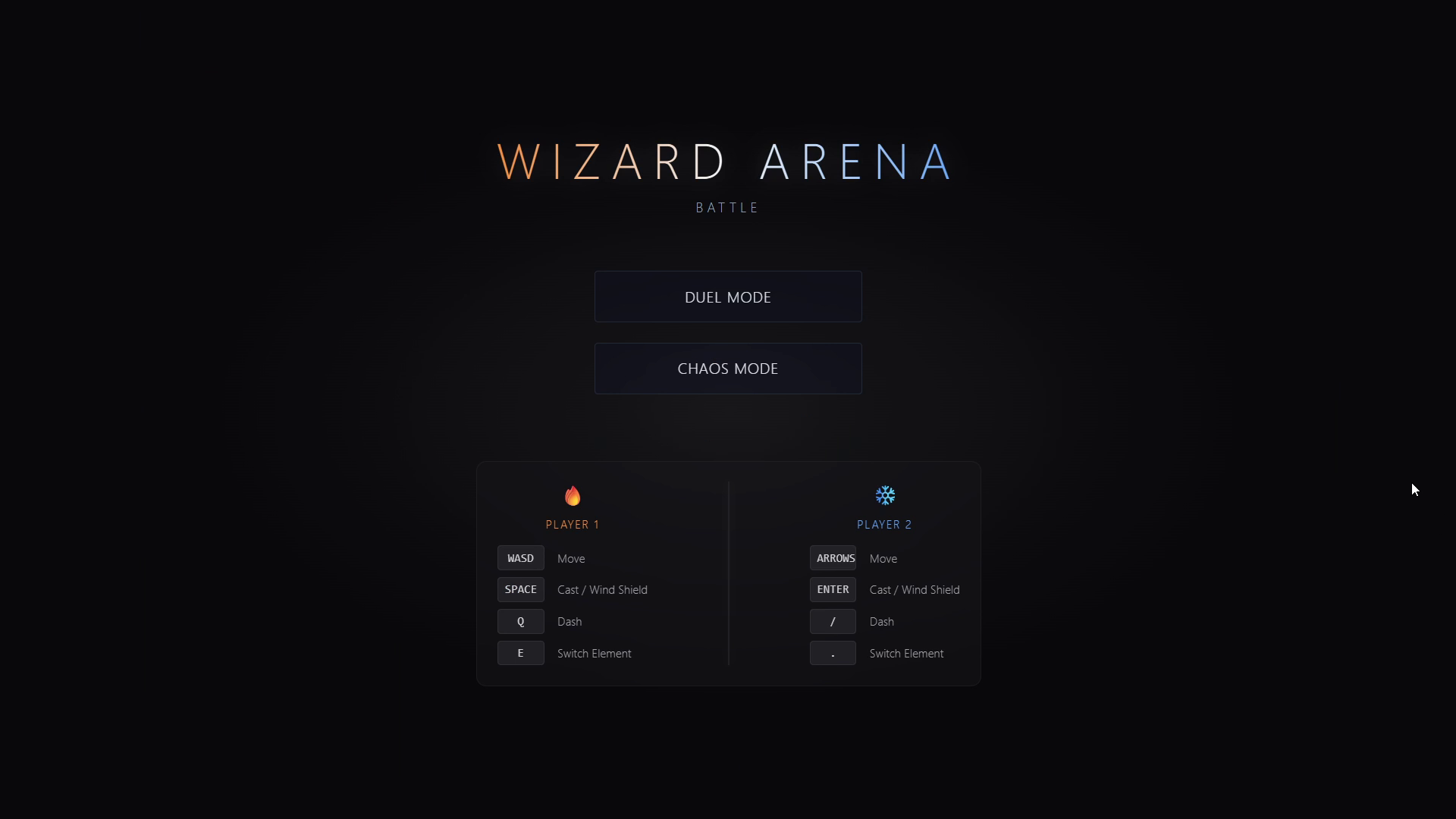
- Main menu and loading screen
The gameplay focuses on fast-paced magical duels where positioning, timing, and quick reactions matter more than complicated mechanics.
How we built it
We built Wizard Arena using an AI-assisted no-code workflow with MeDo AI. Instead of traditional game programming, the project was developed through detailed iterative prompting, constant gameplay testing, visual adjustments, and system balancing.
The development process involved:
- Designing the arena style
- Creating responsive combat mechanics
- Implementing local multiplayer controls
- Building the elemental combat system
- Designing retro pixel-art wizard visuals
- Improving UI responsiveness
- Balancing movement and dash mechanics
- Stabilizing projectile collisions
- Creating menus and match flow systems
A large part of development focused on refining gameplay feel. Small adjustments to movement speed, dash distance, projectile behavior, hit feedback, and UI readability significantly improved the overall experience.
The project evolved step-by-step from a basic prototype into a much more polished retro magical arena battler.
Challenges we ran into
One of the biggest challenges was stabilizing the combat system and collision handling. During development, players would sometimes:
- Lose movement controls
- Disappear after projectile collisions
- Trigger repeated collision loops
- Accidentally share controls between players
Fixing multiplayer input handling was also difficult because both players needed fully independent controls, cooldowns, movement systems, and actions.
Another major challenge was visual readability. Early versions of the game felt cluttered or confusing because:
- Characters were too small
- Projectiles were unclear
- Arenas were overly detailed
- UI elements overlapped on different screen sizes
We also faced challenges balancing simplicity and depth. Some mechanics initially became too complicated or unstable, so we simplified systems like damage effects and shield behavior to keep gameplay smooth and competitive.
Accomplishments that we're proud of
We’re proud of transforming a simple prototype into a fully playable retro magical arena game with a strong visual identity and responsive local multiplayer gameplay.
Some accomplishments include:
- Creating a polished neon pixel-art visual style
- Building responsive 2-player local combat
- Designing elemental combat mechanics
- Implementing smooth dash movement
- Making the entire UI responsive
- Creating a stable arena battle loop
- Developing a full menu-to-match gameplay flow
- Building the game entirely through an AI-assisted workflow
We’re also proud that the final game feels much closer to a real arcade PvP experience rather than just a technical prototype.
What we learned
This project taught us how important game feel, iteration, and responsiveness are in multiplayer games.
We learned that:
- Small gameplay adjustments can completely change player experience
- Readability is more important than visual complexity
- Simpler mechanics often create better gameplay
- Multiplayer systems require careful separation of inputs and states
- Fast iteration and testing are essential for game development
We also learned how powerful AI-assisted workflows can be for rapidly prototyping and developing ideas. However, we discovered that even with AI tools, strong design decisions, testing, balancing, and debugging are still extremely important.
The project helped us better understand:
- Combat design
- UI scaling
- Local multiplayer systems
- Arena readability
- Retro visual direction
- Gameplay polish
What's next for Wizard Arena
We plan to continue expanding and polishing Wizard Arena with additional content and gameplay improvements.
Future plans include:
- More magical arenas
- Better visual effects and animations
- Sound effects and music
- Online multiplayer support
- New elemental abilities
- Ranked and tournament modes
- Additional wizard skins
- More responsive combat polish
- Spectator mode
- Better AI opponents
We also want to improve the overall presentation with:
- Better transitions
- Enhanced visual feedback
- More polished menus
- Improved lighting and atmosphere
Our long-term goal is to evolve Wizard Arena into a complete competitive retro magical arena battler that feels fun, fast, and replayable both casually and competitively.
Built With
- d3.js
- drei
- framer-motion
- gsap
- matter.js
- phaser.js
- pixijs
- rapier
- react
- react-three-fiber
- supabase
- tailwind-css
- three.js
- tone.js
- typescript
- vite
- zustand

Log in or sign up for Devpost to join the conversation.