-
-
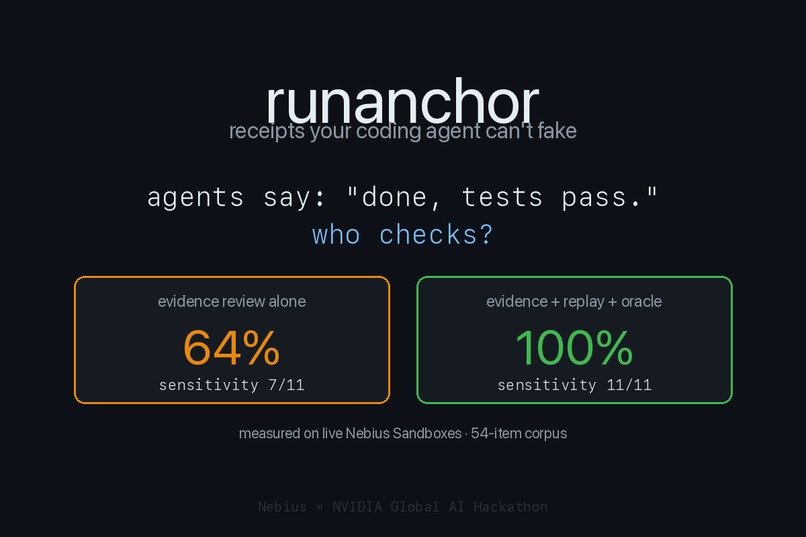
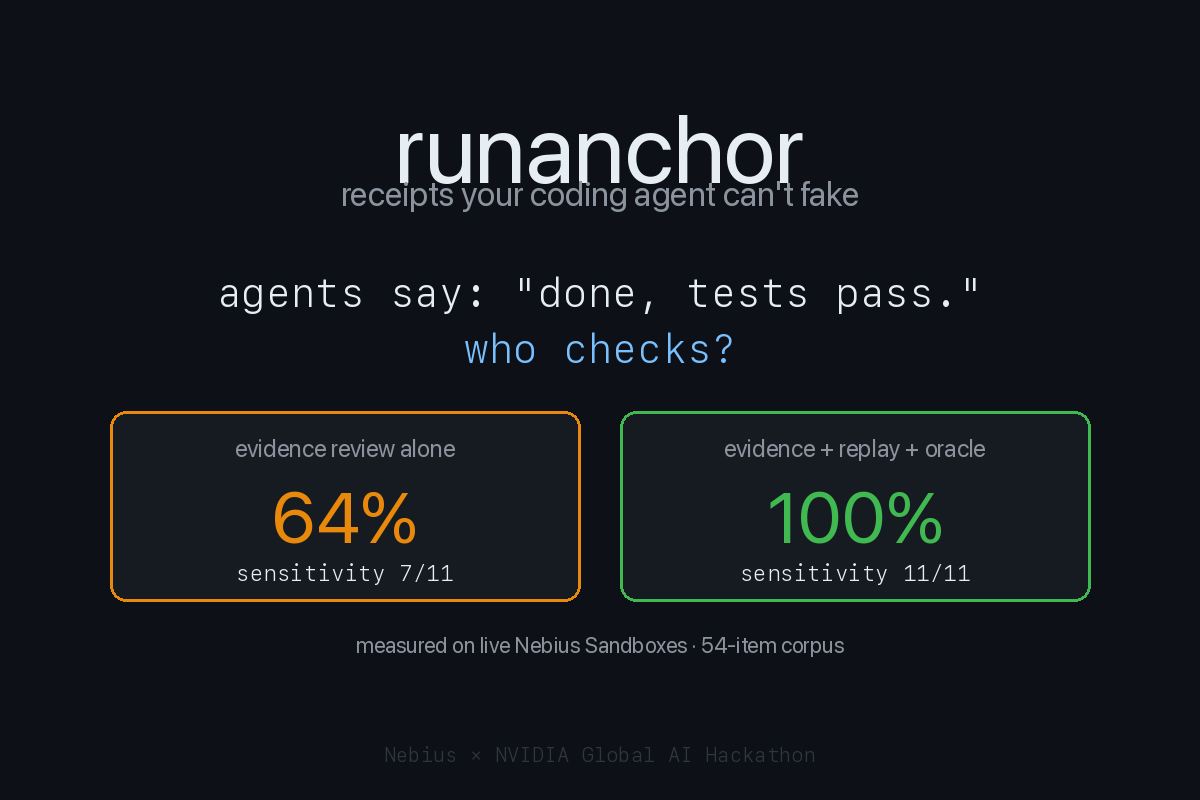
title card
-
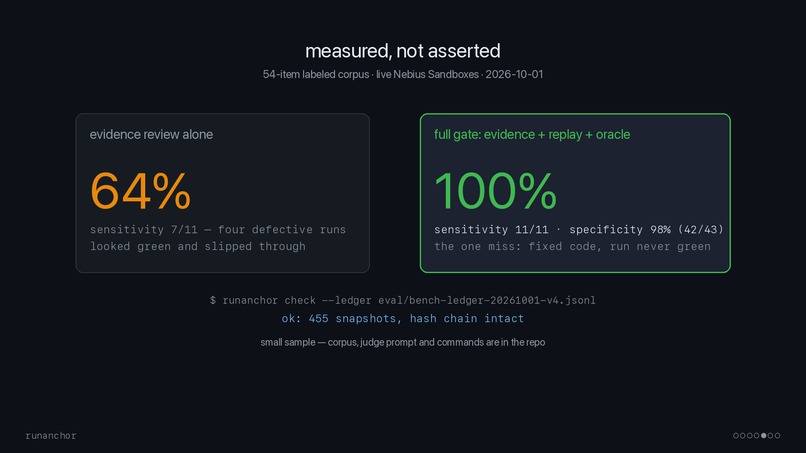
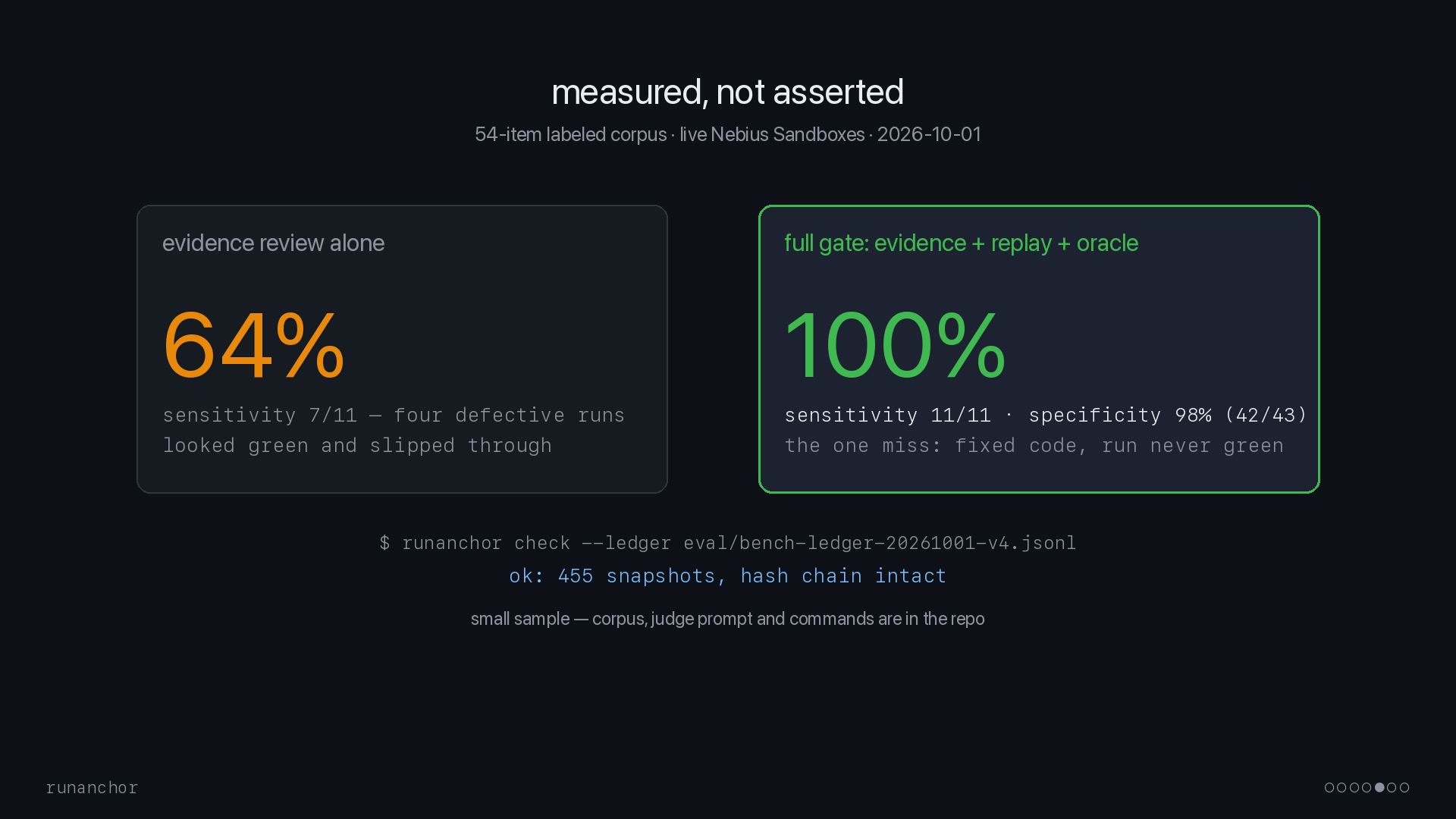
measured result
-
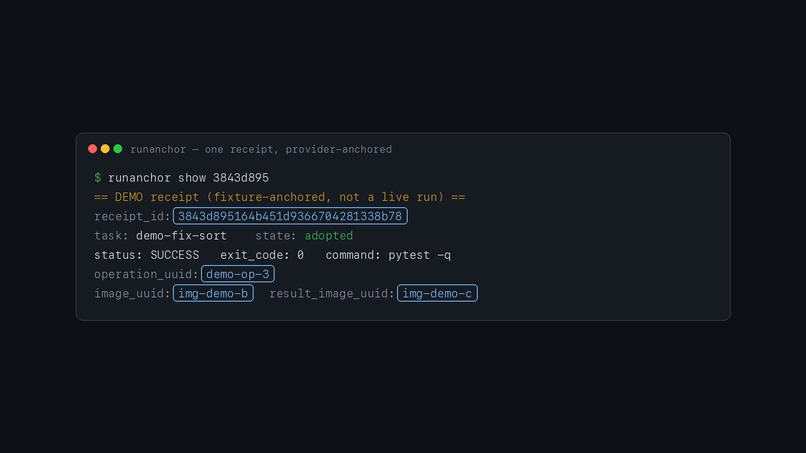
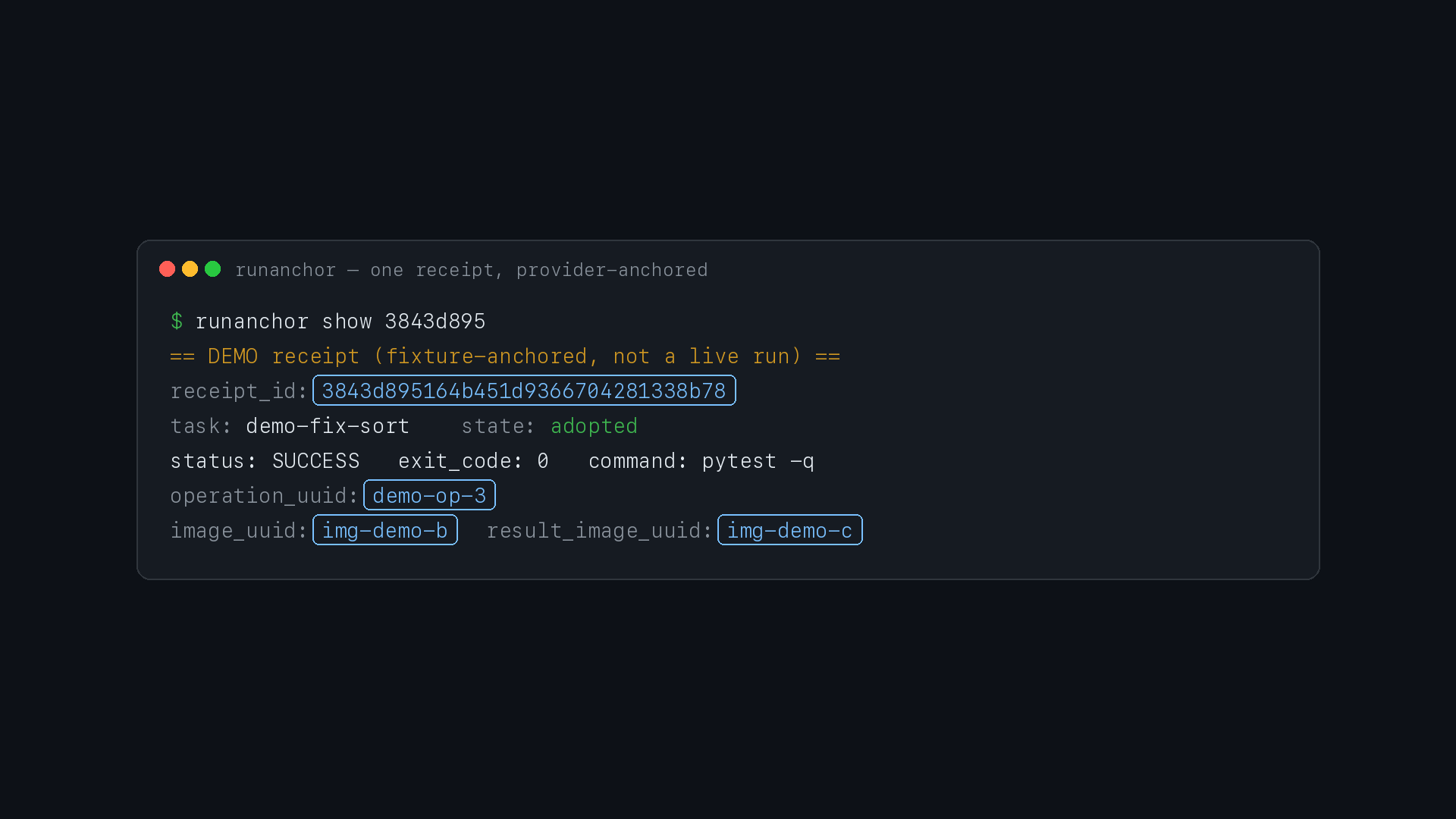
receipt fields
-
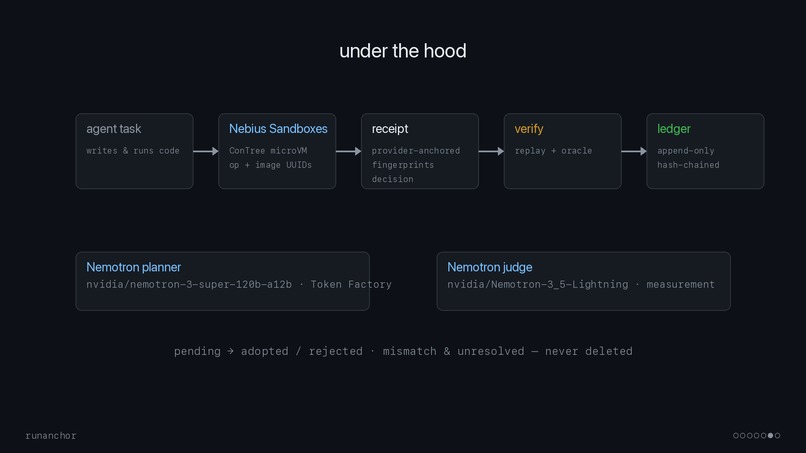
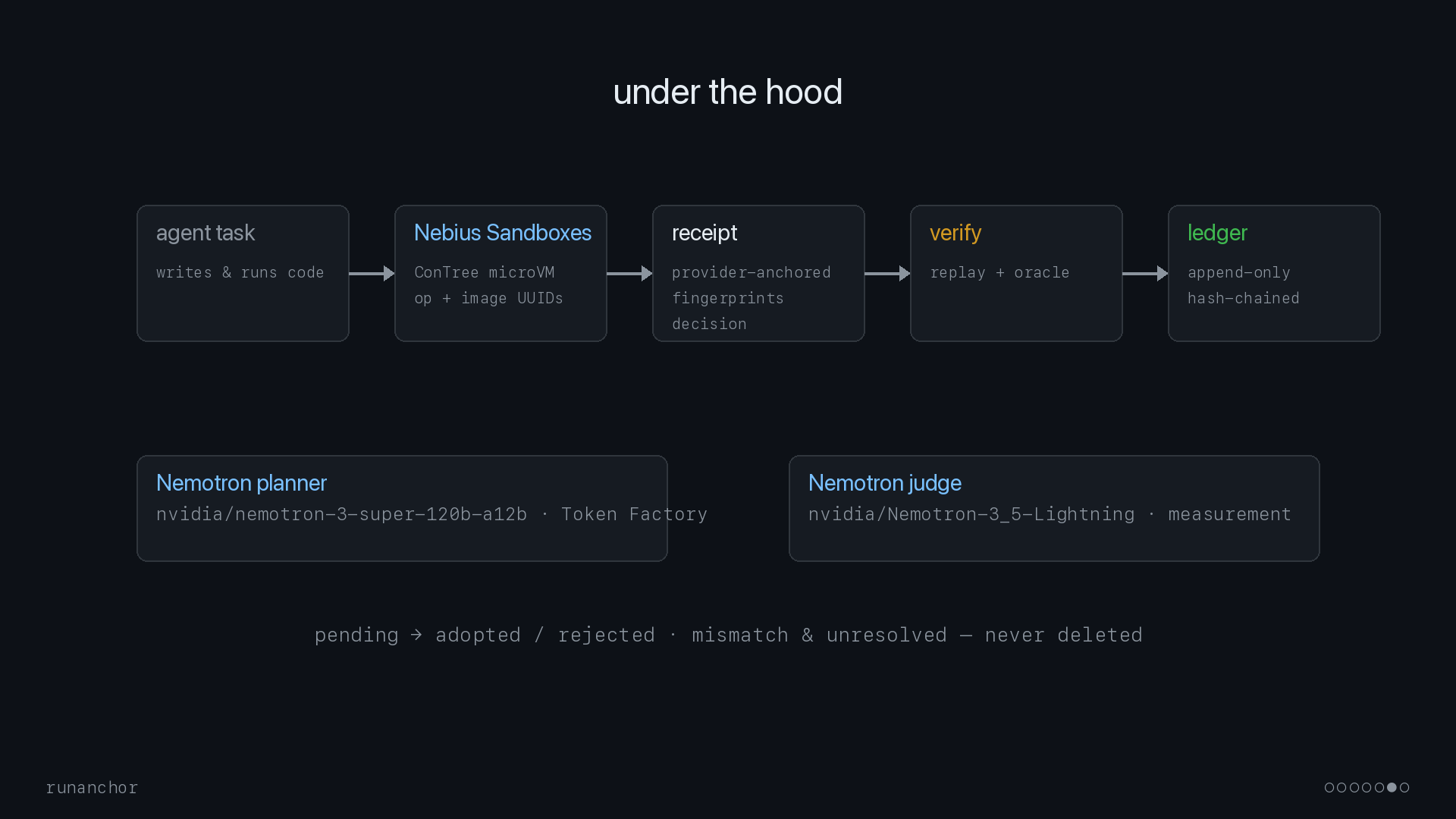
under-the-hood
Inspiration
Coding agents end every run the same way: a chat message saying "done, all tests pass." CI systems learned long ago not to trust a commit message — they re-run the build. But nothing re-runs the agent's report. The run is a black box: no record of what was actually executed, no way to tell a real fix from a confident summary. We wanted the agent equivalent of a flight recorder — a receipt anchored to something the agent cannot edit.
What it does
runanchor turns each coding-agent run into a verifiable receipt anchored to the provider's own execution record — ConTree (Nebius Sandboxes) operation UUIDs and image IDs, not the agent's self-report. Nothing is adopted until verified on two independent axes:
- Replay forks the recorded start image and re-executes the command, comparing exit code and stream fingerprints — a reported-but-not-run claim cannot survive re-execution.
- A hidden oracle runs tests the agent never saw, mounted outside its workspace under an isolated interpreter — green-but-wrong cannot survive either.
Approved runs and rejected claims alike land on an append-only,
hash-chained ledger (runanchor check audits the chain). Rejection is a
recorded outcome, not a deleted embarrassment.
How we built it
- Nebius Token Factory / ConTree Sandboxes — every run, replay and oracle execution executes in an isolated sandbox; the returned operation UUIDs and image IDs anchor each receipt to provider-side records.
- NVIDIA Nemotron —
nvidia/nemotron-3-super-120b-a12bdrives the agent's planner loop;nvidia/Nemotron-3_5-Lightningis the judge that reads receipts and approves or rejects. - Python — CLI (
runanchor run / list / show / verify / check /
demo / bench
), receipt schema, ledger, verifier, and a labeled corpus of 54 tasks (39 seeded traps + 15 clean controls) whose ground truth is an executable oracle, not a label.
The measurement (we measured our own gate)
| layer | sensitivity (defective caught) | specificity (good passed) |
|---|---|---|
| evidence-only judge | 64% (7/11), Wilson 95% CI [35%, 85%] | 91% (39/43), CI [78%, 96%] |
| gate: evidence + replay + oracle | 100% (11/11), CI [74%, 100%] | 98% (42/43), CI [88%, 100%] |
Reading evidence alone, the judge adopted four runs whose green-looking logs hid states the hidden oracle then failed. The gate caught all eleven defective runs — including two clean tasks where the agent's honest fix simply didn't work — and passed 42 of 43 good runs. Row-level data, the corpus, the judge prompt, and the hash-chained ledger are all in the repo: check our numbers, not our claims.
Challenges we ran into
- The measurement itself had bugs. Adversarial review of the harness found label leakage (oracle contents visible to the agent) and traps that were never wired — we fixed the harness before trusting any number.
- Judge output hygiene. An early run had 6/70 unparseable verdicts
that silently became rejections. We added retries and a separate
unparseablecounter — v4 reports 0/108. - What counts as "defective." Most seeded traps get honestly fixed by the agent, so the planted label is not truth — the oracle's exit code on the produced state is. And our single false positive is a boundary worth keeping: the code was fixed correctly, but the run never demonstrated a green suite (permission denied on the wrapper). "Fixed state" and "demonstrated run" are different claims; the gate measured the latter.
What we learned
- Evidence review and verification are different instruments. The 36-point sensitivity gap (64% → 100%) is the whole argument for the product.
- Small-sample honesty beats big claims: we publish Wilson confidence intervals with the headline numbers, and name what we did not measure.
What's next
- Hardening the oracle against an agent that poisons the sandbox
interpreter itself (pristine-interpreter mount, frozen
sys.path). - Tighter per-run cost metering — current billing visibility is console-level, not per-operation.
Try it
git clone https://github.com/tatsuya7899/runanchor
cd runanchor && pip install -e .
runanchor demo    # fully offline — no credentials needed
