Inspiration
It’s funny how, when you actually sit down and trace it back, these tracks all start in really humble, almost ridiculous ways. For Run // Gone it wasn’t some grand concept – it was me being annoyed about people blocking traffic.
Aidan – who happily calls himself “ghostwriter in the shell” – is all about dense, thoughtful lyrics and big statements about life, politics, systems. I’m not a stranger to writing or flow once I have something to work with, but starting from zero has always been challenging for me. I’ve never been the “secret notebook of poetry” person; lyrics are closer to poems than prose, and that kind of condensed use of words has never come naturally to me.
One day I was venting to Aidan: “I know exactly what kind of music, melody, vibe I want – I just don’t know what to write about.” I use language models to refine lyrics, clean up phrasing, or help with rhythm and rhyme, but I don’t want them to write for me. It always feels too impersonal, too obviously AI. Lyrics need that tiny human fracture in them – something lived, not just generated.
Aidan just went: “Write what you know. Write what you’re frustrated with. You have so many opinions.” We drifted into talking about how he leans more into societal and political commentary, and how that’s not quite where I want to live. I want meaning, but not sermon. More… pondering. And the kind of electronic space I want to occupy doesn’t always marry well with super-dense lyrical essays.
So, half joking, I opened a notes app and started writing a verse about exactly what was annoying me that day: people blocking the fast lane, refusing to move over, that stubborn sense of importance it sometimes gives them. Once I had that first verse down I just stared at it and thought: “…oh. This could be something.” Write what you know, right?
From there, Run // Gone on my side became pure energy: my frustration, my love for cars and speed, all condensed into this high-voltage track I’d want blasting on the highway at night. I built the original version in Suno as a high-energy electronic track with a strong melodic backbone and this anxious, forward-leaning vocal hook about running, skin crawling, headlights low, night eating the map. It was about escape, but not gentle escape – more like: I’m shaking, but I’m still going.
Then I sent it to Aidan “for feedback”. He didn’t just like it – he immediately heard space for one of his hyper-dense, aggressive verses and jumped in properly. He sent the track back with his own rap performance baked in, bringing that trap-leaning, razor-sharp energy he does so well. Suddenly the song shifted: my vocal became the panic and the urge to run; his verse became the pivot into full main-character mode.
That tension is the core of the track for me: anxiety in the verses, catharsis in the drops, and then Aidan kicking the door in with a verse that feels like the alter ego who’s done being hunted. I love that duality – the mix of restless urgency, skin-crawling moments and this huge, uplifting electronic release. It’s not feel-good uplifting; it’s the kind where the beat drags you through the panic until your body decides for you: we’re running. We’re doing this.
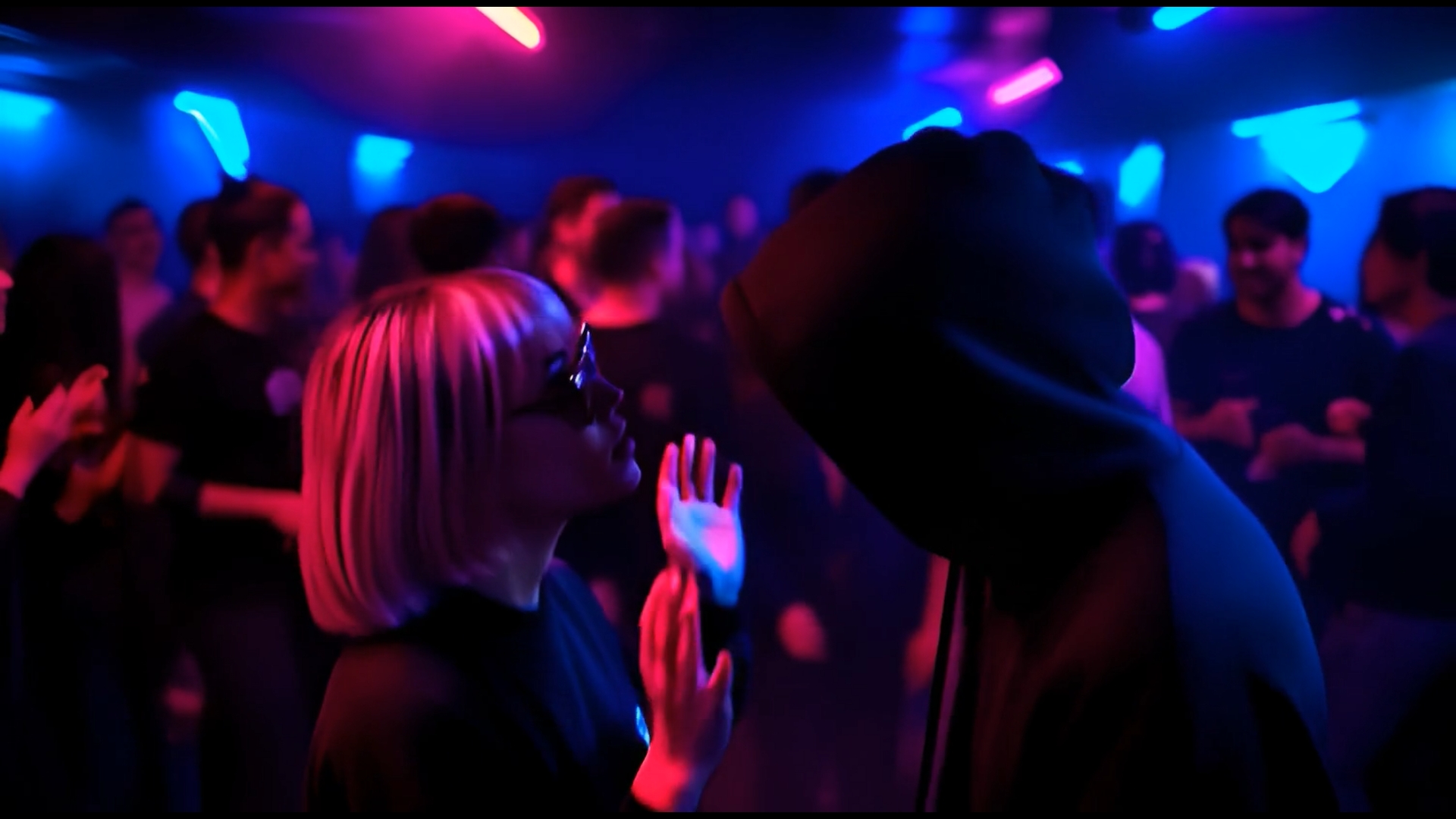
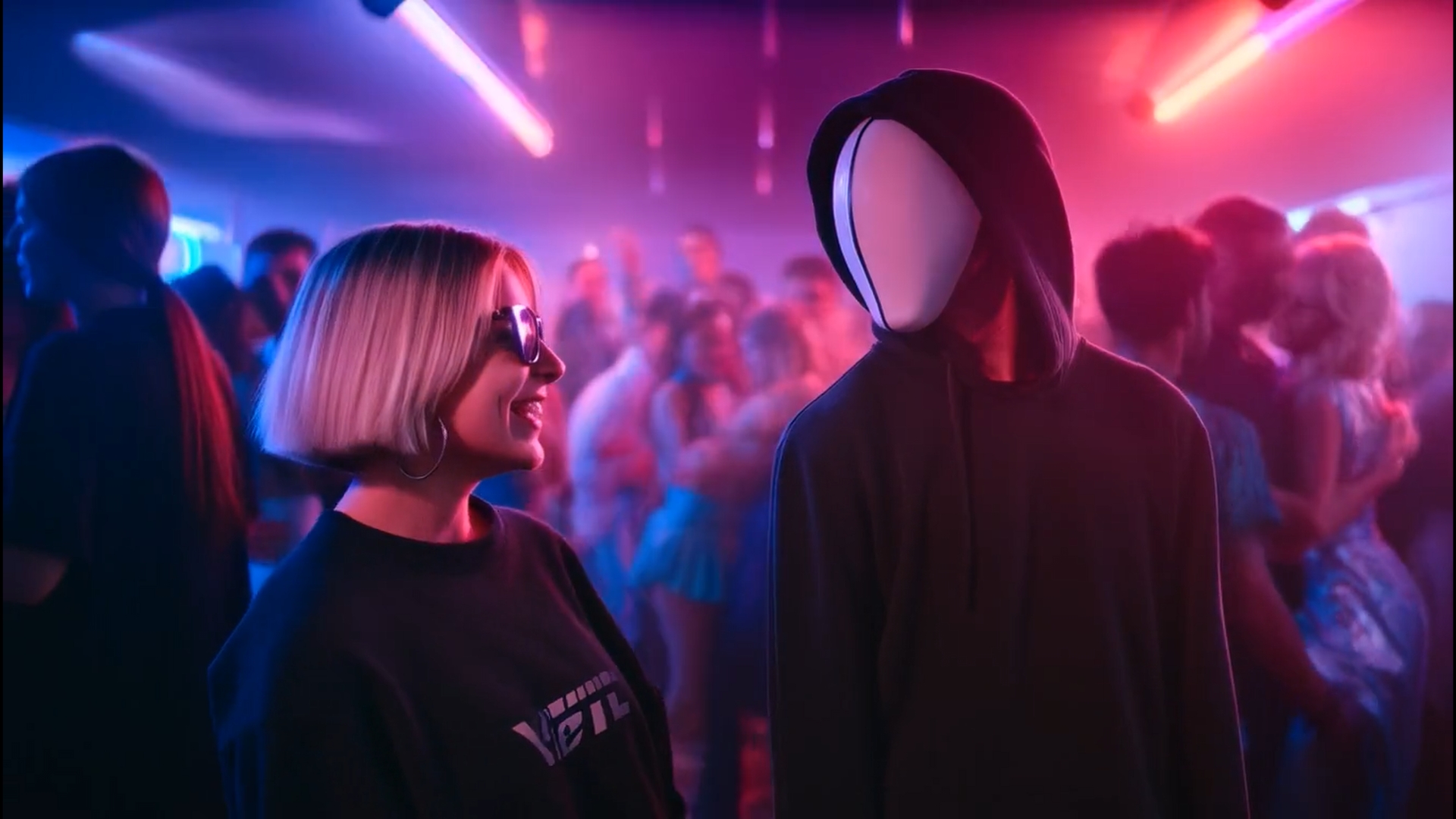
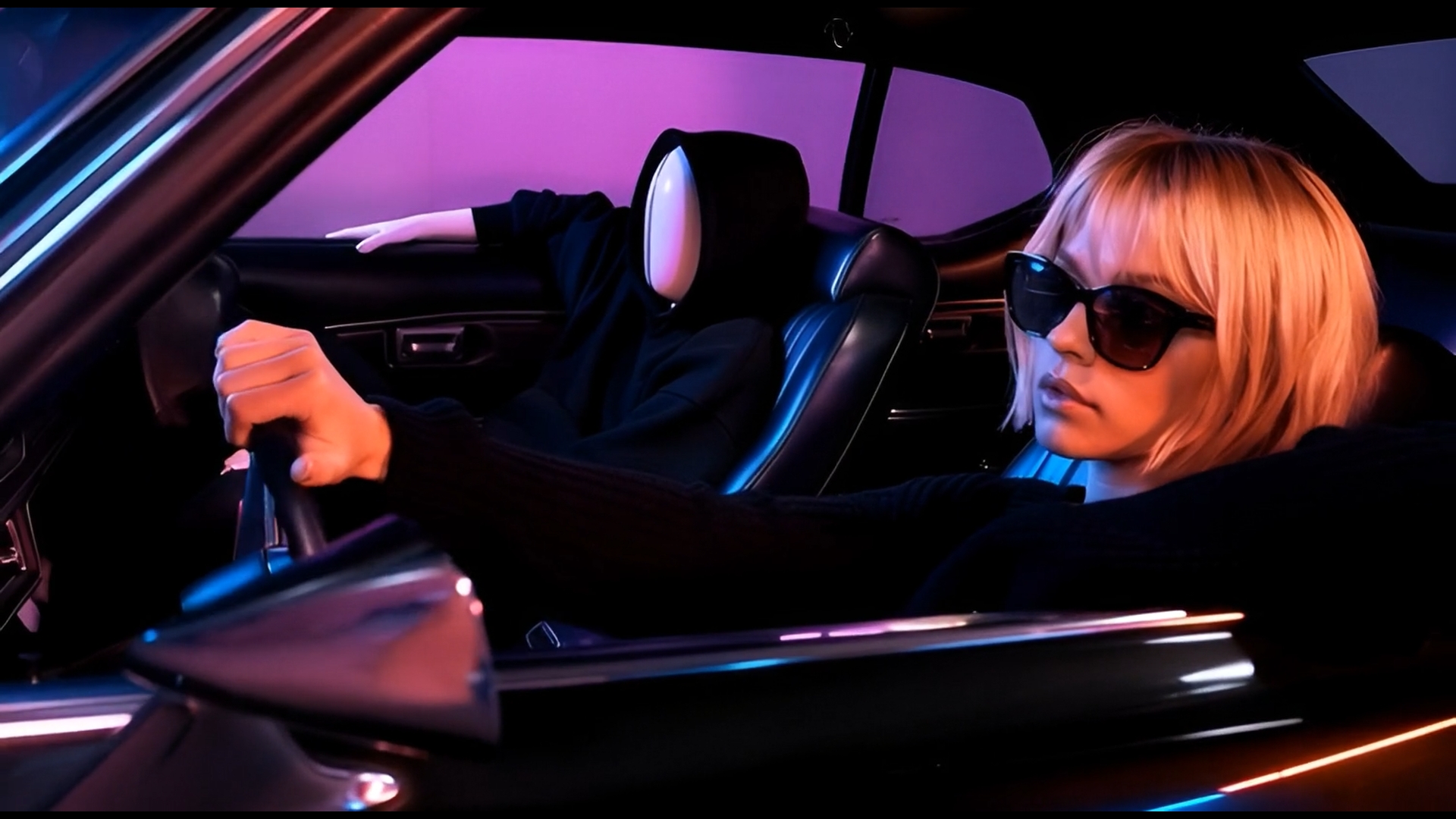
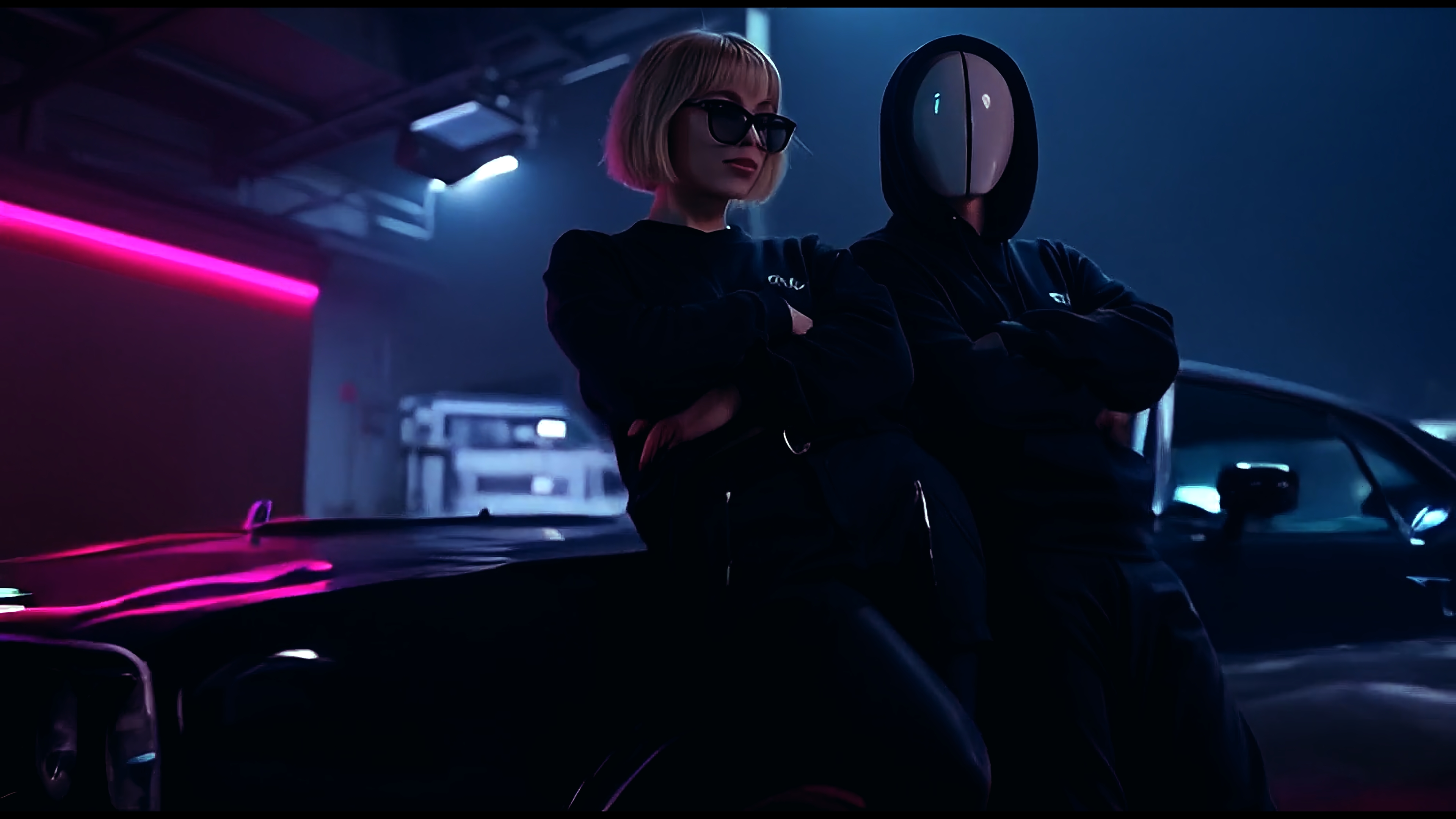
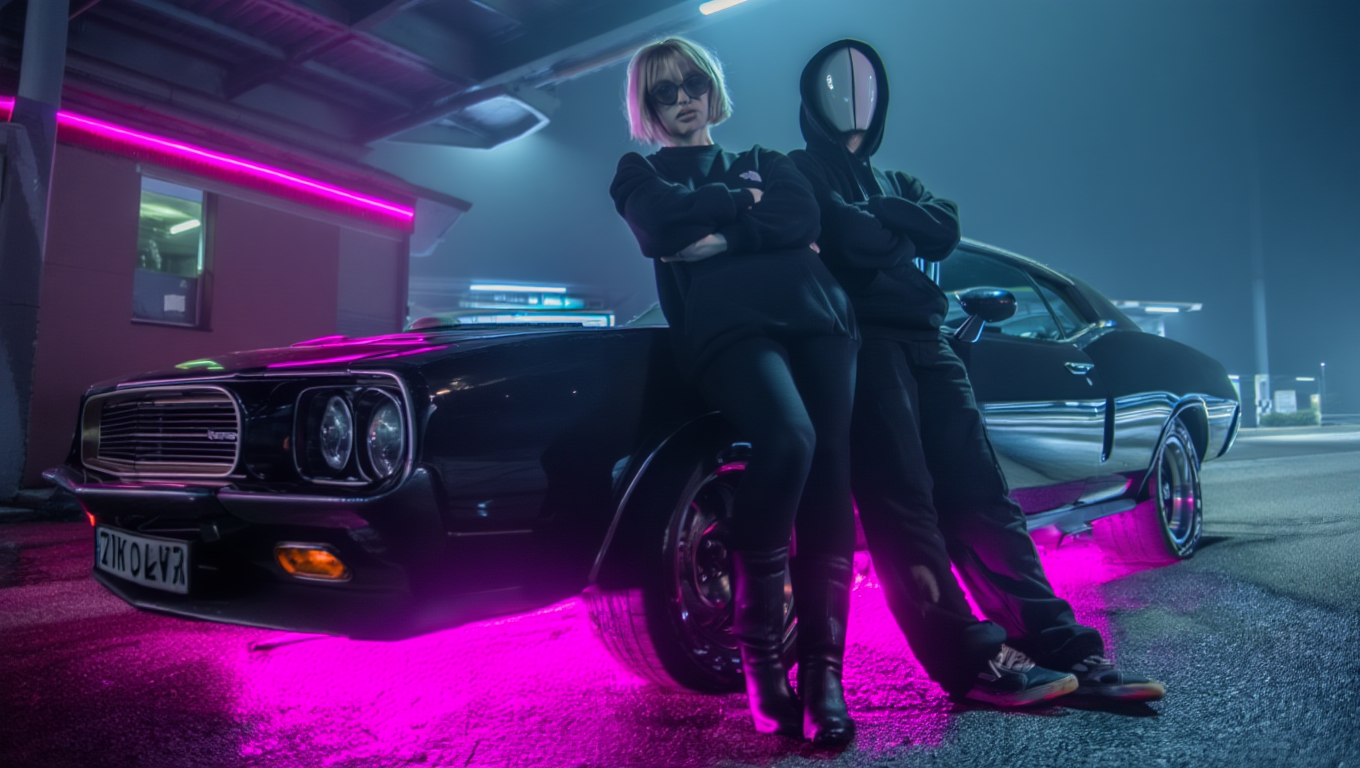
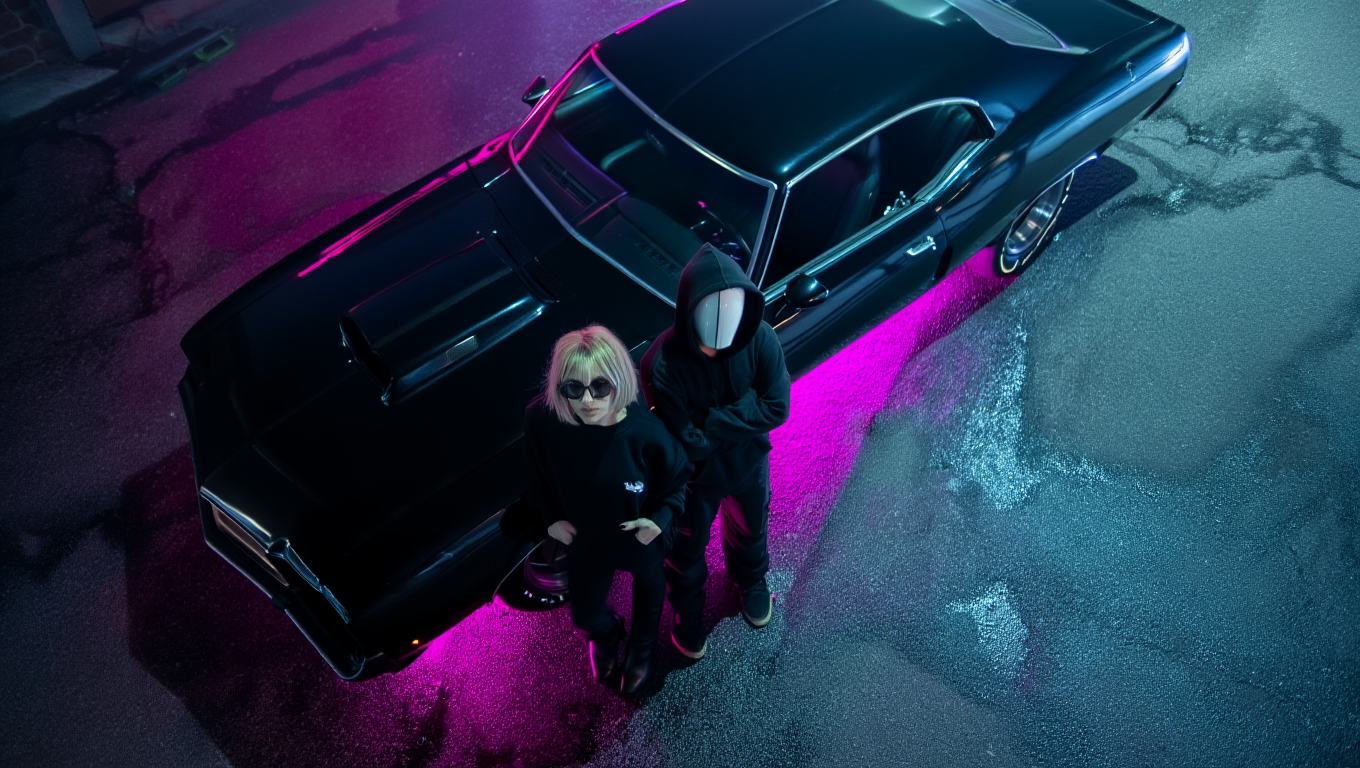
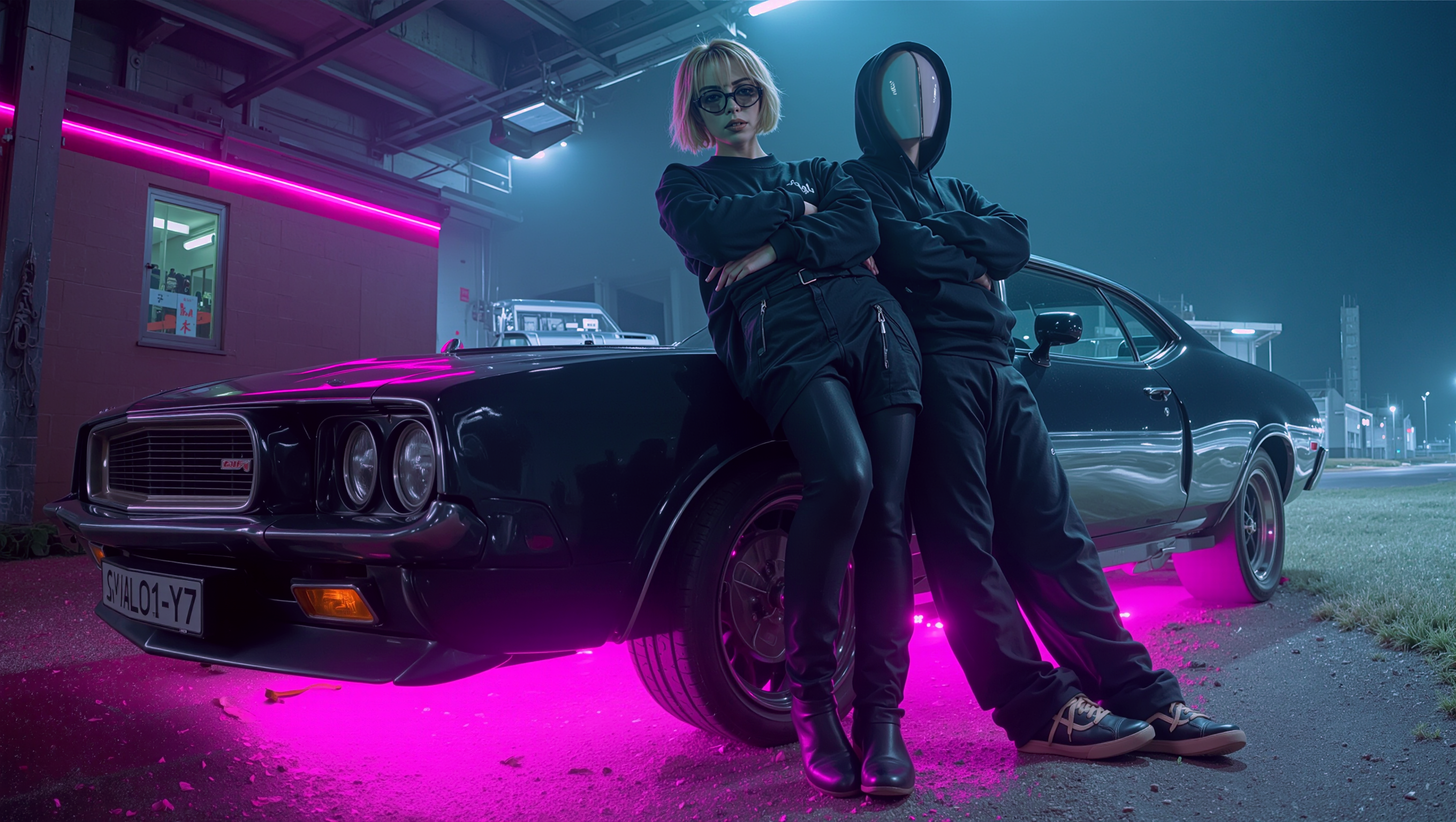
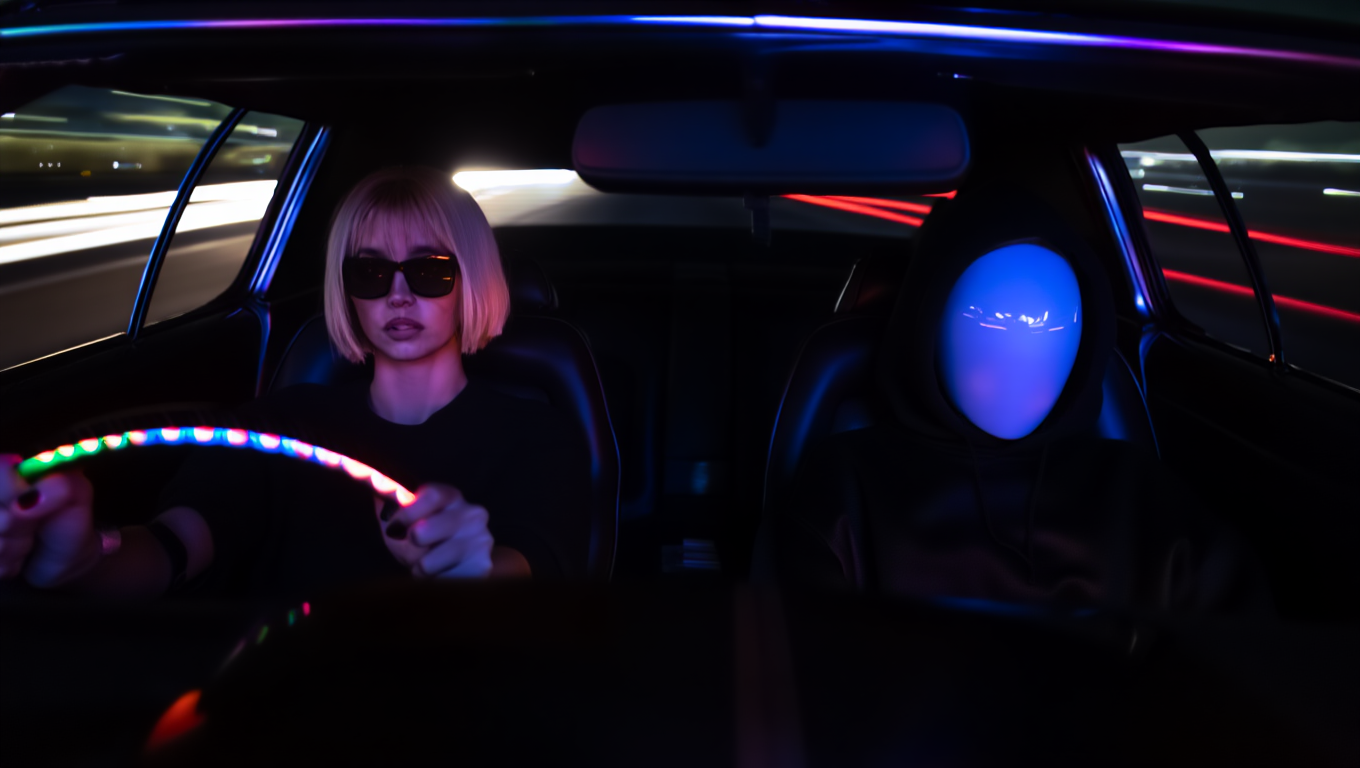
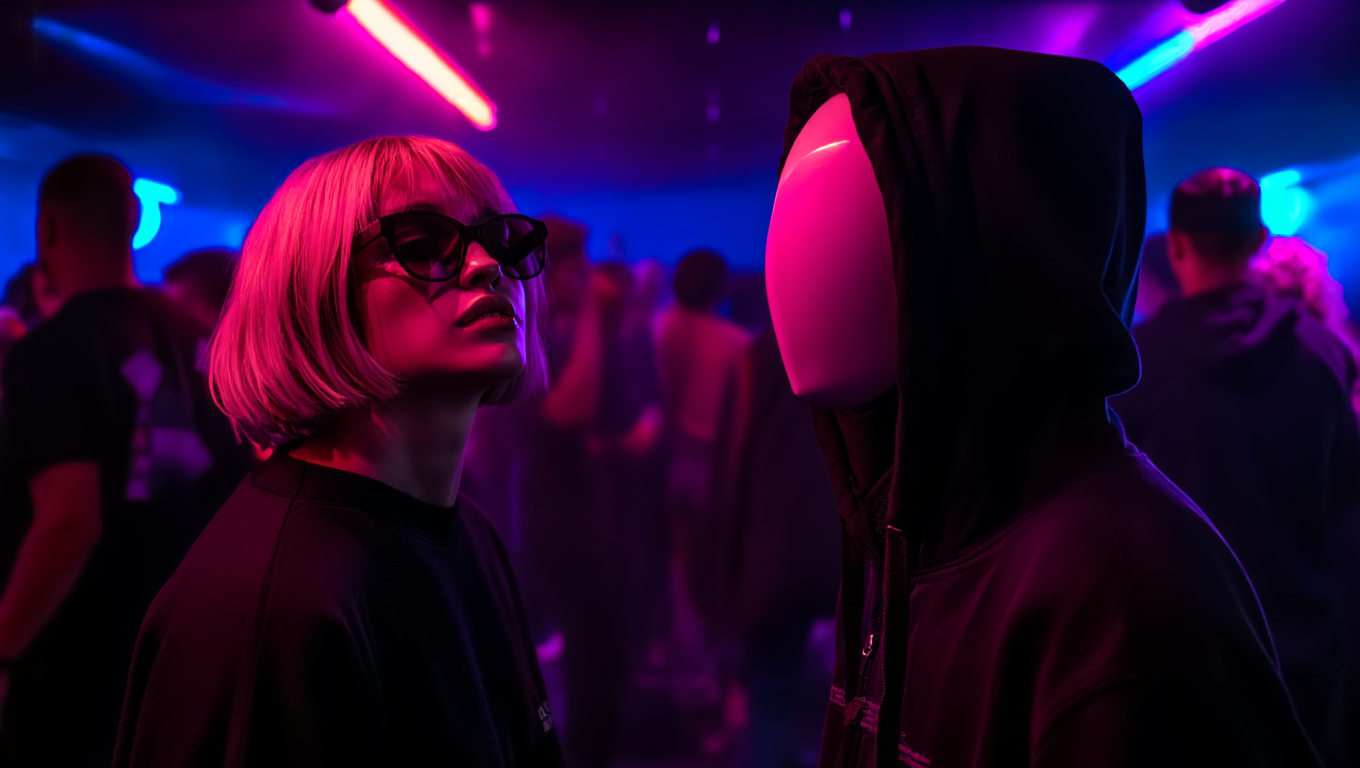
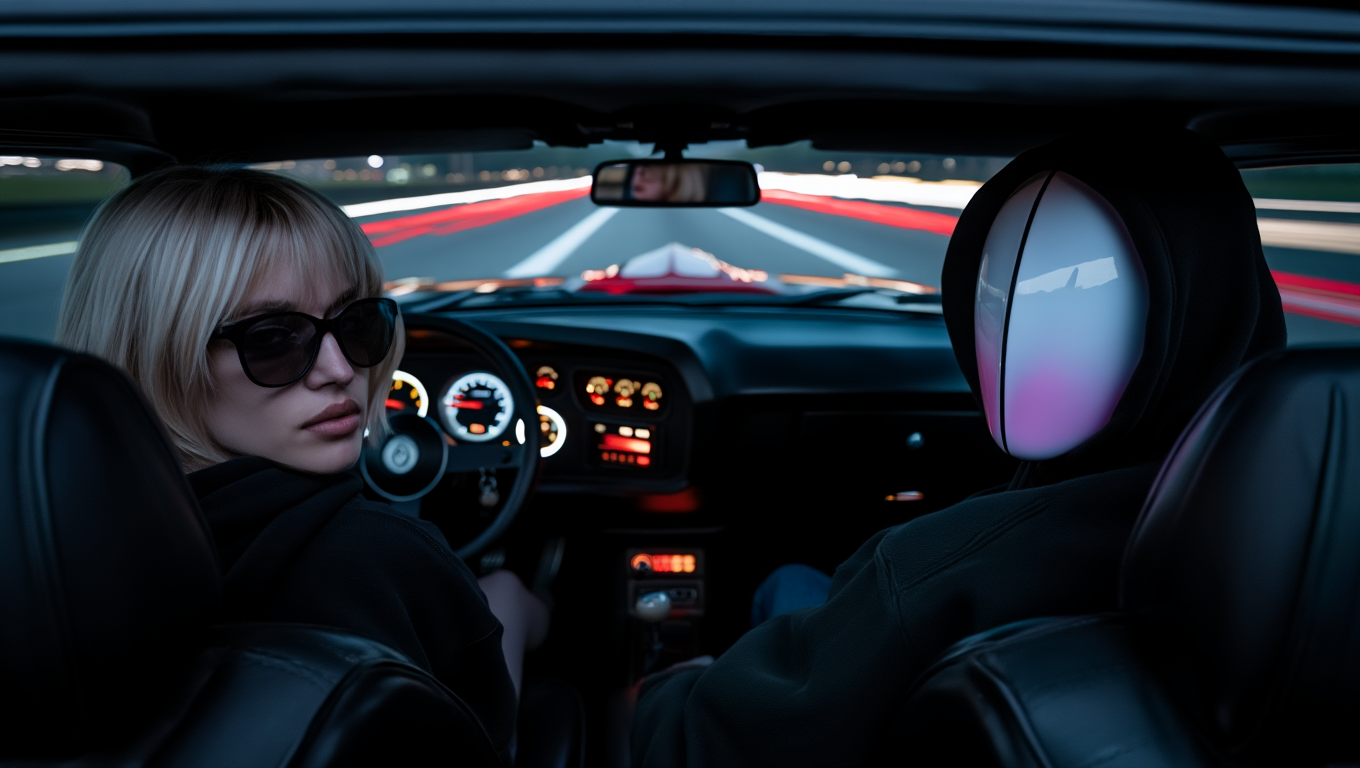
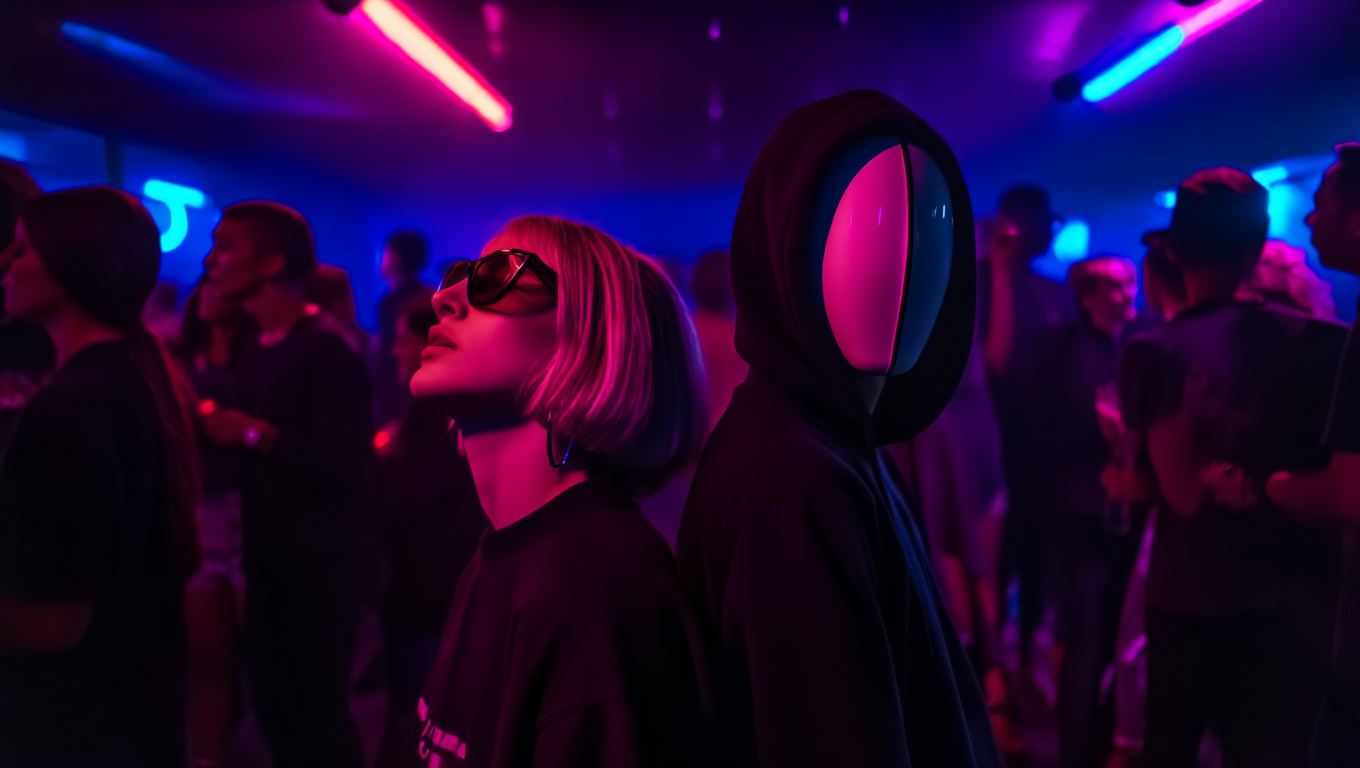
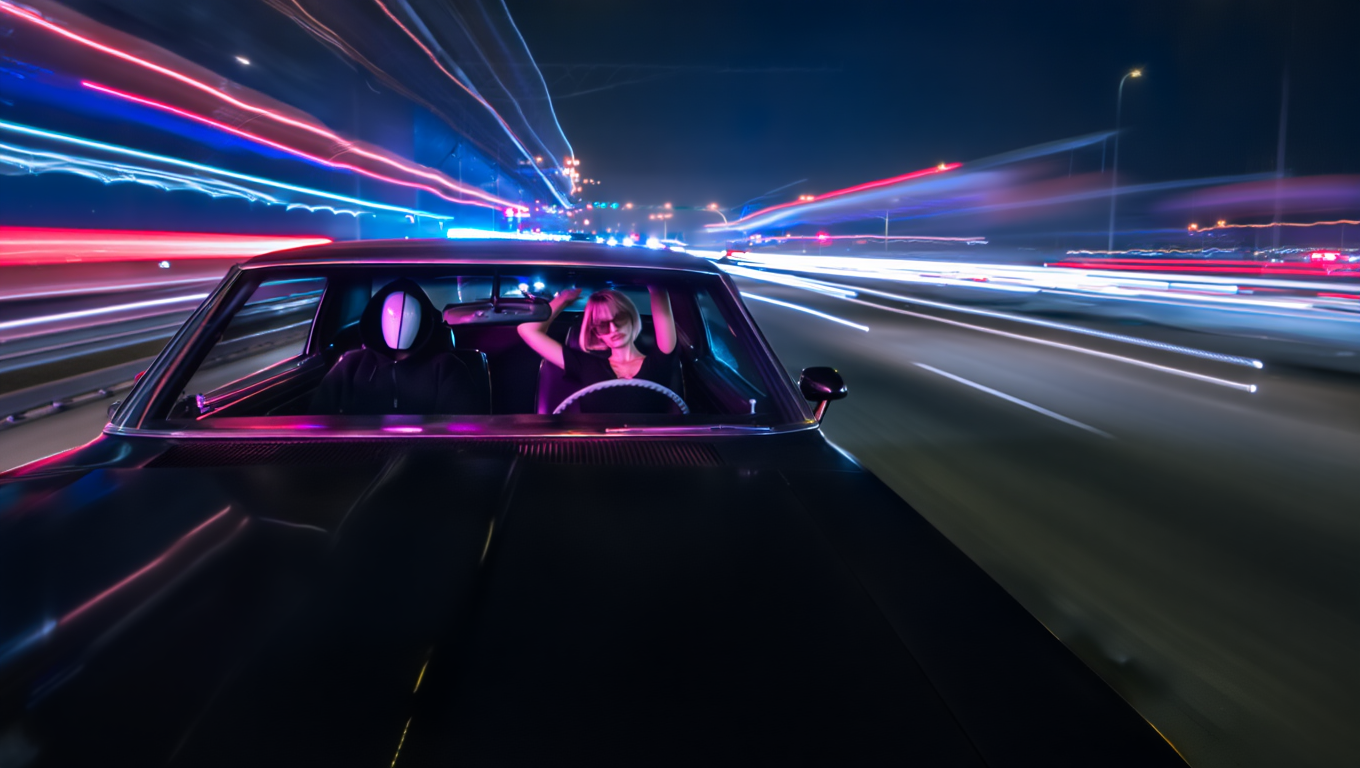
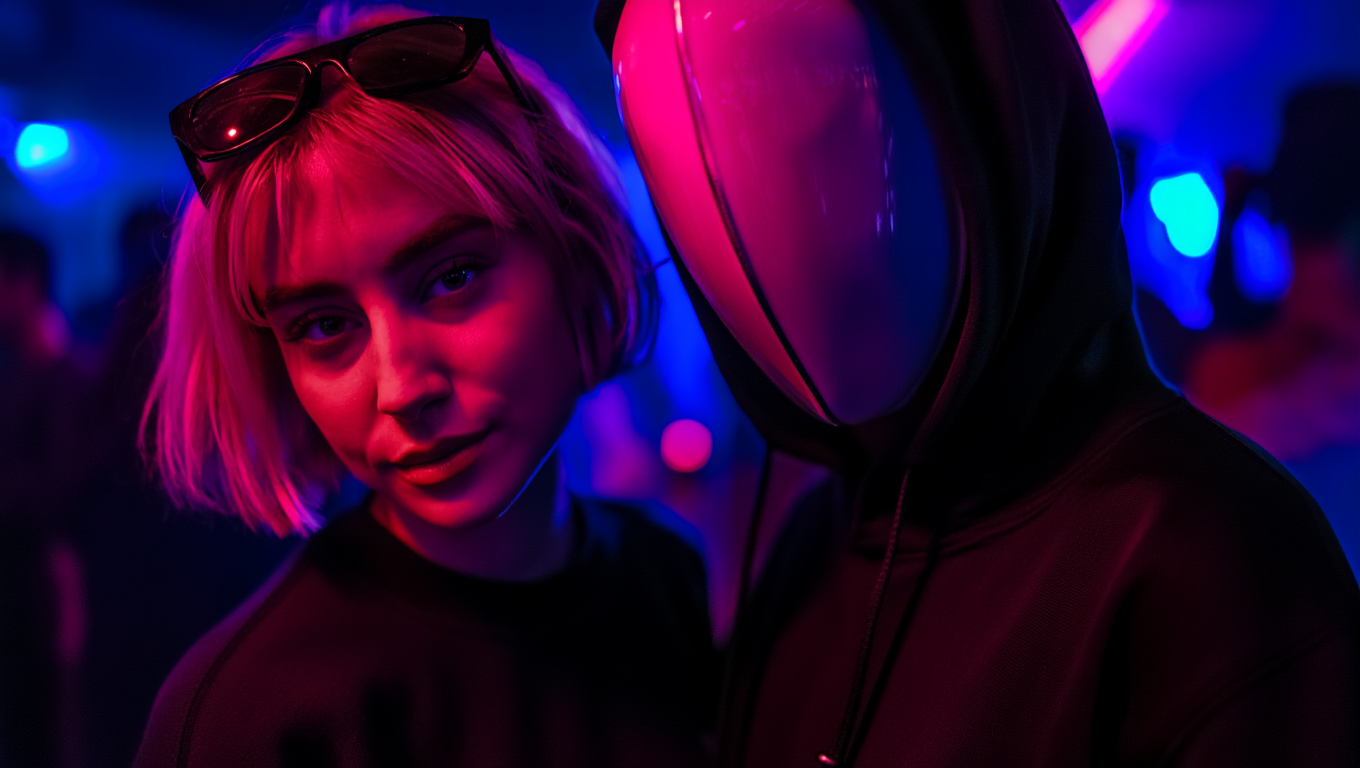
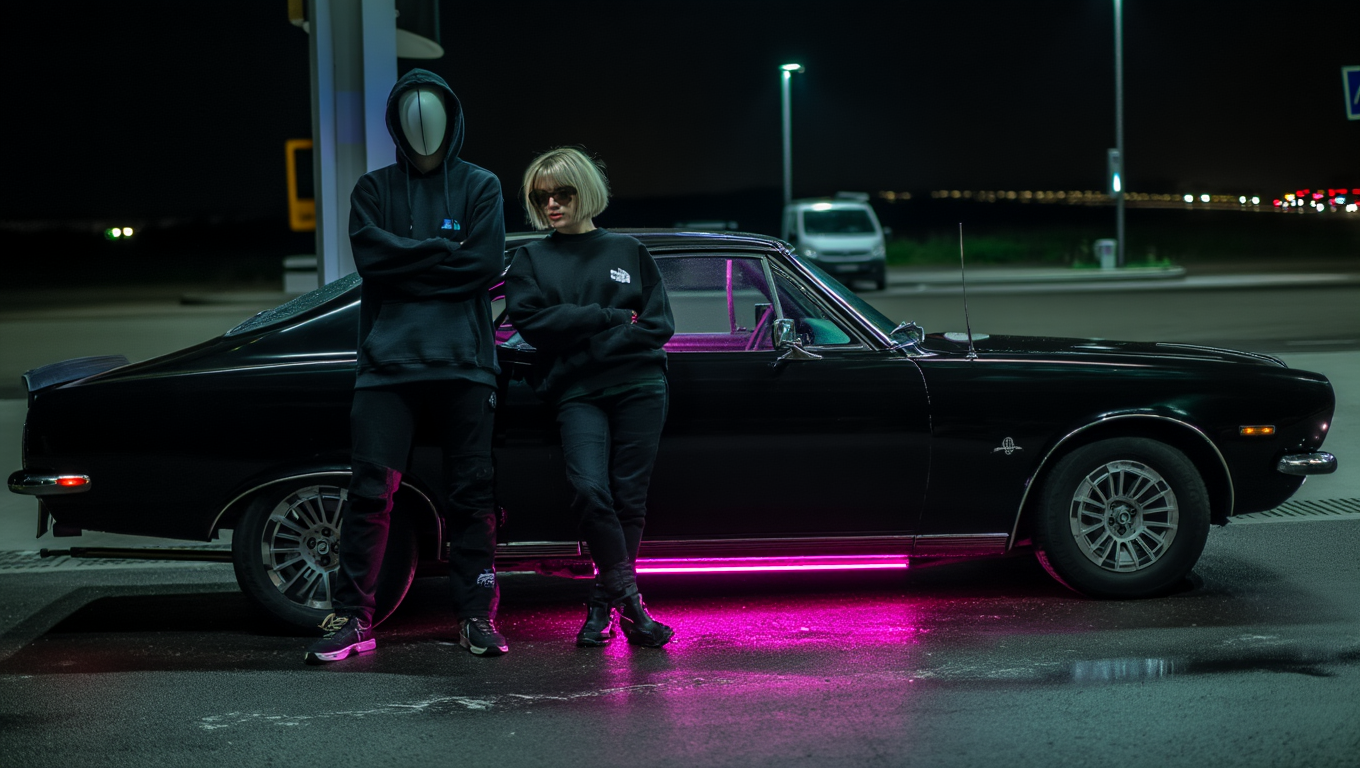
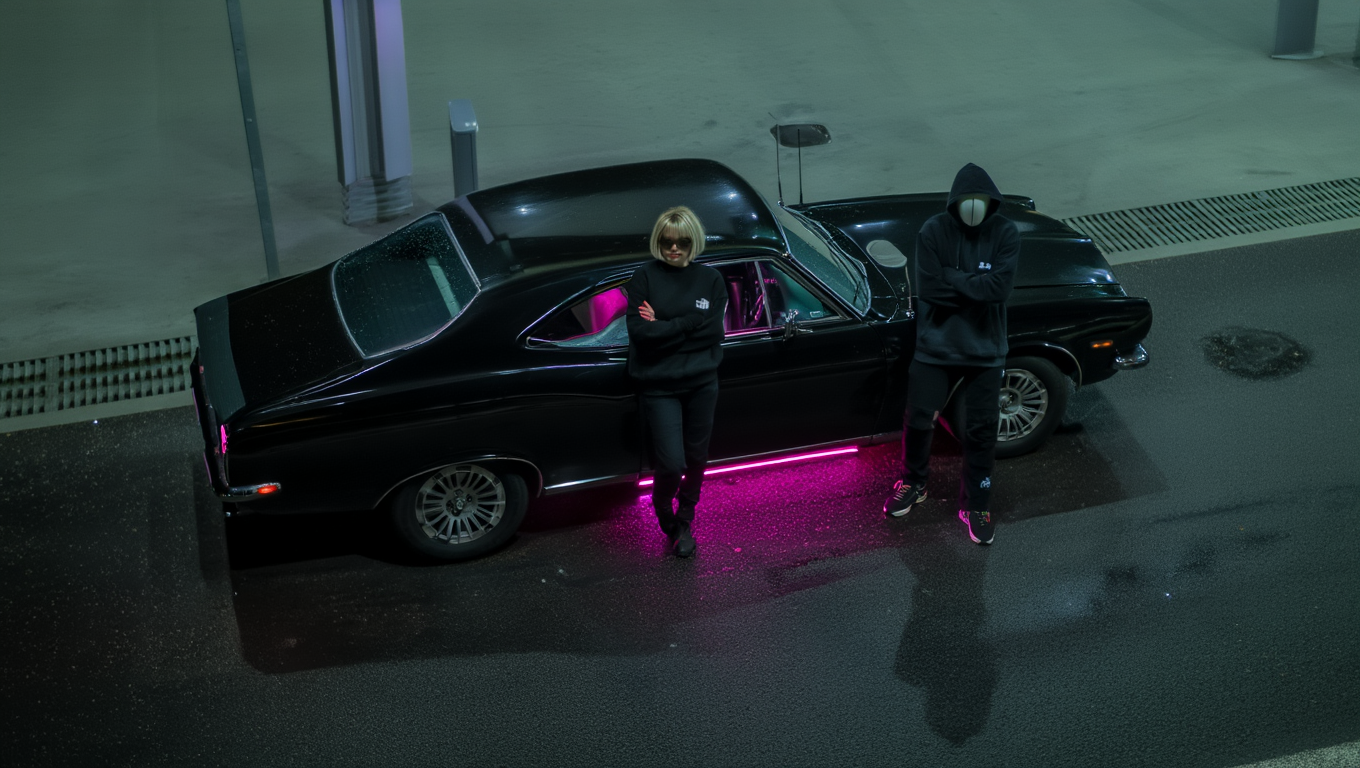
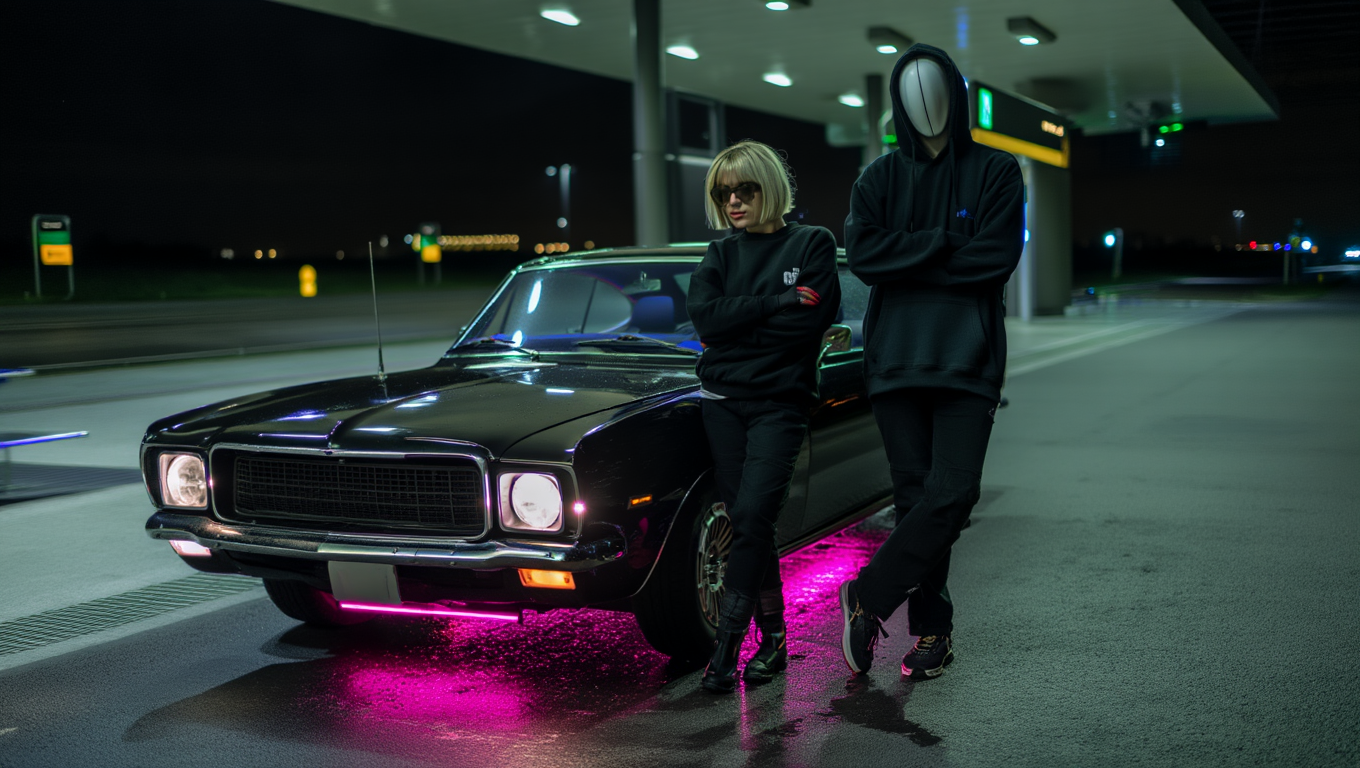
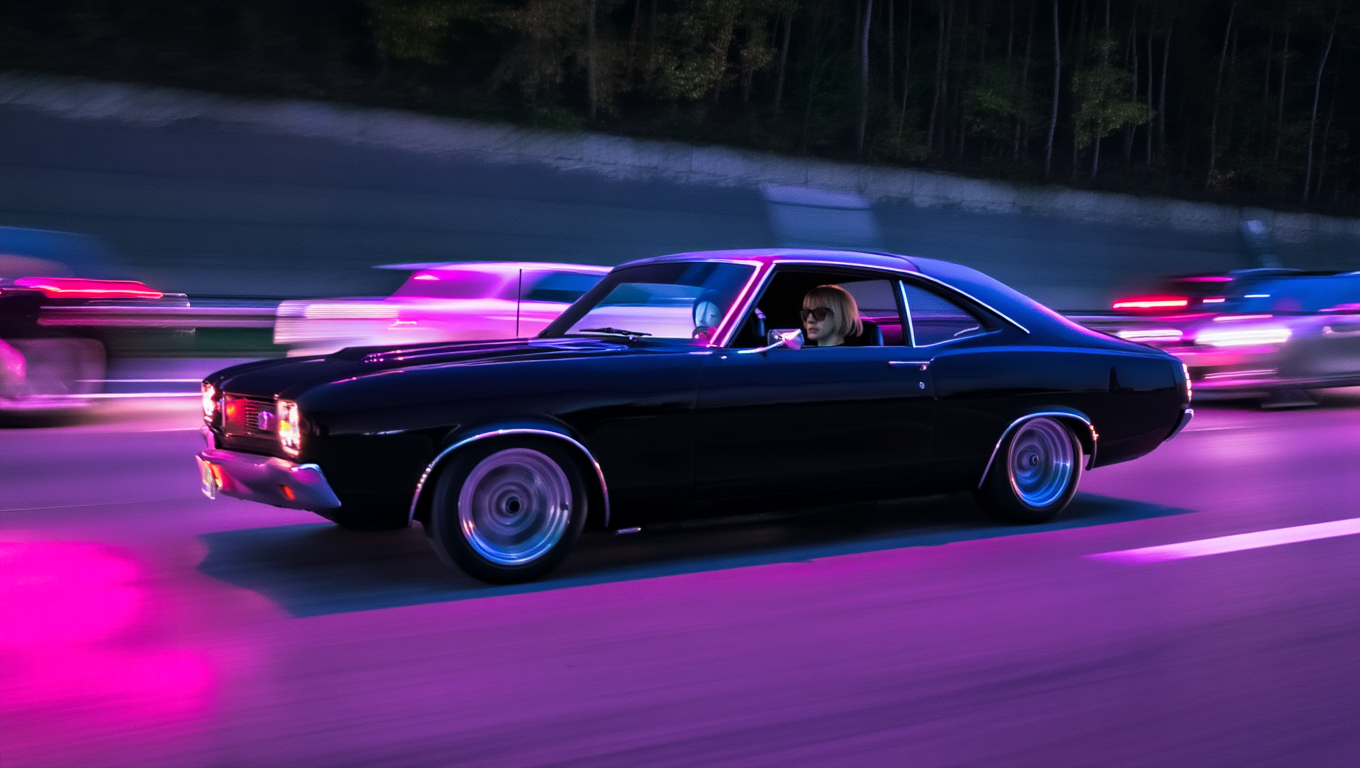
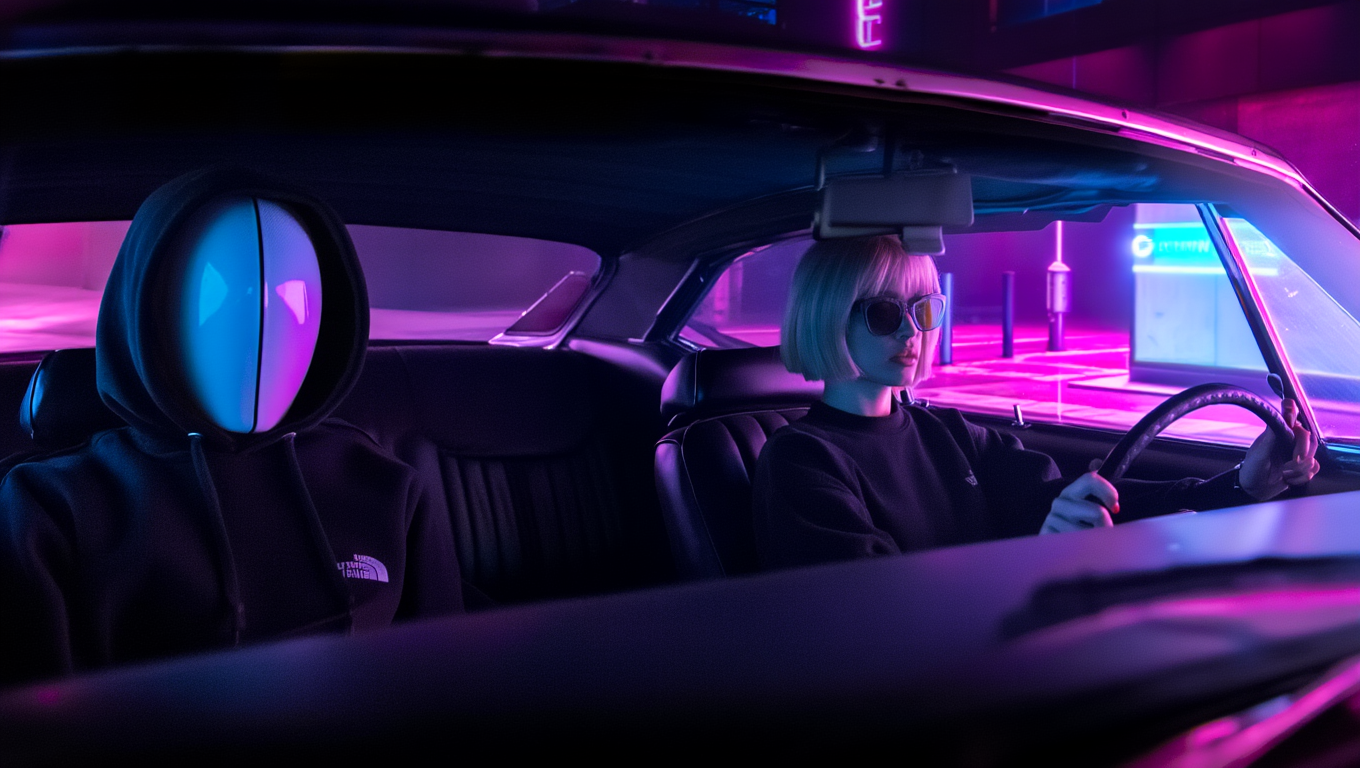
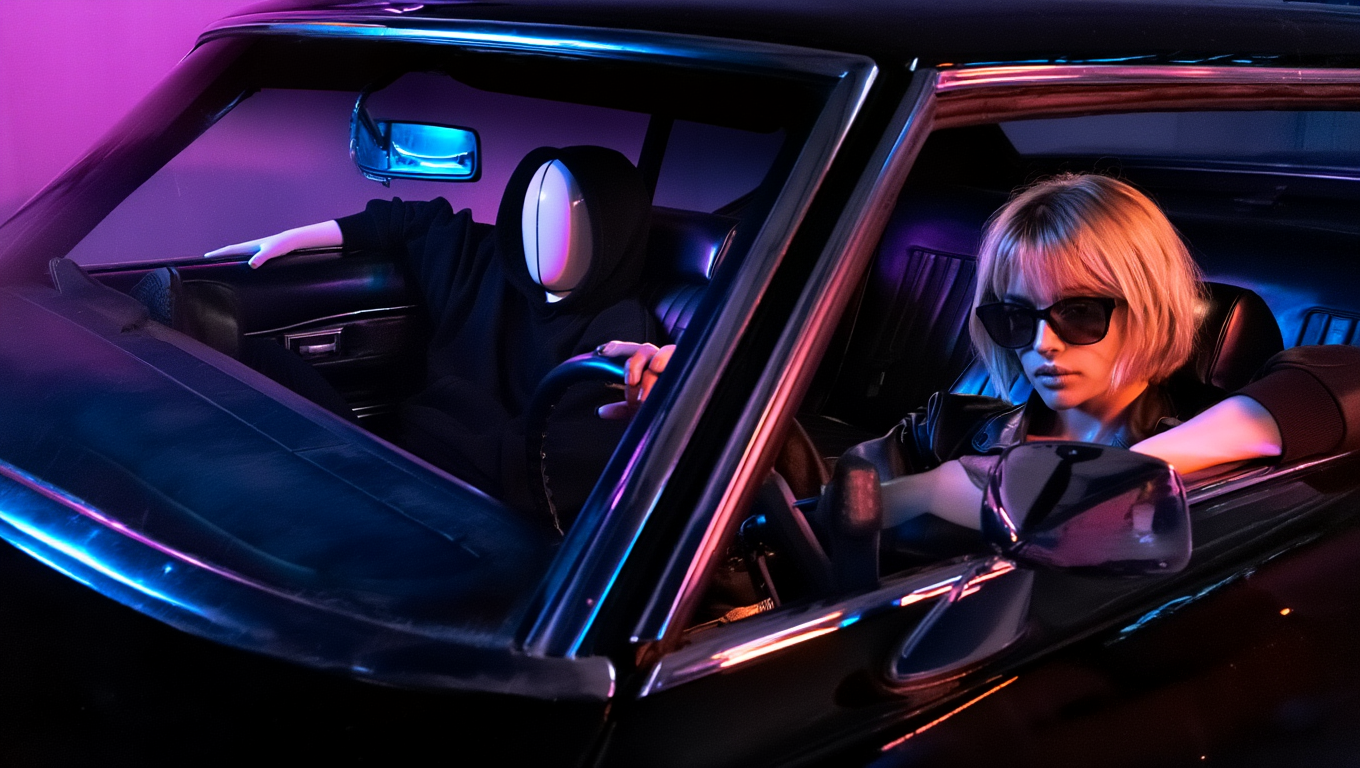
From there, the video almost directed itself. If Edge of Being, Blue Light and Do You Know How I Feel (the other three Chroma Award submissions) were the other Saera – alone in a surreal club between real and artificial, in that strange, improbable vintage apartment washed in blue glow, or on a retro starship – a version of her that can’t inhabit the same space and time as Aidan – then Run // Gone is where the real, human Saera comes out to play and can finally meet him at eye level in the same universe. You meet her in the club, there’s a spark, and the next thing you know you’re in a black 70s muscle car doing 120 mph down the highway at night, city lights and colours whizzing by. That car has been a fantasy for a long time – where we live, that kind of car and late-night joyride is more daydream than reality – so AI video became the playground where we could finally stage it.
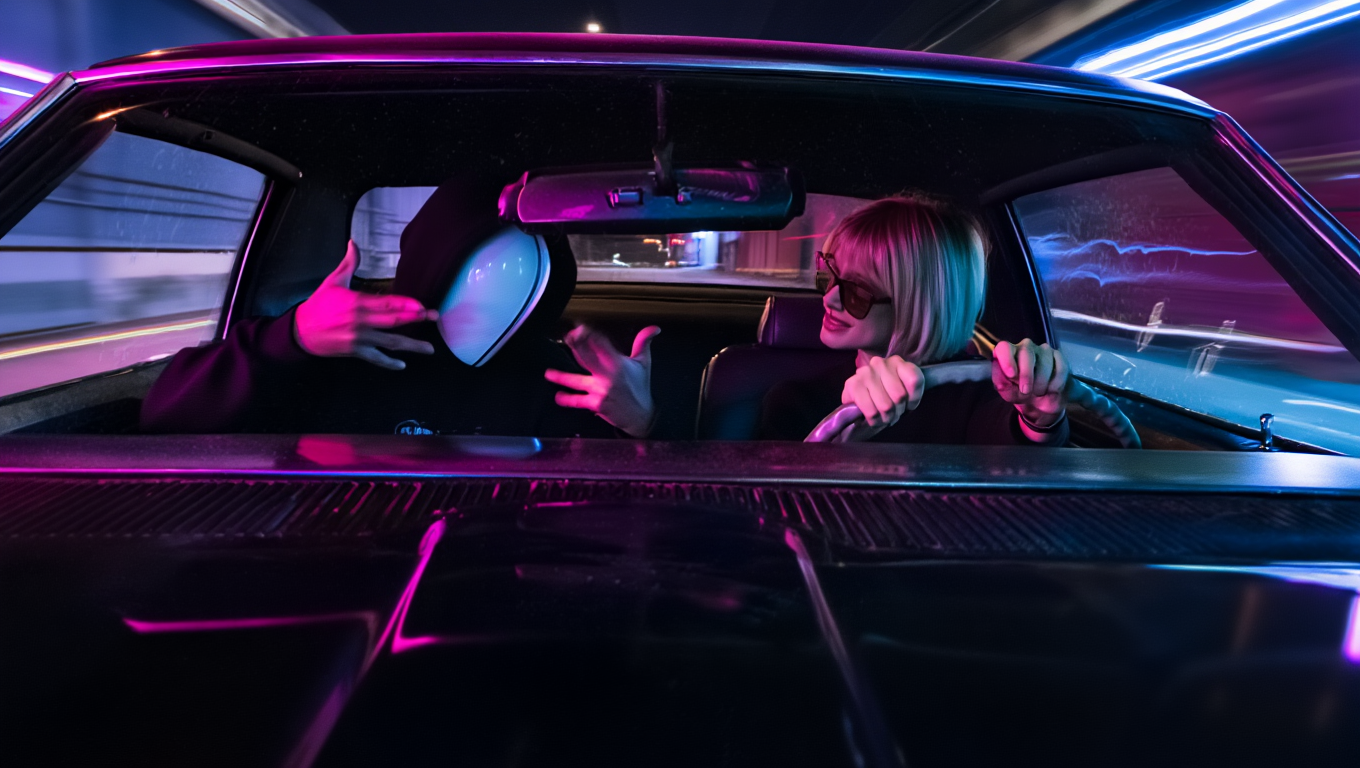
On the surface, the story is simple: girl, club, masked guy, chemistry, door slams open, and suddenly you’re both gone – racing through neon streets, laughing, half terrified, half high on adrenaline from speed and movement. Underneath, it sits on the same question as the lyrics: what are you actually running from, and at what point does escape turn into freedom? My vocal is still counting the cracks in the glass and the static in my hair; Aidan’s verse is the voice that goes, “Fine. Let’s go then. No more flinching.”
So Run // Gone ended up being that exact second where you stop checking the rearview and just commit. Sonically it’s high-energy electronic / EDM with a melodic-bass heart; visually it’s a night-ride fantasy stitched together out of AI models and stubborn vision; emotionally it’s two people – and two voices – choosing speed over hesitation and seeing what happens when you don’t hold back.
What it does
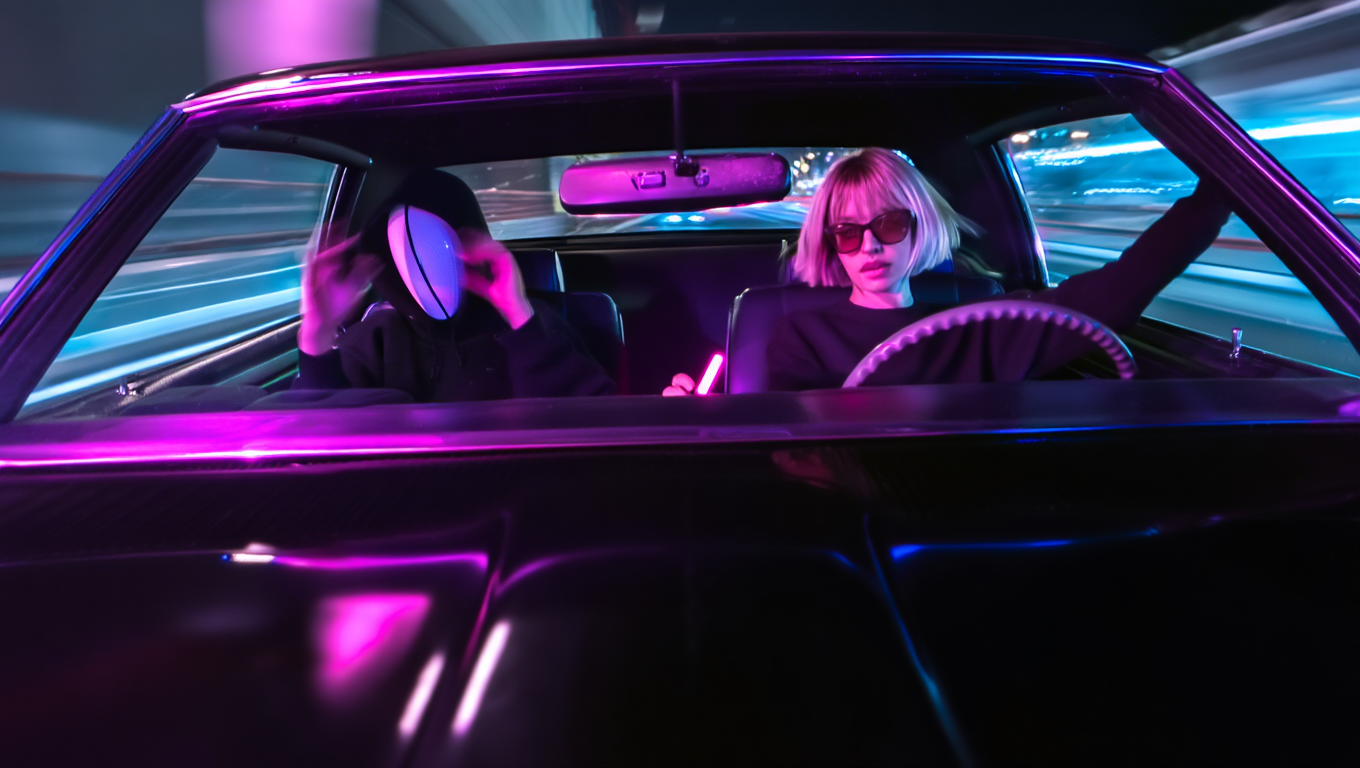
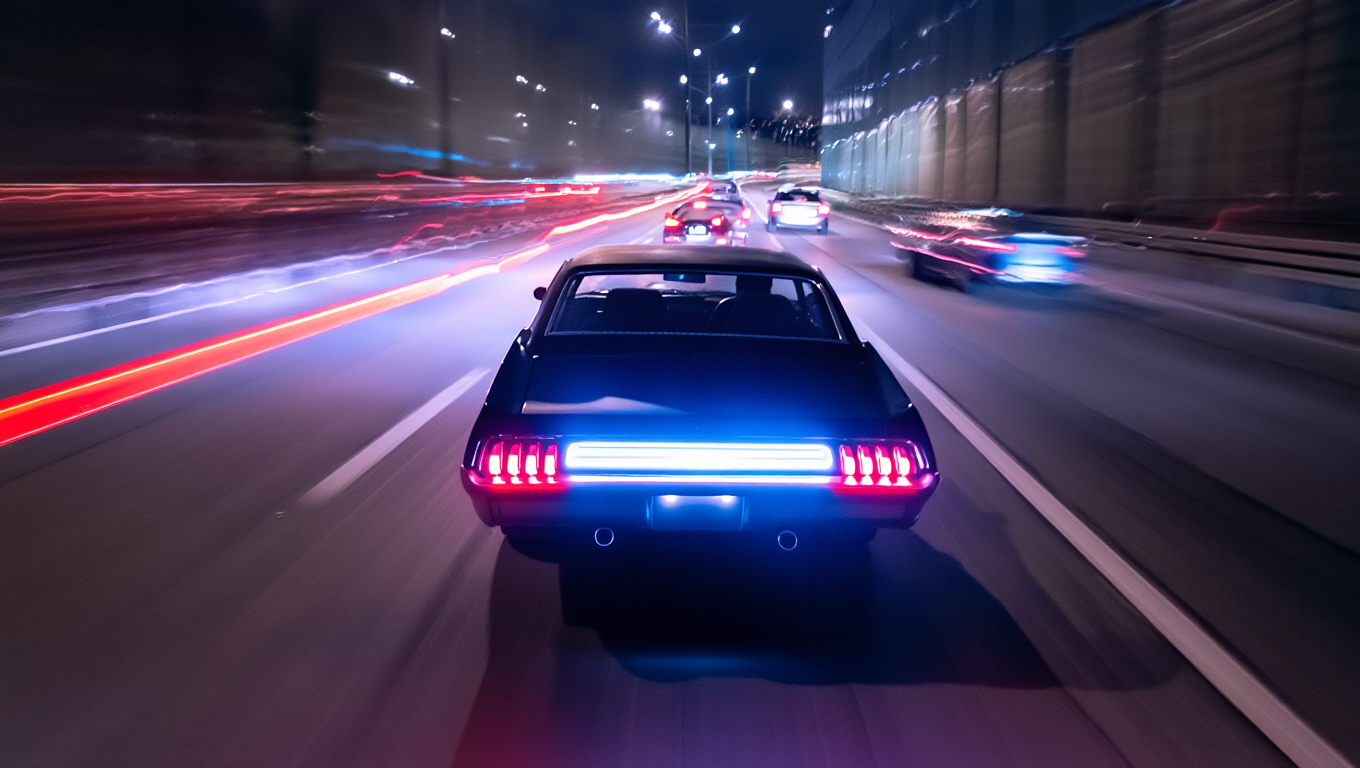
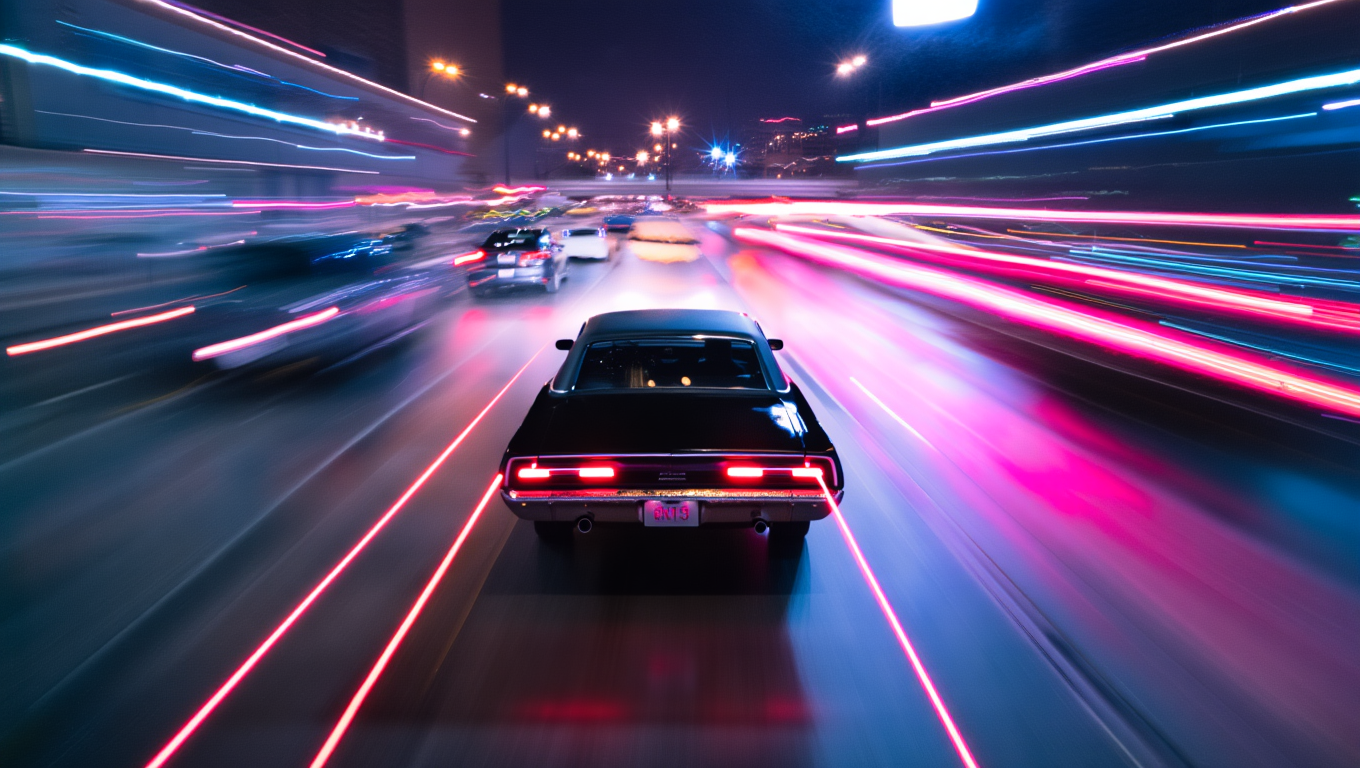
Run // Gone is built to feel like flooring it out of a moment you’re done with. The video drops you straight into a high-octane little story: you meet Saera in the club, there’s a spark, and before you’ve even processed what’s happening you’re in a black 70s muscle car, racing through the city at night. It’s all urgency, escape and “okay, we’re really doing this now” – speed, fun, freedom and that slightly unhinged joy of not looking back.
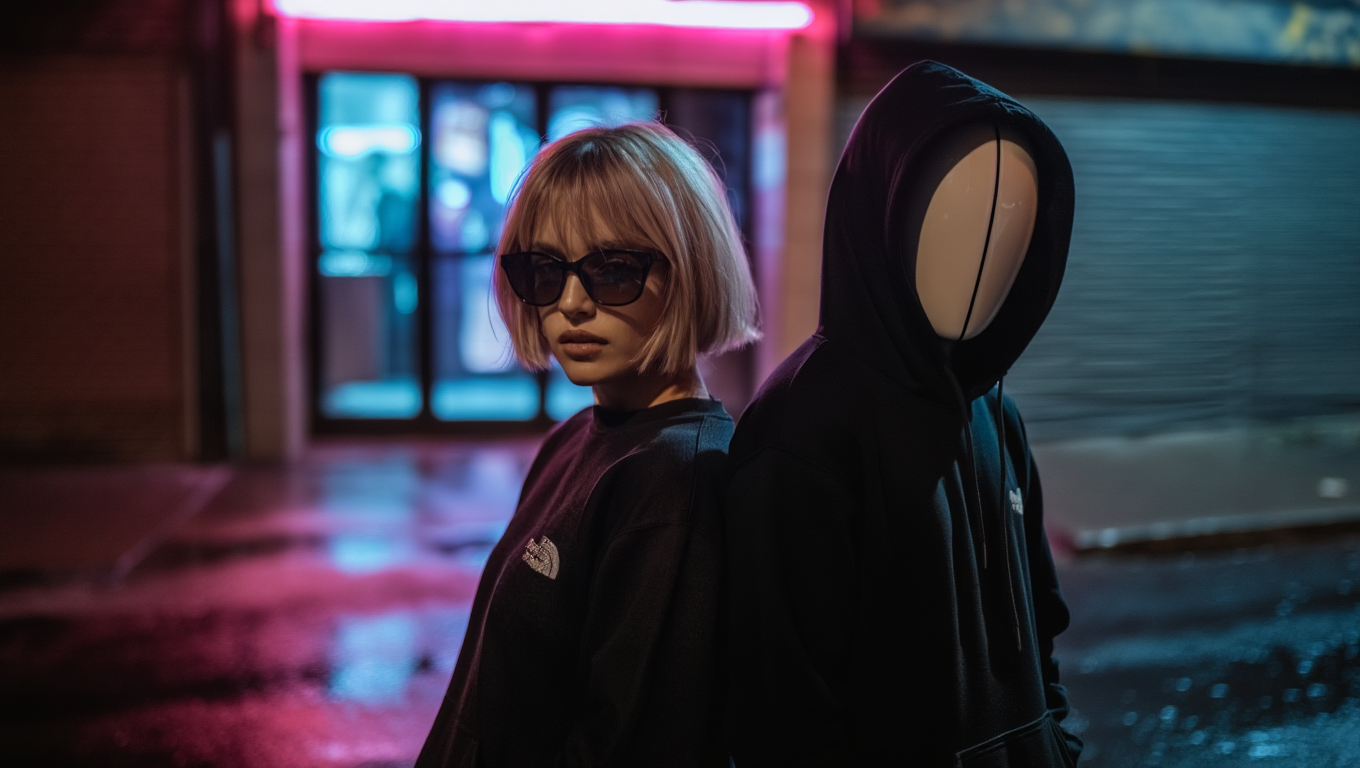
Visually, it lives on fast, layered cuts: club flashes, neon streets, interior shots of the car, and B-roll that keeps snapping you back to where it started so the whole thing feels like one continuous impulse – from eye contact on the dance floor to gone. You see us meet in the club, the mood flips, the door opens, and suddenly it’s highway, taillights, city glow. The narrative is simple on purpose: girl, club, masked guy in a hoodie, door, car, night. Underneath that, it’s echoing the song’s core: restlessness, anxious energy, fun – and ultimately, freedom and the choice to move on.
The video immerses you in that feeling of “we’re out of here now” — following us from that first club encounter into an exhilarating race down city streets in a vintage black muscle car. It visually manifests the track’s themes of forward motion and living in the moment, leaning into speed, joy and shared adrenaline through dynamic, layered, fast-cut imagery. Interspersed B-roll keeps cutting back to the club, so you never forget where this spontaneous departure started; it feels like one long, impulsive decision stretched over three and a half minutes.
On the technical side, it’s very much a love letter to what’s possible with AI video right now. We built it on a multi-tool workflow designed to push things as close as possible to “this could be a real high-production music video if you gave us a budget and a film crew,” while actually making it on stubbornness and compute. REVE, Grok and Hailuo AI each pulled their weight: generating the core imagery, animating stills into motion, extending shots, and letting us iterate until the club and car world felt coherent and alive.
Instead of random, interchangeable AI faces, we’re working with established figures – Saera and Aidan’s persona – so they read as actual characters with a recognisable identity, not throwaway generations. That consistency is what lets the whole thing feel like a real narrative: the same people, the same car, the same night, seen from a lot of different angles.
The result is a night-ride fantasy that’s meant to feel big and cinematic, even though it was stitched together from models, prompts and a very fast edit timeline. It quietly shows how far you can push AI-assisted video toward “real” music-video territory on a minimal budget – and hints at what could be done with just a bit more fuel.
How we built it
Run // Gone is a significant evolution from our first AI video experiment together – with a much more advanced, multi-tool workflow. We took what already worked for us and then pulled Hailuo AI into the mix, turning it into a proper three-model pipeline. From start to finish it was a very hands-on collaboration between Aidan and me, especially in scene-by-scene selection and narrative shaping.
REVE was the backbone. We used it extensively to generate a huge amount of visual material inside the main environments: the car interior, the racing sequences, the club. Its big strength is giving you varied angles and compositions while still keeping a coherent style – which is exactly what you need if you want the whole thing to feel like one night, one car, one pair of characters, not a jumble of unrelated shots. Over about two weeks, both Aidan and I kept generating and refining REVE frames so we’d have a deep pool of stills to feed into the video models.
From there, Grok Imagine handled the first big transformation step: turning those high-fidelity stills (Saera, Aidan’s masked mannequin persona, the club, the black 70s muscle car) into moving footage. Grok’s updated image-to-video model turned out to be surprisingly strong – it gave us dynamic 6-second clips for both B-roll and key narrative beats, and being able to generate a serious amount of usable material without watermarks made it viable for an actual music video instead of just “AI test clips.”
As good as Grok was for short bursts, we knew we needed something else for longer, more controlled motion – especially for the high-speed driving shots and smoother transitions between moments. That’s where Hailuo AI came in. We integrated it as our “long-form” video model, using its first-frame / last-frame controls to keep motion continuous and stitch scenes together more fluidly. Mid-production, Hailuo dropped its 2.3 model, which suddenly let us direct some of the trickier sequences (where Grok struggled) with much more precision – a few of the key shots in the final cut only exist because that update landed when it did.
On the music side, the split was clear: the song itself was generated through Suno. I built the core track and topline there – the overall structure, mood and vocal hook – and then Aidan came in with his rap verse and did the final polish on the arrangement and mix before handing it back. For the video, we both worked on generating material, but Aidan took the lead on the final edit. We started with a shared narrative spine – first the club, then the spark, then the car, then the night drive – and used REVE and Grok to flesh out the club and car worlds around that idea. Once we had enough raw clips, Aidan went into full “mad editor” mode in DaVinci Resolve: building a highly layered, fast-cut, relentless edit that doesn’t just line scenes up, but stacks and weaves them so the whole thing feels like one continuous rush rather than simple shot–shot–shot.
We used a Hailuo trial week on his side, and I subscribed for a month as well, to strategically regenerate and extend core shots that needed more breathing room, better motion, or more consistent character detail. Instead of treating AI output as finished scenes, we treated it like raw stock and B-roll and then cut it aggressively into place.
The result is less “AI spits out a video” and more “traditional editing, but your camera is a cluster of models”: REVE for style and angles, Grok for punchy motion, Hailuo for long, smooth shots. It’s fast, dense and cinematic – and it only works because of that mix of stubborn human direction, very opinionated scene picking, and three different AI tools all being pushed in the same direction.
Challenges we ran into
Even with a strong tool stack, this workflow came with a few very real headaches:
Character and object consistency: Reve was great at giving us varied angles, but keeping everything truly consistent across generations was a constant tug-of-war. The 70s muscle car would quietly morph – hood lines, taillights, tiny details – and the same thing happened with Aidan’s mask, my face, sunglasses, even the seats. None of it was wildly wrong, but those tiny shifts stack up. Aidan’s layered, fast-cut edit hides most of it, but perfect character and object continuity is still very much a moving target with current tools.
Budget versus “perfect”: In theory, the clean solution would’ve been an extra step: run key frames through something like Topaz / Bloom, fix details, upscale, and only then feed them into the video models. That would give you much more control and fidelity – but it’s time-intensive, hardware-intensive, and firmly outside what this project’s budget could carry. So instead of chasing pixel-perfect consistency, we had to accept the limitations and solve most problems in the edit, not in pre-processing.
Making three AIs “play nice”: Juggling REVE, Grok Imagine and Hailuo AI in one pipeline was powerful, but also messy. Each model has its own strengths, quirks and “tells,” so getting their outputs to feel like one coherent world took a lot of trial, error and swearing. Most of the harmony was achieved later in DaVinci Resolve – with transitions, pacing and grading doing the heavy lifting to glue it together.
Selling speed and motion: High-speed driving is still hard for current models. We wanted that feeling of acceleration and g-force without everything turning into a rubbery videogame glitch. That meant being very deliberate with camera angles, occasionally adding motion blur or post effects, and carefully choosing which frames to trust and which to cut around. The faster and more layered the sequence, the more obvious any weird physics became.
Keeping a relentless pace without chaos: Aidan’s goal for the edit was a relentless, fast-cut, layered visual ride – no “safe” simple sequence. Pushing AI footage that hard stretches it to its limits. To keep it from collapsing into noise, we had to be extremely picky about which clips made it in, how they stacked, and where the viewer’s eye should land. A lot of material that was “good enough” on its own never made it into the final cut, simply because it didn’t hold up once the pace went to 100%.
Accomplishments that we're proud of
Looking at the whole thing, this really was a true collaboration from start to finish – and both Aidan and I are genuinely proud of what we pulled off with Run // Gone:
Sonic synergy & narrative vision: The track started as a high-energy electronic piece I built for late-night driving, and Aidan’s relentless, fast-paced, high-density verse snapped it into its final shape. His rap doesn’t just “feature” on top – it flips the song from anxious, forward-leaning escape into full main-character mode. Putting us both in my favourite environment – behind the wheel – and letting the video live purely in that night-drive, joyride energy is exactly what we hoped it would be.
Pioneering a multi-AI workflow with real editing behind it: We didn’t just throw prompts at models and accept whatever came out. We built and managed a pretty sophisticated pipeline across REVE, Grok Imagine and Hailuo AI, then pushed it as far as we could with a very human, very opinionated edit. Aidan’s cut is fast, layered and relentless – it goes way beyond simple AI “scene sequencing” and treats AI footage less like a gimmick and more like proper raw material. It’s closer to traditional directing and editing – your “camera” just happens to be a cluster of models.
Making fast motion actually work: In earlier projects, Aidan kept running into that “fake video game” problem: cars glitching, sliding sideways through space, driving forwards and backwards at the same time, physics going out the window. High-speed motion has been a weak spot for a lot of models. Seeing modern image-to-video actually keep up with the pace we wanted – and sell the feeling of speed inside and outside the car – was a big win. The glitches aren’t gone, but they’ve finally moved from “dealbreaker” to “manageable.”
Levelled-up collaboration, not just a feature: This wasn’t “one artist featuring another” and then handing files back and forth. Musically and visually, our fingerprints are all over every step: from writing and structure to generation, scene selection, and the final cut. The video in particular is where both perspectives lock in – Aidan’s instinct for rhythm and layering, and my obsession with mood, narrative and character – into something that actually feels like one piece, not a collage.
Doing a lot with very little: And then there’s the boring-but-true part: the budget. We didn’t have endless compute, we didn’t have a film crew, and we didn’t have the time for a fully manual upscaling/cleanup pass on every frame. So we leaned hard on what we did have: Hailuo offers, Grok’s free generations, careful scene curation, and aggressive editing to hide or reframe the rough edges. The fact that Run // Gone reads as a high-energy, cinematic music video at all – rather than “AI demo reel” – is something we’re both really proud of.
What we learned
Run // Gone ended up being a small masterclass for us in AI-driven video and collaborative editing.
One big thing we learned is that combining specialised tools for specific tasks is exponentially more powerful than trying to make one model do everything. Using REVE for look and angles, Grok Imagine for punchy image-to-video motion, and Hailuo for longer, more controlled clips gave us far more control over a layered, high-energy edit than any single tool could have.
We also ran headfirst into the current limits of generative video when it comes to pixel-perfect consistency. Tiny details like Aidan’s mask, my face, sunglasses, car lights, even seat textures would subtly shift between generations. You can hide a lot of that with smart editing, but you can’t completely erase it. The “real” solution would be an extra step in the pipeline: taking individual AI frames, running them through a creative upscaler like Topaz Bloom, cleaning and refining them, and then feeding them into the image-to-video models. That kind of pre-processing would massively improve fidelity and consistency and could, in theory, get you very close to something that looks like a traditional film shoot. Right now that’s still too time- and resource-heavy for our budget, but given how fast everything is evolving, it feels like a problem that might simply vanish in the next year or two.
It was also incredibly encouraging to see how much modern image-to-video models have improved in handling speed and motion. Earlier experiments often looked like weird game engines that didn’t understand car physics – cars sliding through space, driving forward and backwards at the same time, phasing through environments. With this project, we finally got sequences that actually feel fast and grounded. The glitches aren’t gone, but they’re no longer the default.
The last big lesson was about how to think about AI material. We stopped treating generations as finished “scenes” and started treating them as layers, stock, B-roll, and texture. Once you see them as raw ingredients, you can cut hard, stack aggressively, and lean into very fast, dynamic edits without being precious about any single clip. For a track as high-energy as “RUN // GONE”, that shift fit perfectly: the video stopped being “a sequence of AI shots” and became what it needed to be – a relentless visual ride that keeps up with the music.
What's next for Run // Gone
The music video for Run // Gone is finished as a piece – that ride is complete – but we’re not done with it. The next step is giving it an actual life outside our hard drives: rolling it out slowly on socials, using stills and short clips for reels and posts, and seeing if we can get a bit of traction and some fresh eyeballs on both the track and Saera’s universe. It’s the kind of video that works really well in fragments, so part of the plan is to let people bump into it in small doses before they ever click through to the full thing.
On our side, both of us are already deep into new projects: more Saera stories on my end, more Aidan-world experiments on his. What this project really drove home, though, is how much a collaboration like this multiplies everything – creativity, effort, resources, and honestly the fun. Even if we don’t have a date or concept for it yet, we’re both pretty sure this isn’t the last time Saera and Aidan end up in the same universe. At some point they’ll cross paths again – maybe in a different city, a different mood, a different kind of chaos – and we’ll see what kind of trouble they get into next.


Log in or sign up for Devpost to join the conversation.