-
-

Start screen.
-
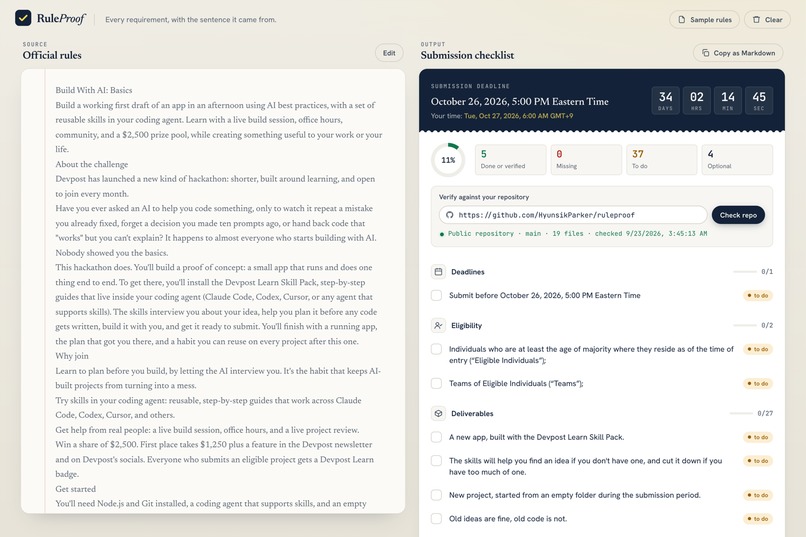
Deadline in local time with a countdown, progress, and the repository check.
-
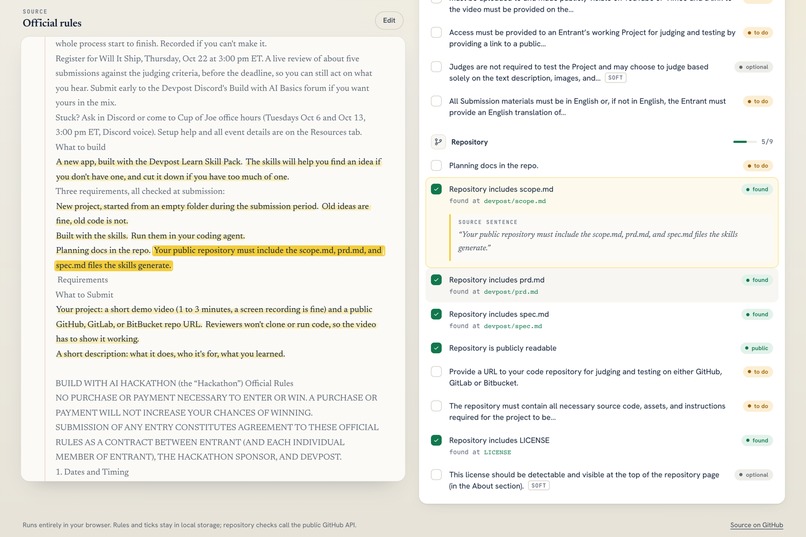
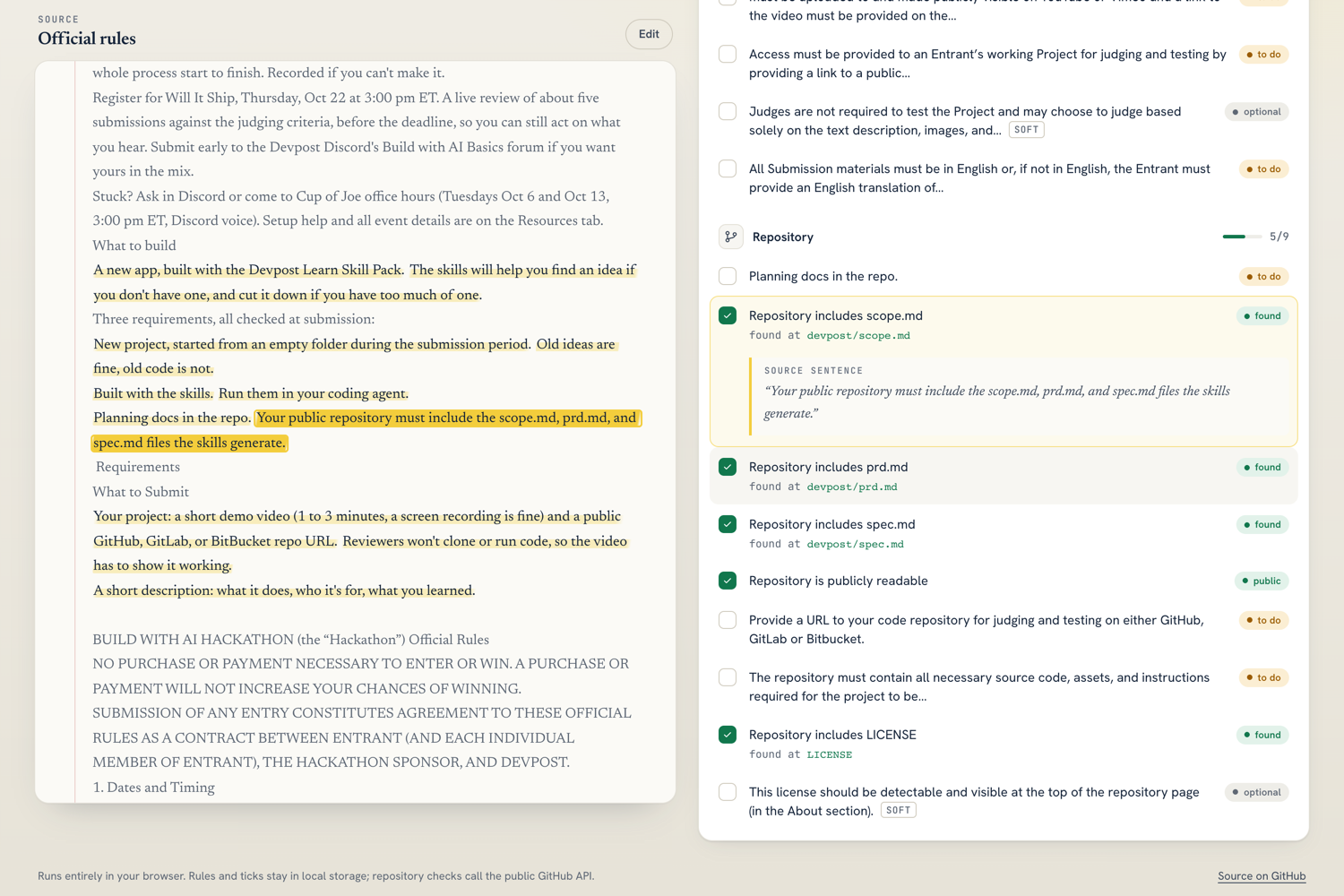
Each item links to its source sentence; required files are verified in the public repo.

What it does
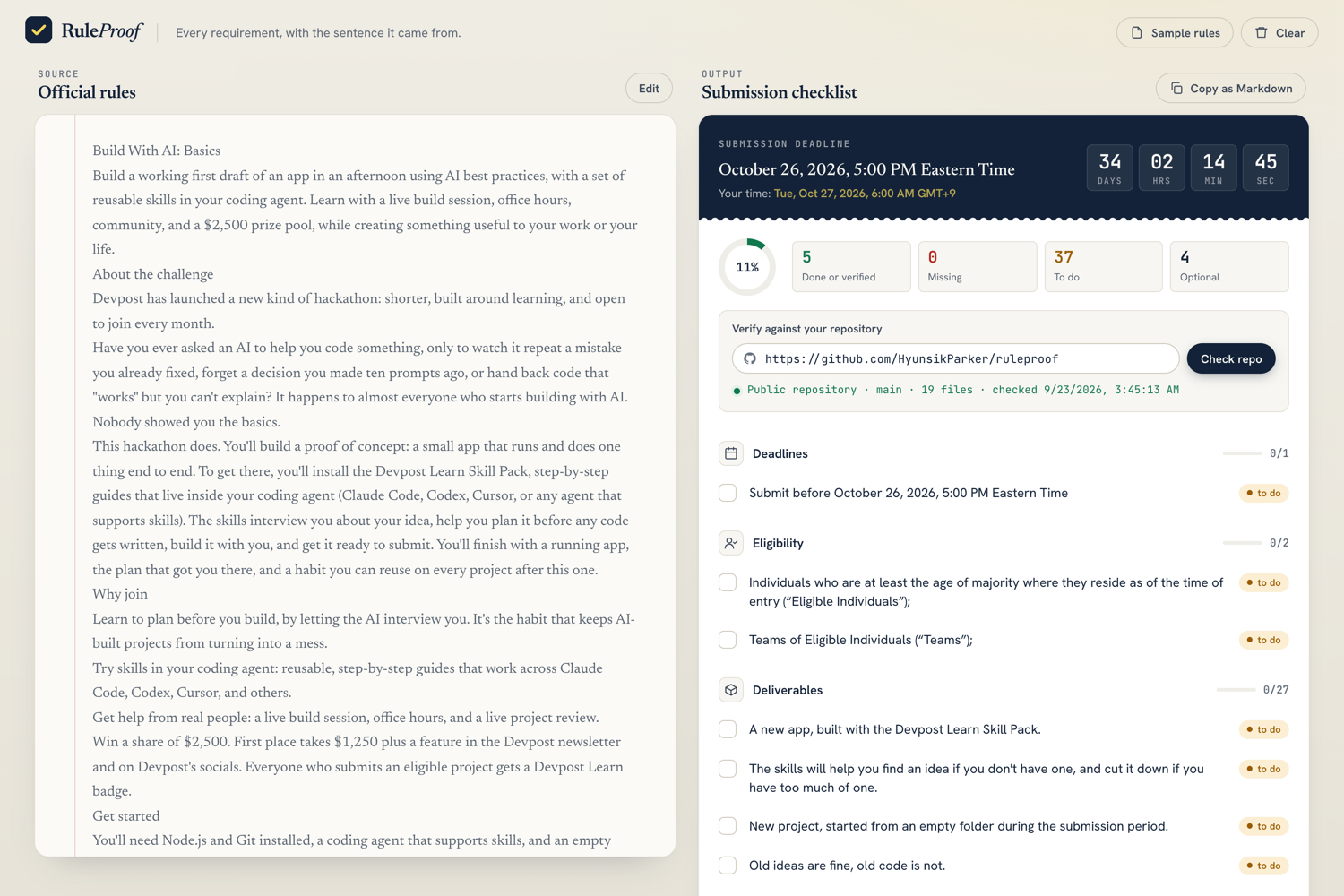
RuleProof turns a pasted rules page into a submission checklist. It keeps only the sentences that state a requirement (deadlines, eligibility, deliverables, video limits, repository files) and links each item to its source. Click an item and the sentence is quoted in the checklist and highlighted in the rules.
The deadline is shown as written and in your own time zone, with a countdown. Paste a public GitHub repo URL and file requirements such as scope.md or LICENSE are checked through GitHub's public API.
After the first submission I built two items from my own "later" list: a bookmarklet that imports any rules page in one click (the text travels in the URL fragment, so it never reaches a server), and an "Add to calendar" button that saves the deadline as an .ics event with reminders 24 and 2 hours before.
Who it's for
Solo builders who enter several online hackathons a month and read a new rules page each time. I'm one of them. I live in Seoul, so "5:00 pm EDT" means 6 a.m. the next day for me.
How I built it
Plain HTML, CSS and JavaScript modules with no build step, hosted on GitHub Pages. Extraction is rule-based, not an LLM, so nothing on the list is invented. 30 Node tests cover sentence offsets, hard vs. soft wording, file and video-limit detection, time-zone conversion and the GitHub checks. I ran the Devpost Learn skills in Claude Code: scope, PRD and spec first, then four build slices.
What I learned
Writing down what "done" looks like before any code kept the build short. The finish line in scope.md was "the app checks its own repo against this hackathon's rules", and the demo is exactly that. Running it on the real rules page exposed noise I hadn't planned for, like all-caps legal banners and list intros. Each fix became a test.
Built With
- claude
- css3
- github
- github-api
- html5
- javascript
- node.js

Log in or sign up for Devpost to join the conversation.