Inspiration
As RUET students, we realized that learning is often not the problem—knowing what to learn next is.
Students have lecture slides, notes, assignments, question banks, online resources, and academic discussions, but these resources are often scattered. More importantly, a student can get a good or bad quiz score without really understanding which concepts they have mastered, where they are struggling, or what they should focus on next.
We wanted to build something beyond another LMS or chatbot.
That led us to RUET MIND—an AI-powered learning companion that tries to understand a student's learning state and turn it into actionable guidance.
What it does
How we built it
We built the prototype using Google AI Studio and Gemini as the core AI layer.
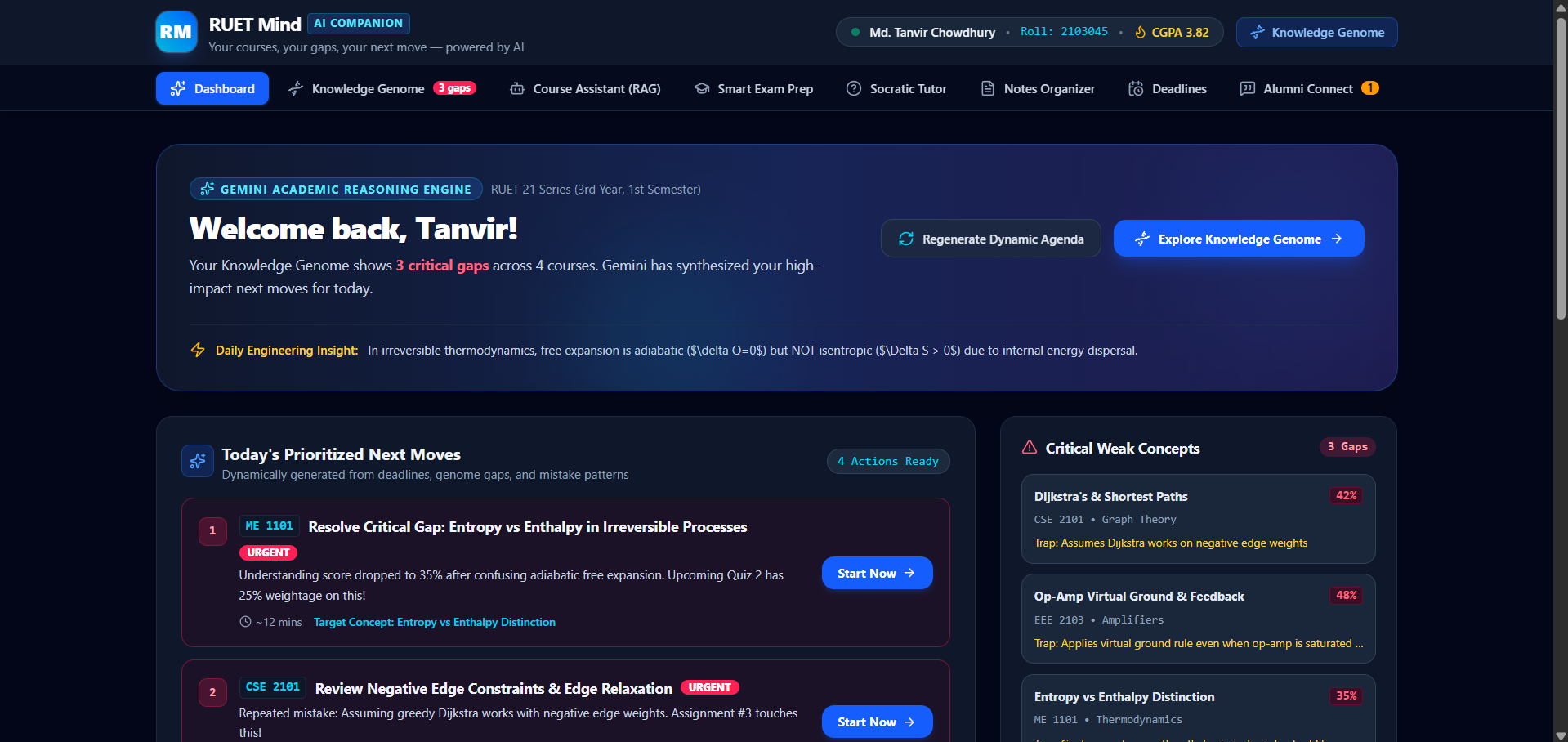
The application analyzes student learning information and uses Gemini to generate structured insights such as concept understanding, weaknesses, recommendations, learning roadmaps, and relevant alumni matches.
The general flow is:
Student Learning Data ↓ Gemini ↓ AI Knowledge Genome ↓ Weakness & Skill Gap Analysis ↓ Personalized Recommendations ↓ AI Alumni Matching
The frontend provides an interactive dashboard where students can explore their learning profile, recommendations, roadmap, and alumni connections.
We used modern web technologies along with Gemini APIs and built the prototype with deployment in mind so that it can be accessed as a live web application.
Challenges we ran into
Building the prototype within a very limited hackathon timeframe was our biggest challenge.
We had to balance:
Innovation → Technical implementation → Reliability → User experience
We initially had many ideas for the platform, but we quickly realized that trying to build a complete LMS would make the project too large.
So we focused on a smaller but more meaningful core:
Understand the student → Identify the gap → Recommend the next step → Connect them with the right people.
Another challenge was making AI outputs useful rather than generic. We had to think about how to structure the information so that Gemini's responses could actually drive features inside the application rather than simply appear as chatbot messages.
Accomplishments that we're proud of
Building RUET MIND within a very limited hackathon timeframe was itself a major accomplishment. We are especially proud of turning an idea into a working AI-powered prototype rather than simply creating a concept or mockup.
Our key accomplishments include:
🧬 Built the AI Knowledge Genome — a dynamic way to represent a student's concept-level strengths, weaknesses, and learning gaps instead of relying only on overall scores. 🎯 Created personalized learning recommendations that turn identified weaknesses into actionable next steps. 🗺️ Developed AI-powered learning roadmaps based on a student's current knowledge and goals. 🎓 Added AI-powered RUET Alumni Matching, connecting students' career goals and skill gaps with relevant alumni expertise. 🤖 Integrated Gemini meaningfully as the intelligence layer behind analysis, recommendations, and personalization—not just as a basic chatbot. 💻 Built a working end-to-end web prototype within the constraints of a 3–4 hour hackathon. 🔐 Implemented environment-based API key handling, keeping sensitive credentials separate from the public source code. 🚀 Prepared the project for real-world deployment, including a public source repository and live-demo workflow.
Most importantly, we're proud that we didn't try to build another traditional LMS. We focused on a simple idea:
Don't just track what students do. Understand what they know, discover what they need, and help them find where to go next.
What we learned
One of our biggest lessons was that meaningful AI is much more than adding a chatbot to an application.
We learned how to design AI around a real user problem and make AI-generated insights actually drive useful features.
During the hackathon, we learned about:
Building applications with Gemini Designing AI-powered workflows Structuring AI-generated information Creating personalized recommendations Working with APIs and environment variables Protecting API credentials Building and testing a full-stack application Deploying an AI-powered web application Designing a product around real student needs
Most importantly, we learned to ask:
"What useful action can the user take because of this AI insight?"
What's next for RUET MIND
RUET MIND is currently a prototype, but the concept can grow into a larger academic ecosystem for RUET.
Future versions could include:
Real course materials and course-specific knowledge bases Previous-year question analysis Assignment and deadline tracking More detailed concept graphs Long-term learning analytics Verified RUET alumni profiles Mentor-student communication Course-specific AI assistants More advanced personalized learning paths
Our vision is simple:
A learning platform should not just store educational content. It should understand the learner.
RUET MIND aims to make that possible by combining AI-powered learning intelligence with the knowledge and experience of the RUET alumni community.
Built With
- api
- bun
- cloud
- css3
- github
- googleaistudio
- html5
- react
- typescript
- vite
