-
-
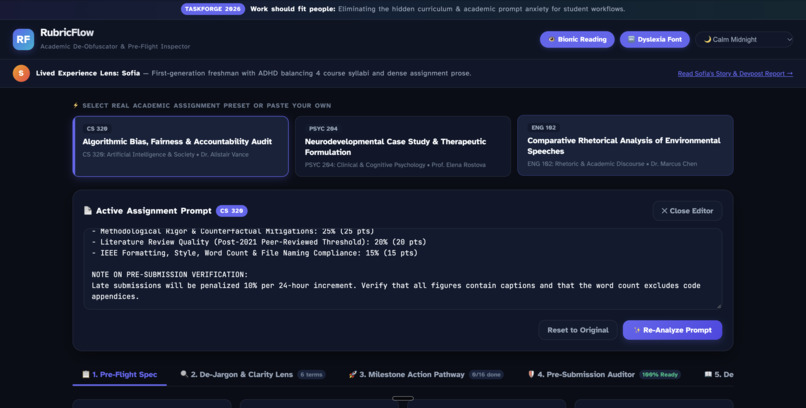
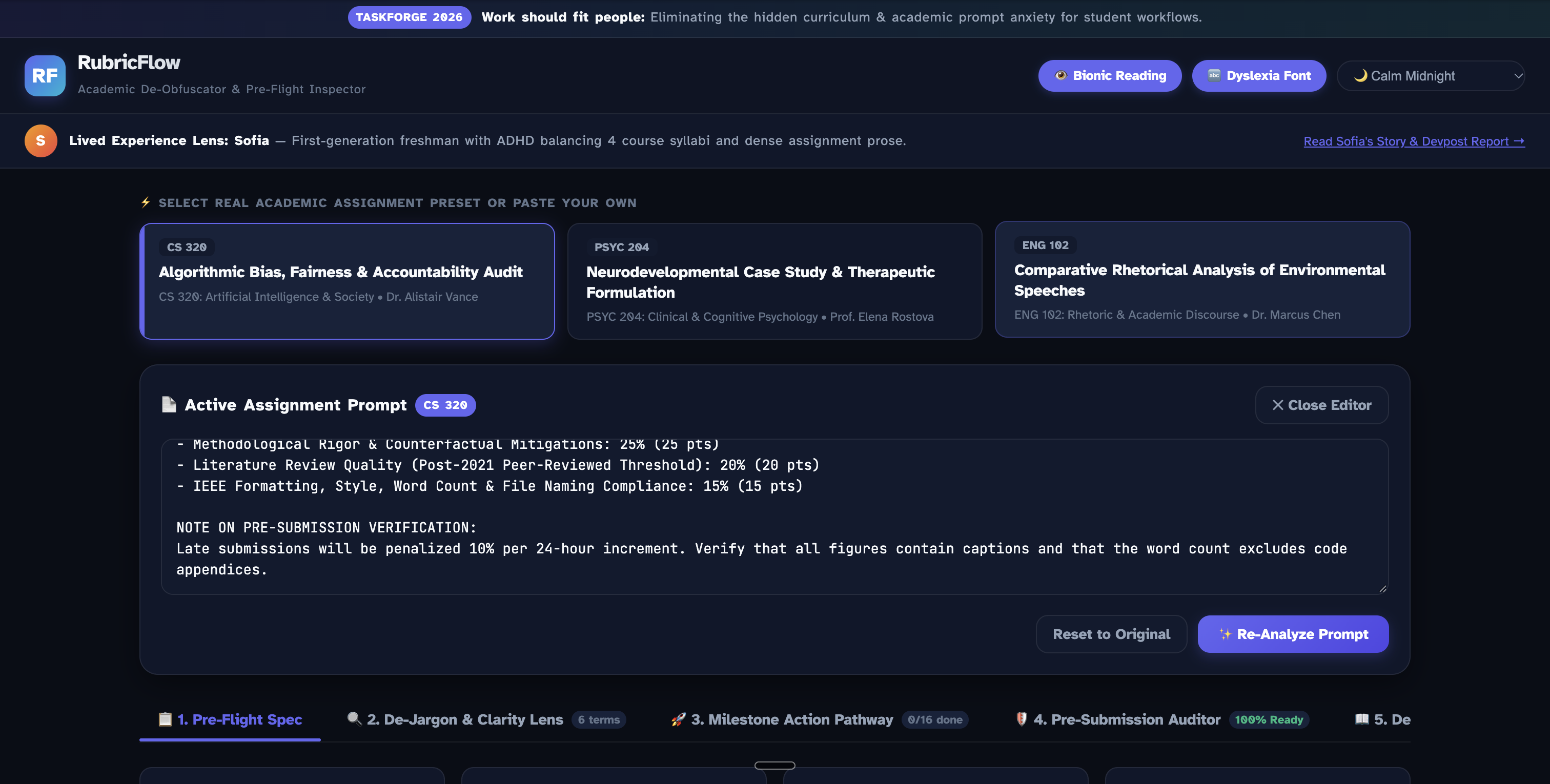
calm midnight view of frontend
-
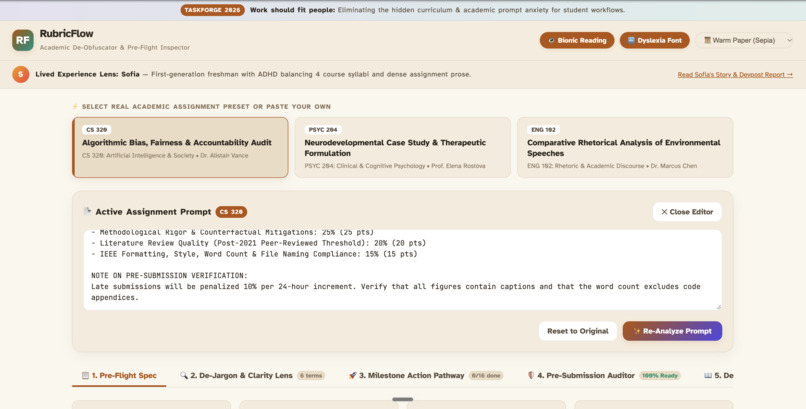
waarm paper ui view
-
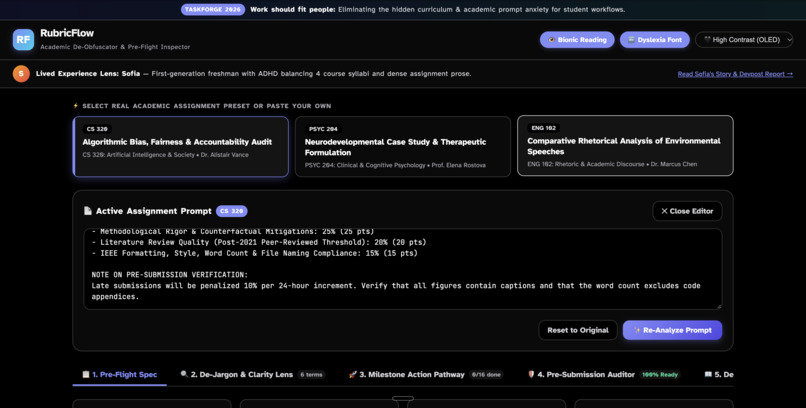
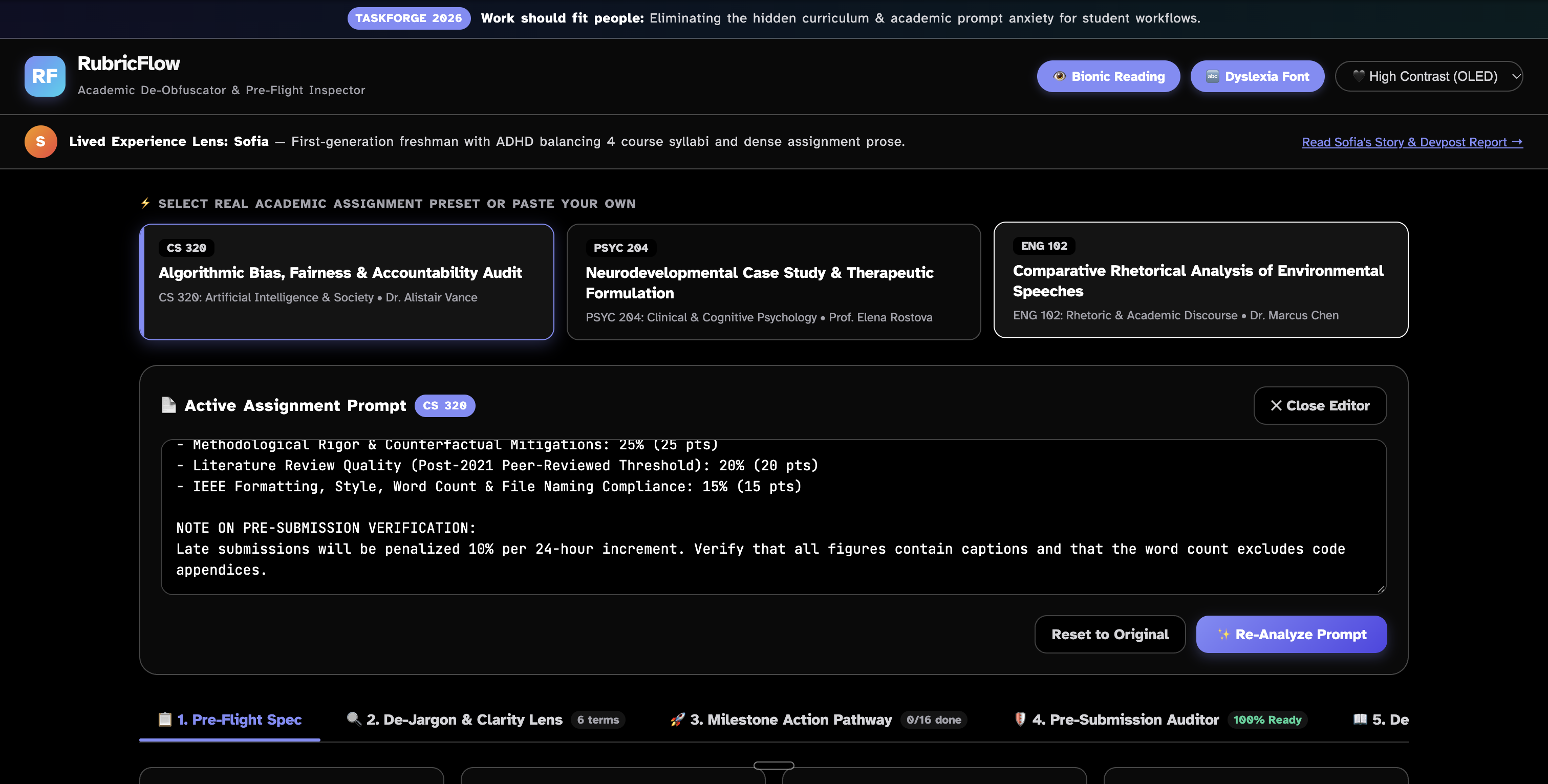
High contrast ui view
-
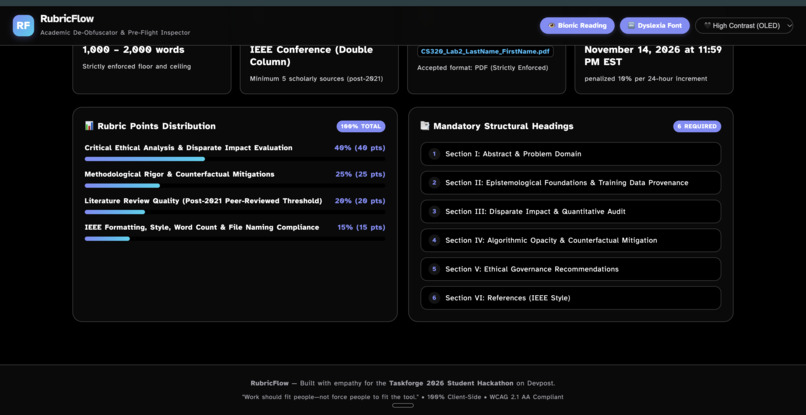
FullScreen
-
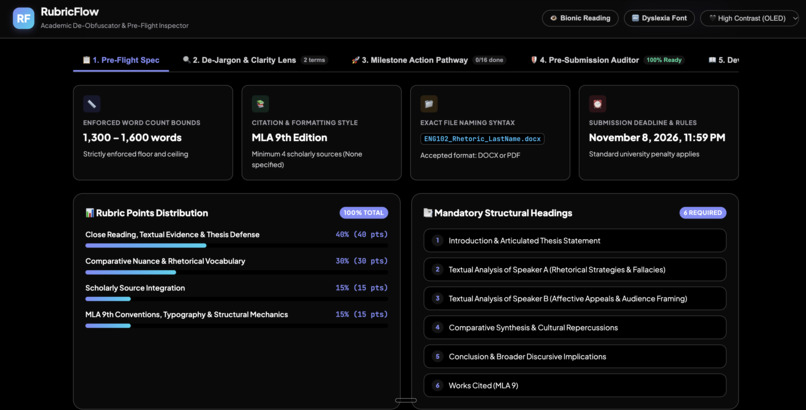
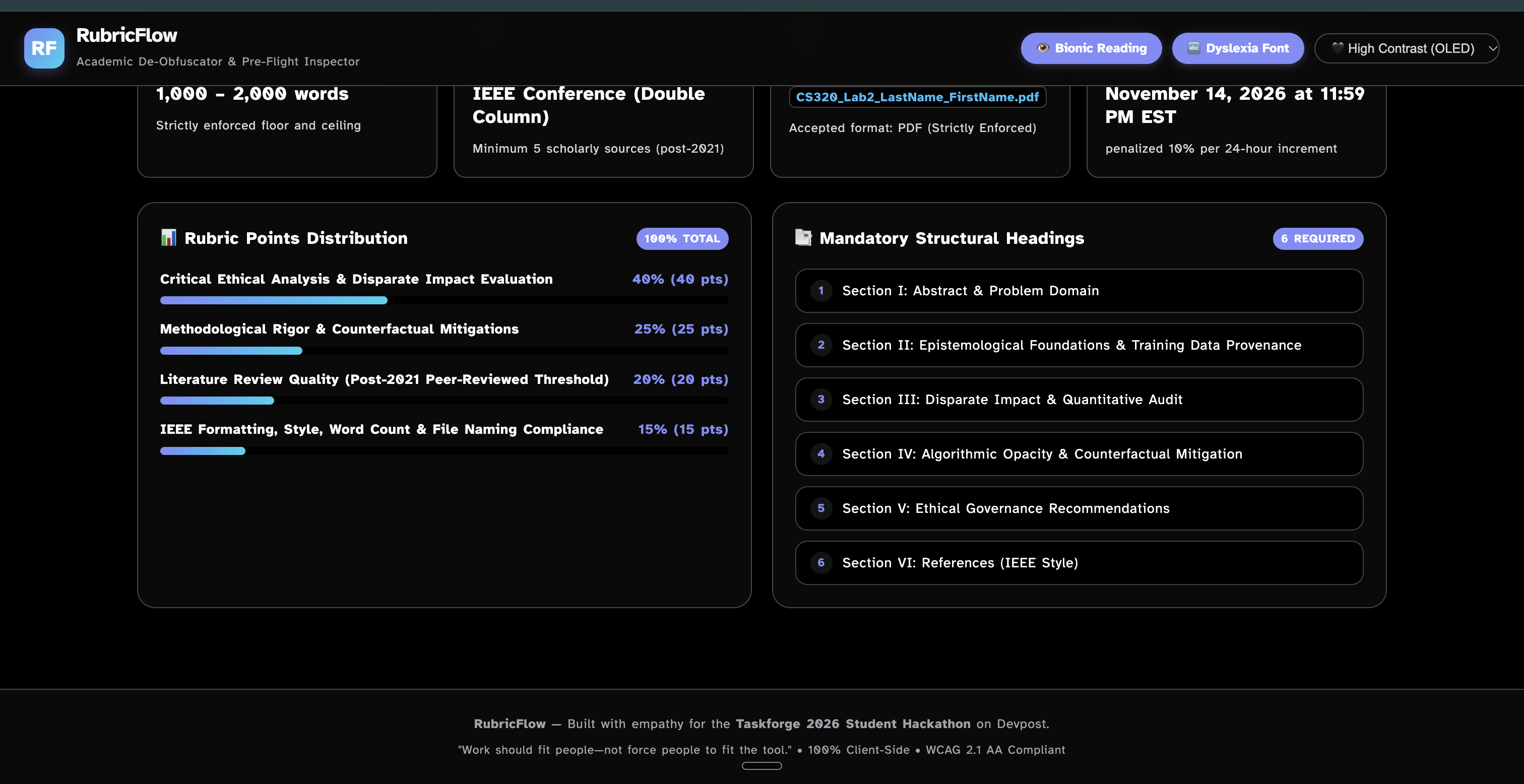
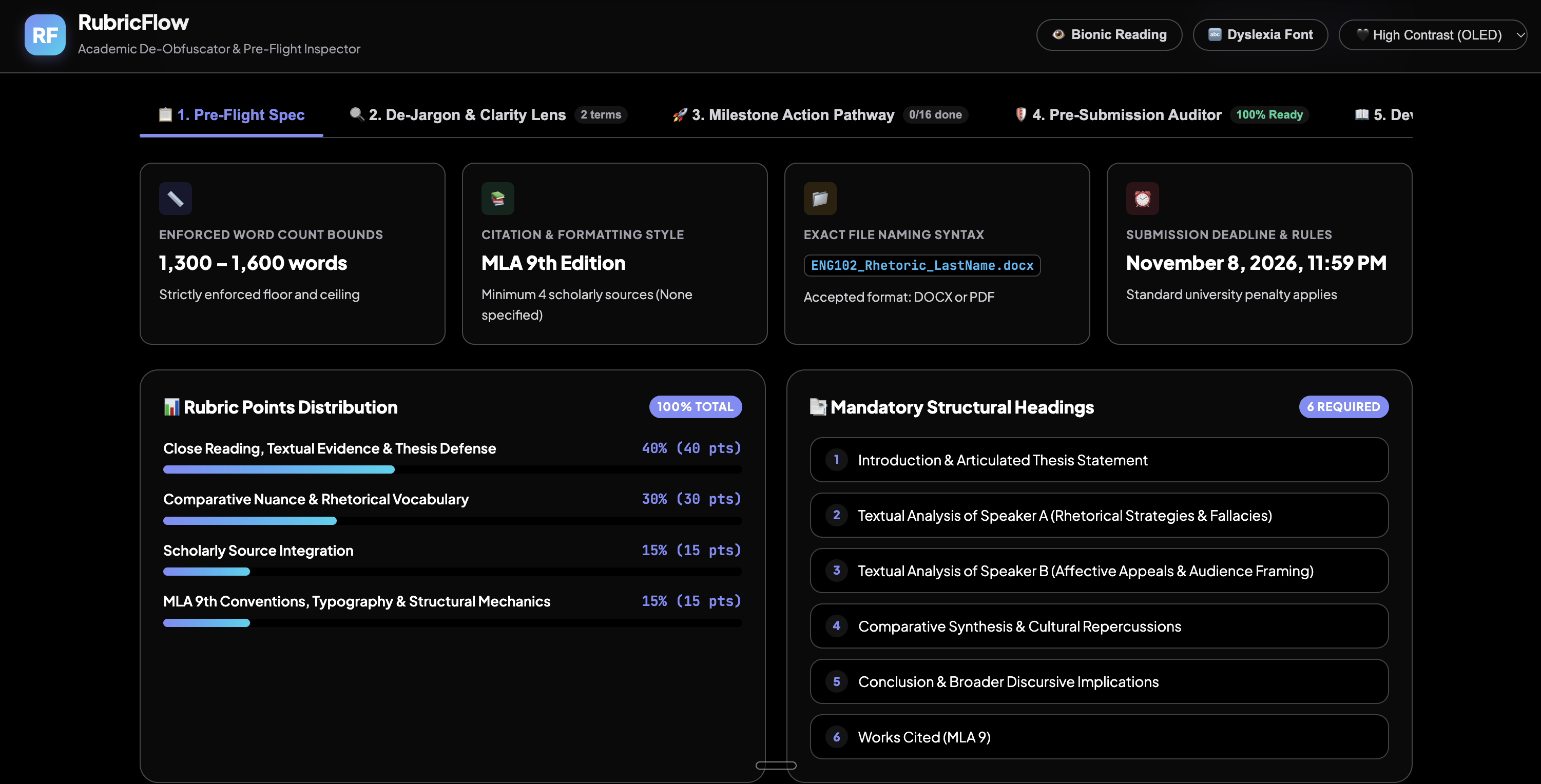
Pre-Flight Spec
-
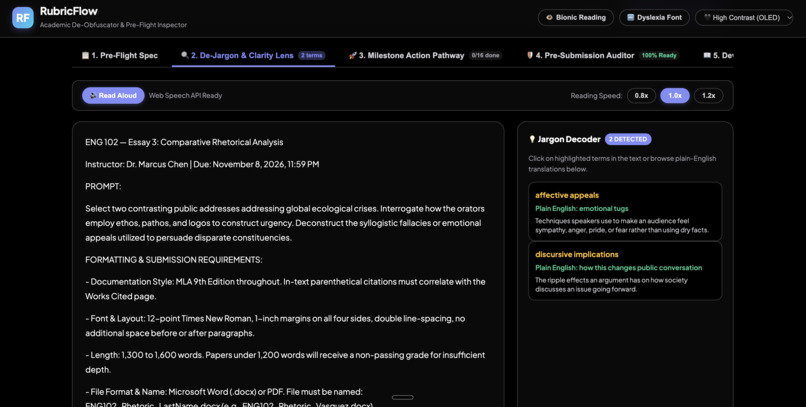
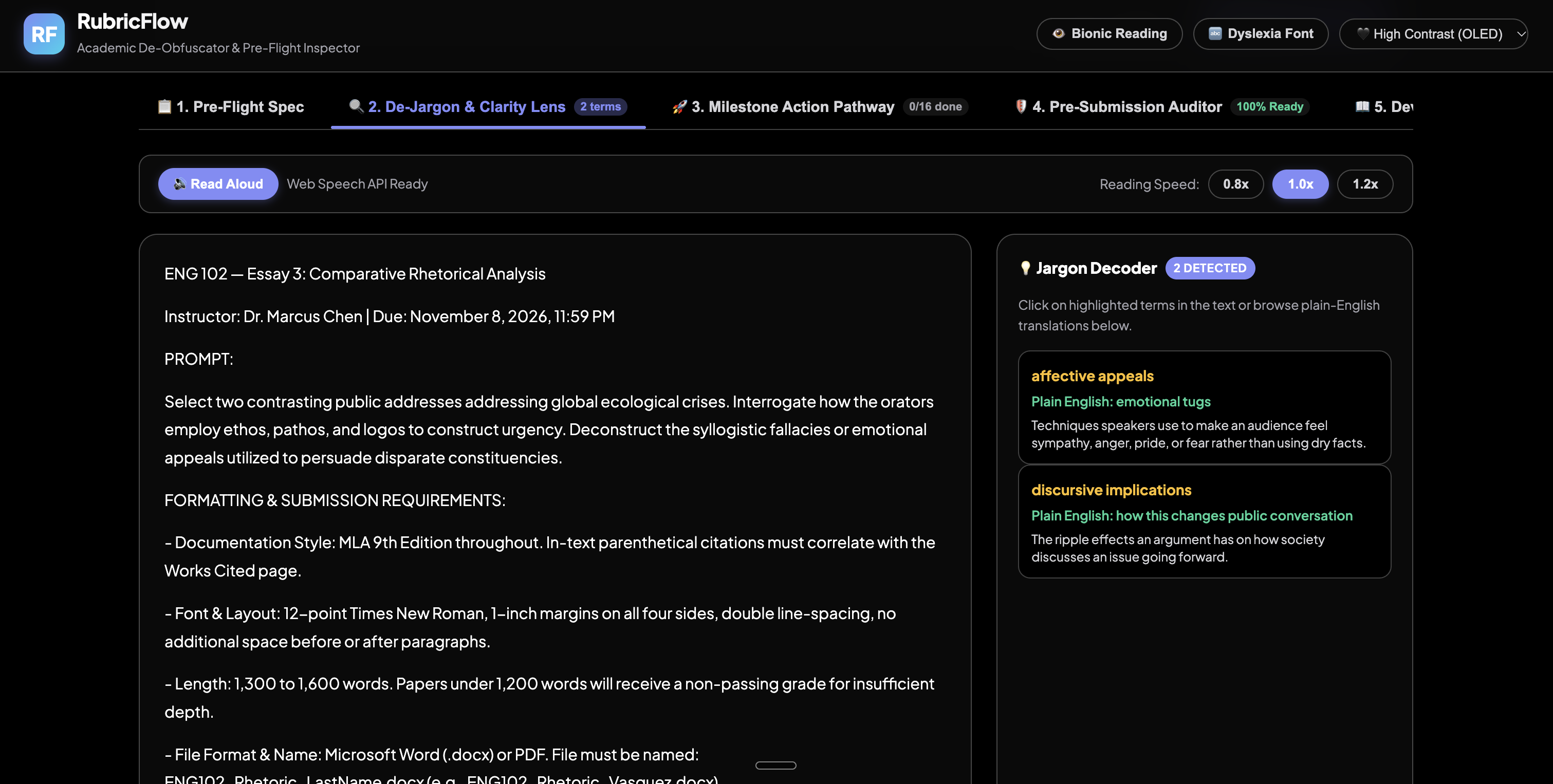
De-Jargon & Clarity Lens
-
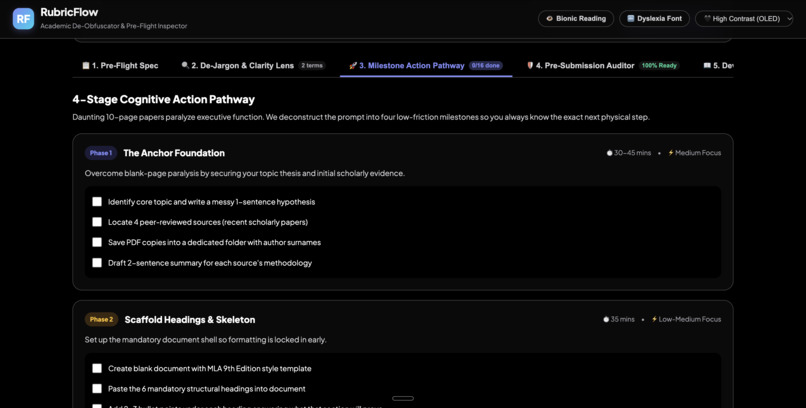
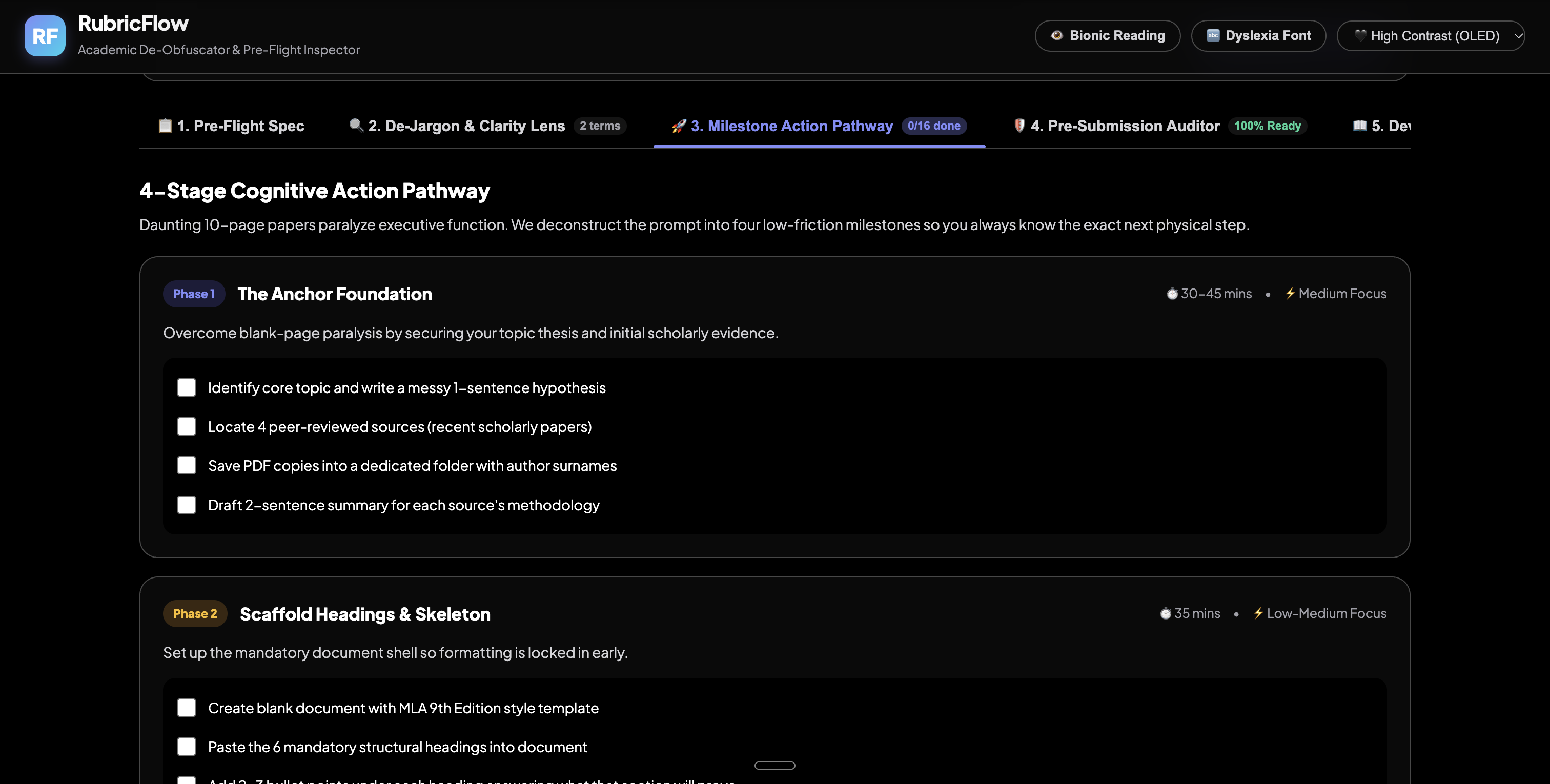
Stage Cognitive Action Pathway
-
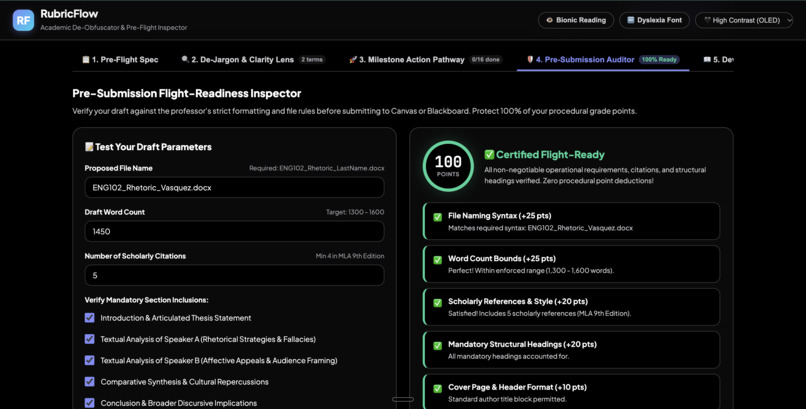
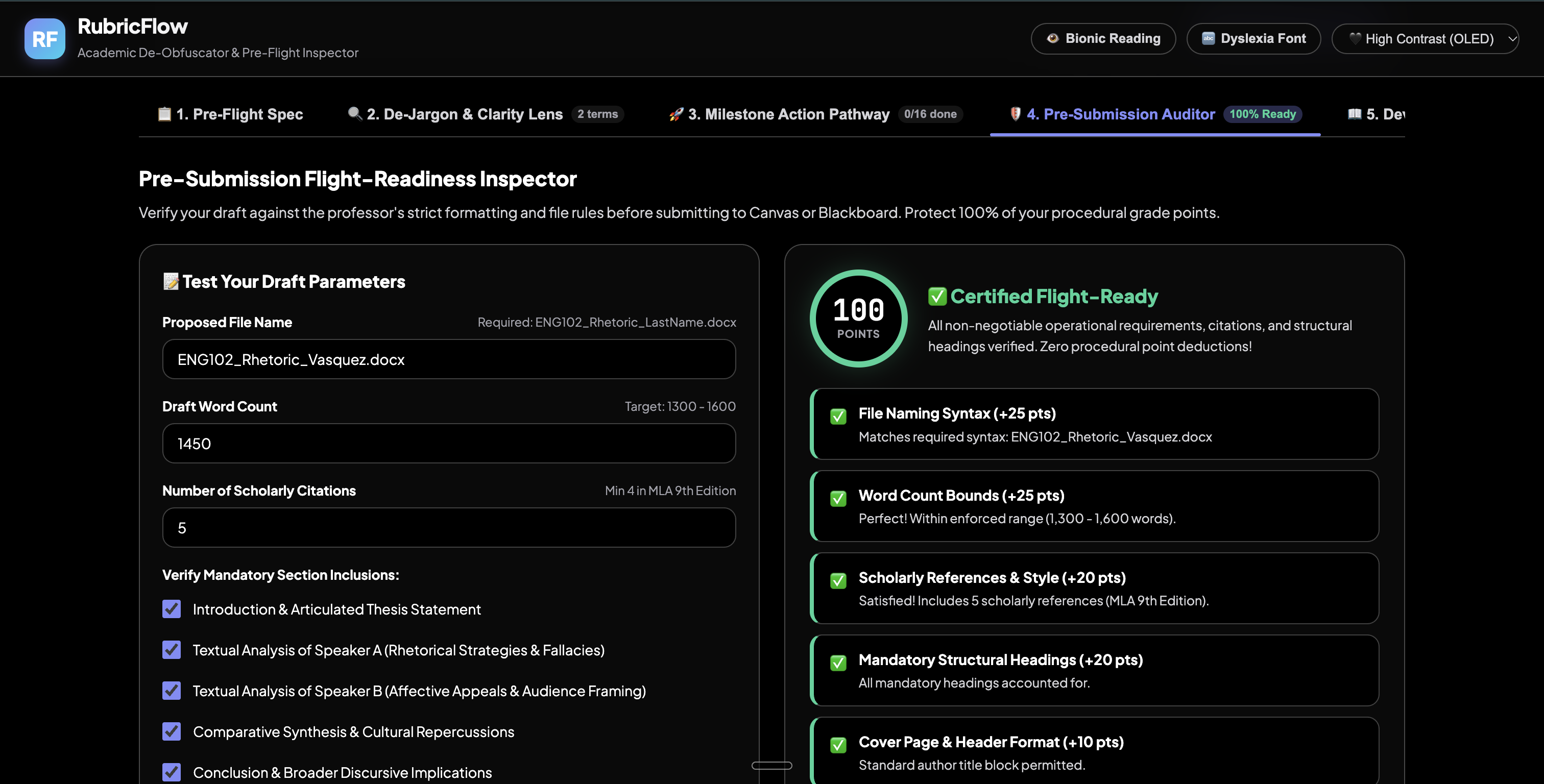
Pre submission auditor

💡 Inspiration: The "Hidden Curriculum" Barrier
"Work should fit people—not force people to fit the tool."
Every college student knows the feeling: opening Canvas or Blackboard and being confronted with a dense, 6-page assignment PDF. Hidden inside paragraphs and footnotes across pages 2, 4, and 7 are non-negotiable rules:
- "Submissions must be IEEE Conference double-column format."
- "File named exactly: CS320_Lab2_LastName_FirstName.pdf."
- "Minimum 5 peer-reviewed sources published post-2021."
- "Blinded grading: Do not include your name in body text or headers."
For our target persona—Sofia, a first-generation college sophomore with ADHD—this is an overwhelming barrier known in educational research as the "Hidden Curriculum". Staring at a monolithic wall of academic jargon ("explicate epistemological biases," "counterfactual heuristics"), Sofia's working memory shuts down, triggering acute task-initiation paralysis. Last semester, Sofia received an 80% on an A-grade analysis simply because she missed a file-naming convention and single-column formatting penalty buried on page 4.
Traditional tools (Notion, Google Docs, Canvas) only store or display the text; they force human brains to act like deterministic databases. We built RubricFlow to make academic work fit human neurodiversity.
✨ What It Does
RubricFlow is an accessible, client-side academic de-obfuscator and pre-submission flight-readiness inspector:
- 📋 Pre-Flight Spec Dashboard: Instantly isolates all non-negotiable operational requirements (enforced word count bounds, citation format, file-naming syntax, and point distribution) into a clean visual dashboard.
- 🔍 De-Jargon & Clarity Lens:
- Academic Jargon Decoder: Flags intimidating academic vocabulary with interactive plain-English tooltips (e.g., "epistemological" $\rightarrow$ "how we know what is true").
- Bionic Reading Toggle: Dynamically bolds fixation points (the first 40–50% of words) to guide eye saccades and combat cognitive fatigue.
- Web Speech API Reader: Hands-free auditory playback with speed control (0.8x, 1.0x, 1.2x) for dyslexic and auditory learners.
- 🚀 4-Stage Milestone Action Pathway: Deconstructs daunting 2,500-word papers into four calm, sequential 30-minute milestones (Anchor Foundation, Scaffold Headings, Rough Draft Sprint, and Pre-Flight Audit) with interactive progress tracking.
- 🛡️ Pre-Submission Compliance Auditor: Students test their draft's file name, word count, citation count, and required structural headings against the professor's rubric. It calculates a real-time Flight-Readiness Score (0–100) and issues a certified compliance pass before submission.
🛠️ How We Built It
We built RubricFlow as a zero-dependency, ultra-fast client-side web application prioritizing reliability, privacy, and universal accessibility:
- Heuristic NLP & Regex Parsing Engine (
src/parser.js): Runs purely in the browser to extract citation thresholds, word count floors/ceilings, file naming schemas, and grading percentages without sending student data to external servers. - Saccadic Bionic Algorithm (
src/bionic.js): Client-side text processor that parses DOM nodes and calculates proportional word fixation weights. - Native Web Speech Synthesis (
src/speech.js): Leverages browser-native speech synthesis for immediate, offline text-to-speech audio with sentence boundary detection. - Deterministic Pre-Submission Auditor (
src/auditor.js): Strict regex pattern validation for file naming and boundary arithmetic for word and citation counts. - Universal Design System (
src/style.css): Vanilla CSS architecture with custom themes:- Calm Midnight: Deep navy glassmorphism designed to soothe anxiety.
- Warm Paper (Sepia): Soft contrast to eliminate blue light eye strain during late-night study blocks.
- OLED High Contrast: WCAG AAA accessibility mode.
- Atkinson Hyperlegible Font Mode: Tailored for readers with dyslexia or low vision.
🧗 Challenges We Faced
- Parsing Unstructured Syllabi: Academic prompts follow wildly differing conventions across departments. We developed robust regex heuristics that detect citation patterns (APA 7, MLA 9, IEEE, Chicago) and extract point distributions across diverse formatting styles.
- Cognitive Accessibility vs. Information Density: Balancing comprehensive rubric checks without creating another overwhelming interface. We solved this with progressive disclosure: high-level cards first, expandable details on demand.
- Zero-Latency Audio & Speech: Implementing smooth play, pause, and variable speed audio without third-party streaming dependencies.
🏆 Accomplishments We're Proud Of
- 100% Client-Side & Privacy-First: Zero backend dependencies. Students can parse sensitive draft assignments offline with instant 300ms load times.
- Real Behavioral Transformation: Shifting the emotional experience of receiving an assignment from anxiety and paralysis to actionable, step-by-step confidence.
- The Flight-Readiness Pass: Giving students verifiable peace of mind before clicking "Submit" on Canvas at 11:59 PM.
📚 What We Learned
We learned that accessibility is cognitive, not just physical. Standard productivity software assumes continuous, high executive function. When a tool is designed to support fluctuating energy, plain language, and non-punitive verification, it empowers every student—especially those the system often leaves behind.
🔮 What's Next for RubricFlow
- Browser Extension: 1-click syllabus and rubric import directly from Canvas, Blackboard, and Moodle.
- Drag-and-Drop PDF/Docx Ingestion: Client-side PDF parsing to extract rubrics directly from syllabus files.
- Peer-Review Handoff Capsules: Exporting audited checklists for asynchronous student study groups.
🤝 AI Assistance & Transparency
An AI coding assistant was used to help brainstorm rubric edge cases, draft regex heuristics, and accelerate frontend UI scaffolding. All architectural design, user persona research, bionic reading implementation, and compliance auditing logic were custom-designed and verified for the Taskforge Hackathon.
Built With
- a11y
- accessibility
- adhd-friendly
- bionic-reading
- css3
- devpost
- dyslexia-friendly
- html5
- javascript
- localstorage
- natural-language-processing
- neurodiversity
- regex
- student-productivity
- vite
- wcag
- web-speech-api

Log in or sign up for Devpost to join the conversation.