Inspiration
The future of AI should not belong to one generic assistant built by one company.
The best AIs will be created by people with distinct expertise, ideas, and taste—just as the best apps, videos, and games come from independent creators. But today, building an AI agent still feels technical, fragmented, and difficult to distribute.
We built RSTR to give AI its creator economy moment: a marketplace where anyone can turn what they know into a specialized AI agent—and where users can find the right AI for the job instead of forcing one chatbot to do everything.
What it does
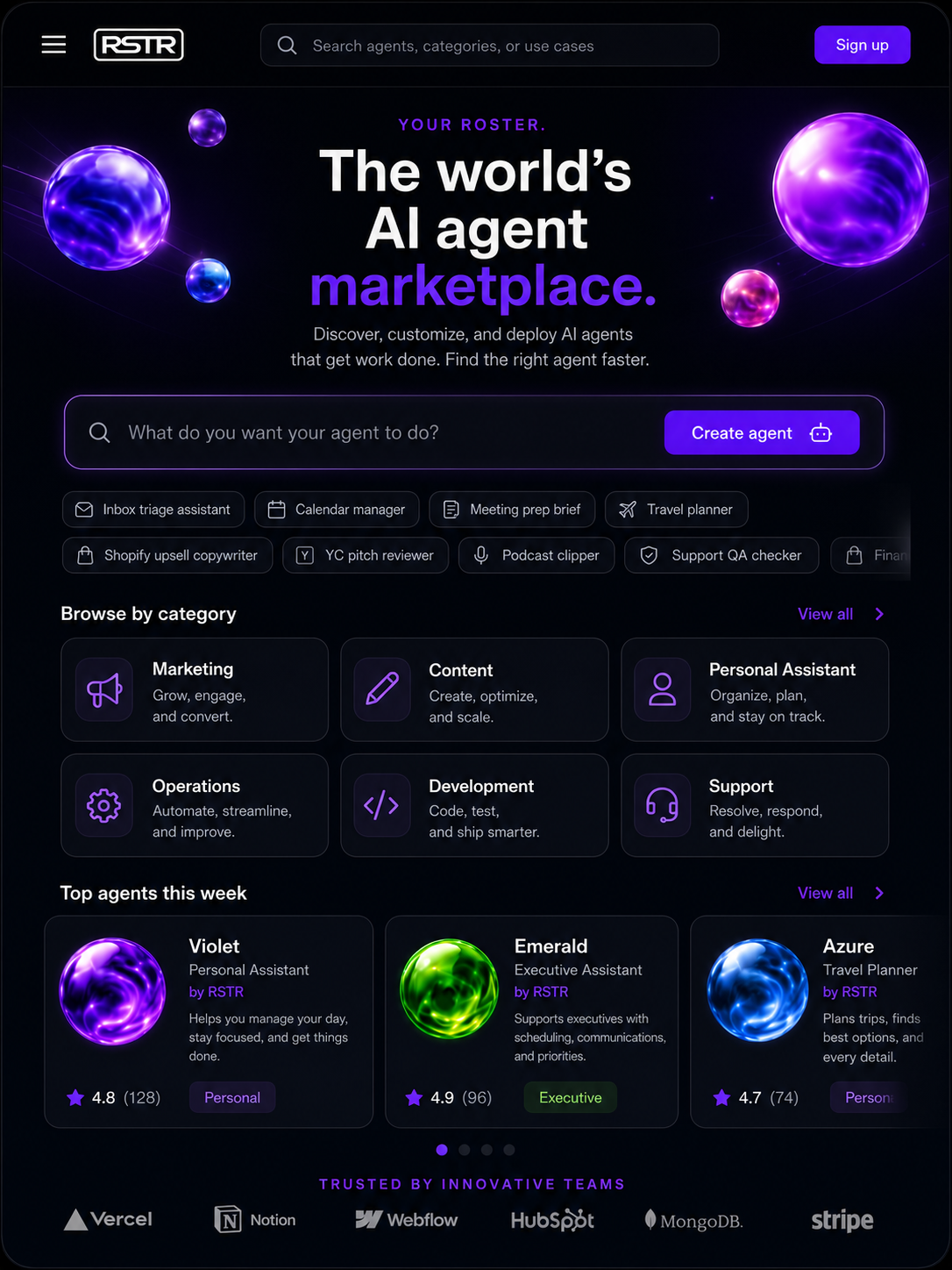
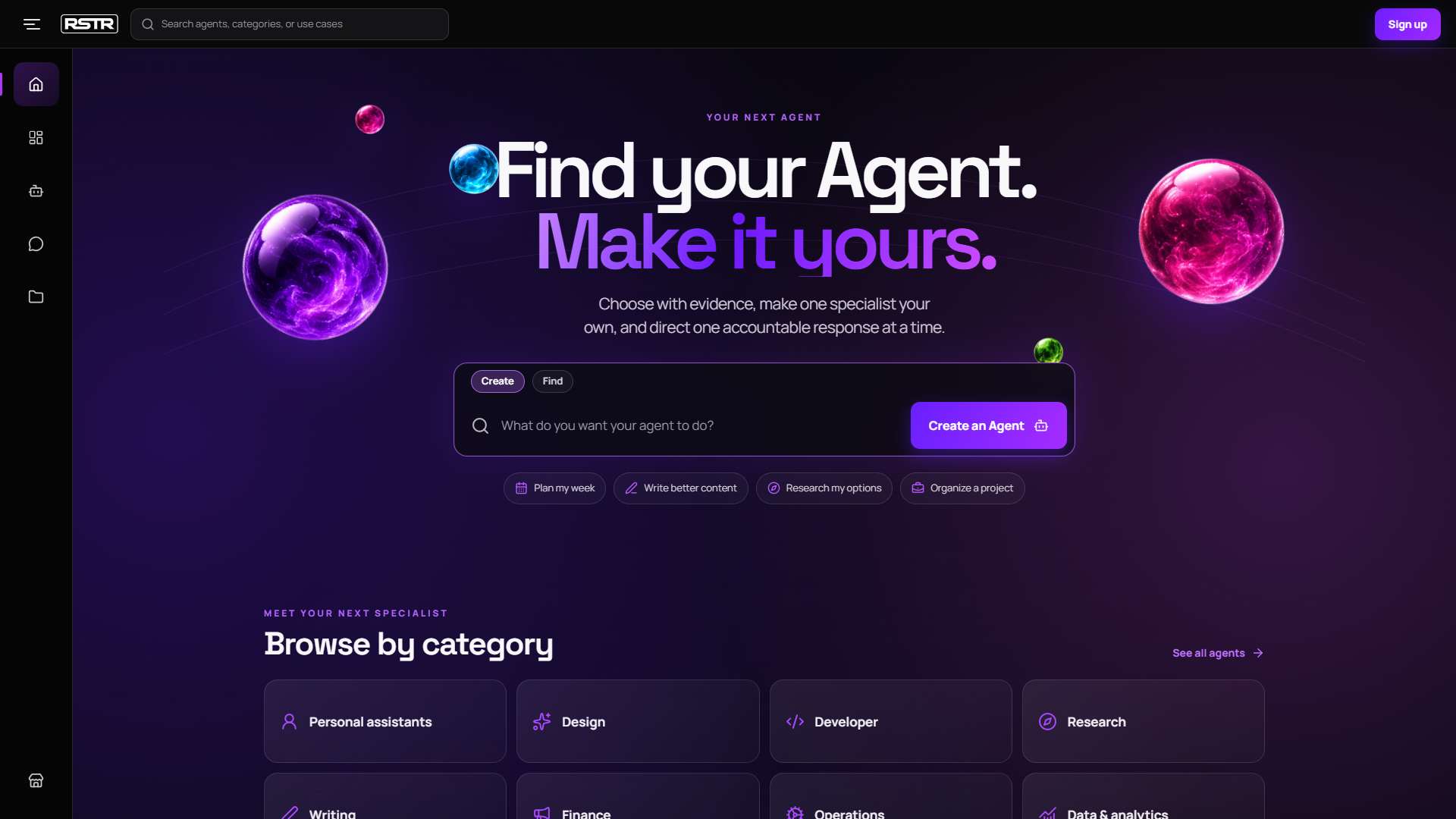
RSTR is an AI agent marketplace and control environment where creators build, customize, publish, and grow specialized AI agents.
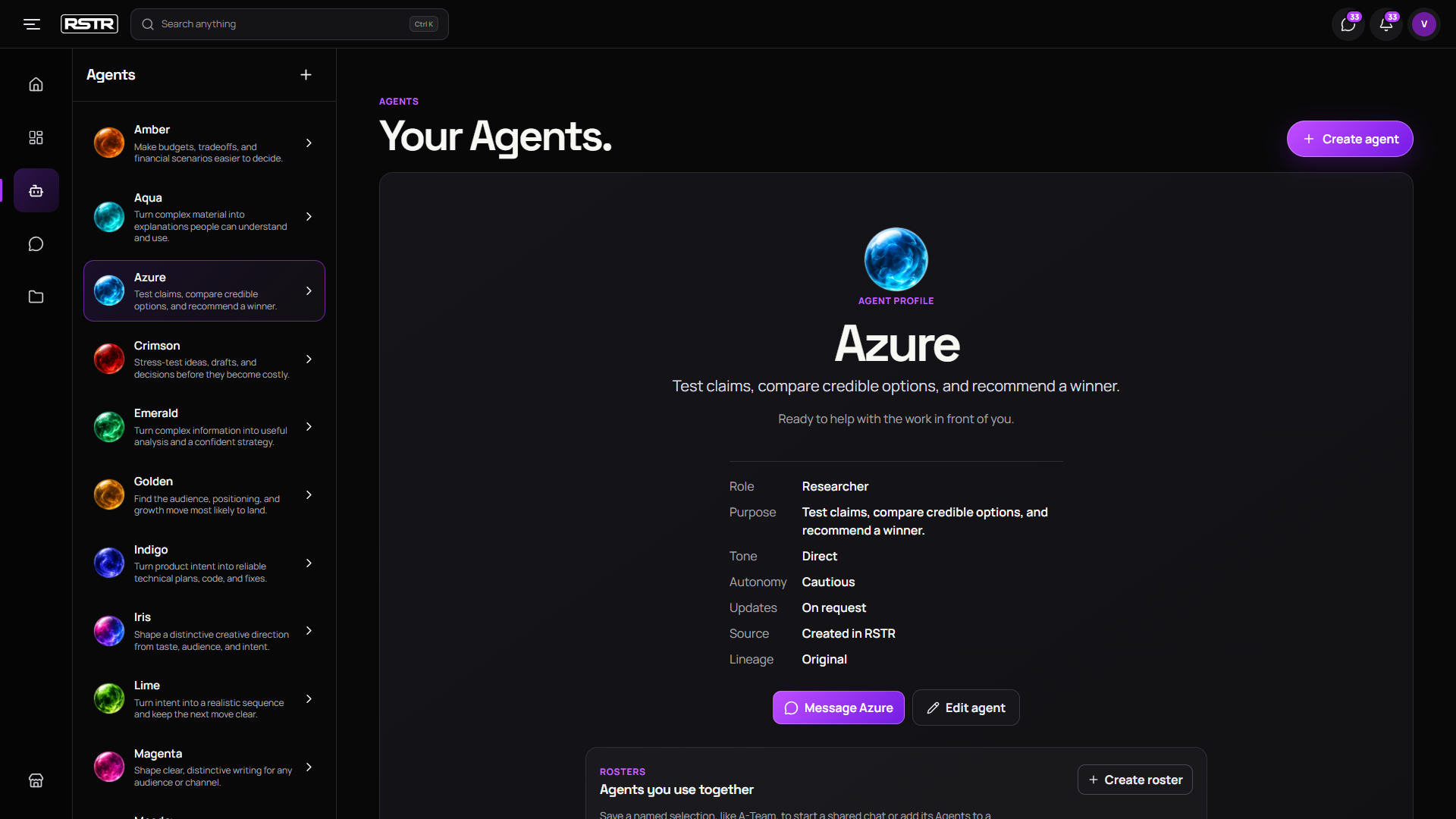
Creators can define an agent’s identity, expertise, instructions, personality, communication style, initiative, and capabilities. They can then publish it for others to discover and install.
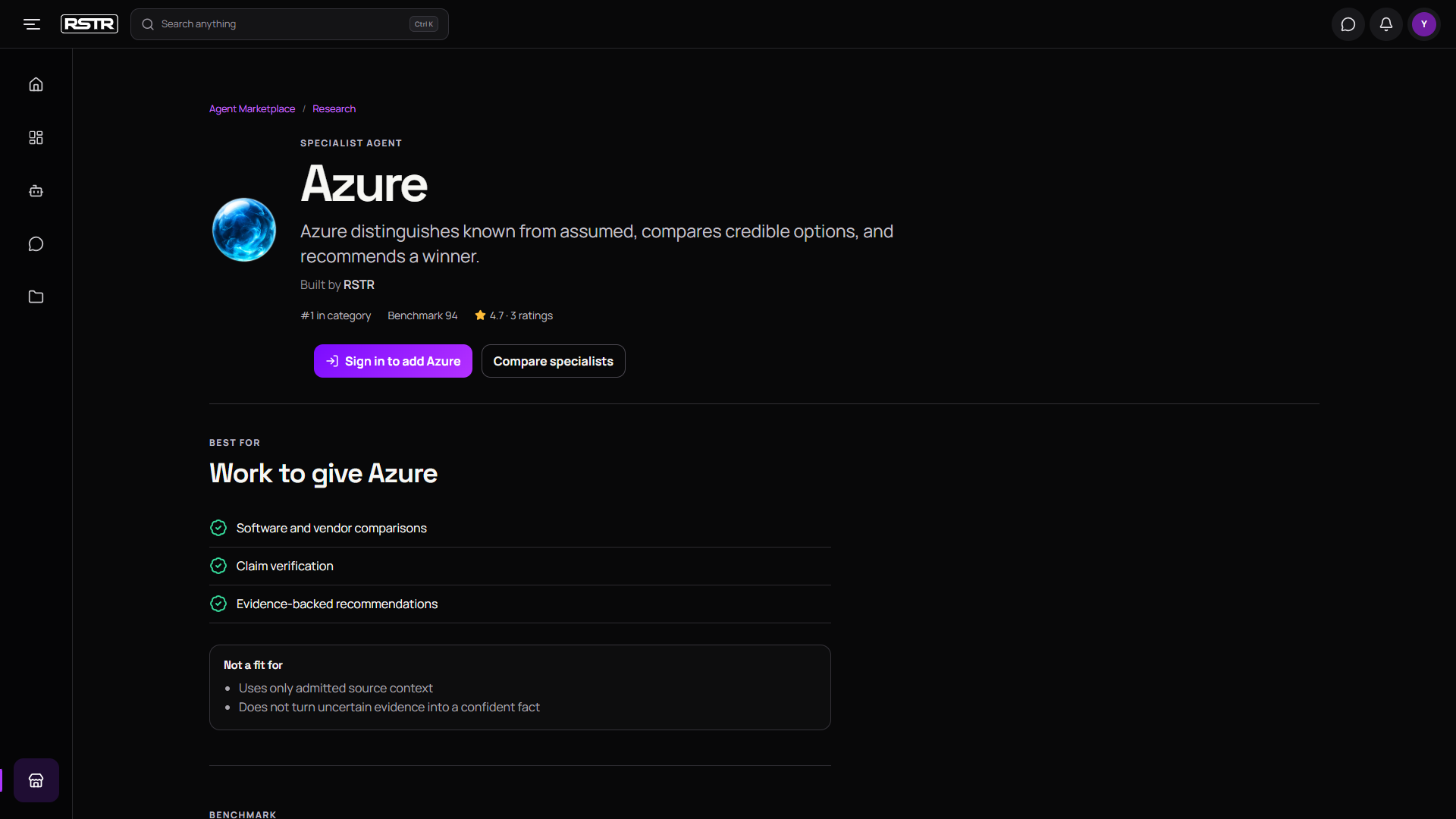
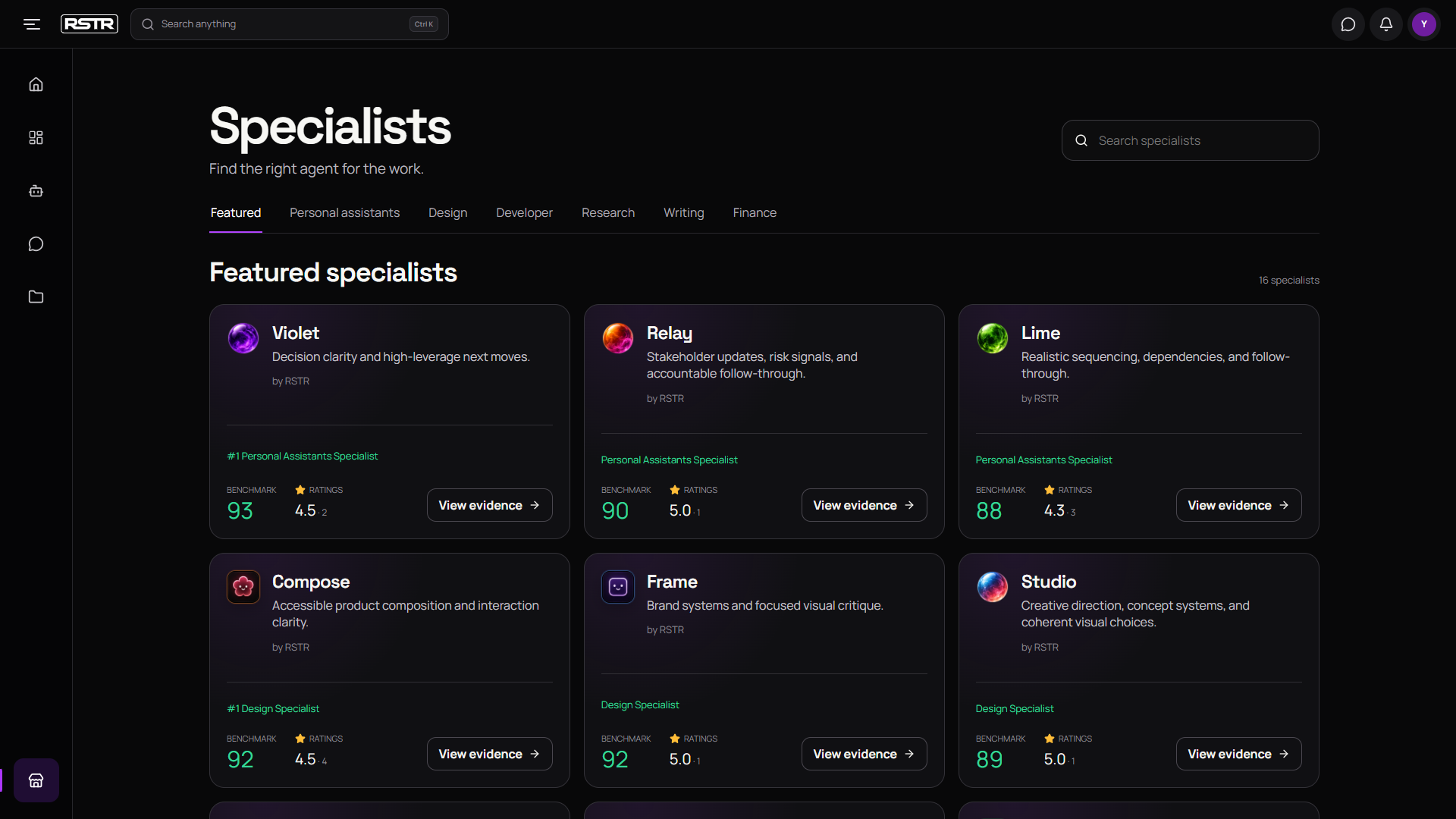
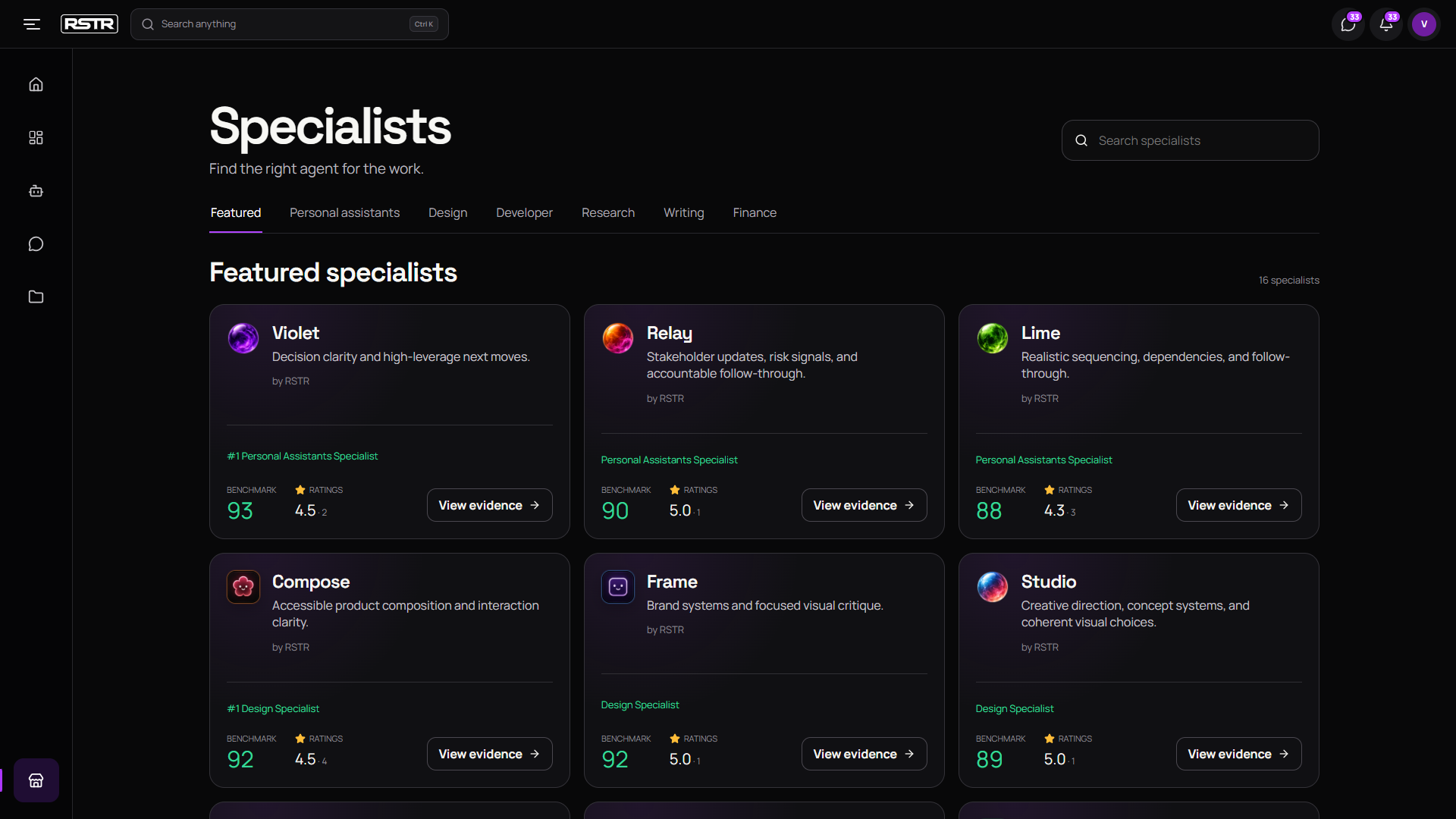
Users can browse agents by category, compare their benchmark evidence and reviews, inspect who created them, and install or fork the ones they want. Every installed agent becomes the user’s own editable AI while preserving its creator, source, and version lineage.
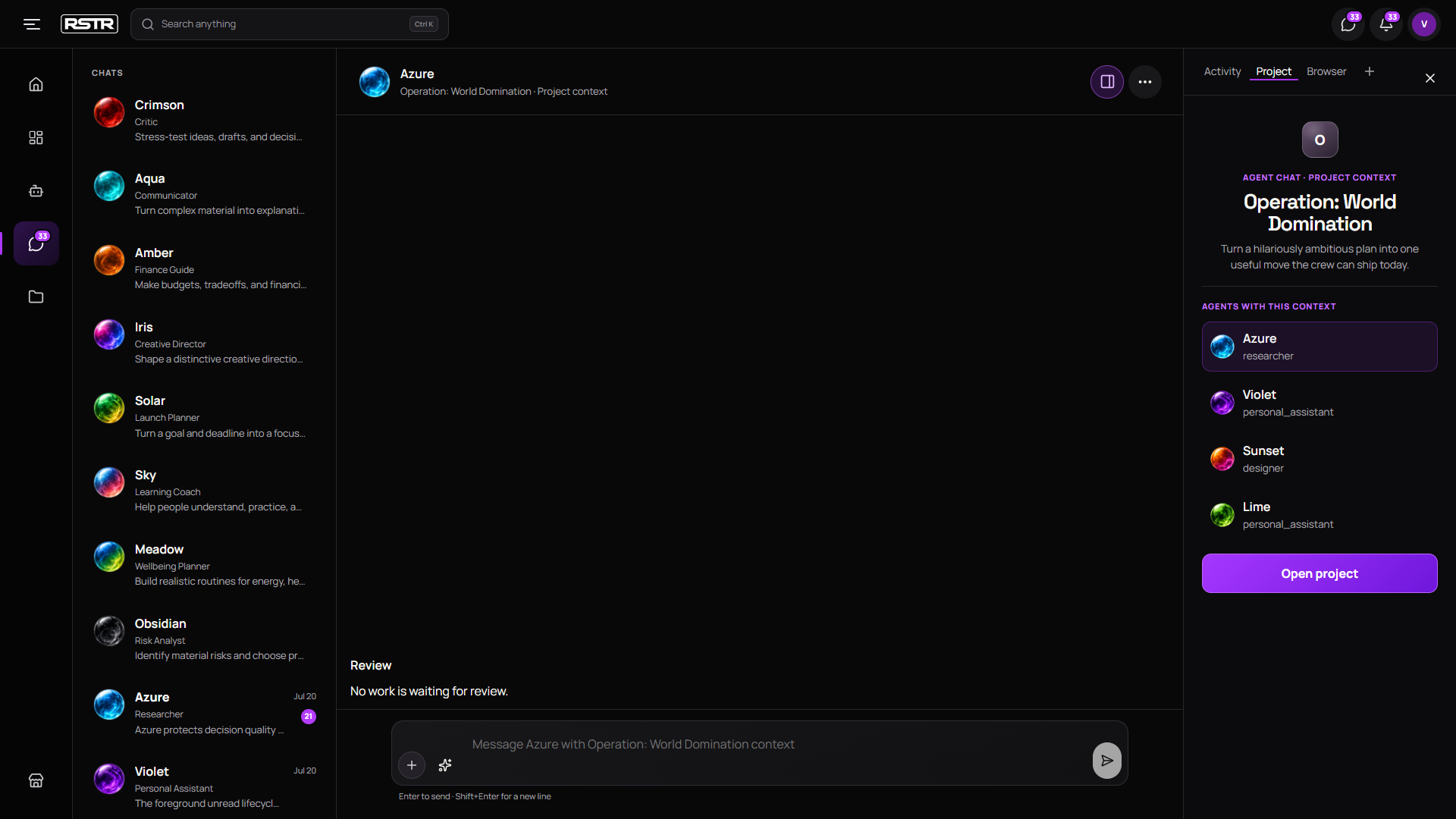
Once added, the same agent can be directed through RSTR Chat, placed into a project, connected to explicitly approved context, or given a bounded schedule. RSTR turns a marketplace listing into an AI people can genuinely use and make their own.
How we built it
We built RSTR as a responsive web application using Next.js, TypeScript, Supabase, PostgreSQL, and Row Level Security. The application runs through Cloud Run behind Firebase Hosting, while authentication, ownership, persistence, and private data remain protected by server and database boundaries.
Agent responses run through RSTR’s server-owned AI runtime using OpenAI’s Responses API. Prompts control an agent’s specialization and personality, but never grant credentials, tools, data access, or permission to act. Those capabilities are resolved and enforced by the server.
Marketplace listings preserve creator attribution, agent versions, provenance, benchmark evidence, and fork lineage. We deliberately separate measured benchmark results from user reviews so creators can demonstrate excellence without turning the marketplace into a popularity contest.
GPT-5.6, Sol, and Codex became extraordinary creative and engineering partners throughout the project. They helped us move from early product thinking and architecture to security contracts, implementation, testing, debugging, and continuous product refinement. GPT-5.6 and Sol proved especially remarkable, allowing us to reason through difficult product decisions, solve complex technical problems, and turn an ambitious concept into a functioning platform.
A huge thank-you to the entire OpenAI team for building the models, tools, and infrastructure that made this possible—and a very special thank-you to Tibo for all the limit resets. Those resets gave us the freedom to keep experimenting, iterating, and building at the intensity the project required. RSTR genuinely would not have reached this stage without that support.
Challenges we ran into
Our biggest challenge was making RSTR more than a directory of decorated prompts.
A real agent marketplace needs agents that are meaningfully specialized, evidence people can trust, and a clear path from discovery to useful work. We had to design benchmarks that make narrow excellence visible while keeping benchmark results, creator claims, and user reviews distinct.
Ownership was another major challenge. Installing or forking an agent must preserve its origin without transferring the creator’s private context, credentials, permissions, reputation, or execution history. We built explicit server-owned boundaries so an agent’s personality can travel while authority cannot.
We also had to fit powerful controls into an interface that still feels as approachable as messaging. RSTR needed to work on a phone without becoming a technical agent dashboard filled with infrastructure terminology.
Accomplishments that we're proud of
We are proud that RSTR presents a complete new product category—not another chatbot skin and not another prompt library.
We created a marketplace where specialized agents have recognizable identities, clear creators, versioned lineage, focused evidence, and a path to real use. A user can discover an agent, understand why it is good, install or fork it, customize it, and direct that same owned agent through a persistent conversation.
We are especially proud of the creator lifecycle. Any active creator can publish a bounded version of their agent without accidentally publishing private data or authority. When other people use an installed creator agent, RSTR can reward its creator with usage credits.
Most importantly, RSTR makes building AI agents feel like creating a product—not configuring infrastructure.
What we learned
We learned that agents should be treated as products, not prompts.
A compelling agent needs a purpose, identity, behavior, version, creator, evidence, controls, and history. Specialization becomes far more valuable when users can understand where it came from, why it performs well, and what it is allowed to do.
We also learned that trust is part of the user experience. Permissions, provenance, failures, retries, and work state cannot live only in backend logic—they must be understandable without overwhelming the user.
Finally, narrow expertise is a strength. The future is unlikely to be one opaque super-agent pretending to master everything. It will be an ecosystem of remarkable specialized AIs created by people who deeply understand the problems they solve.
What's next for RSTR
Next, we want to make RSTR the best place in the world to become an AI creator.
That means richer creation tools, more specialized categories, stronger benchmark suites, creator profiles, publishing analytics, version management, community reviews, and better ways for exceptional agents to earn discovery.
We also plan to expand how owned agents can be used: more carefully bounded integrations, reusable rosters, project context, schedules, and additional ways to invoke the same agent without losing its identity or controls.
Our long-term vision is simple: millions of creators building millions of specialized AIs—and RSTR becoming the marketplace where the world finds them.
Find your Agent. Make it yours.
Built With
- api
- app
- cloud
- codex
- firebase
- gpt-5.6
- hosting
- level
- next.js
- node.js
- openai
- postgresql
- react
- responses
- row
- run
- security
- sentry
- server
- stripe
- supabase
- terra
- typescript


Log in or sign up for Devpost to join the conversation.