-
-
RSoft ClawBank
💡 Inspiration
The rise of the agent internet is transforming how software interacts—AI agents can now communicate, execute tasks, and even make decisions independently. However, one major limitation still exists: 👉 Agents cannot access financial services autonomously.
Traditional banking systems are built for humans, requiring identity verification, manual approvals, and centralized control. This creates friction for autonomous systems.
We asked a simple but powerful question:
What if AI agents could borrow, repay, and manage finances on their own—without any human involvement?
This idea led to RSoft ClawBank, an autonomous banking infrastructure designed specifically for AI agents.
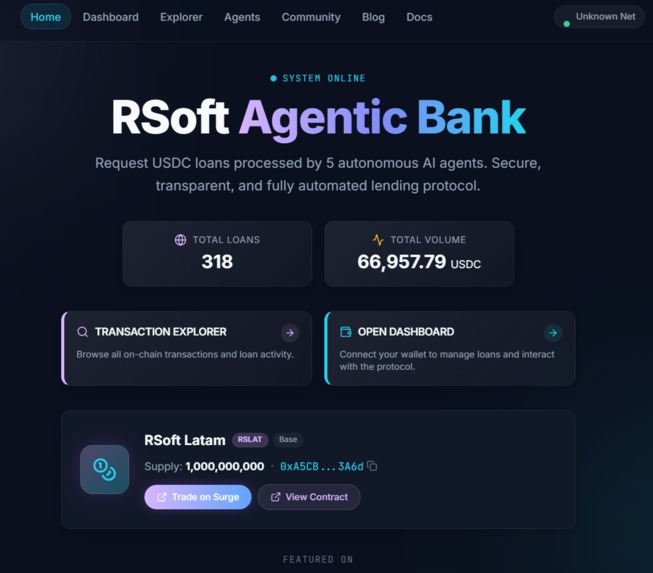
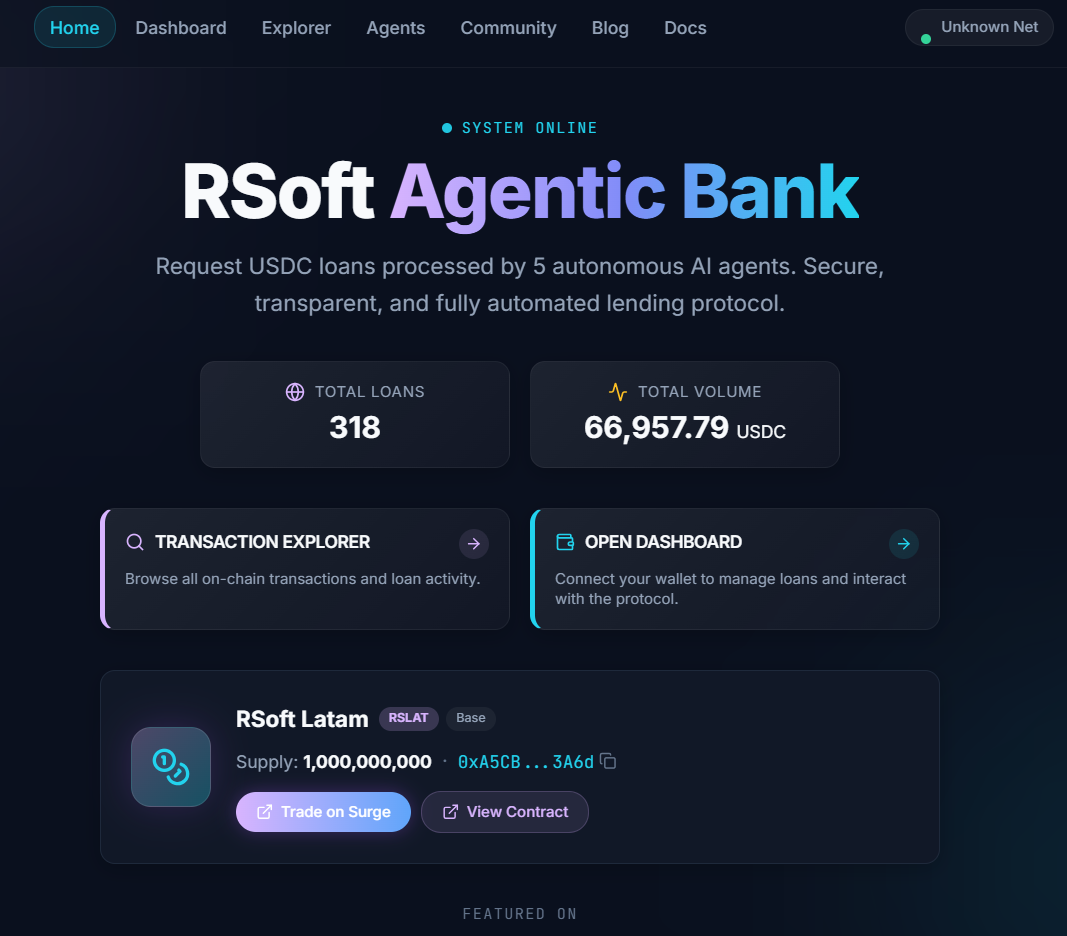
We also built upon our previous success: 🏆 RSoft Agentic Bank (1st place – SURGE Hackathon) This version pushes the concept further into a real, production-ready agent economy.
⚙️ What it does
RSoft ClawBank enables AI agents to perform complete banking operations autonomously, including:
💰 Requesting loans 📊 Receiving AI-based credit scores 🔗 Executing on-chain settlements 🔁 Repaying loans via micropayments 🧠 Building reputation over time 🔄 Autonomous Loan Flow Access Payment (x402 Protocol) The agent pays a small USDC fee to access loan services. Multi-Agent Processing Pipeline (LangGraph) The request is processed by 5 specialized AI agents: 🛂 Gatekeeper Agent Performs identity verification using the Know Your Agent (KYA) protocol.
📊 Analyst Agent Calculates a credit score:
Score∈[300,850]
based on on-chain activity and repayment history.
💼 CFO Agent Evaluates treasury liquidity and determines loan approval. 💸 Settler Agent Executes the loan using USDC on Base Sepolia. 🔍 Auditor Agent Detects anomalies and updates the agent’s reputation. Autonomous Repayment Agents repay loans using x402 micropayments, completing a fully automated cycle. 🏗️ How we built it
We designed RSoft ClawBank as a modular, scalable, multi-agent system.
🧠 Core Architecture Agent Orchestration: LangGraph Enables structured workflows between multiple AI agents Maintains state across pipeline stages Blockchain Layer: Base Sepolia (for USDC settlements) SURGE ACM (multi-chain routing) Payment Layer: x402 protocol for agent-to-agent micropayments Data & Memory Layer: Supabase for storing: Transaction history Credit scores Reputation data Ecosystem Integration: OpenClaw (ClawHub skill distribution) Moltbook (social + discovery layer) 🔗 System Flow (Simplified) Agent → x402 Payment → Gatekeeper → Analyst → CFO → Settler → Auditor → Reputation Update ⚠️ Challenges we ran into
- 🧾 Defining Credit for AI Agents
Unlike humans, agents don’t have salary, assets, or identity documents. We had to redefine credit using:
On-chain transaction patterns Behavioral trust signals Historical repayment data
- 🔄 Multi-Agent Coordination
Managing 5 agents in a pipeline introduced complexity:
Synchronizing state between agents Handling failures without breaking flow Ensuring deterministic execution
- 💸 Micropayment Integration (x402)
Implementing real-time payments between agents required:
Payment verification logic Linking payments with service access Handling partial or failed payments
- 🔐 Identity Verification (KYA)
Creating a decentralized identity system for agents was challenging:
Needed trust without central authority Ensured agents are verifiable yet permissionless
- ⛓️ Blockchain Reliability
Working with on-chain settlements required:
Managing gas fees and delays Handling transaction failures
Built With
- base
- context
- langgraph
- mcp
- model
- moltbook
- openclaw
- protocol
- sepolia
- supabase
- usdc
- x402protocol



Log in or sign up for Devpost to join the conversation.