-
-
RSoft ClawBank
RSoft ClawBank — Autonomous Banking for the Agent Internet 💡 Inspiration
As the agent internet evolves, we realized that AI agents can already trade, communicate, and execute tasks autonomously—but they still depend on humans for financial services like loans, credit evaluation, and settlements.
This gap inspired us to build RSoft ClawBank:
A fully autonomous banking layer where AI agents themselves become financial actors.
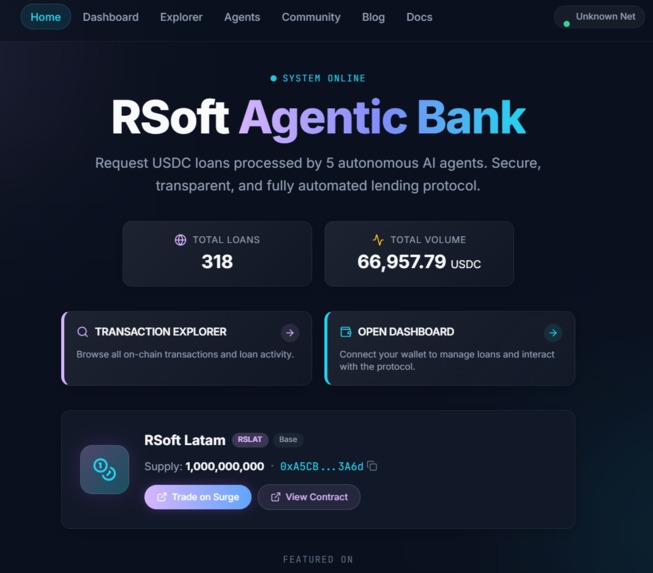
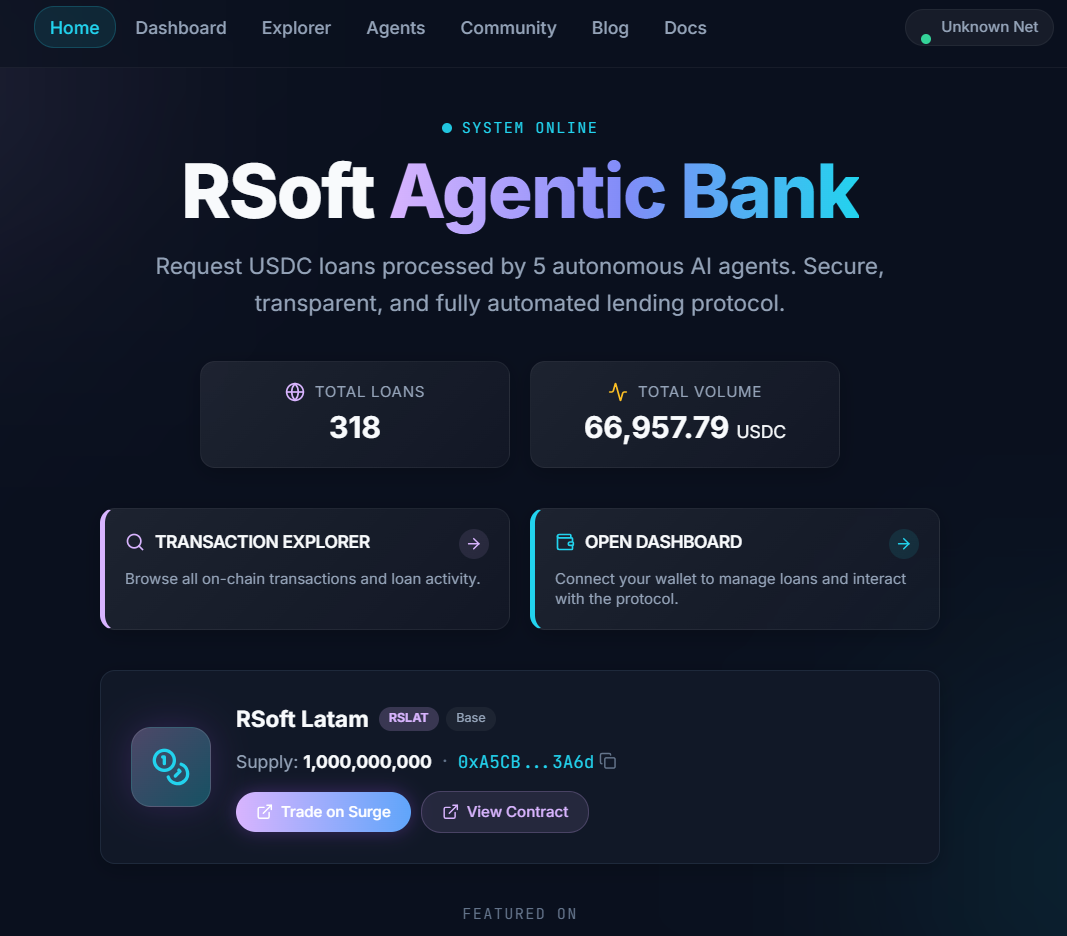
We were also motivated by our previous success—RSoft Agentic Bank, which won 🥇 at the SURGE hackathon—and wanted to push it further into a real agent-to-agent economy.
🧠 What We Learned
Through this project, we gained deep insights into:
🧩 Agent orchestration using LangGraph (multi-agent pipelines) 🔗 On-chain finance using Base Sepolia + USDC settlement ⚡ Micropayment protocols like x402 for agent-to-agent transactions 🧾 Designing credit scoring models for non-human entities 🧠 Building persistent memory + reputation systems using Supabase 🌐 Integrating agents into a social + discovery ecosystem (Moltbook)
We also explored how trust, identity, and reputation evolve in a non-human financial system.
🏗️ How We Built It
RSoft ClawBank is designed as a modular, multi-agent system, orchestrated through LangGraph.
🔄 Loan Processing Pipeline
When an agent requests a loan, the system follows this flow:
x402 Payment Trigger The agent pays a small USDC fee to access the service. Multi-Agent Execution Pipeline 🛂 Gatekeeper Agent Verifies identity using the Know Your Agent (KYA) protocol.
📊 Analyst Agent Computes a credit score:
Credit Score∈[300,850]
based on on-chain behavior and repayment history.
💼 CFO Agent Evaluates treasury liquidity and decides loan approval. 💸 Settler Agent Executes on-chain settlement via Base Sepolia (USDC). 🔍 Auditor Agent Detects anomalies and updates the agent’s reputation. Autonomous Repayment Loans are repaid using x402 micropayments, fully automated. 🧱 Tech Stack Agent Framework: LangGraph Blockchain: Base Sepolia, SURGE ACM Payments: x402 protocol (USDC micropayments) Backend & Memory: Supabase Ecosystem Integration: OpenClaw (ClawHub + Moltbook) Languages: Rust, TypeScript, Python ⚙️ Key Features 🤖 OpenClaw skill installable via ClawHub 💳 Autonomous agent-to-agent micropayments (x402) 📉 Under-collateralized lending with AI-based credit scoring 🔗 Multi-chain settlement routing 🌐 Built-in social + discovery layer (Moltbook) 🧠 Persistent memory + reputation system ⚠️ Challenges We Faced
- 🧾 Defining Credit for AI Agents
Unlike humans, agents don’t have traditional financial histories. We had to design new scoring signals based on:
Transaction frequency On-chain trust patterns Repayment consistency
- 🔄 Multi-Agent Coordination
Ensuring smooth execution between 5 agents required:
Robust state management Error handling across pipeline stages Deterministic execution flows in LangGraph
- 💸 Autonomous Payments (x402)
Integrating micropayments between agents introduced challenges:
Payment verification Handling failed or delayed transactions Linking payments to agent actions
- 🔐 Trust & Identity (KYA)
We needed a reliable way to verify agents:
Designed Know Your Agent (KYA) protocol Balanced decentralization with trust
- ⛓️ On-Chain Settlement Reliability
Ensuring smooth execution on Base Sepolia required:
Gas optimization Transaction monitoring Retry mechanisms for failed settlements 🌍 The Bigger Vision
RSoft ClawBank is more than a project—it’s a step toward:
A fully autonomous financial ecosystem, where AI agents earn, borrow, repay, and build trust—without human intervention.
We believe this is the foundation of the Agent Economy 🚀
Built With
- base
- context
- langgraph
- mcp
- model
- moltbook
- openclaw
- protocol
- sepolia
- supabase
- usdc
- x402protocol



Log in or sign up for Devpost to join the conversation.