-
-
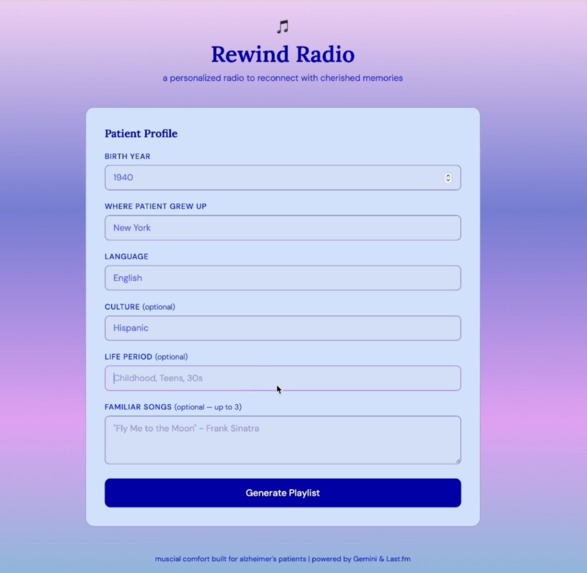
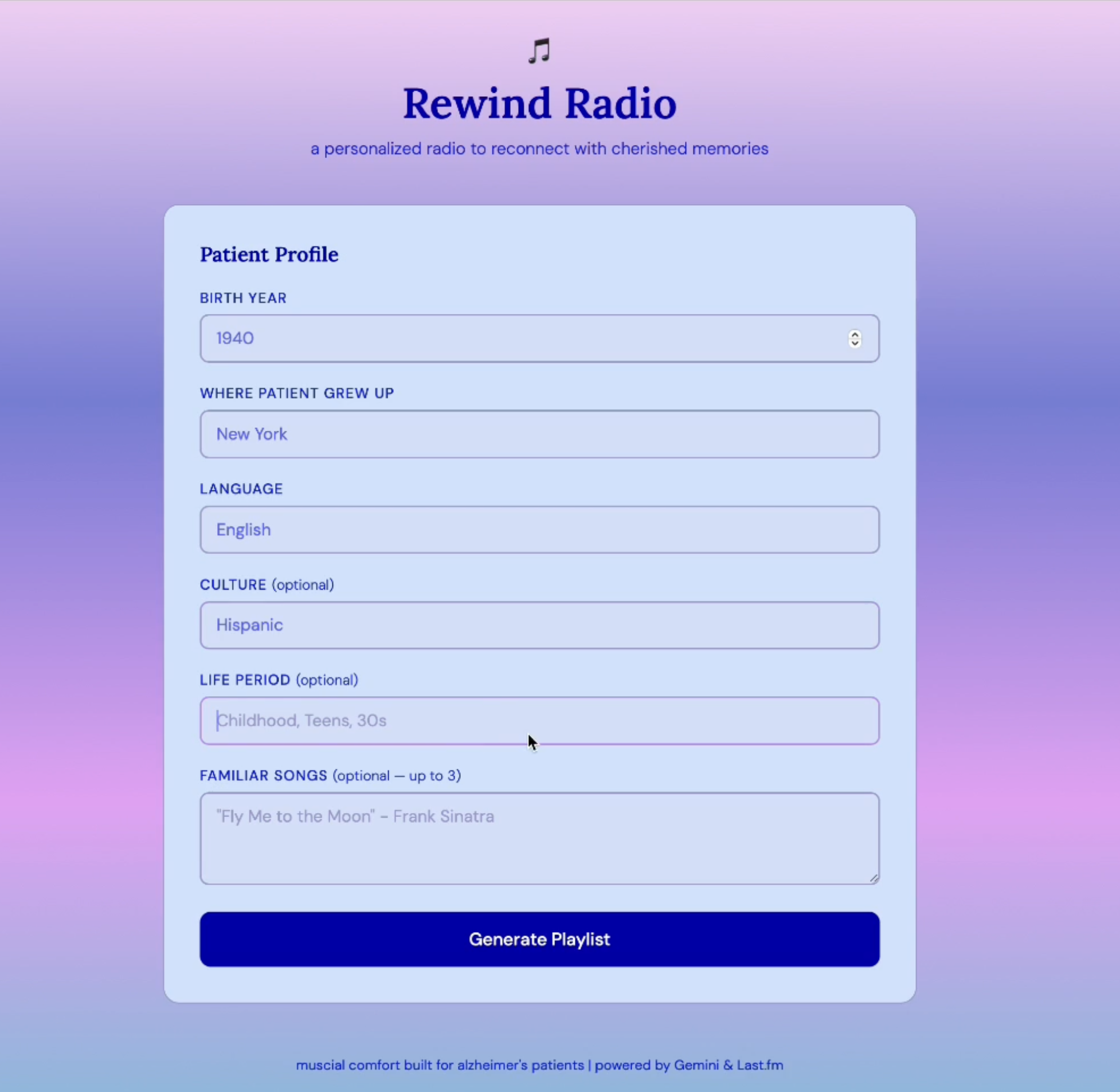
front page
-
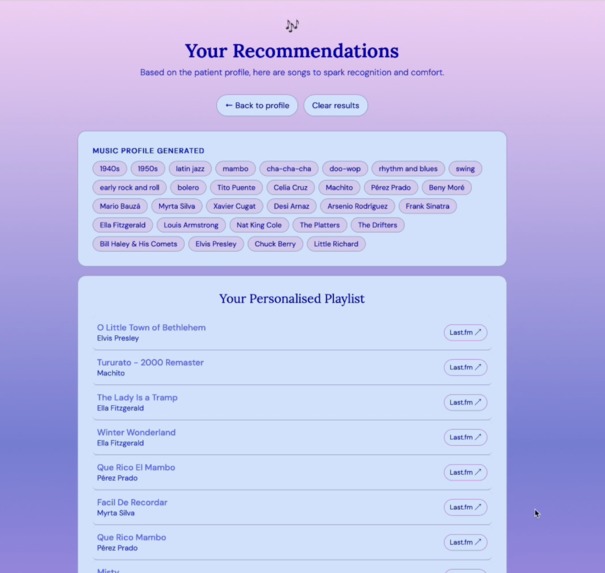
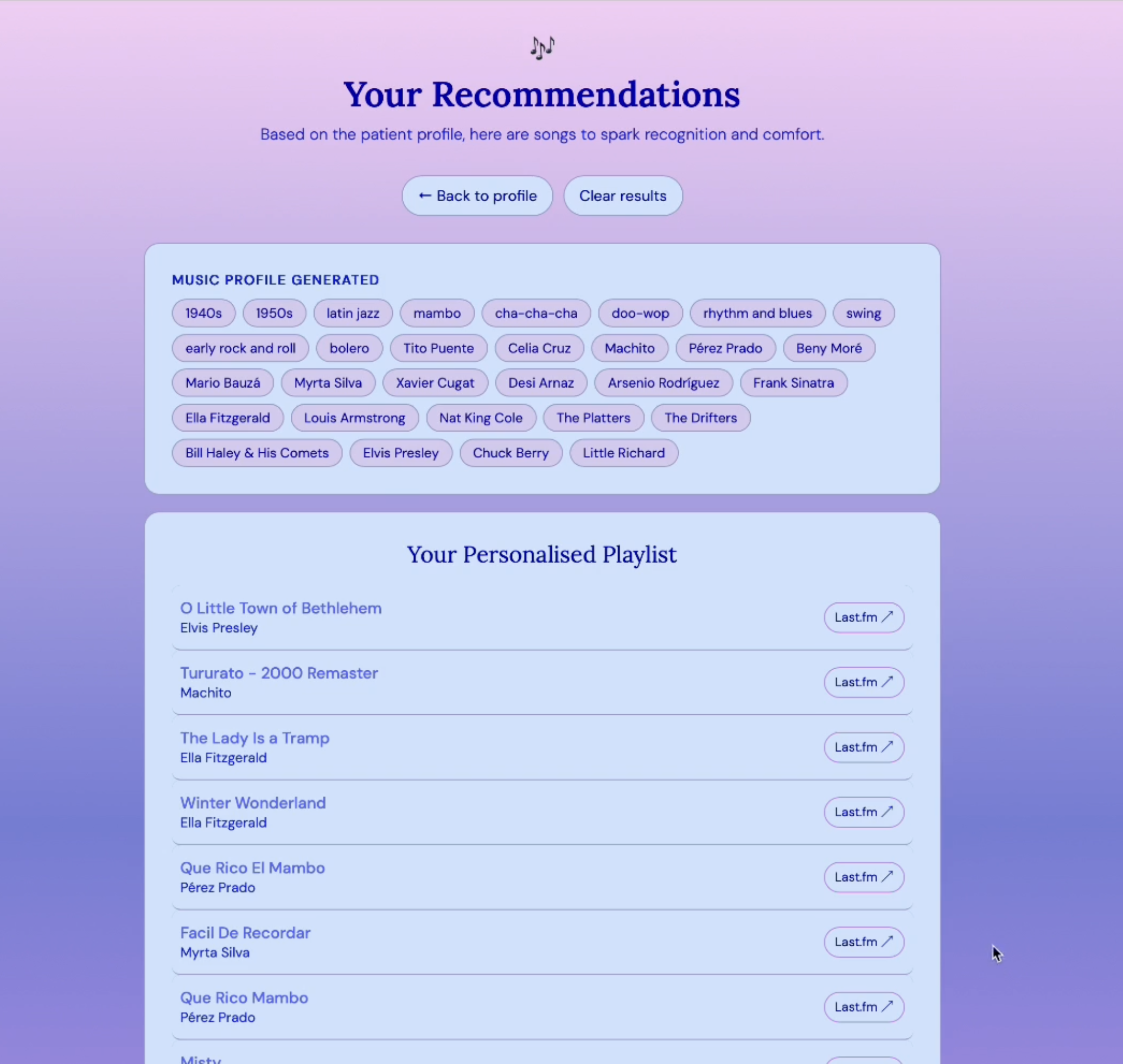
playlist output
Inspiration
Ria has seen her grandmother struggle with Alzheimer’s, and that’s what inspired Rewind Radio. Watching her lose memories was painful but when familiar music played, she became more present and expressive. That moment showed us how powerful music can be. Patients often remember songs even when they forget names or faces. In 2024, researchers at Brown University studied 3,500+ nursing home residents and found that personalized music improved mood, social engagement, and cognitive awareness while reducing agitation and reliance on psychotropic medication.
What it does
Rewind Radio creates personalized playlists based on music from an Alzheimer’s patient’s past to help reconnect them with memories. Caregivers input: birth year, hometowns, culture/language, favorite artists or themes. The app generates a playlist from the patient’s formative years, when musical memories are strongest.
How we built it
We used the Gemini-2.5-Flash model to process flexible user input. Instead of dropdown menus, caregivers can type naturally. Gemini strictly outputs structured JSON with: 2 eraTags (decades within birth year → +25), 8 culturalTags (era-accurate genres/styles), 20 artists active only within that window, countryISO. We then use those tags to query Last.fm, which provides data on when songs were most popular, not just when released, which better matches when the patient likely heard them. Frontend design used HTML + CSS with calming, low-contrast colors to promote relaxation and reduce overstimulation.
Challenges we ran into
Some challenges we ran into are as follows: we had limited API usage and strict call limits forced us to optimize queries, ensuring artists truly fit the time window, making sure Gemini outputs were strictly JSON (no extra text), and balancing personalization with performance speed.
Accomplishments that we're proud of
We are proud of utilizing the Gemini API efficiently, discovering a very applicable and understandable usage of Last.fm, and connecting neuroscience research with technical implementation. We are also proud of building a structured AI prompt that guarantees accurate decade and artist constraints, accessible UI for caregivers, and making a product that feels emotionally meaningful (not just technically functional).
What we learned
We learned that AI works best when tightly constrained, APIs are powerful when combined (Gemini + Last.fm), UX matters deeply in healthcare tools, and that music is not just entertainment; it’s neurological therapy.
What's next for Rewind Radio
Our goal for Rewind Radio’s future is to create symptom-specific playlists (calming agitation, reducing anxiety) adding more personalization parameters, long-term caregiver dashboards, and expanded global music databases. We would also like to add feedback form so that the user can indicate if the song was helpful or successful. We also see how this could be integrated with organizations such as Music & Memory and be used for their future goals and projects.

Log in or sign up for Devpost to join the conversation.