-
-
RPC3 architecture
Inspiration
This project aims at providing an alternate solution to the classic and widely used client-server architecture when it comes to consuming remote services. This architecture works well when the service in question is managed by a central organization, because it is straightforward, cheap and simple to understand:

But if we want a service that is entirely autonomous and decentralized, we need to imagine a new architecture where the client doesn't interact with a server, but with a network of computers that work together and reach consensus about the results.
First thing that comes to mind when hearing this definition is blockchain technology. Indeed, blockchain provides a great part of the solution, especially smart contracts which allowed the surge of decentralized exchanges and other DApps. But this comes with a certain number of known limitations :
- Computational resources of smart contracts are limited, whether it is CPU power, memory or disk storage. EVM chains for example use a gas system as a way to monetize these resources, and capacity depends on the maximum size of blocks which is very limited
- Programming of smart contracts can only be done with a limited set of instructions. Because result needs to be deterministic, we cannot use regular server-side programming languages, frameworks and libraries. We need to rely on oracles and inter-chain communication protocols to get data from external world, which adds layers of complexity.
- Deploying updates is a tough task as smart contracts are by design not upgradeable. Design patterns exist in order to mitigate this limitation, like the proxy pattern, but some cases may require more complex migration logic that inherently induces various risks.
When I discovered Oasis Protocol and how they managed to add privacy on smart contracts, I immediately realized that it would unlock new use cases and solve problems that did not have a solution until now. Regarding the three points above, there are indeed some projects out there that aim at solving one or many of these problems, but they often imply the creation of a new protocol or a new blockchain from scratch. However, here I was able to glimpse the possibility of a solution that only uses smart contracts on an already existing protocol, by leveraging its privacy capabilities.
This is how the RPC3 project is born. I gave it this name because the type of client-server interactions that I wanted to cover matches pretty well the definition of Remote Procedure Calls, and the "3" is a reference to web3 as the solution relies on web3 technologies.
Overview
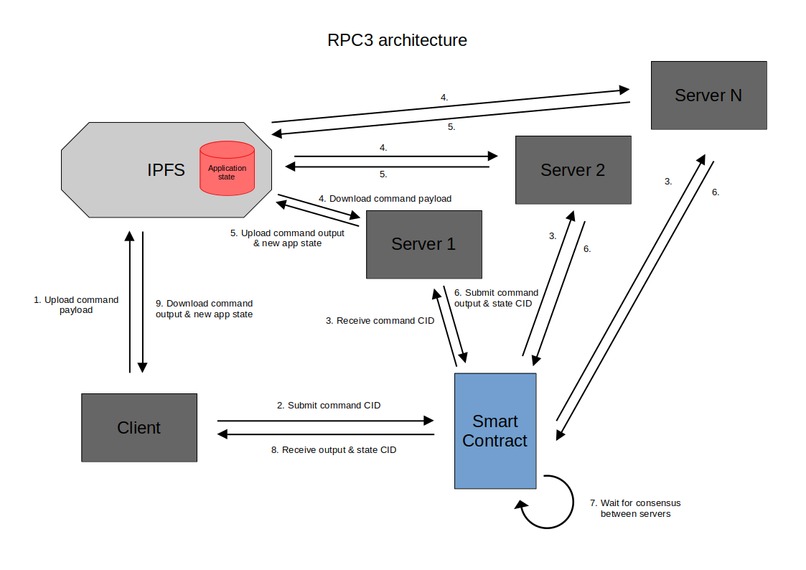
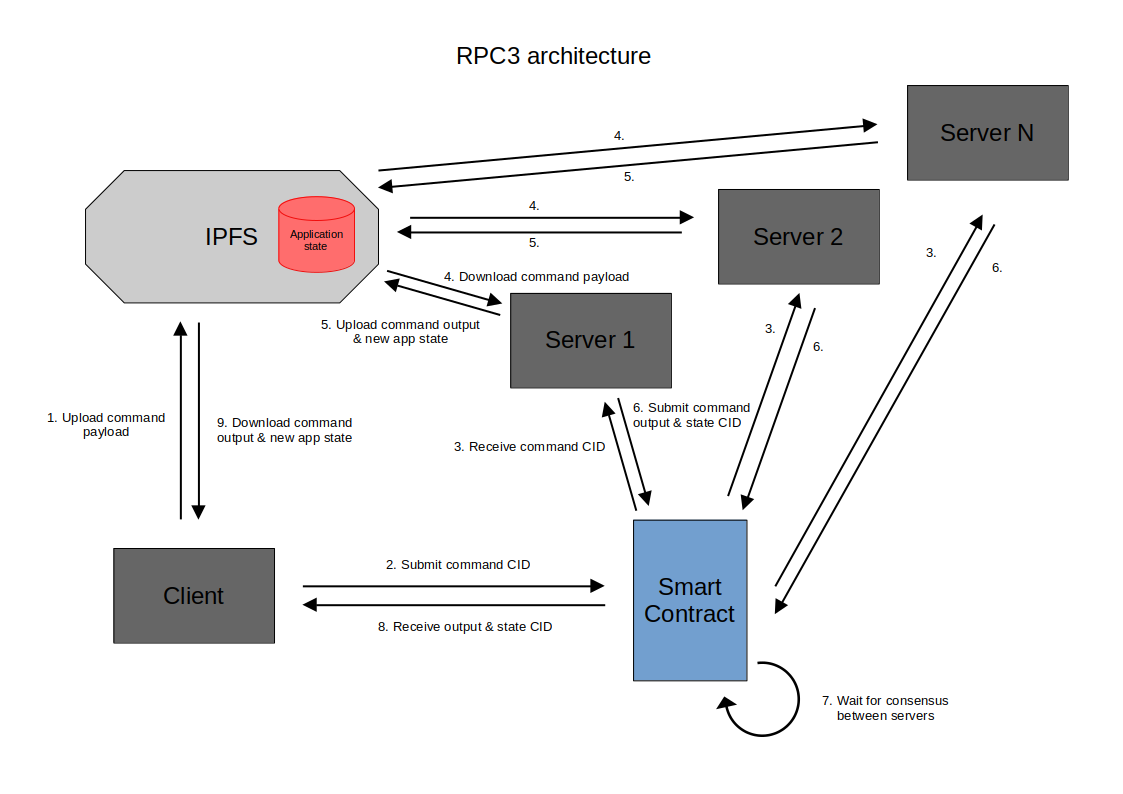
We obviously cannot expect such a new architecture to be as simple and straightforward as the classic one, simply because of the number of technical challenges being inherently higher. Some balance must be found between complexity and feasibility, the initial brainstorming is certainly what took the most time; especially when you are working solo on it. Here is what I finally came up with:

Let's break this down:
- The general concept is that instead of one central server, we have many servers operated by independant individuals or organizations. All of these servers run the same application code, written with the usual programming languages, frameworks and libraries. The smart contract acts as a coordinator between all of these servers, while data storage and transmission is done via IPFS (request and response payloads + application state)
- When the client wants to send a command, it uploads the payload (opcode, parameters, etc) of the command to IPFS, then submits the CID (IPFS hash-based content identifier) to the smart contract
- Servers are notified of incoming commands from the contract, they will download the content from IPFS and execute the command on their local environment
- Each server write the command output and the new application state to IPFS, and submit both resulting CIDs back to the contract
- The contract determines whether a consensus has been reached by comparing results between servers
- The client is notified that a response is available, from there they can get the CID and download the content from IPFS
Remarks
- The consensus step is the very thing that is not achievable with a blockchain without privacy capabilities. Indeed, the results submitted must be kept private in order to have participants compute the results themselves instead of just blindly reposting the results that are currently winning the consensus. Although it doesn't prevent cases where many servers cooperate and "share" results between each other (also known as Sybil attacks), this can be mitigated for example by requiring servers to stake tokens in the contract to be able to participate. The use of a privacy-enabled blockchain also makes it possible to have end-to-end encryption so user data remains encrypted in both request/response payloads and application state.
- Sending commands is only useful if the client needs to perform an operation that modifies application state. For read-only queries, the client is expected to download the application state from IPFS and query the data themselves. This is a similar problem that we have with blockchains, where the client needs to download the whole blockchain by self-running a node in order to query data without relying on a third party. So just like blockchains, it would be totally possible to have intermediates that act as a gateway for clients to query data in a more convenient way.
- Since servers run code that is written in usual languages, they are technically allowed to call external web2 services through HTTP-based APIs for example. This gives developers the full responsibility not to create side-effects or rely on potentially non-deterministic sources. On the other hand, this has the huge benefit of removing the need for oracles. After all, this architecture is pretty similar to how some oracle protocols work.
- Upgrading the code of servers is possible without redeploying the coordinator smart contract. The process would be similar to blockchain node upgrades, where a committee agrees on a block number that represents the deadline before which servers need to deploy the new code. If the application state needs a migration, launching the migration script would be a regular access-controlled command sent through the system just like any other command.
Scope and project contents
This repository contains:
- A smart contract written in Solidity for the Sapphire EVM paratime that has the following features:
- Register and unregister servers with a Dutch auction-styled staking mechanism that offers protection against Sybil attacks
- Accept requests from clients and organize them in batches to improve scalability and keep down gas costs
- A basic consensus algorithm to compare results between servers, with customizable quorum and ratio thresholds
- Housekeeping mechanism to filter out inactive servers from the consensus process
- Basic reward mechanism to incentivize servers to contribute positively, without explicitly defining the source of income that fund these rewards
- A rudimentary demo app that allows clients to increment a private counter:
- A command-line client app that connects to a local IPFS node and can interact with the contract. The users chooses a number and will increment a counter by that number, that initially starts at 0
- A server app that connects to the same local IPFS node and includes scripts to launch many servers and simulate the consensus process
- The off-chain state of the application (in this case, the counter values for each user) is a SQLite database file living on IPFS. Clients may download it to retrieve the value of their counter, and servers use it to update its contents
- A "private computation unit" (PCU) smart contract that adds an encryption layer to the whole system. This contract is entirely decoupled from the system itself, which is why I didn't mention it when I explained the general concept. It basically makes it possible for clients to send encrypted requests and for servers to perform computations over private data, before sending the encrypted response back to the client while keeping the application state encrypted as well. The counter demo app leverages that in order to keep the counters private to the users owning them (one user cannot see the value of another user's counter, and servers have no knowledge of the values being computed).
Limitations and disclaimers
- Although I made the effort to properly unit-test all of my smart contracts, the code of the demo applications is essentially untested and is prone to bugs.
- The system has not been tested at a large scale. There probably are limitations that can only be observed in real-world conditions that I may have missed. For example, when I played around with IPFS, I noticed that newly uploaded data may take some time to propagate from one node to another. I'm not sure how problematic that could be in the context of this project, and I didn't have the opportunity to evaluate the impact yet.
- Currently you need to manually send funds to the contract in order to reward servers for their contribution. This is good because it allows to define the app's business model in a decoupled way, but this part is not covered in the demo counter app.
- The consensus process takes a certain time to complete. Between the submission of the command and the availability of the output, there is an observed minimum of 40 seconds of delay. This makes it non suitable for applications requiring live data or frequent updates. The scope is limited to fast read, slow write type of applications.
Challenges and accomplishments
Working on this project was of course extremely challenging for me. While I do have a solid programming background in Node.js and that I've been working as a software engineer for 2 years, it was my first time coding in Solidity. I made progression in this project in a learning-by-doing fashion; but Solidity being a very simple language with familiar syntax, learning the language itself wasn't an issue for me. Most of the work was about mastering the different kind of data location (storage, memory, calldata), and how the different instructions affect the gas costs and how to optimize them.
An essential aspect that I've got to learn was security of smart contracts. I documented myself about reentrancy attacks, how to implement reentrancy guards and pull payments using openzeppelin solutions, and how to implement EIP712 permits in order to authenticate view calls. I even managed to design a EIP712 implementation that is 100% gasless by leveraging Sapphire encryption!
The last challenge was to think about all of the edge cases inherent to the complexity of the system I designed. How to code a proper staking mechanism, how to code a proper consensus algorithm, how to handle cases where servers go inactive, what to do when clients submit invalid data... But in the end, I had fun and I'm happy with the result :)
What's next ?
My dream would be to become the creator of an application that would entirely be run by its users, just like what Satoshi managed to achieve with Bitcoin. It is not a coincidence that Mirayashi sounds like Satoshi...
With this project I hope to lay the foundation for decentralized applications with real-world use cases that go way beyond the exchange of digital assets. By "real-world use cases", I mean social platforms, calendars, cloud services, messaging apps, word and image processing, or even games. If you look at the dApps that perform well as of today, they are for most of them centered on the exchange of financial value (DEX, lending, NFT marketplaces...). But the reason why we still barely have any popular dApp that cover the most everyday use cases, like the ones I just enumerated, I'm convinced that the various limitations and the difficult integration with the web2 world that I exposed earlier in this document play a significant role. And I'm proud to present this Proof-of-Concept to show the world that an alternative might actually be possible.
The next steps for me would be to acquire constructive feedback in order to determine which aspects can be improved design-wise. I would then work on refining the implementation by writing modules and libraries to help other developers design their first RPC3-based app. And maybe, who knows, I will make my own one as well, that one app that could potentially allow me to achieve my dream.


Log in or sign up for Devpost to join the conversation.