Inspiration
Small creative teams (a band, an illustrator and a writer, a few people selling a digital product) usually split money with a spreadsheet and trust. The arguments never start with the arithmetic. They start with "where did that number come from?" A collaborator wants to see the sentence in the agreement that gives them their share, which sales and deductions produced the pot, and what the payment provider actually did. We wanted a desk that answers those three questions on one screen.
What it does
New: Split studio: drag a wheel instead of typing percentages, one colour per collaborator, corrections in words. Royalty Loom is a local royalties desk organized around four jobs: Statement, Sales, Splits and Payouts.
Agreement to shares. Paste the agreement. A local AI model finds each named collaborator and returns only a name and the exact sentence that gives their share. The app restores the original wording, derives the percentage from that quote, and shows the complete agreement beside it. A person confirms the shares apply to the reporting period before they are used.
Sales to net receipts. Import the month's CSV (recognized store exports or any file through an explicit column mapper). Sales, refunds and fees are shown as individual transactions before anything is calculated.
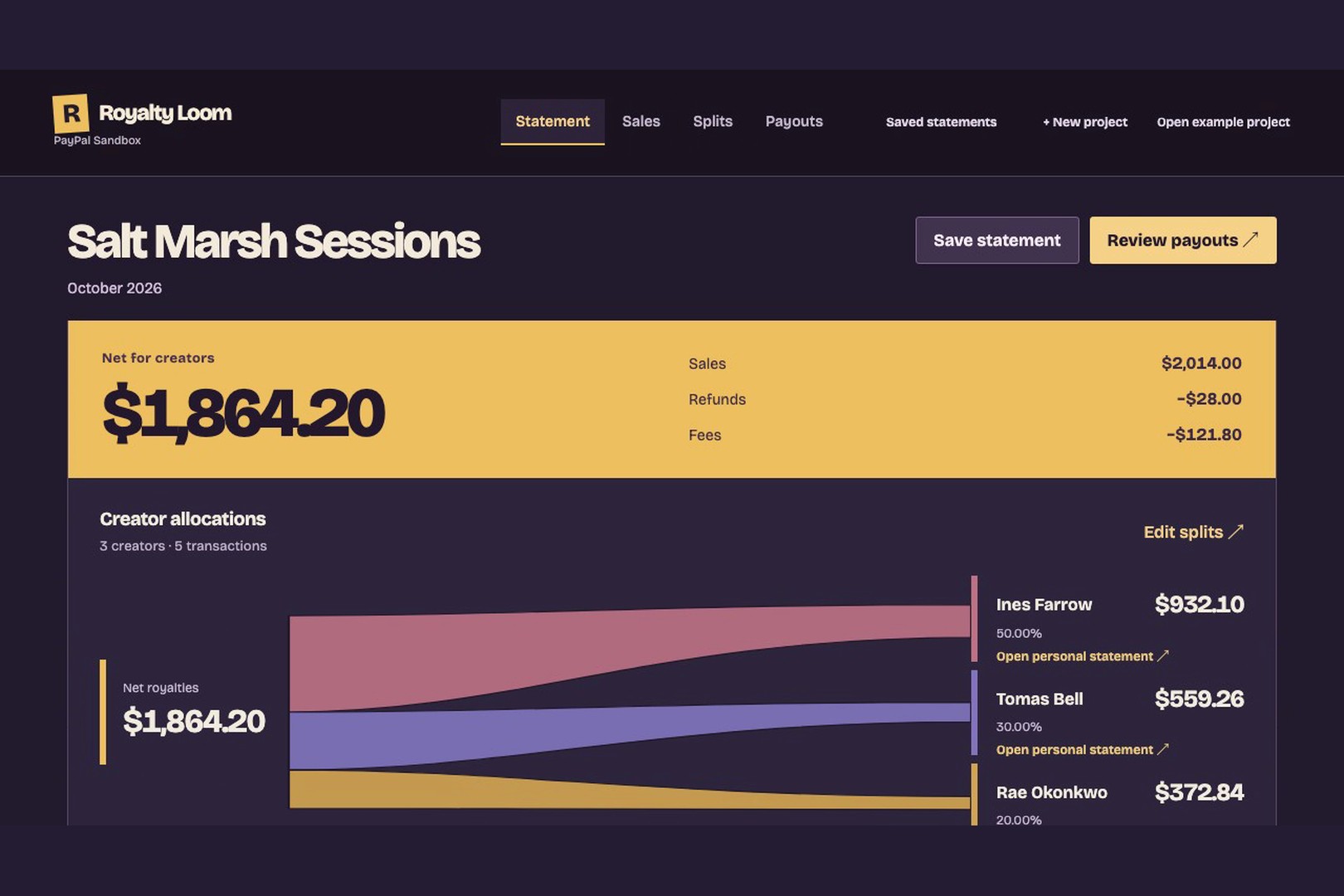
Statement. Allocations are computed in integer cents and always sum to the distributable amount. Each creator gets a private, downloadable statement with their amount, the clause behind it and an issuer contact.
Payouts. One PayPal payout per creator is prepared from the reviewed statement. Nothing is sent until the operator ticks an approval box and types the authorization. The app then shows the batch ID PayPal returned and reads each item's status back from PayPal.
In the demo, a three-person record project turns $2,014.00 of October sales into $1,864.20 for creators, split $932.10 / $559.26 / $372.84, and submits a real three-item batch to the PayPal Sandbox.
How we built it
A single Python application with no runtime dependencies to install, serving a hand-written HTML/CSS/JavaScript interface on loopback, with SQLite for saved periods and payout history.
- AI: an OpenAI-compatible chat endpoint (a local Qwen 2.5 model through Ollama or a bundled llama.cpp runtime) with a strict JSON schema. The model is asked for names and quotations only. Shares and money are derived by deterministic code from the quoted text, never by the model.
- PayPal: server-side Sandbox OAuth and the Payouts API. Each batch carries a durable sender batch ID so a retry cannot pay twice. Status is reconciled read-only against the original batch, recipients, items and amounts. The endpoint is restricted to the Sandbox.
Challenges we ran into
- Getting a language model to be useful without trusting it with numbers. The answer was to make it a locator: it points at sentences, and everything else is checked code.
- Agreements that the supported model cannot represent (conditions, tiers, undefined terms). The app stops and sends these to manual review instead of producing a confident wrong split.
- Lost responses. If a payout request times out, the result is unknown, not failed. Recovery works by looking up the original batch, never by sending again.
- Cent-exact allocation: percentages rarely divide cleanly, so remainders are assigned deterministically and the total is asserted.
Accomplishments that we're proud of
- Every percentage on screen links to the exact sentence that justifies it.
- Statements that sum to the cent, with a private version per creator.
- A real PayPal Sandbox payout batch submitted from the app after an explicit typed authorization, with per-recipient status read back from PayPal.
- Reviewed advances and recoupment across periods, and a private backup that restores a whole desk.
What we learned
People do not want an AI to decide who gets paid. They want it to do the reading and then show its work. Keeping the model's job that narrow made the whole product easier to trust and easier to test.
What's next
- Observe full recipient completion with funded Sandbox recipient accounts, then production Payouts.
- More agreement shapes: tiers, thresholds and per-territory splits.
- Multi-currency statements.
- A recipient view where each creator can open their own statement history.
Built With
- css
- html
- javascript
- llama.cpp
- ollama
- paypal-payouts-api
- paypal-sandbox
- python
- qwen2.5
- sqlite
