-
-
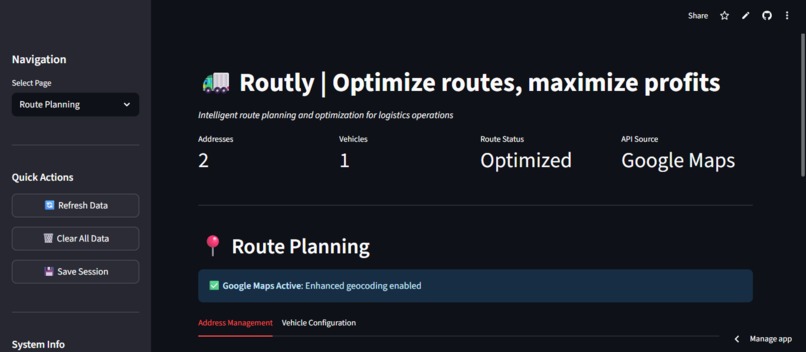
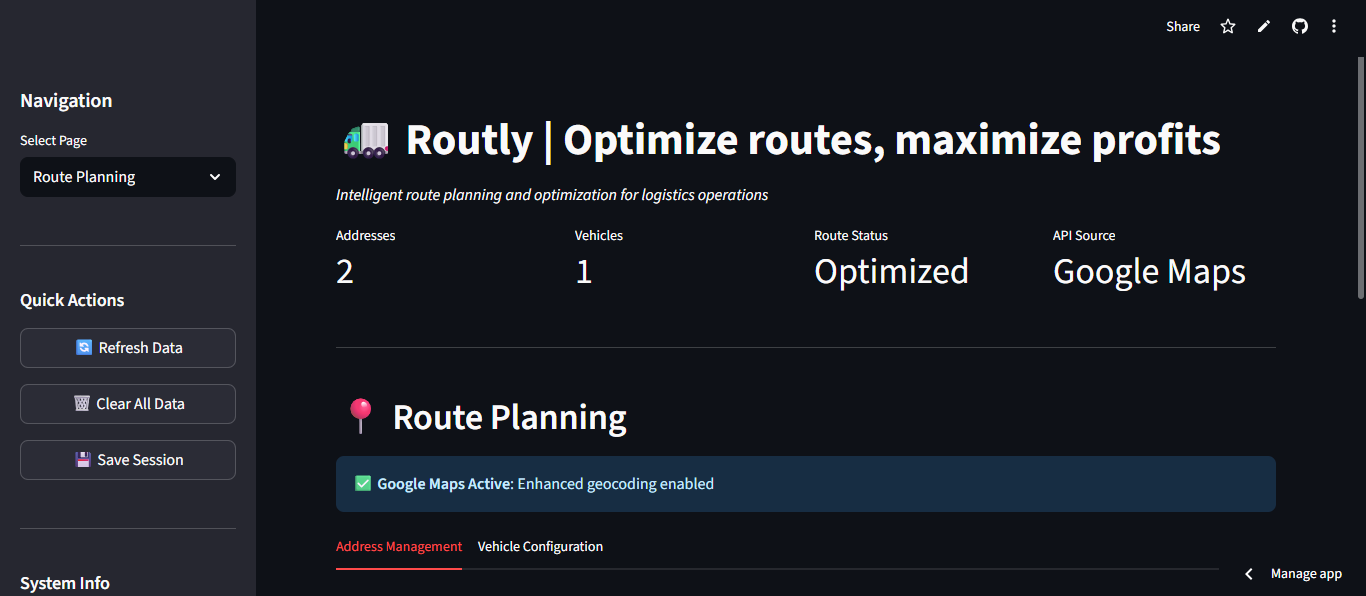
Routly Dashboard
Inspiration
Watching small businesses struggle with manual route planning sparked this project. Delivery drivers were making unnecessary trips, wasting fuel and time because they couldn't access the same optimization tools that big companies use. I wanted to democratize route optimization by creating a web app that works immediately without expensive setup or technical expertise.
What it does
Routly is a complete logistics platform that optimizes delivery routes using advanced algorithms. Users can input addresses manually or via CSV, configure multiple vehicles with capacity constraints, and get optimized routes with interactive maps and turn-by-turn directions. The system includes analytics dashboards, cost breakdowns, performance tracking, and professional PDF route sheets for drivers. It works instantly with free services but offers enhanced accuracy when Google Maps API is available.
How I built it
I used Python with Streamlit for the web interface and Google's OR-Tools for route optimization algorithms. The architecture separates concerns into data models, services, optimization engines, and UI components. I implemented intelligent geocoding with automatic fallback from Google Maps to free OpenStreetMap data, ensuring the app works without any configuration. Working with Kiro as an AI development partner helped navigate complex algorithmic challenges and architectural decisions throughout the project.
Challenges I ran into
The biggest challenge was implementing vehicle routing algorithms - the mathematical complexity behind TSP and VRP problems required deep learning of OR-Tools parameters. Managing state across Streamlit's multi-page interface proved tricky, especially sharing complex data between address input and vehicle configuration components. Scaling performance from 10 to 500+ addresses required implementing clustering, batch processing, and progress indicators. Creating a configuration system that balances simplicity with power user features took multiple iterations.
Accomplishments that I'm proud of
I built a production-ready logistics platform that rivals enterprise software but works immediately without setup. The hierarchical configuration system automatically detects available services and provides transparency about what's active. My interactive mapping with clickable route segments and comprehensive analytics dashboard creates a professional user experience. Most importantly, we achieved the goal of making powerful route optimization accessible to small businesses while maintaining scalability for larger operations.
What I learned
Building Routly taught me that software architecture matters as much as algorithms - clean separation between models, services, and UI components made the complex system manageable. User experience design requires anticipating the entire user journey, not just the happy path. Error handling and graceful degradation are crucial for real-world applications. Working with AI as a development partner amplifies human capabilities rather than replacing them, enabling more ambitious projects than possible alone.
What's next for Routly
I plan to integrate real-time traffic data to replace our current intelligent mock system, add machine learning for route prediction based on historical patterns, and implement multi-day route planning for complex logistics operations. Future enhancements include driver mobile app integration, customer notification systems, and advanced analytics with predictive insights. I am also exploring Docker containerization for easier deployment and API endpoints for third-party integrations.
Built With
- google-maps
- kiro
- matplot
- numpy
- or-tools
- pandas
- python
- streamlit

Log in or sign up for Devpost to join the conversation.