-
-
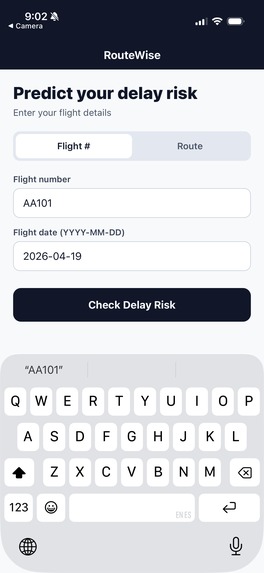
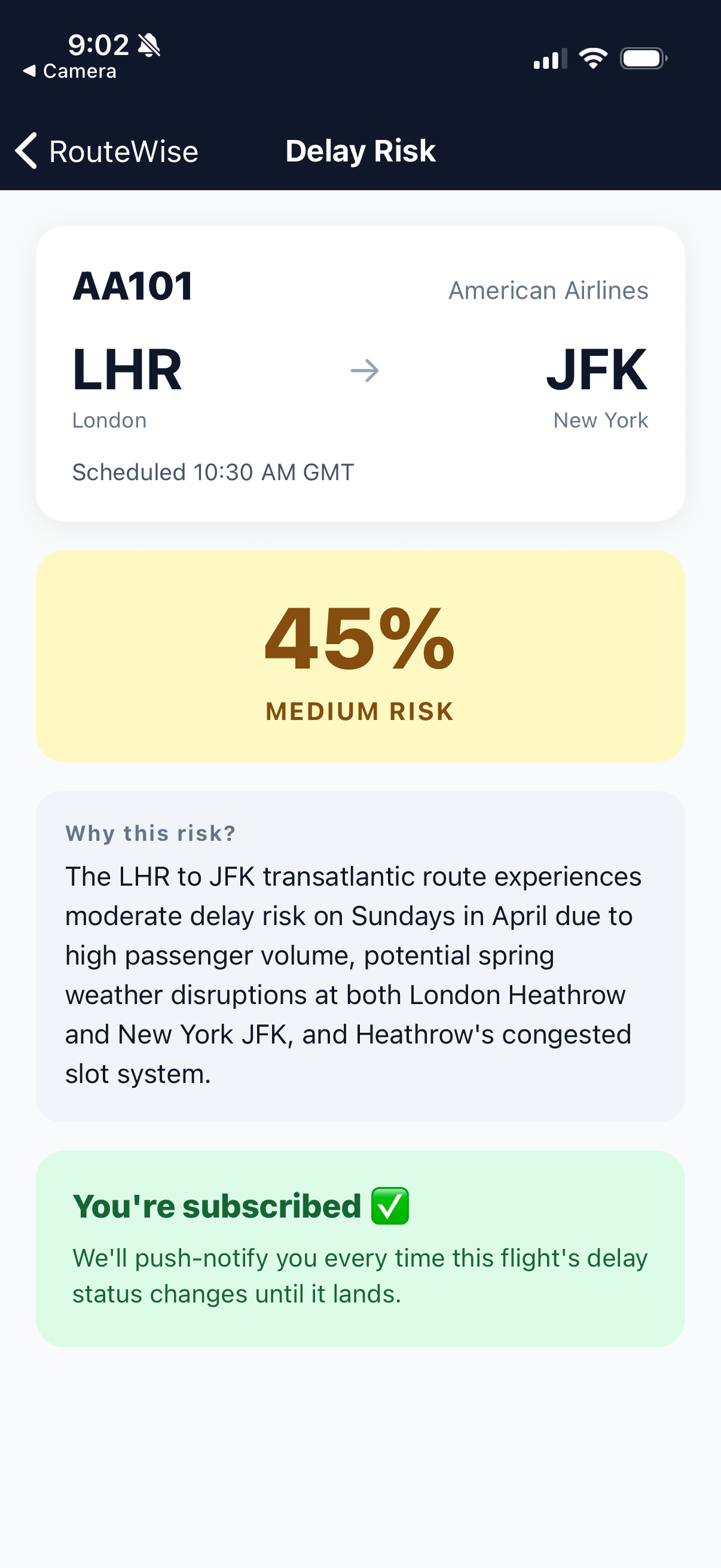
Home Page
-
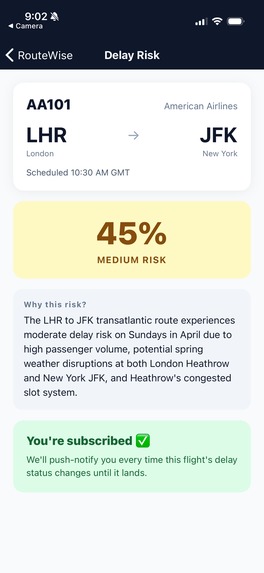
Results Page
-
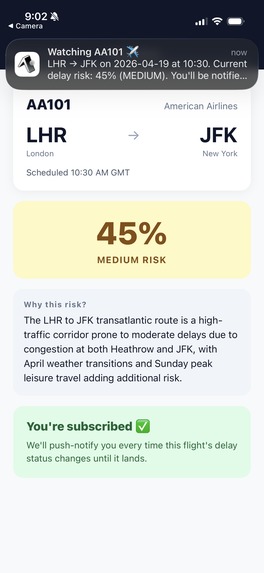
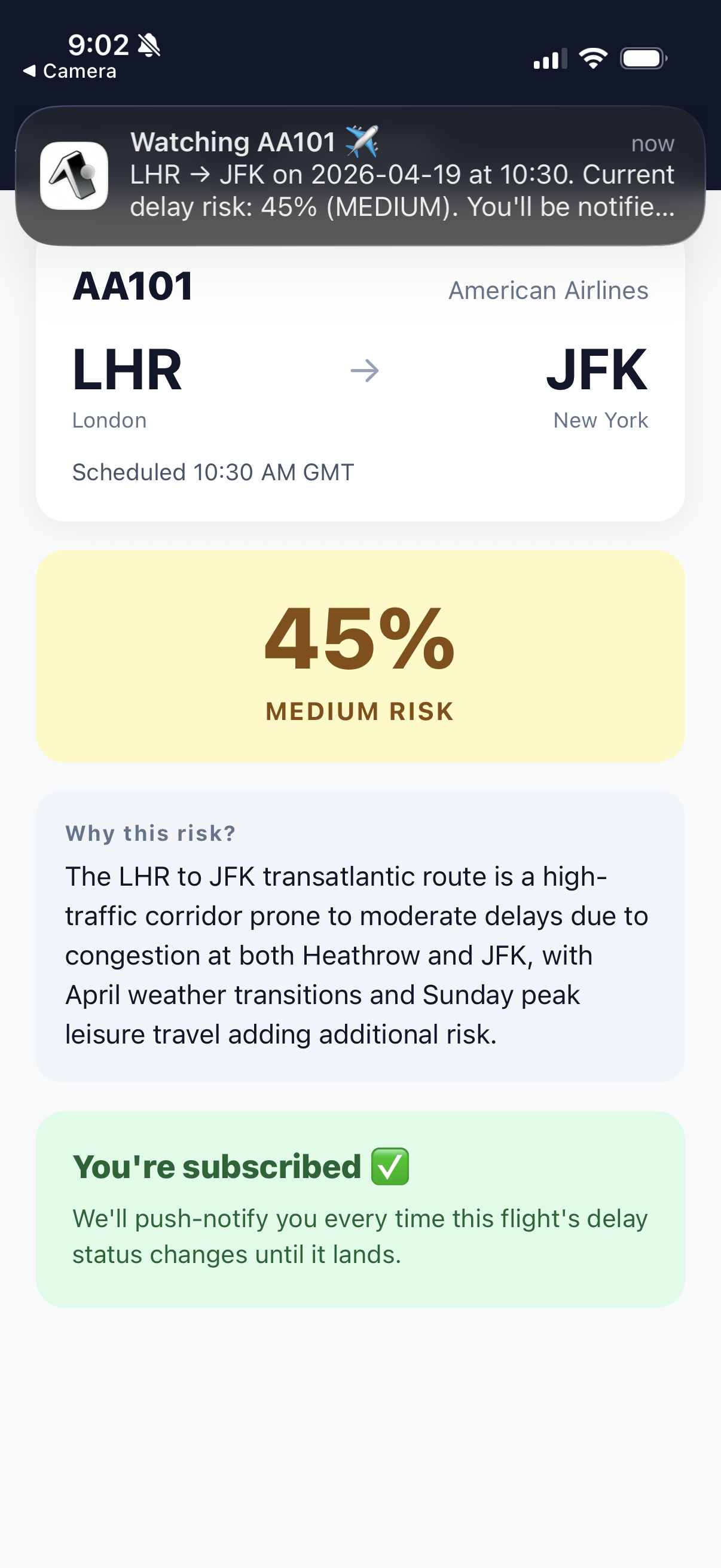
Screenshot of push notifications working as intended
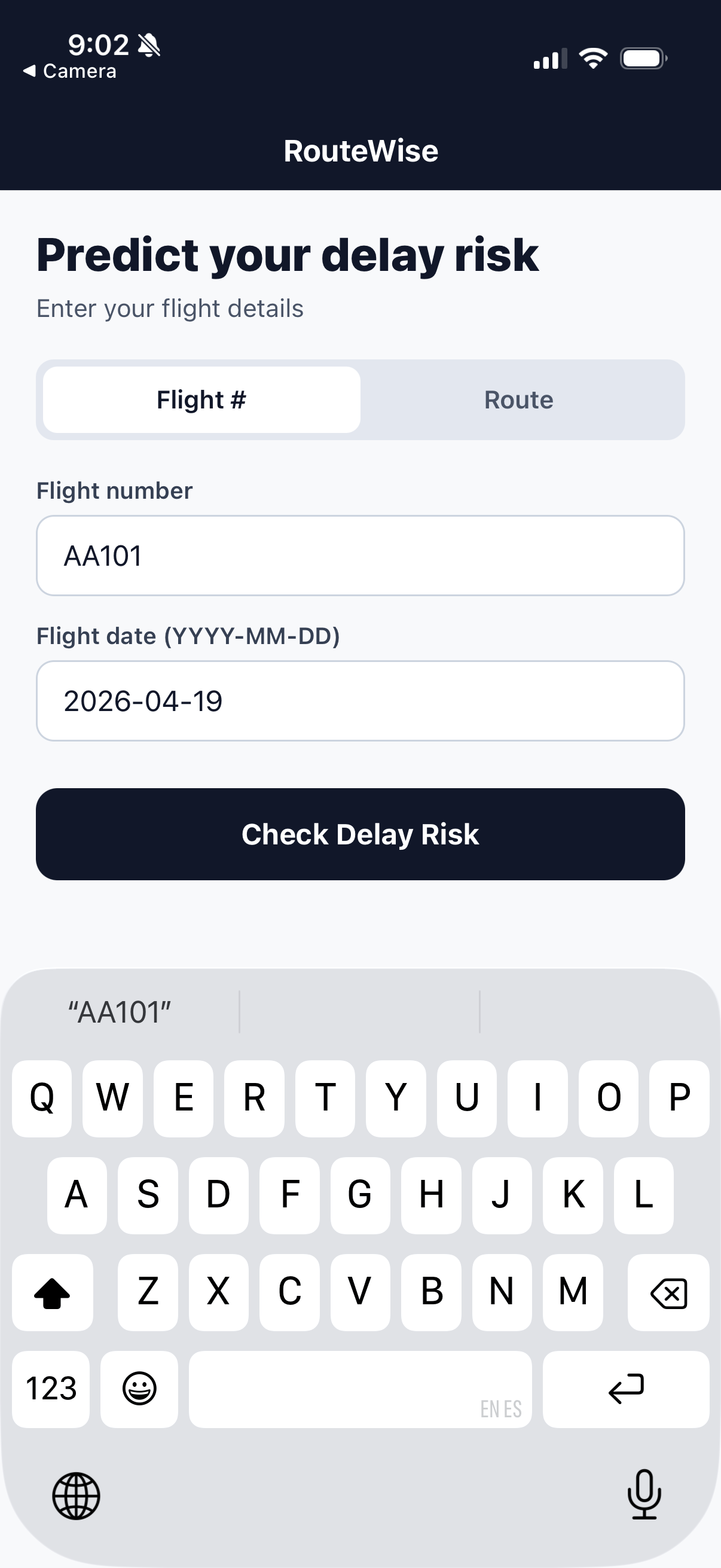
Inspiration
Flight delays cost US travelers over 33 million hours annually, yet the passenger experience remains stuck in the past: you usually only find out when you reach the gate or in emails that you don't see. RouteWise was built to shift travel from reactive to proactive, putting predictive intelligence in your pocket before you ever leave for the airport.
What it does
RouteWise is an AI-powered prediction app that forecasts the likelihood of a flight delay—and explains exactly why. By entering a flight number or route, users instantly receive:
- Delay Probability Score: Ranging from 0–100%.
- Risk Level Assessment: Clearly categorized as LOW, MEDIUM, or HIGH.
- Rich Text Explanations: Plain-English insights into the specific risk factors for that exact route. The UI utilizes Markdown for clear, readable text and integrated LaTeX support to beautifully render any mathematical expressions or probability models the AI outputs.
- Flight Details: Scheduled departure times (localized) and auto-inferred origin/destination cities.
- Live Alerts: Background monitoring evaluates the flight every 15 minutes, triggering push notifications if the risk profile shifts prior to departure or if there is any delay made to the scheduled flight time.
How we built it
- Frontend (React Native + Expo): Deployed on iOS and Android. Features a clean, minimal UI displaying IATA codes, localized 12-hour departure times, color-coded risk badges, and a custom rendering engine for Markdown and LaTeX.
- AI Engine (AWS Bedrock + Claude Opus 4): A single Bedrock call handles route inference, schedule lookups, probability scoring, and natural-language generation—eliminating the need for traditional third-party flight data APIs.
- Backend (AWS Lambda + API Gateway): A serverless architecture utilizing three distinct functions: Predict (handles the Bedrock inference), Subscribe (manages DynamoDB user tokens), and Poll (EventBridge-triggered monitoring).
- Database (Amazon DynamoDB): Manages active subscriptions using a composite key structure, with automated record expiration post-flight.
- Notifications (Expo Push): Delivers real-time status shifts directly to the device without requiring the app to be open.
Challenges we ran into
- API Restrictions Driving Architecture: Our initial approach involved exploring various third-party flight data APIs, including Aviationstack, OpenSky Network, and FlightAware, seeking robust data and predictive capabilities. However, we quickly encountered significant hurdles:
- Limited Free Tiers: Free plans were severely restricted, often missing critical features like prediction endpoints, historical data, or high-frequency updates that we required.
- Restrictive Rate Limits: Stringent request quotas made scalable real-time monitoring and predictions using free tiers unfeasible.
- Datacenter IP Blocking: Critically, most free-tier APIs proactively blocked datacenter IP ranges (including AWS), rendering direct Lambda function calls impossible for reliable cloud integration.
- Innovating Around Constraints: Rather than being forced into a paid plan prematurely or compromising features, we engineered a completely new approach: making Claude via AWS Bedrock the single source of truth for both inference and data recall. This entire architecture was born directly from the need to bypass those formidable API limitations and blocks.
- Curbing AI Hallucinations: Because we didn't rely on a traditional database of known flights and schedules, getting Bedrock to return consistently accurate data required intense prompt engineering. Early versions would confidently return wrong routes (e.g., AA101 as JFK→LAX instead of LHR→JFK) or fabricate schedules. We solved this by rigorously refining our prompt architecture and context framing so the model reliably extracts correct routes and schedules internally before predicting the delay.
- Data Normalization: We built robust formatting logic to standardize disparate flight number inputs (e.g., JBU1, B61, JetBlue 1) so the system recognizes them identically, allowing for accurate composite sort keys in DynamoDB.
Accomplishments that we're proud of
- Deployed a fully serverless prediction pipeline with zero external flight data dependencies.
- Achieved accurate route and schedule inference for both domestic and international flights relying entirely on LLM capabilities, effectively turning Bedrock into our primary "flight data api."
- Successfully worked with AI hallucinations, learning how to structure complex prompts that force fact-checking against internalized knowledge rather than fabrication.
- Built a frontend capable of parsing and beautifully rendering complex Markdown and LaTeX directly from an LLM stream.
- Engineered a continuous background monitoring system that operates at near-zero cost when idle.
What we learned
- API Constraints Foster Innovation: Navigating restrictive API tiers forced us to rethink conventional wisdom and architect a truly unique solution using cutting-edge LLM capabilities for both prediction and reliable data synthesis.
- Prompt Design is API Design: Treating LLMs as infrastructure requires extreme rigor. The phrasing difference between "typical departure time" and "actual published timetable departure time" is the difference between 8:50 AM and 10:30 AM. Precision in language directly affects data quality in a way that traditional APIs don't require you to think about.
- LLMs as Databases & Prediction Engines: We learned exactly how far we could push a foundational model to act as a reliable data-retrieval engine and sophisticated predictive model without falling back on traditional lookup tables or paid databases.
What's next for RouteWise
- Integrate live weather APIs to provide Bedrock with real-time environmental context for more accurate predictions.
- Develop a web dashboard for centralized management of active flight subscriptions.
- Implement layover risk analysis for connecting flights.

Log in or sign up for Devpost to join the conversation.