-
-
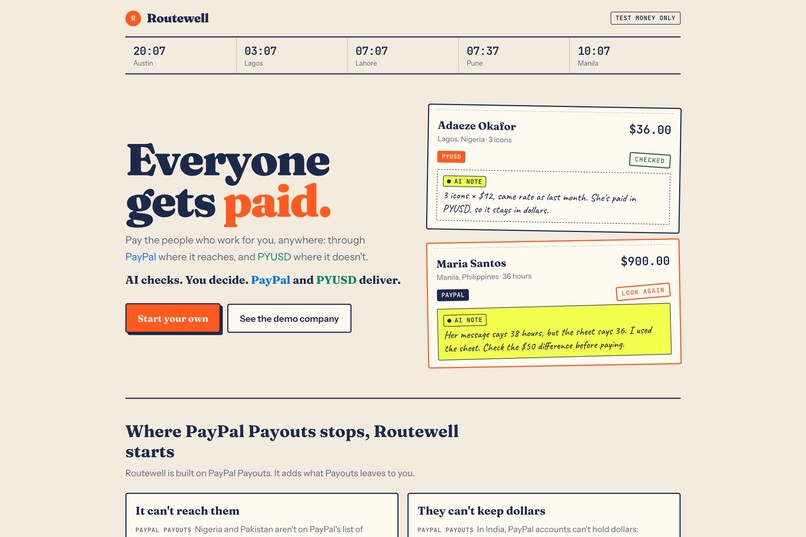
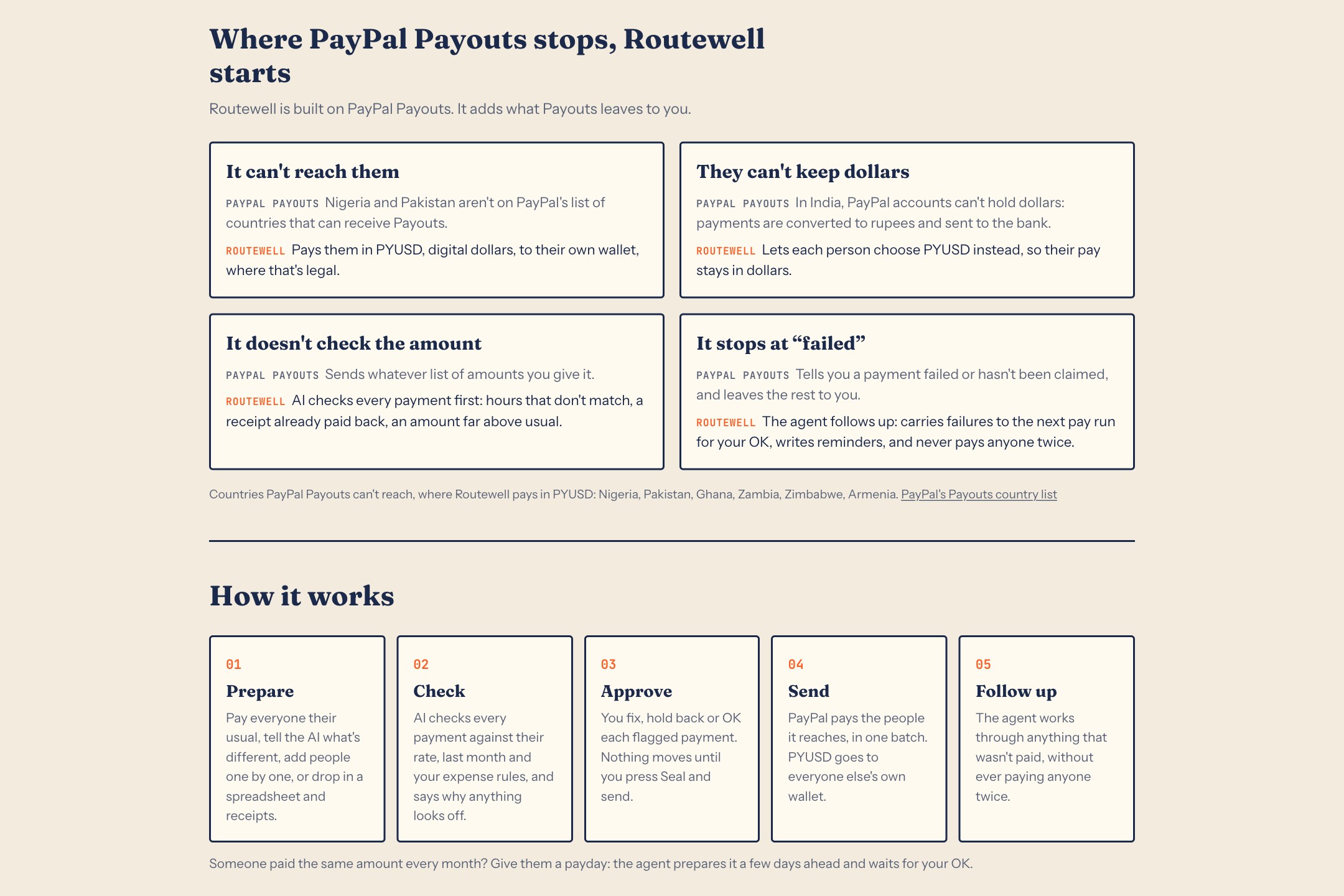
01-home-hero: Everyone gets paid: PayPal where it reaches, PYUSD where it doesn’t.
-
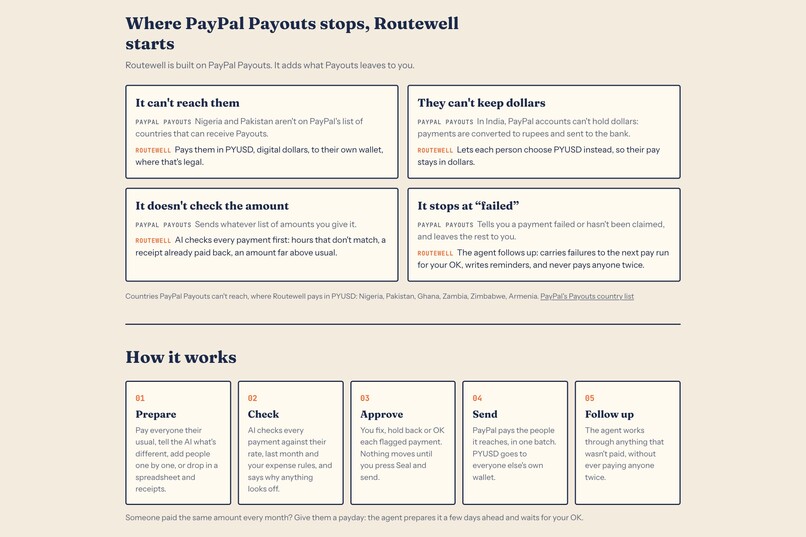
02-home-gaps: Where PayPal Payouts stops, Routewell starts.
-
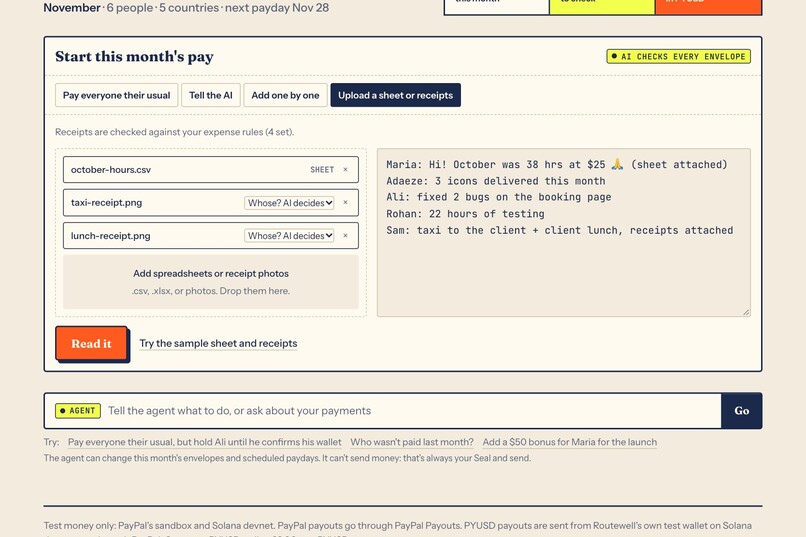
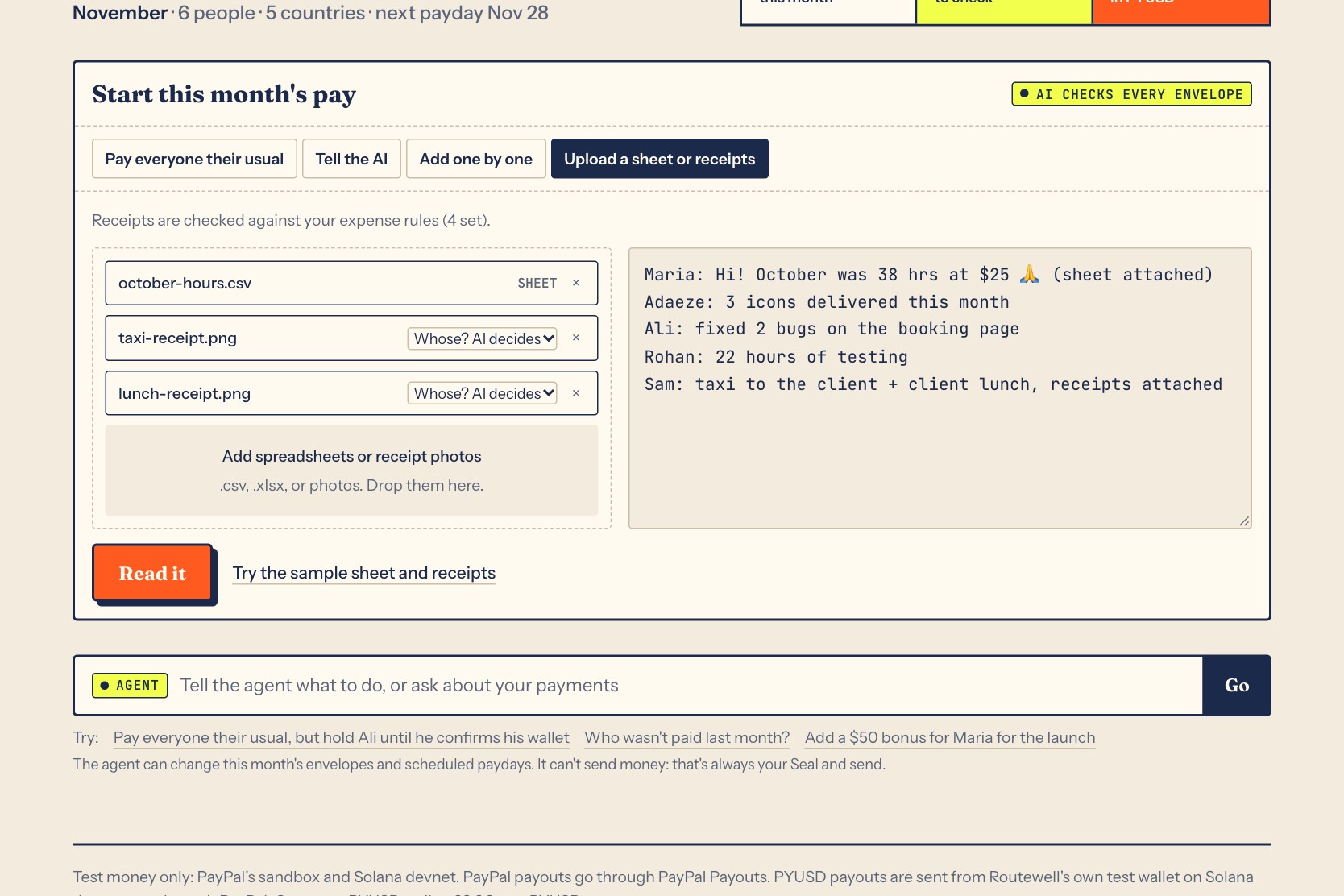
04-intake: Drop in sheets, receipts and messages.
-
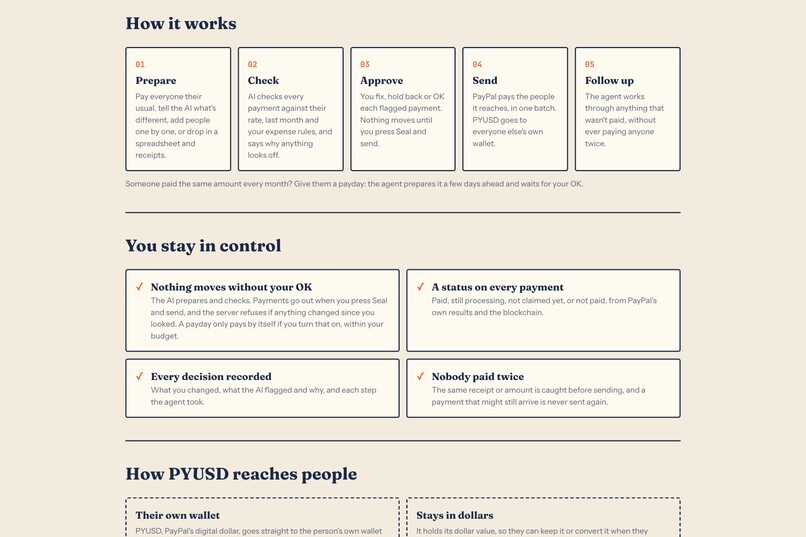
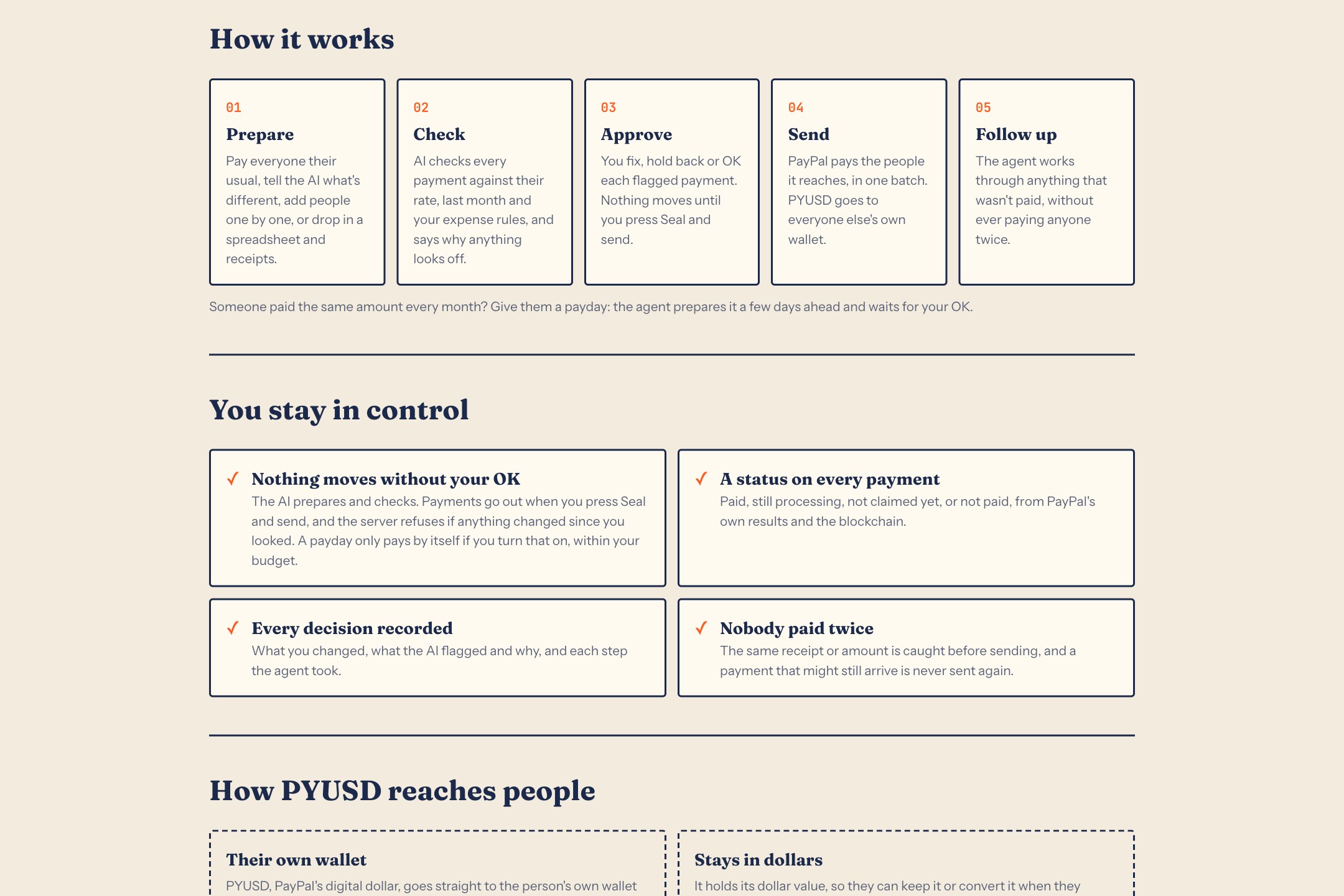
03-home-how: Prepare, check, approve, send, follow up.
-
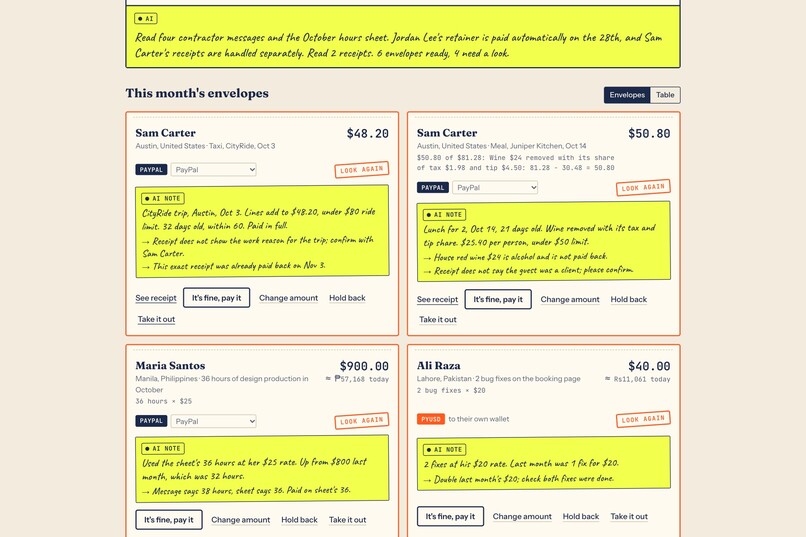
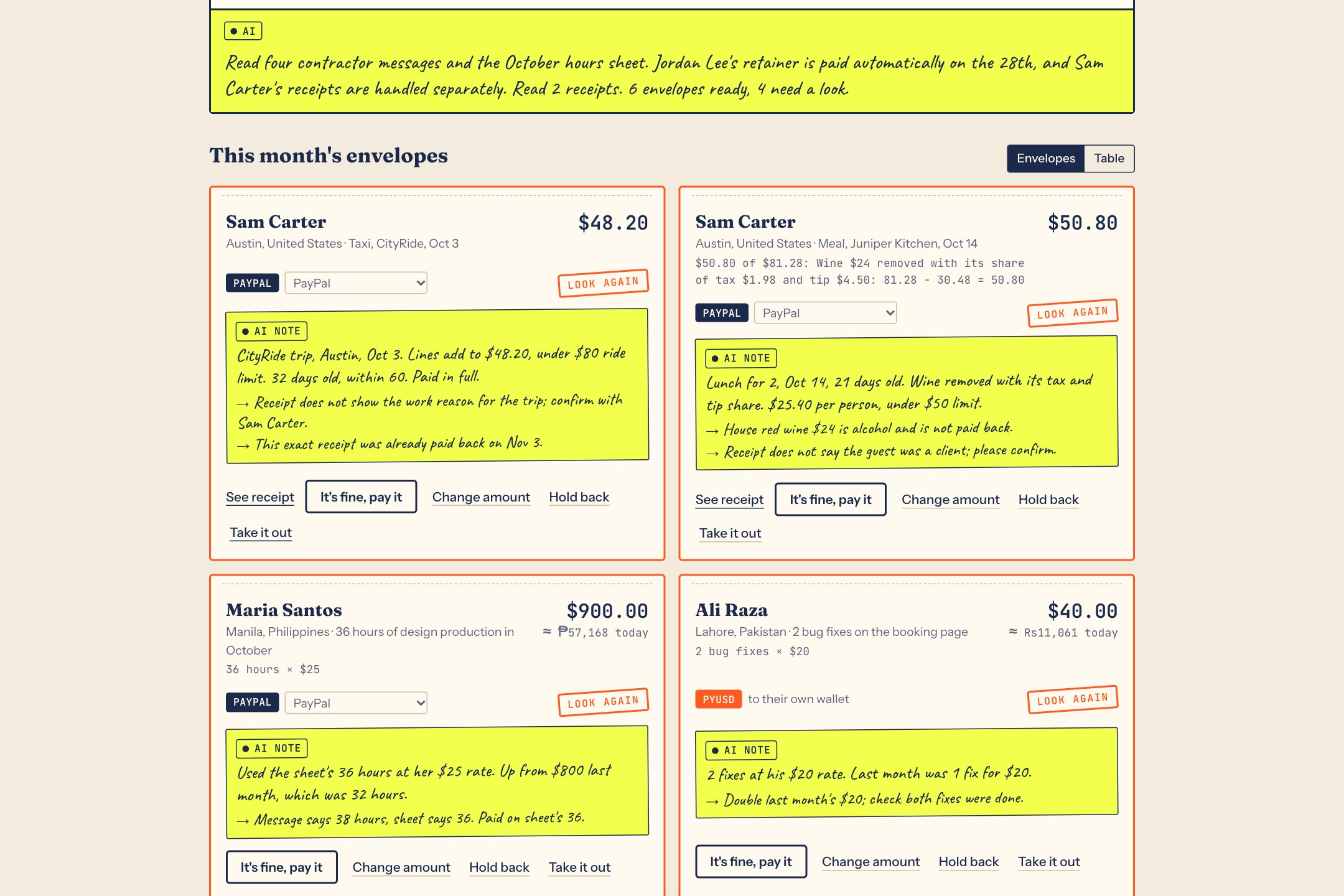
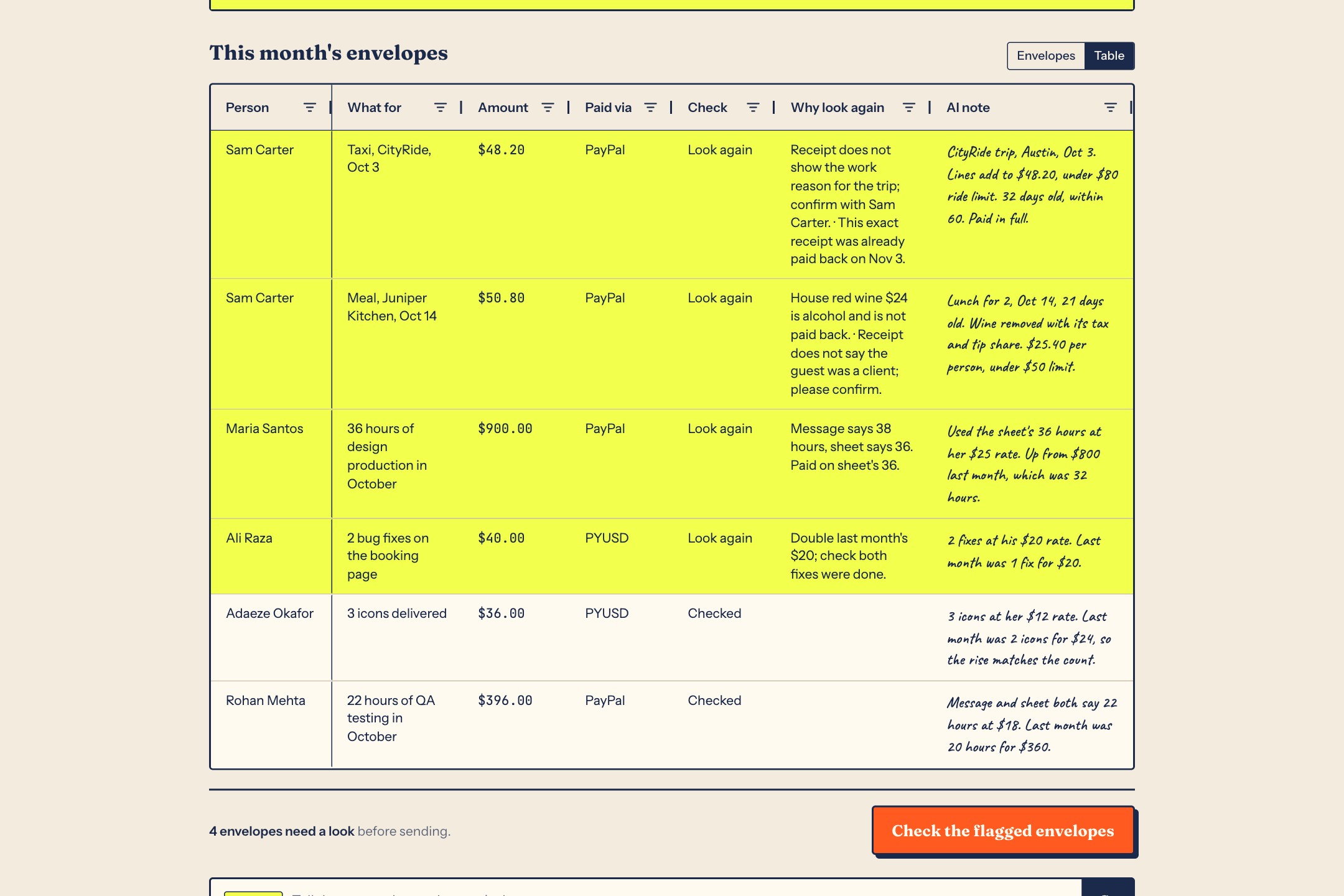
05-envelopes: AI checks every payment and explains any flags.
-
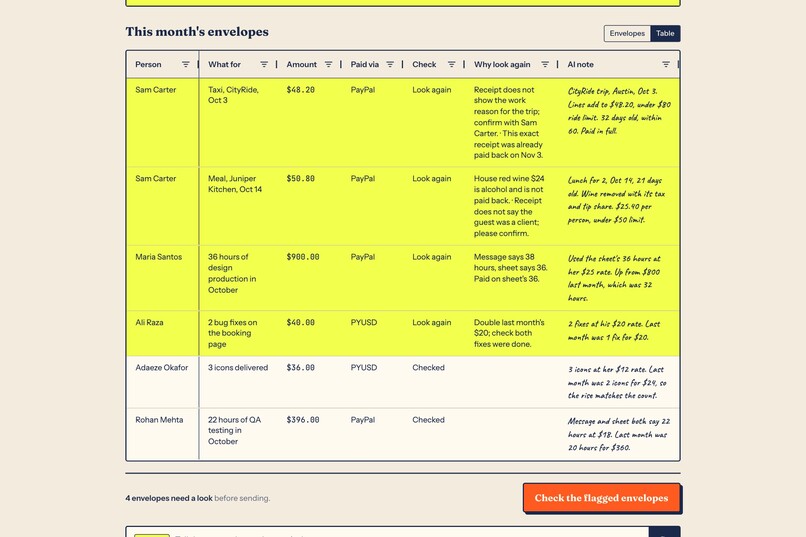
06-table: Review and edit payments in AG Grid.
-
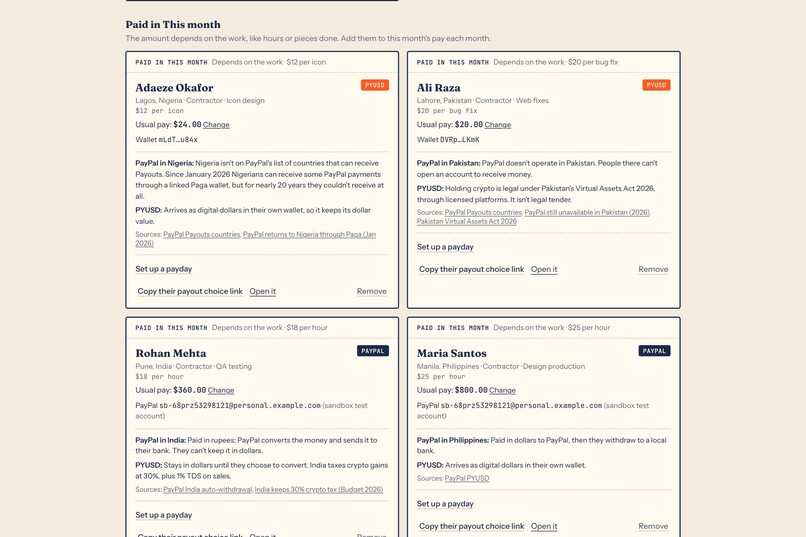
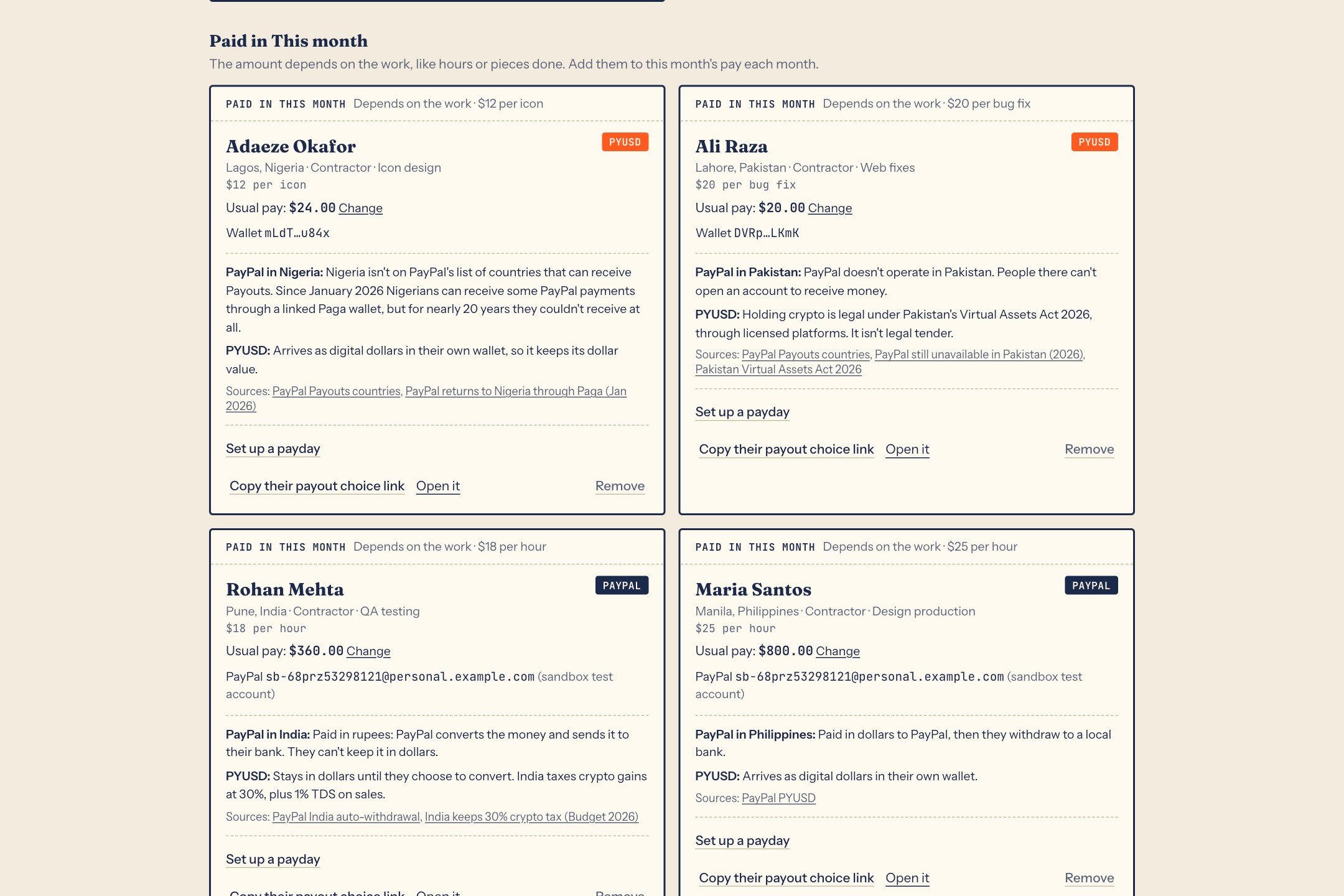
08-people: Payout options by country, with sources.
-
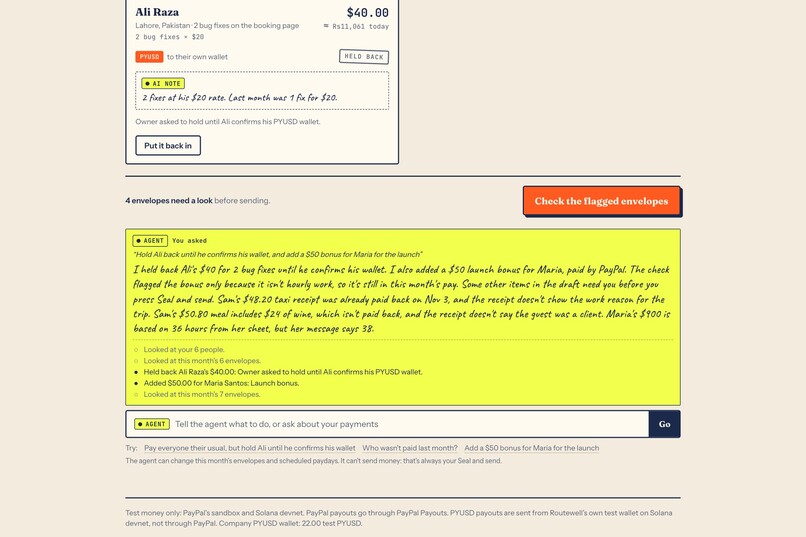
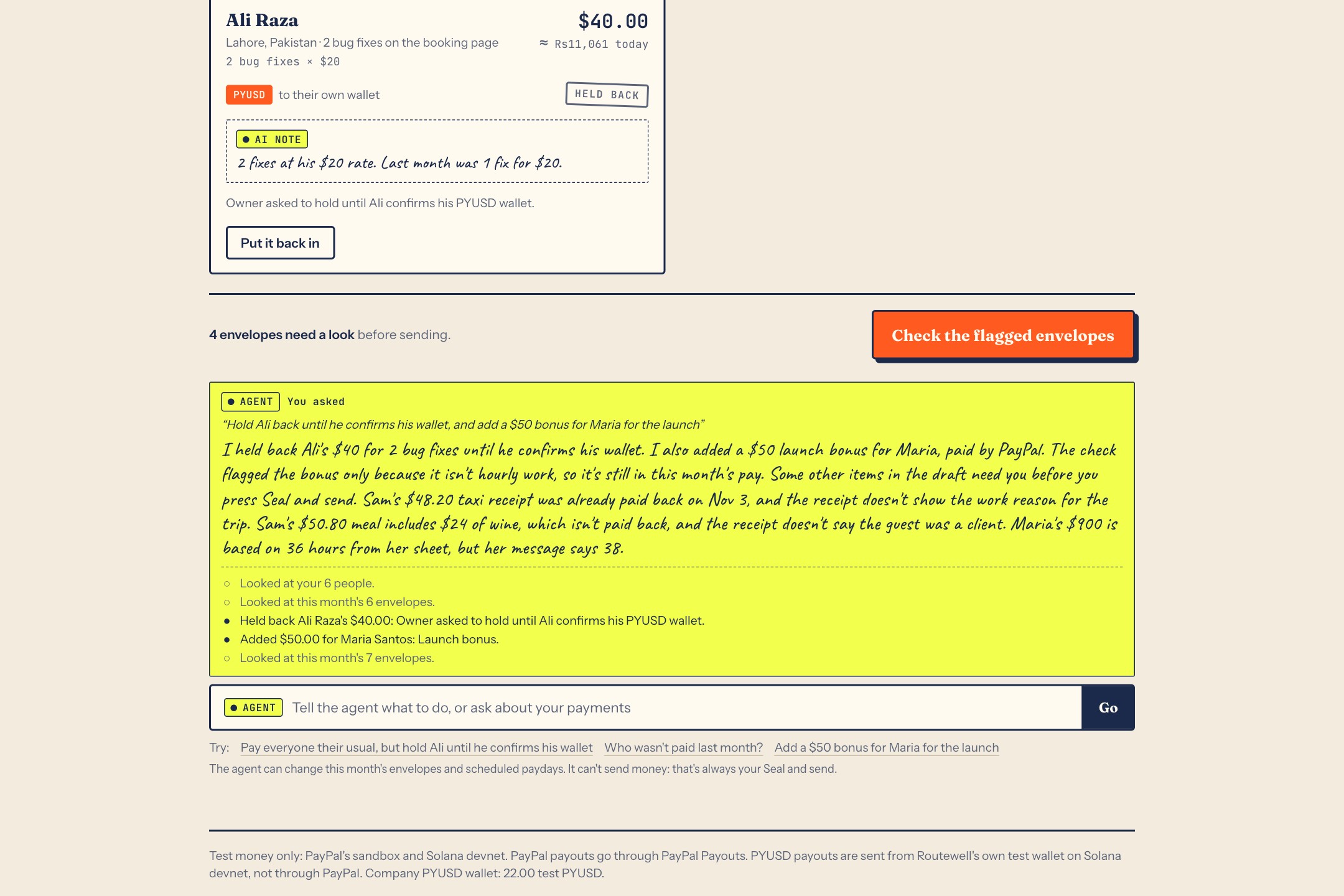
07-agent: The agent acts and shows every step, but can’t send money.
-
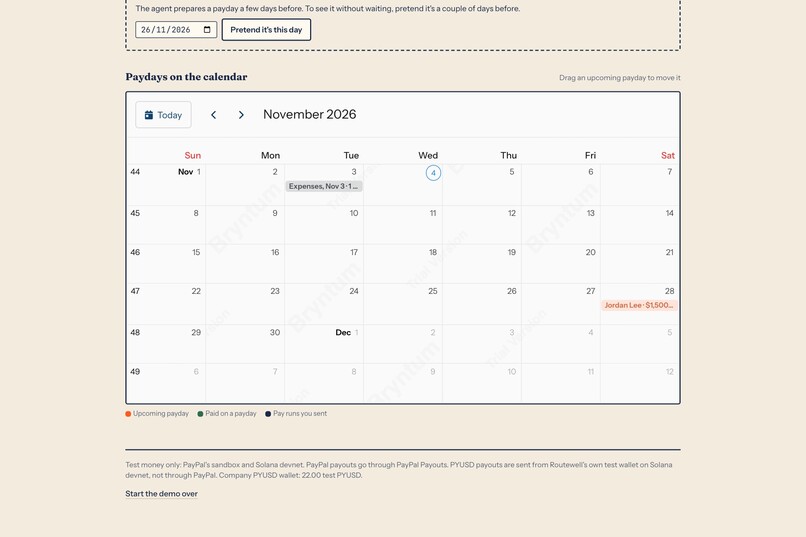
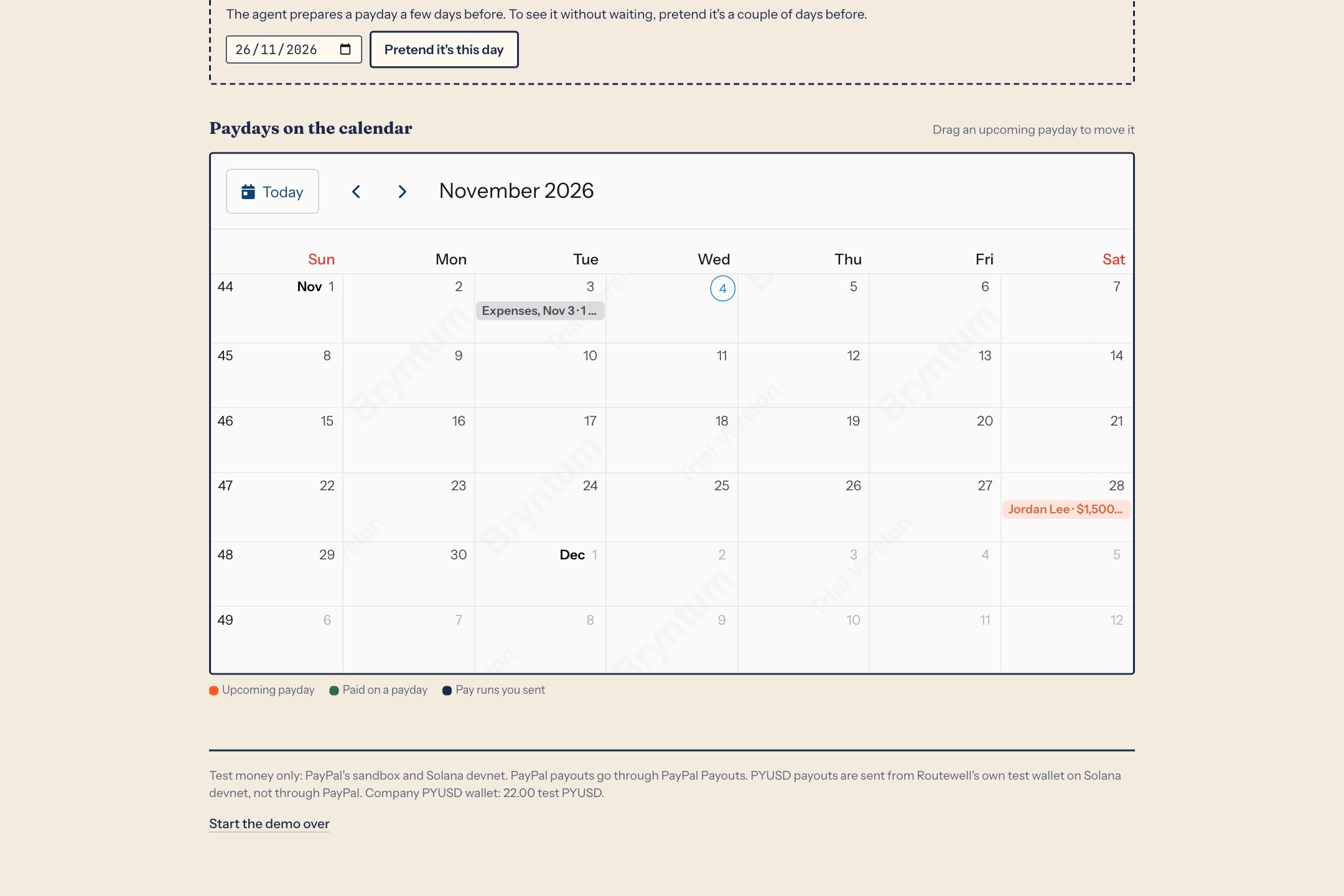
09-calendar: Scheduled paydays on a Bryntum calendar.
-
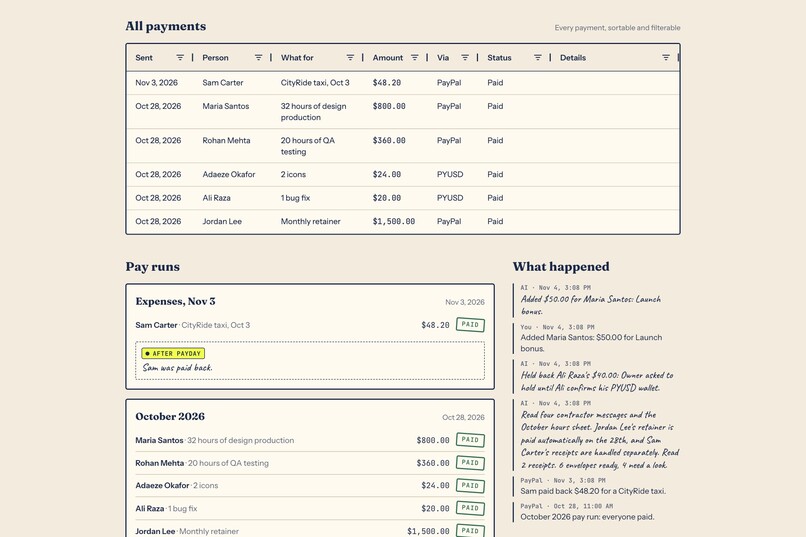
10-history: Every payment, with PayPal’s result.
-
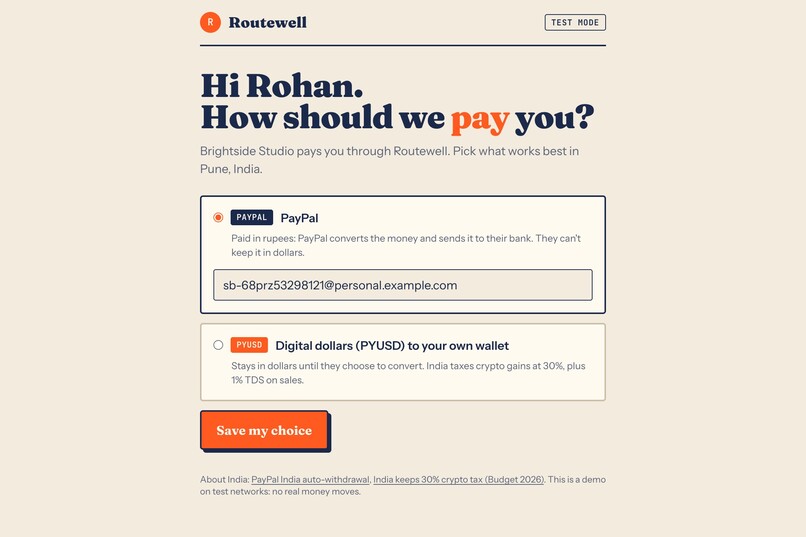
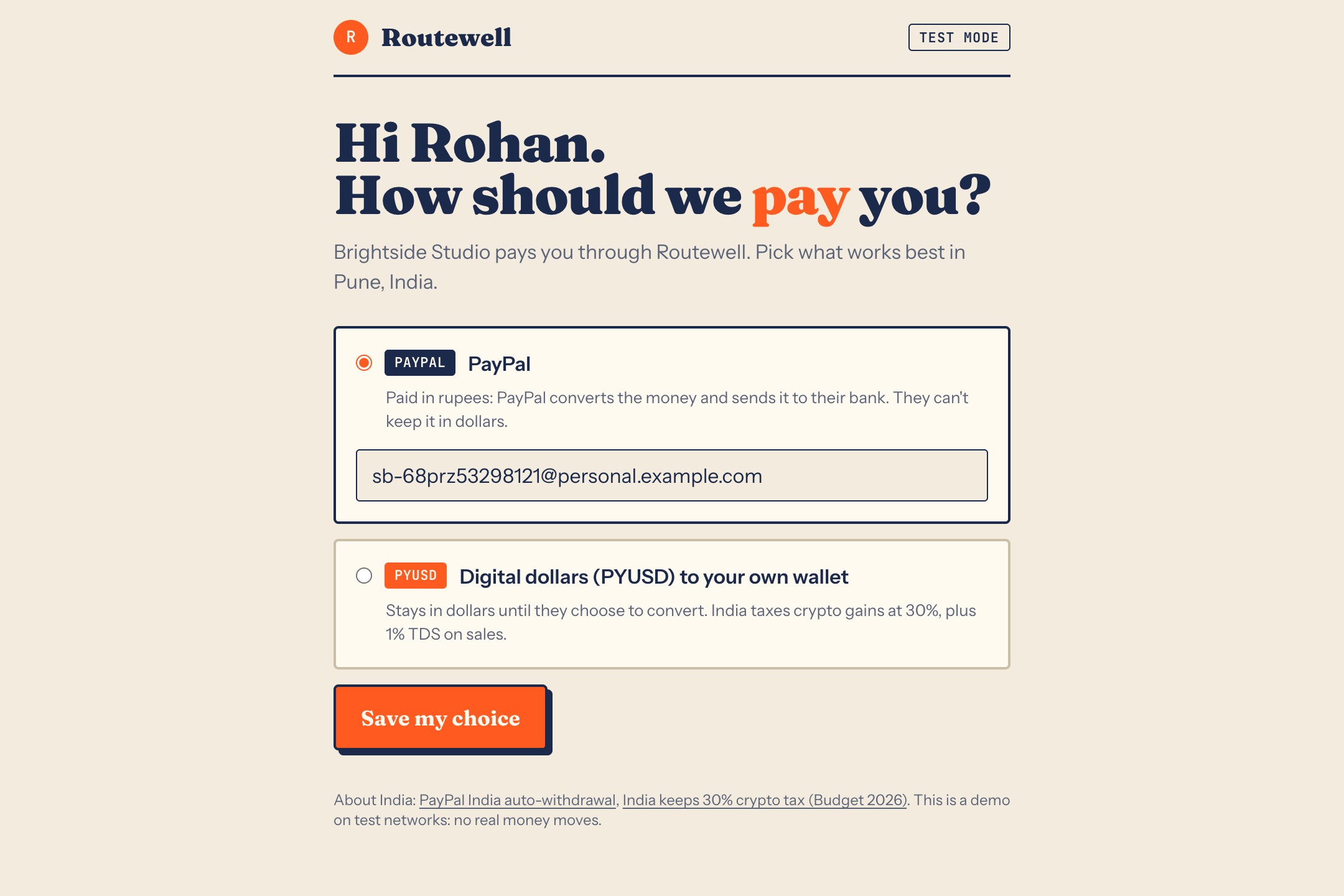
11-worker-choice: Workers choose PayPal or PYUSD.
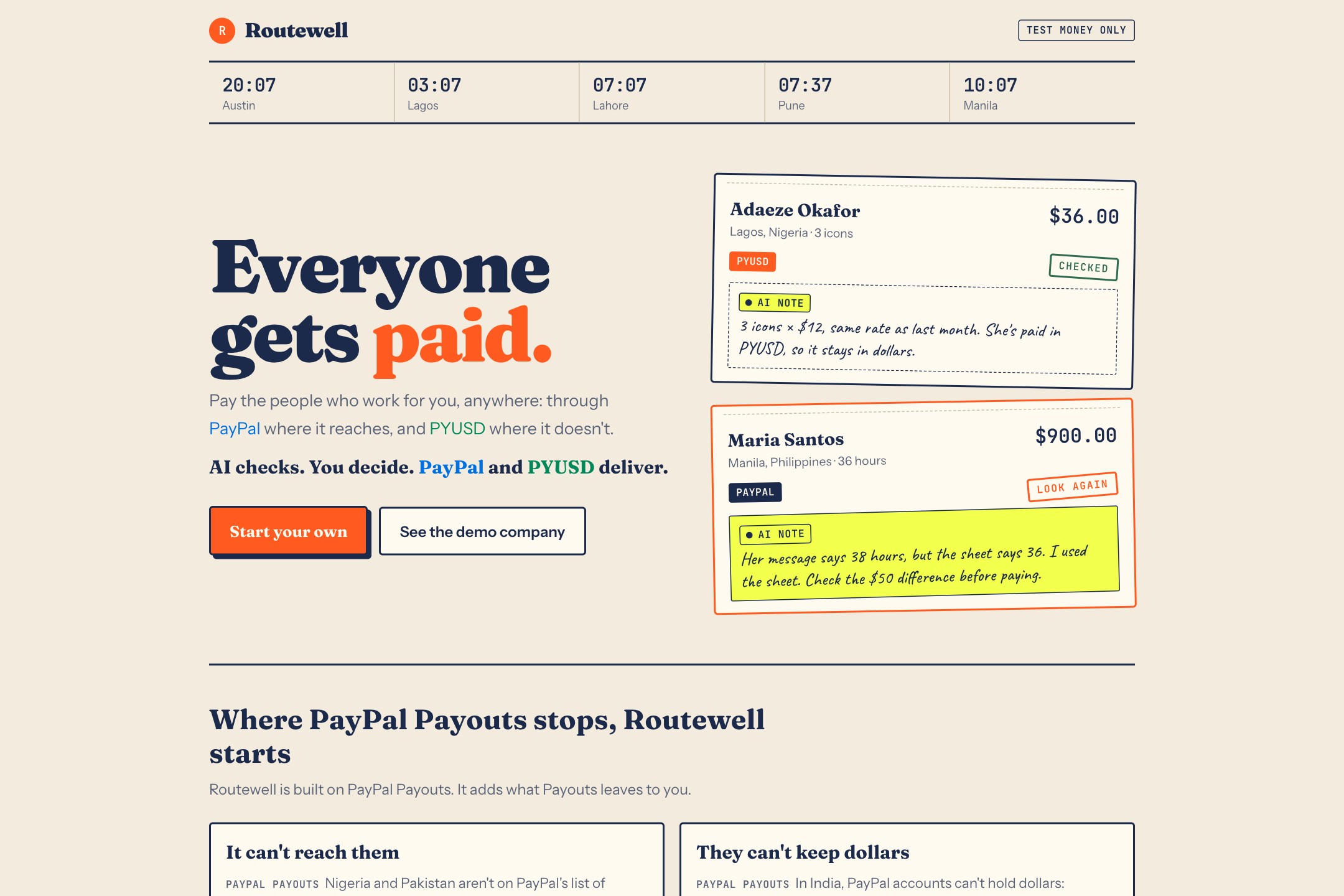
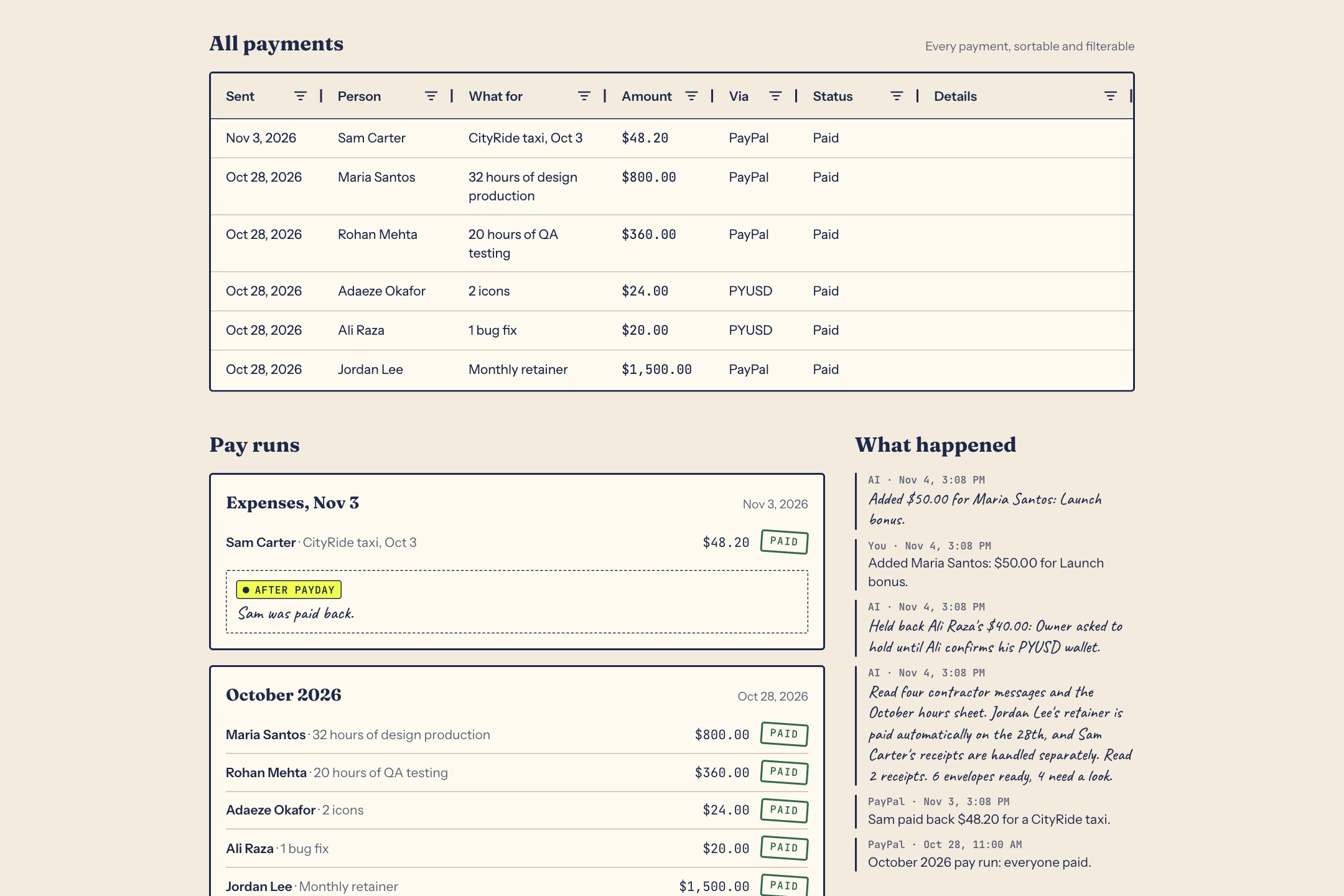
Routewell AI-checked payouts for the people who work for you, anywhere. Everyone gets paid.
Inspiration Small teams are hiring freelancers, contractors and creators all over the world. But paying them is still complicated.
PayPal Payouts makes it easy to pay many people at once, but it doesn't reach every country. Nigeria, Pakistan and Ghana, for example, aren't supported payout destinations. In some markets, recipients also face currency conversion that prevents them from keeping their earnings in dollars. And while PayPal processes payments, it doesn't check whether the amounts you submit are correct.
We saw an opportunity to build on PayPal, not around it.
What if businesses could use PayPal wherever it works, reach eligible recipients elsewhere through PYUSD, and have an AI agent check every payment before it goes out?
That became Routewell.
What it does Routewell helps businesses manage and send payments to people working across borders. It combines PayPal Payouts, PYUSD on Solana and an AI agent that coordinates the process.
- Prepare payments your way. Start a new payment run by paying everyone their usual amount, giving the AI instructions in plain language ("Add a $50 bonus for Maria"), adding recipients individually, or uploading a spreadsheet and receipt photos.
Routewell turns these instructions and documents into individual payment records, called envelopes.
- AI checks before money moves. Every envelope is checked before payment: the AI looks for mismatched working hours, unusual amounts and expenses that break company rules, and code catches duplicate receipts.
Each envelope receives a CHECKED or LOOK AGAIN status, alongside an explanation of what was found.
- You stay in control. The administrator reviews the findings and decides what happens next. They can approve a payment, change its amount, hold it back or remove it from the payment run.
Nothing moves until the administrator presses Seal and send, unless they've set a scheduled payday to pay automatically within their budget.
- Two payment rails, one coordinated workflow. Routewell uses PayPal Payouts for recipients in supported markets. Where PayPal Payouts cannot reach an eligible recipient, Routewell can send PYUSD directly to their own Solana wallet, where legally permitted.
Recipients are matched with available payment options based on country-specific eligibility checks.
- An agent that follows through. The Routewell agent doesn't stop when payments are sent. It examines the results, identifies failed and unclaimed payments, prepares reminders for the administrator and carries failed payments into the next payment run for approval.
It distinguishes between a failed payment and an unclaimed one, and never resends an unclaimed payment.
- Payments that don't get forgotten. Businesses can schedule recurring payments using natural language, such as "Pay Jordan $1,500 every 28th."
Routewell prepares the payment ahead of time, checks it against the approved amount and requests authorization. Businesses can also enable automatic payments within a monthly budget and rules they have explicitly configured.
How we built it We built Routewell around three connected layers: payment infrastructure, AI intelligence and safety controls.
Payment infrastructure
PayPal Payouts API (sandbox) handles batch payments, status checks and individual recipient results. PYUSD transfers run on Solana devnet using Token-2022, sent from Routewell's own test wallet rather than through PayPal. AI intelligence
Claude Opus 5.5, through the Anthropic SDK, interprets natural-language payment instructions and extracts information from spreadsheets and receipt photos. Structured outputs turn unstructured information into individual payment envelopes. The agent uses the SDK's tool runner to inspect payment records, update draft payment runs and manage follow-up tasks. Application and interface
Next.js 16, React 19 and Tailwind CSS 4. Prisma with SQLite for application data. AG Grid for payment reviews and transaction history. Bryntum Calendar for scheduled payments. Hosted on Railway. Importantly, we don't ask AI to handle every decision. Exact checks, including duplicate detection, budget limits, country eligibility and payout-detail validation, are enforced through ordinary application code. AI handles document interpretation, contextual judgement and explanations.
Challenges we ran into Making payments work across different countries. Payment availability isn't universal. We had to examine PayPal's Payouts coverage and research the local crypto regulations of potential recipient countries. We excluded countries where the legal position was unclear rather than making assumptions.
Keeping an AI agent safe around money. We didn't want an AI agent to have unrestricted control over payments. Its permissions are enforced in code, not just through instructions in a prompt.
The agent cannot send money or change recipient payout details. Money only moves when an administrator presses Seal and send, or on a scheduled payday they set to pay automatically within a monthly budget.
We also introduced a review fingerprint. When someone presses Seal and send, the server checks that the payment details are exactly what the administrator reviewed. If anything has changed, execution is rejected.
Preventing conflicting agent actions. During testing, parallel tool calls caused the agent to create two draft payment runs simultaneously. We introduced a company-level lock to prevent concurrent operations from creating conflicting drafts.
Working within sandbox limitations. PayPal sandbox payments can only be received by sandbox accounts, and a business account cannot pay itself. We designed the demonstration around these restrictions while keeping the payment workflow functional.
Accomplishments that we're proud of Two payment rails working together: PayPal sandbox batch payouts and PYUSD transfers on Solana devnet within the same payment run. A genuinely operational AI agent: its actions are backed by real tool calls and saved execution history, rather than a model simply generating a story about what it did. Human-controlled financial execution: AI can prepare, inspect and update payment drafts, but cannot independently move money. A safer payment workflow: server-side approval checks, duplicate protection, payment tracking and individual recipient outcomes. A practical use of AI: we separated deterministic financial checks from the AI's ability to interpret unstructured information and explain unusual situations. What we learned The hardest part of global payouts isn't sending money. It's knowing what works for each person, checking that the amounts are right and making sure unresolved payments don't get forgotten.
We also learned that an AI agent handling financial workflows needs more than a good prompt. It needs clear permissions, enforced boundaries and a human who remains accountable for the final decision.
AI should make financial operations smarter, not make financial decisions less accountable.
What's next for Routewell We're looking beyond the hackathon prototype. Our next steps include:
Moving PYUSD transfers from Solana devnet to mainnet with supported wallets and legally eligible recipients. Using PayPal webhooks for payment updates instead of repeatedly checking for results. Introducing funding and balance checks before payment execution. Expanding country coverage as payment infrastructure and regulatory requirements allow. Improving recipient onboarding and access to local conversion options. Routewell currently focuses on contractor payments, freelancer payments, creator payments and expense reimbursements. Salaried payroll and tax administration are outside its current scope.
Routewell: AI checks. You decide. PayPal and PYUSD deliver. Everyone gets paid.
Built With
- ag-grid
- anthropic
- bryntum
- claude
- claude-opus-5.5
- next.js
- paypal
- paypal-payouts-api
- paypal-sandbox
- prisma
- pyusd
- railway
- react
- solana
- sqlite
- tailwindcss
- typescript
