-
-
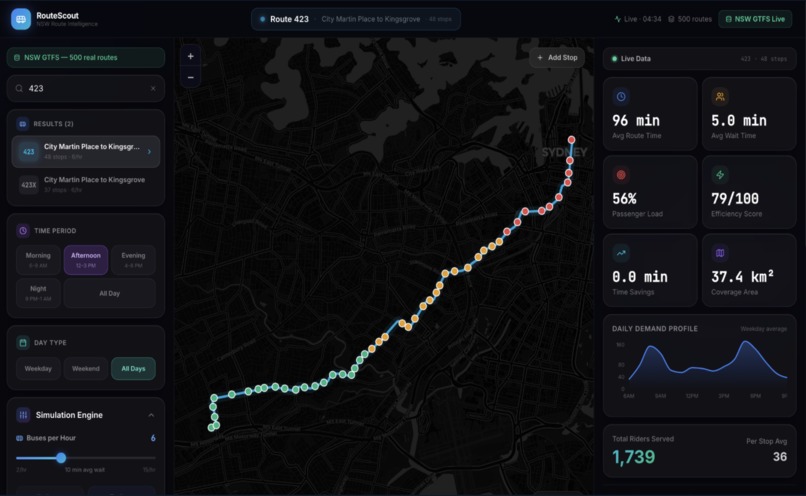
Dashboard
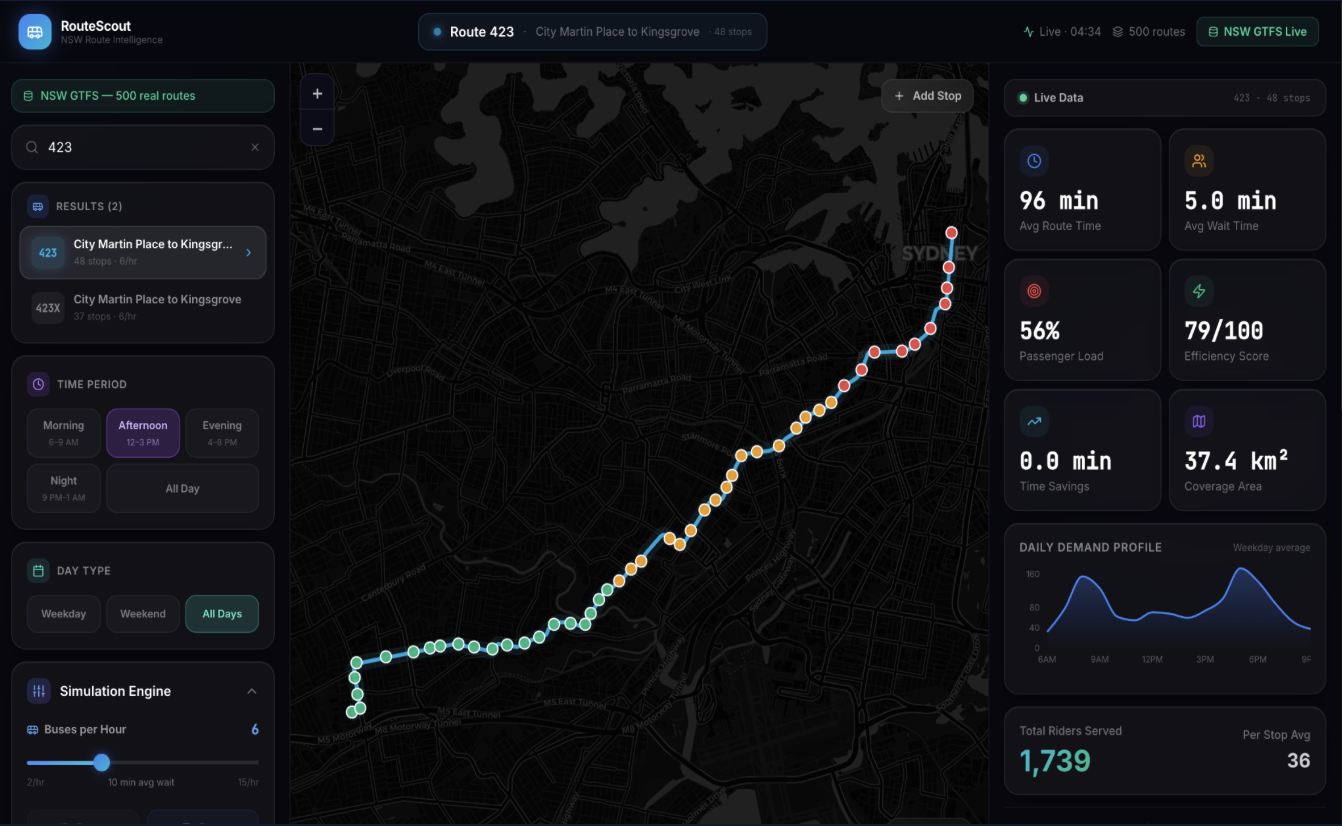
Inspiration
The project was inspired by the immense pressure on NSW bus networks, which manage over 13,000 services across metropolitan and regional corridors. We realized that manual optimization at this scale is nearly impossible because current planning tools haven't kept pace with network complexity. Seeing that route inefficiency costs an estimated $2.4B annually in Australia, we were driven to build an AI partner that could turn siloed data into smarter, more efficient routes.
What it does
RouteScout is a transport intelligence platform and decision engine designed to modernize the NSW bus network. It functions as an "intelligence layer" for planners, allowing them to:
See the network live: View routes, stops, and vehicles updating in real-time.
Identify problem areas: Automatically surface overloaded stops, underused routes, and peak congestion patterns.
Simulate before commitment: Test route changes (like adding/removing stops) and predict the impact on travel time and passenger flow in minutes rather than weeks.
Optimise outcomes: Provide data-backed recommendations to close service gaps and reduce cost-per-rider.
How we built it
We built an embedded intelligence system that ingests and unifies fragmented Transport NSW datasets. Our four-step approach includes:
Discover: Retrieving route shapefiles and ingesting live NSW GTFS feeds and Opal tap-on/off data.
Model & Analyse: Combining traffic datasets with real-time feeds to measure dwell time, route efficiency, and ridership per stop.
Simulate: Using historical demand to model route changes and predict rider redistribution.
Recommend: Comparing side-by-side "before and after" scenarios to prioritize evidence-based interventions.
Challenges we ran into
Challenges we ran into The project addressed several significant hurdles currently facing transport planners:
Data Silos: Route, stop, and ridership data rarely combine into a single view.
Reactive Cycles: Inefficiencies are often identified weeks after they occur.
Manual Modeling: Scenario modeling in spreadsheets is slow and error-prone, taking an average of 3-6 weeks to model a single route change.
Capacity Mismatch: Balancing over-served peak corridors with under-served outer routes.
Accomplishments that we're proud of
We successfully demonstrated how data-backed planning can lead to measurable improvements. In our illustrative outcome for the 370X (Parramatta – CBD) route, we showed that RouteScout could:
Reduce average passenger wait time by 45% (from 14.2 min to 7.8 min).
Bring peak load factor down from 118% (over capacity) to a manageable 81%.
Increase the route's overall efficiency score from 58/100 to 92/100.
Successfully close 4 out of 4 identified service gaps.
What we learned
We learned that 68% of planners cite a lack of real-time data access as a primary barrier to efficiency. We discovered that by moving away from static dashboards toward interactive scenario testing, we can provide a unified view that reflects actual rider behavior rather than assumptions. Most importantly, we learned that proactive network optimization—identifying and fixing issues before they affect performance—is the key to a modern transit system.
What's next for RouteScout
The goal for RouteScout is to move from a "reactive" state to a "proactive" intelligence partner embedded within the Transport NSW planning process. We aim to further refine our AI to catch optimization opportunities that manual teams miss and expand our simulation engine to cover every metropolitan and regional corridor in the state. Our ultimate outcome is a smarter, more equitable NSW bus network delivered faster than ever before.
Built With
- fast-api
- framer-motion
- next.js
- open-street-map
- osrm-api
- python
- react
- typescript


Log in or sign up for Devpost to join the conversation.