-
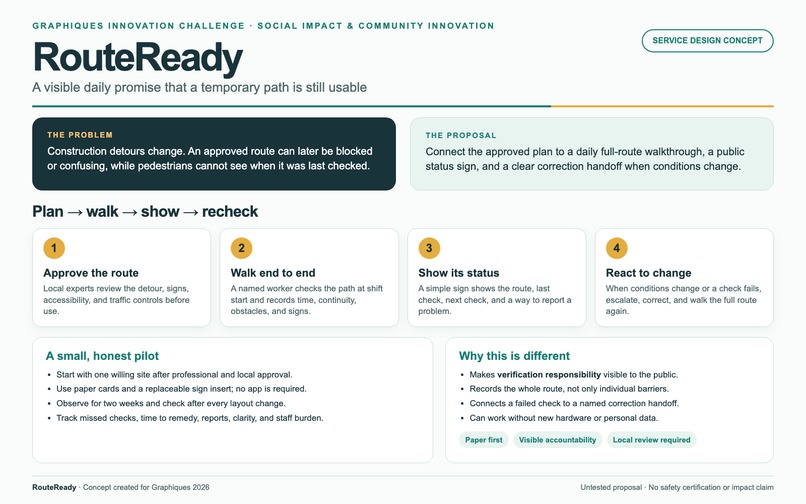
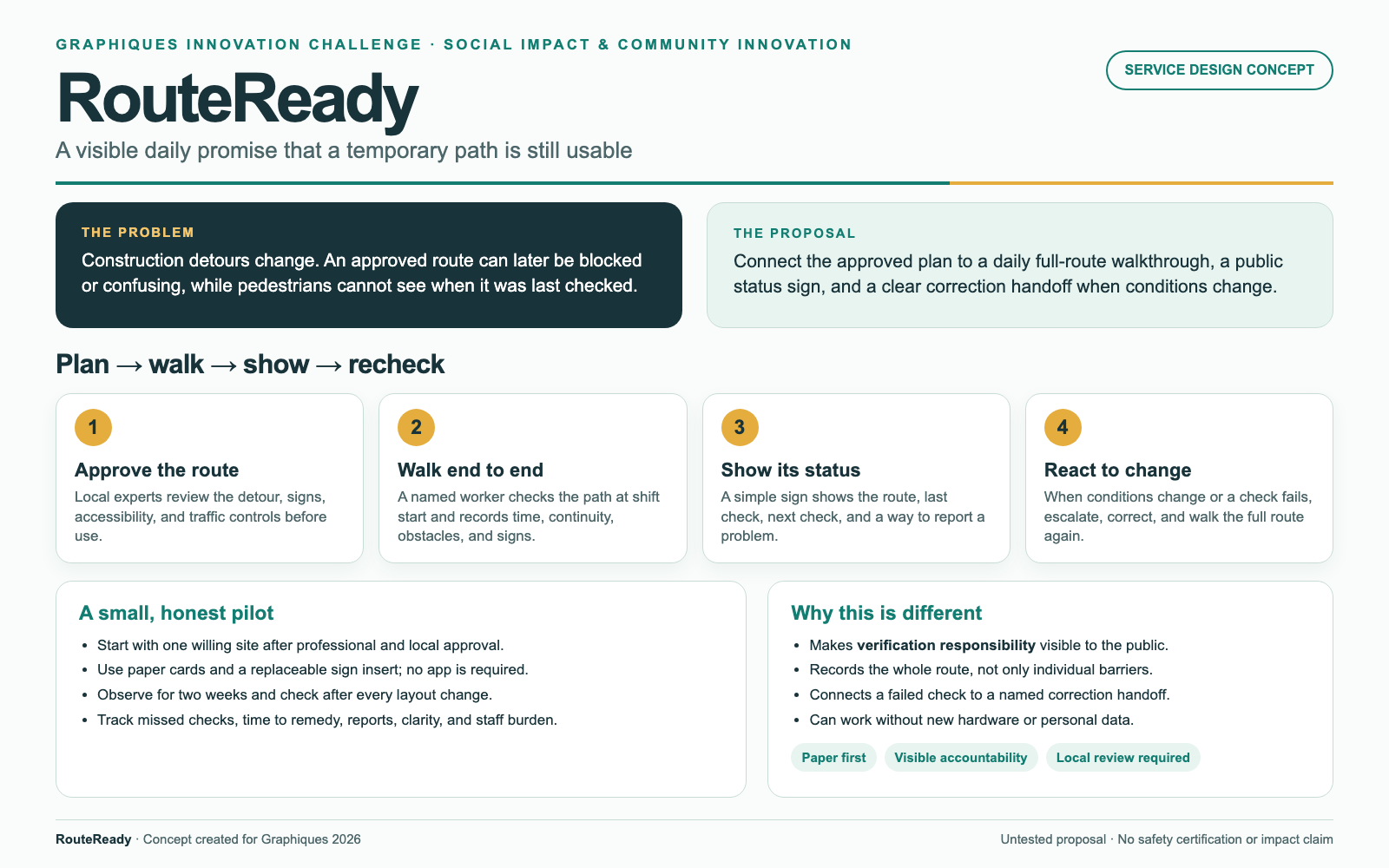
RouteReady concept board: plan, walk, show, and recheck the temporary pedestrian route
RouteReady
Tagline: A visible daily promise that a temporary walking route is still usable.
Primary theme: Social Impact & Community Innovation
Problem
Construction barriers can change from one day or shift to the next. A temporary pedestrian route that was clear when planned may later be interrupted by moved equipment, debris, unclear signs, or an unexpected gap. People who use mobility aids, push strollers, or need an easy-to-follow route can be affected most. A route drawing alone does not tell the public when someone last checked the actual path, who owns a correction, or what to do when conditions change.
Proposed solution
RouteReady is a paper-first inspection and communication protocol for the team responsible for a temporary pedestrian detour. It adds a repeatable handoff between the approved route plan, the real street, and the people trying to use it.
- Plan and approve. The responsible site team and local authority review a temporary route against the rules that apply in their jurisdiction. RouteReady does not replace traffic-control design or accessibility approval.
- Walk the whole route. At the start of each shift, a named worker follows the route from its first sign to the point where it rejoins the normal path. A short card records the time, direction, continuity, surface and obstacles, crossings, signs, and access to nearby destinations.
- Show the current status. A simple public-facing sign identifies the approved detour, last check time, next check time, and a way to report a problem without requiring a phone app. Clear wording and a diagram are provided in locally appropriate formats.
- React to change. When a barrier moves or a check fails, the worker marks the route as needing review, escalates to the responsible supervisor, corrects the issue under the approved plan, and checks the full route again before presenting it as current. The card preserves the handoff across shifts.
The innovation is the visible verification loop: the public sees more than an arrow, while the site team sees a specific, time-stamped responsibility to recheck the route after conditions change. The workflow can start with a clipboard and replaceable sign insert. Optional digital records could come later, after the analog process is tested.
Implementation and pilot
A pilot would involve one willing site and the authority that controls its pedestrian route. Before use, a qualified local reviewer would verify the actual detour, signs, reporting channel, accessibility provisions, safety controls, and legal requirements. Workers would receive a short walkthrough and a paper card. The route would be checked at shift start and after any layout change, with a supervisor responsible for failed checks.
Over a proposed two-week observation period, the team would record whether checks happen on time, time to resolve a failed route, reported obstructions, visitor ability to locate the detour, and staff effort. Feedback would be used to simplify the card and sign. A failed check is a trigger for review and correction, not a claim that a path is safe. The attached concept board shows the workflow.
Status and limits: RouteReady is an untested service concept. No site deployment, partnership, measured improvement, or legal certification is claimed. It was created for this entry with AI assistance and uses no third-party map, image, or proprietary data.

Log in or sign up for Devpost to join the conversation.