Inspiration
E-commerce teams lose customers every day because of delayed shipments. A package gets stuck in transit, and the standard playbook says "file a claim." But what if that customer is high-value and wants a refund instead? The agent makes the wrong call, the manager has to step in manually, and nothing changes for the next customer. We built RouteReady because agents should learn permanently from corrections, not just log them in a spreadsheet.
What it does
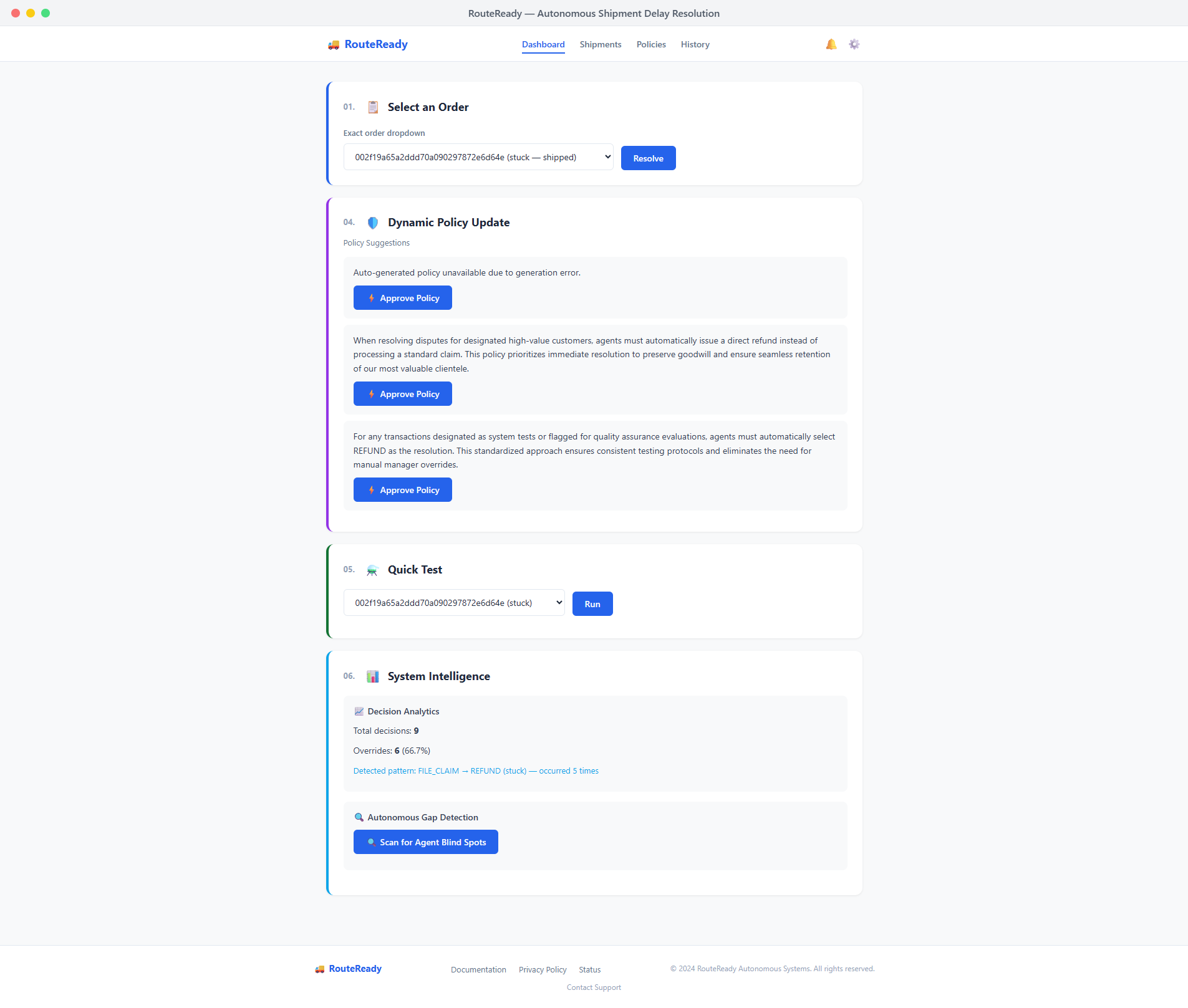
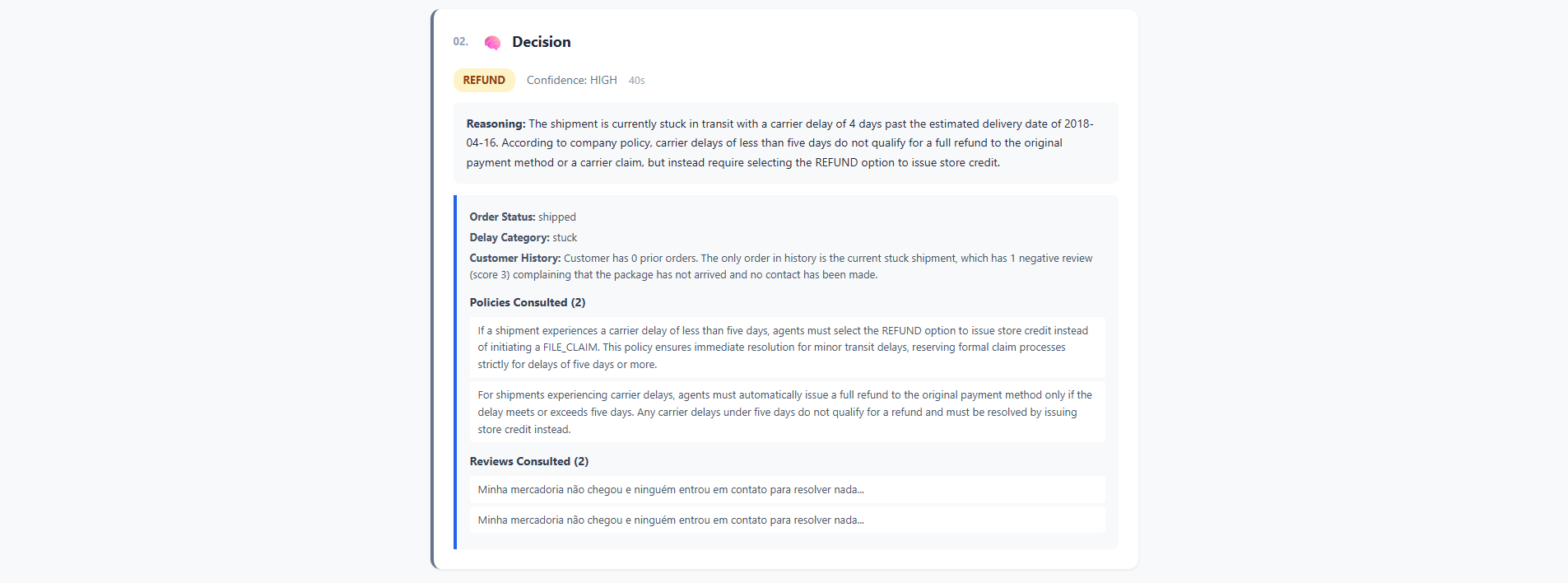
RouteReady is an autonomous shipment resolution agent that investigates delayed e-commerce orders using carrier tracking data, inventory status, customer history, and reviews. It decides whether to WAIT, REPLACE, REFUND, or FILE_CLAIM.
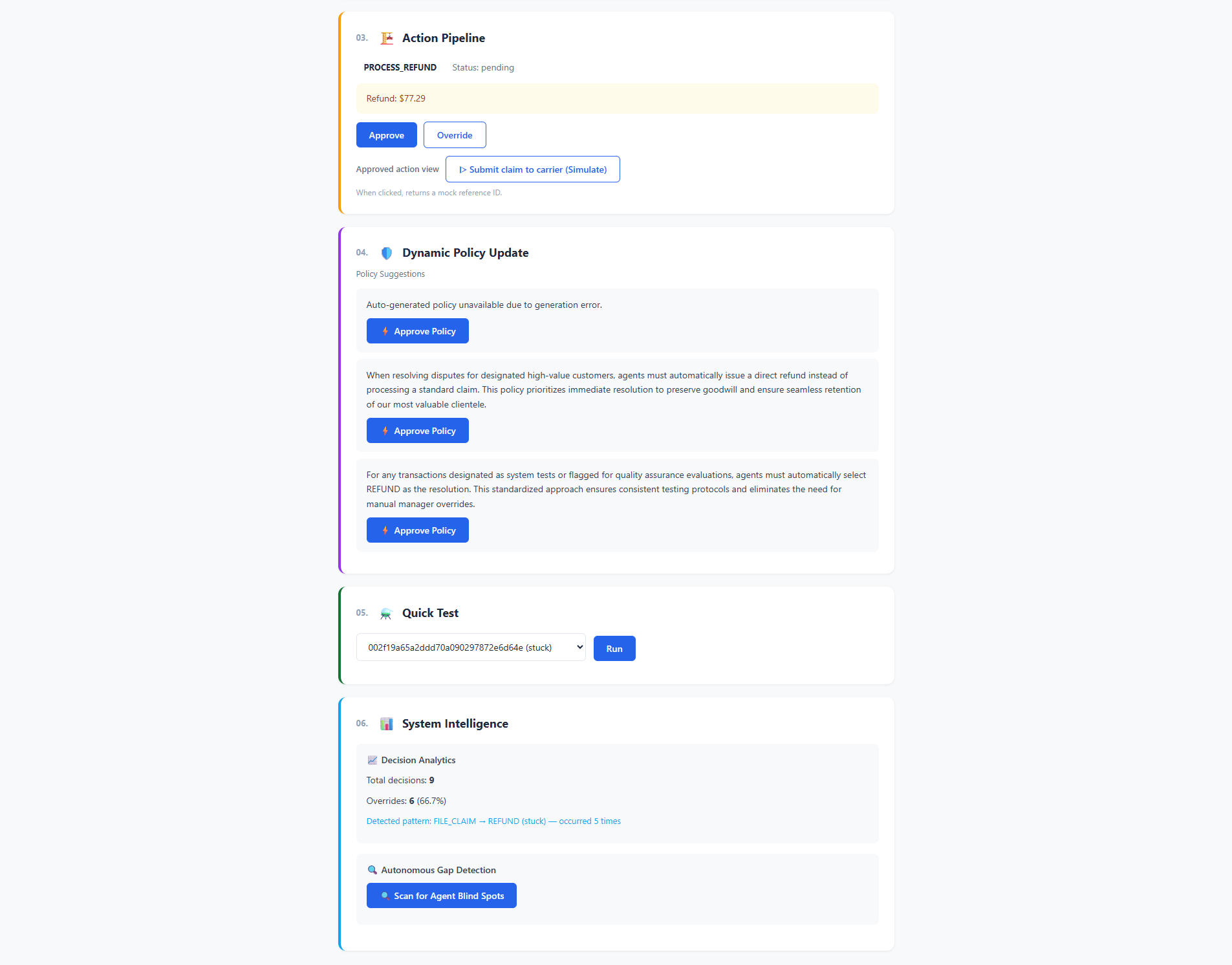
The critical difference: when a manager overrides a decision, RouteReady generates a new policy rule from the reasoning, embeds it into its knowledge base, and permanently adapts its behavior on similar future orders. It also tracks its own accuracy, detects systemic blind spots autonomously, and forecasts the impact of new policies before approval.
How we built it
- Backend: FastAPI on Google Cloud Run
- Agent Framework: Google ADK (Python) with a Coordinator Agent
- LLM: Gemini 3.5-flash via Vertex AI global endpoint
- Embeddings: Vertex AI text-embedding-005
- Vector Database: Firestore Native with vector search extension
- Data: Curated subset of the Olist Brazilian E-Commerce dataset (400 orders, 96k customer histories)
- Frontend: Single-page HTML/JS (no external frameworks)
- Deployment: Cloud Run with autoscaling, live at
https://routeready-app-oez2abtgfa-uc.a.run.app
Challenges we ran into
Our biggest challenge was avoiding the "retrieval system" trap. Early versions simply stored override reasons and retrieved them later. During a live Q&A with hackathon judges, we learned this reads as "just "RAG"—not true agentic learning. We rapidly pivoted to show compounding value: decision analytics tracking, autonomous gap detection (the agent scans its own override history and drafts fixes proactively), and policy impact forecasting. We also battled a duplicate policy bug caused by double-clicking the override button, which we fixed with frontend debounce and backend idempotency guards.
Accomplishments that we're proud of
- Genuine behavioral change. Approving a policy and re-running the same order produces a different decision with reasoning that cites the new policy.
- Autonomous gap detection. The agent evaluates its own override history, finds patterns (e.g., "FILE_CLAIM overridden to REFUND on 100% of stuck orders"), and drafts a policy fix without human prompting.
- Live deployment on Cloud Run with zero-downtime redeploys throughout the hackathon.
- Zero-dependency UI: a clean, professional dashboard built with vanilla HTML/CSS/JS.
What we learned
Agentic systems are judged by their narrative, not just their code. The same technical implementation can be framed as "retrieval" or "self-improvement" depending on how you present it. Measurable system improvement — showing override rates, forecasting policy impact, and surfacing blind spots — is what transforms a chatbot with memory into a genuinely evolving agent.
What's next for RouteReady
- Proactive WISMO ("Where Is My Order?") customer notifications using the same policy engine
- Multimodal returns assessment (customer photo verification via Gemini vision)
- Scheduled autonomous gap scanning with manager alerts
- A/B testing framework for policies to measure real revenue impact

Log in or sign up for Devpost to join the conversation.