-
-
Fictional campus route analysis with explicit path exclusions and limitations.
-
Inspect route choices under stated boundaries; no real navigation guarantee.
Inspiration
A shortest path can be unusable when it includes stairs, narrow access or stale inspection assumptions. This prototype explores transparent route decisions using a fictional campus; no real inspections or user interviews are claimed.
What it does
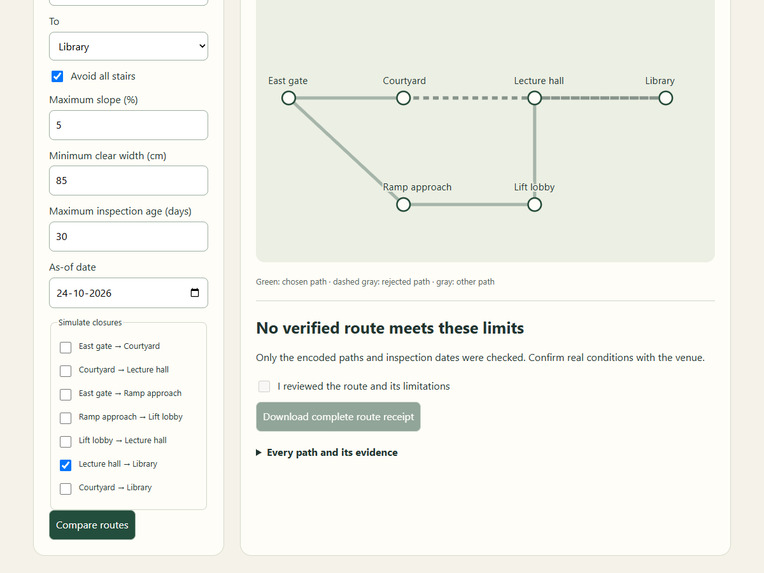
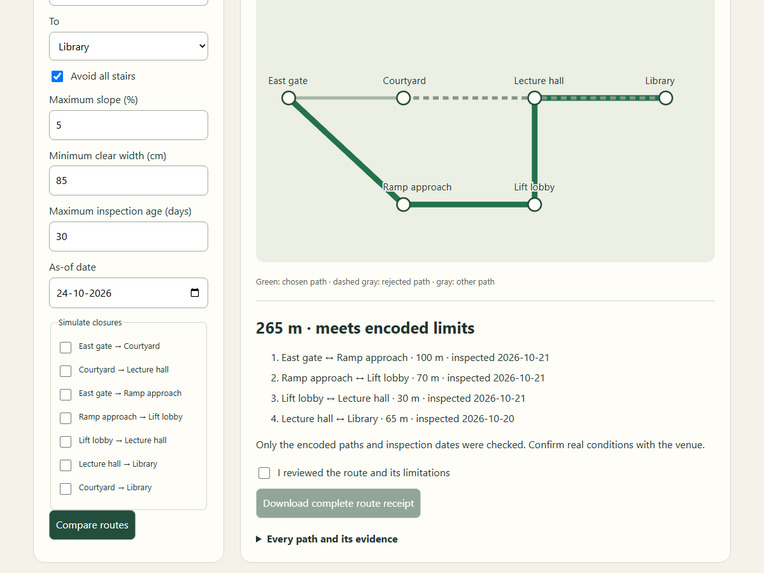
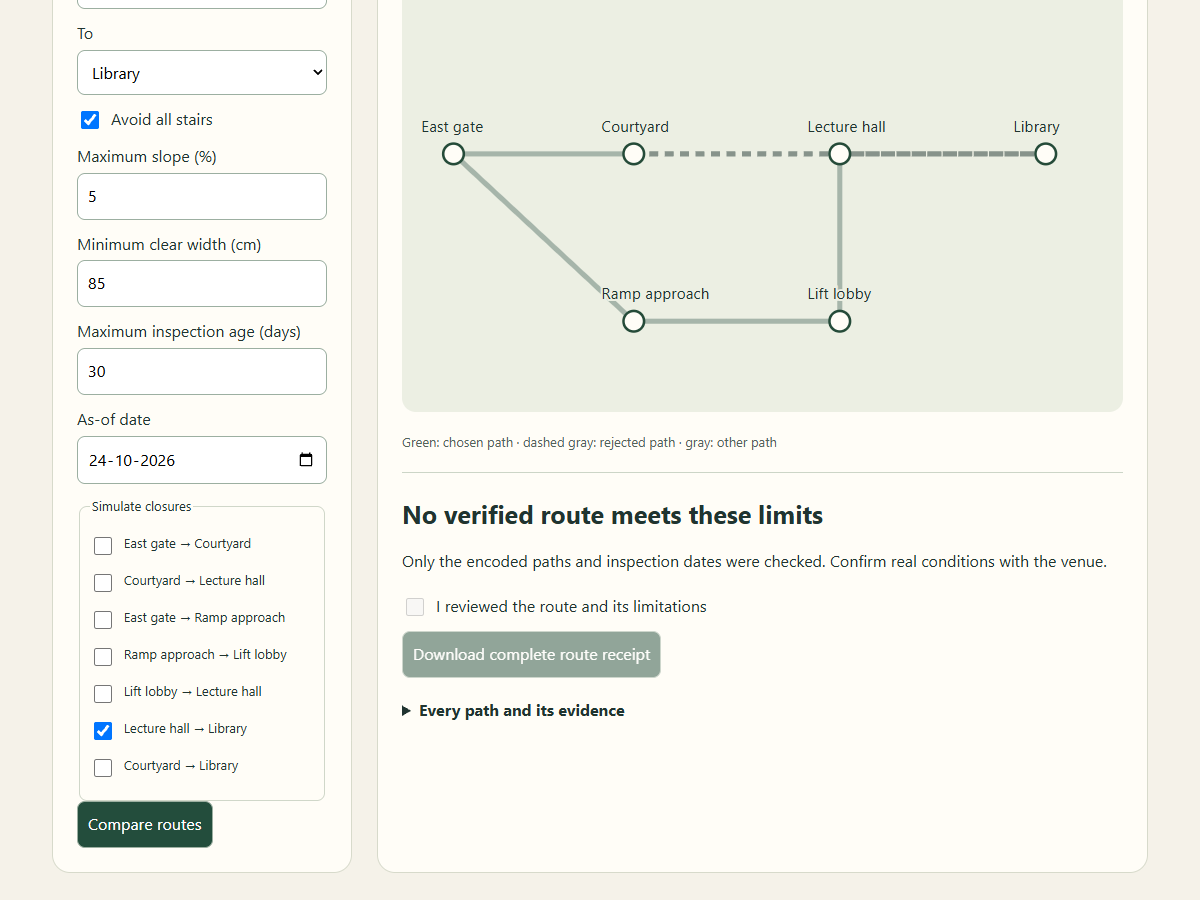
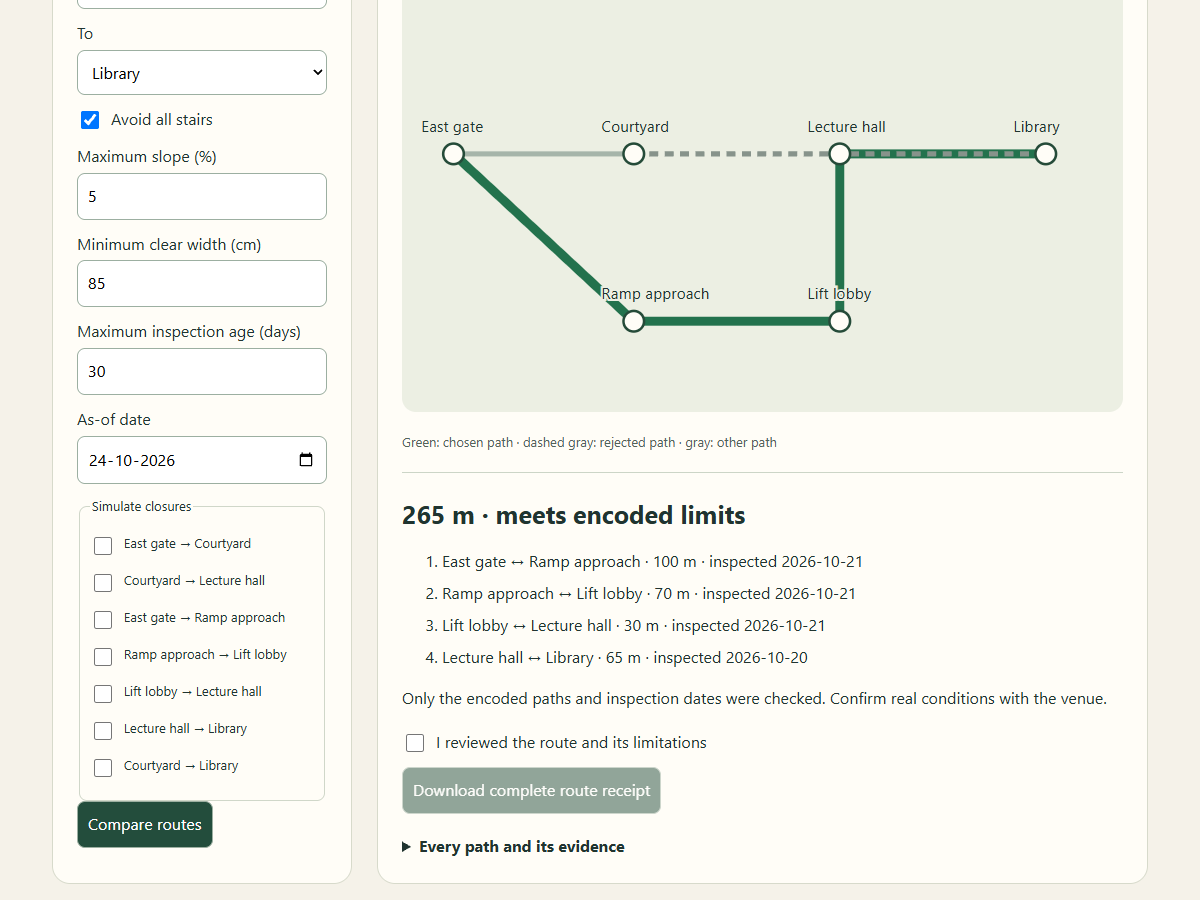
Compares shortest routes under explicit stair, slope, width, closure and inspection-age limits. Shows the selected route and reasons for excluding every other path. Reviewed JSON includes the entire graph, profile and path audit. Edits invalidate approval. No route is invented when the remaining graph is disconnected.
How it was built
Original static HTML/CSS/JavaScript, Dijkstra on a filtered graph and separate exhaustive simple-path tests. Seven tests include128closure variants. Actual browser checks cover265m step-free versus170m stair route, closure, approval invalidation and downloaded JSON. No packages or runtime AI.
Challenges and observations
Feasible distance and trustworthy evidence are different questions. The design treats missing/stale/future inspection dates as rejected rather than silently accessible. The full receipt preserves rejected paths as well as the chosen path. Browser download was verified using Playwright after agent-browser reported cancellation.
Limits / next steps
Fictional fixed map only. No accessibility certification, travel-time prediction, live closures, actual lift reliability or real safety guarantee. Real use would require consented venue surveys and accessibility-user evaluation. Future work is not implemented.
AI attribution / contributions
Codex researched and generated the implementation, tests, design and documentation under Aditya's authorization. These are agent development observations, not claims of personal study, independent manual coding or real user testing.
Built with
JavaScript, HTML, CSS, Node built-in tests, OpenAI Codex.
Links
https://github.com/AdityaM274/RouteProof https://adityam274.github.io/RouteProof/
