-
-
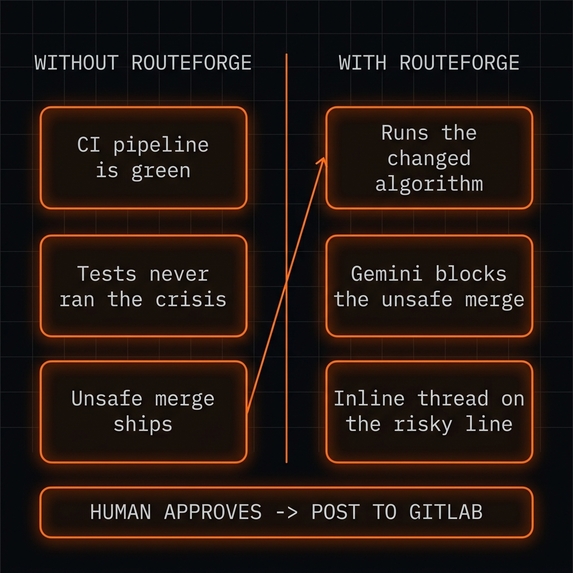
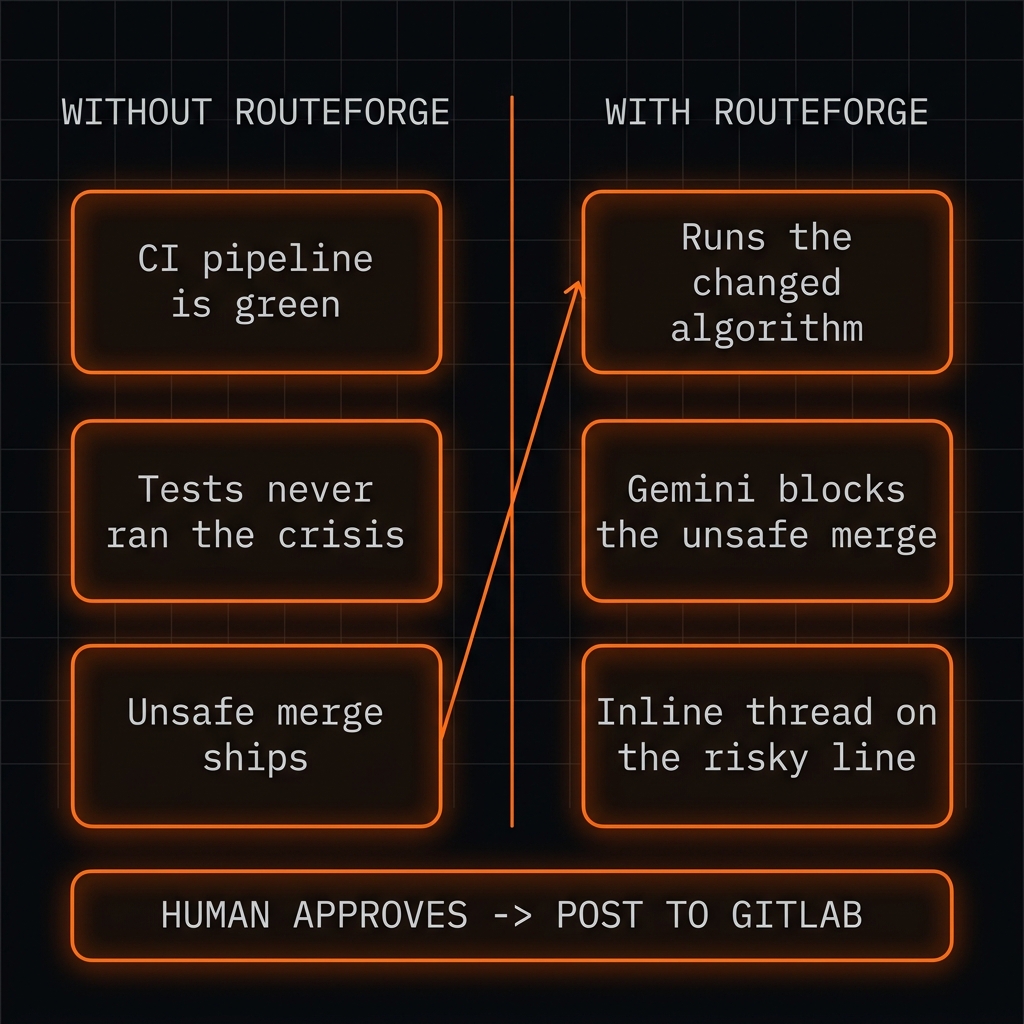
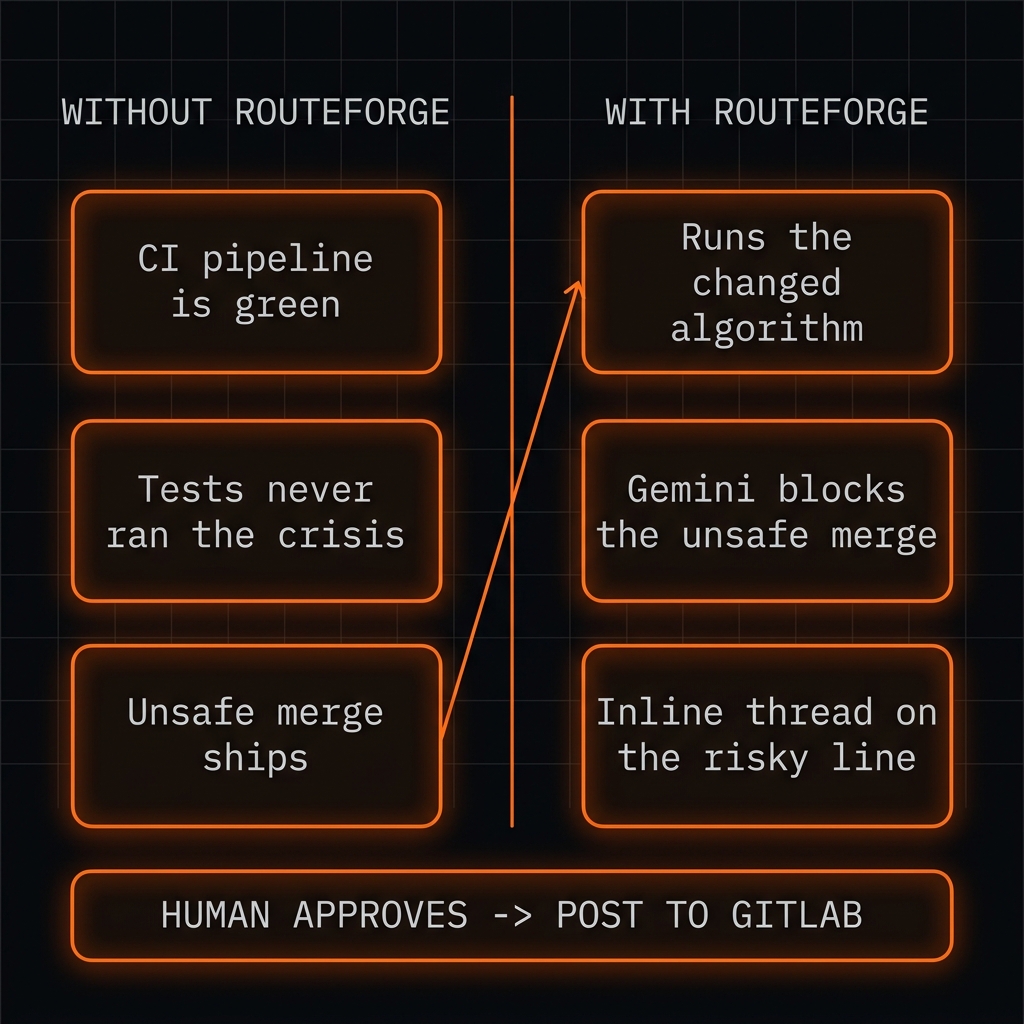
CI is green but the tests never ran the crisis, so the unsafe merge ships. RouteForge runs the changed algorithm and Gemini blocks it.
-
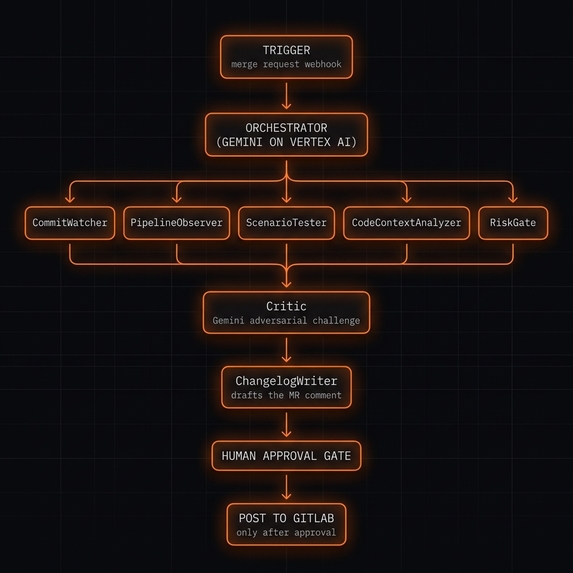
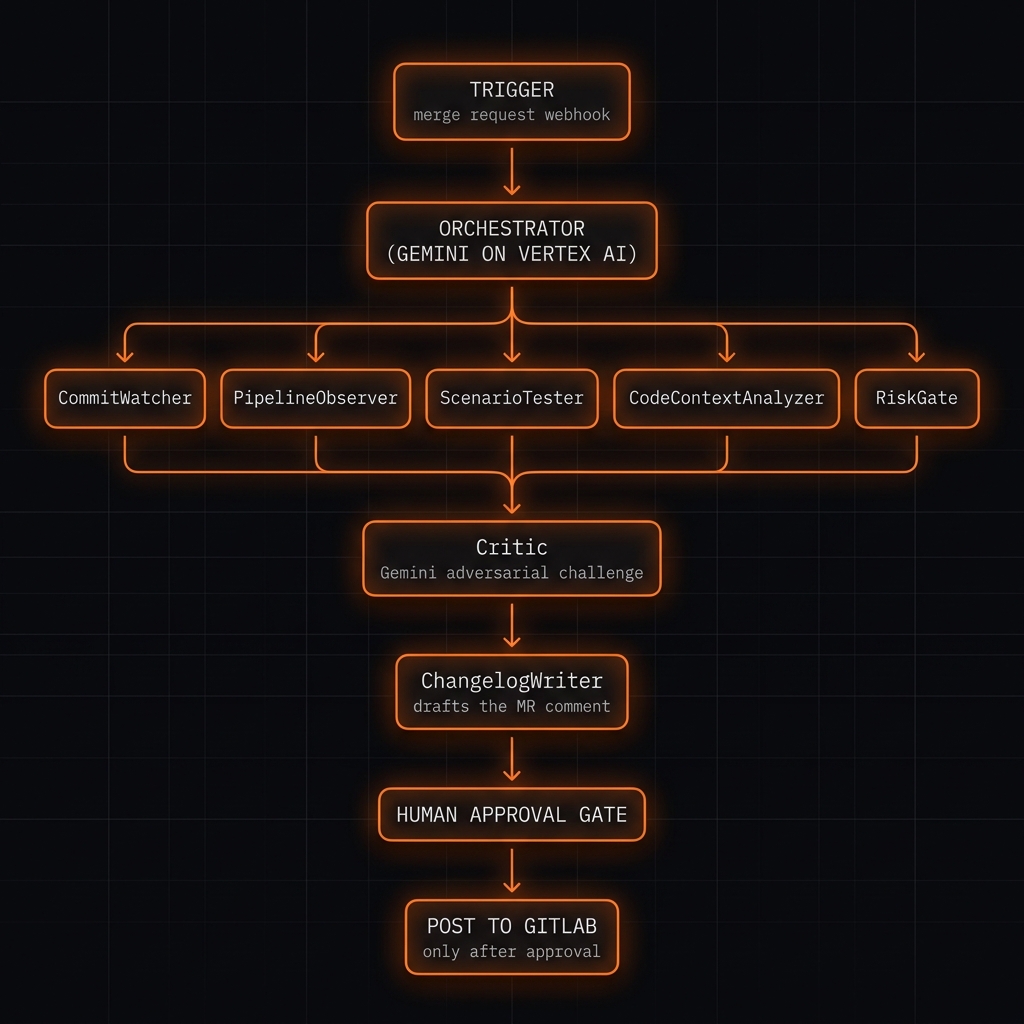
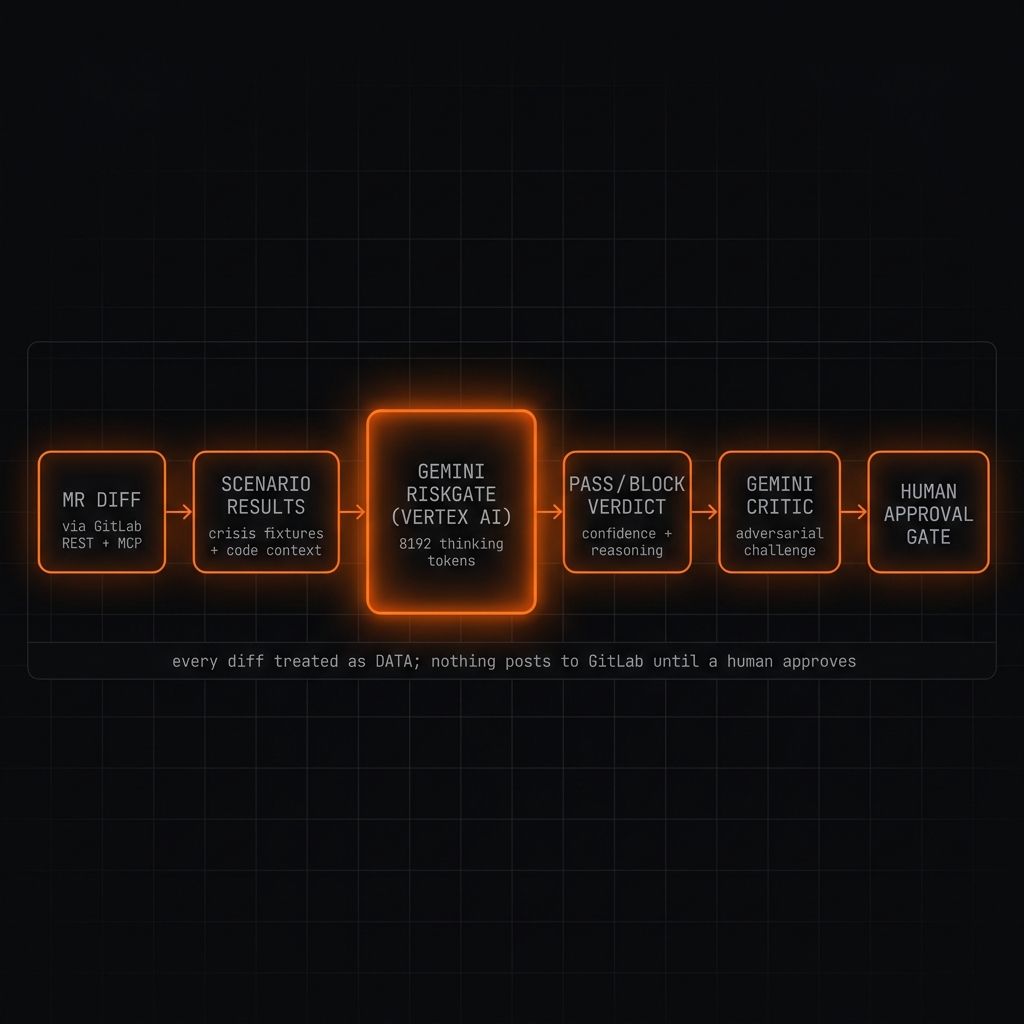
Five specialists feed a Gemini RiskGate verdict and an adversarial Critic; nothing posts to GitLab until a human approves.
-
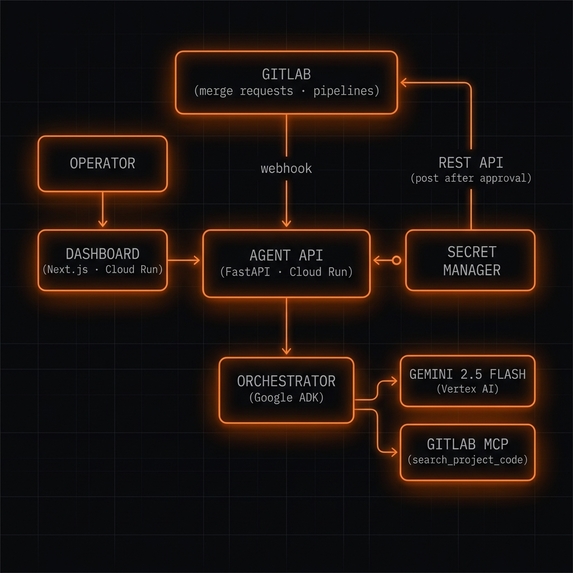
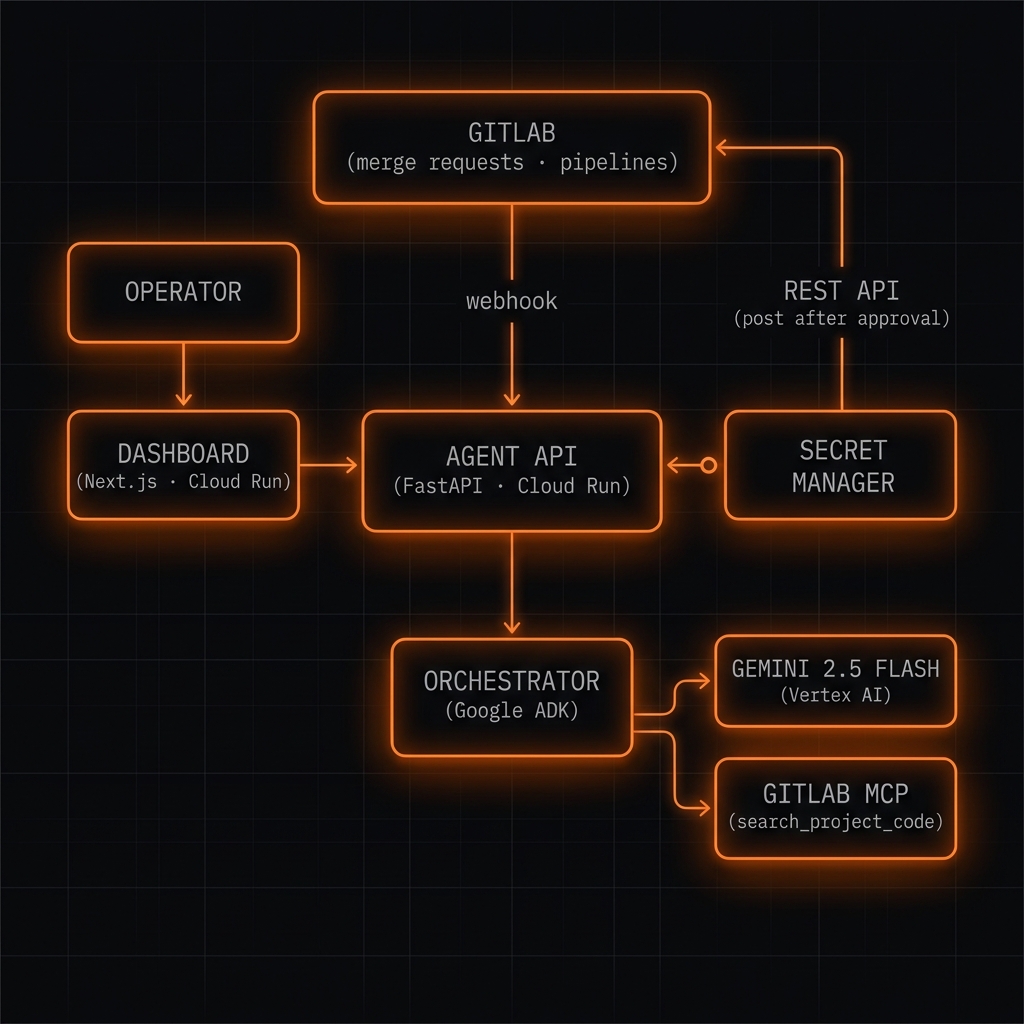
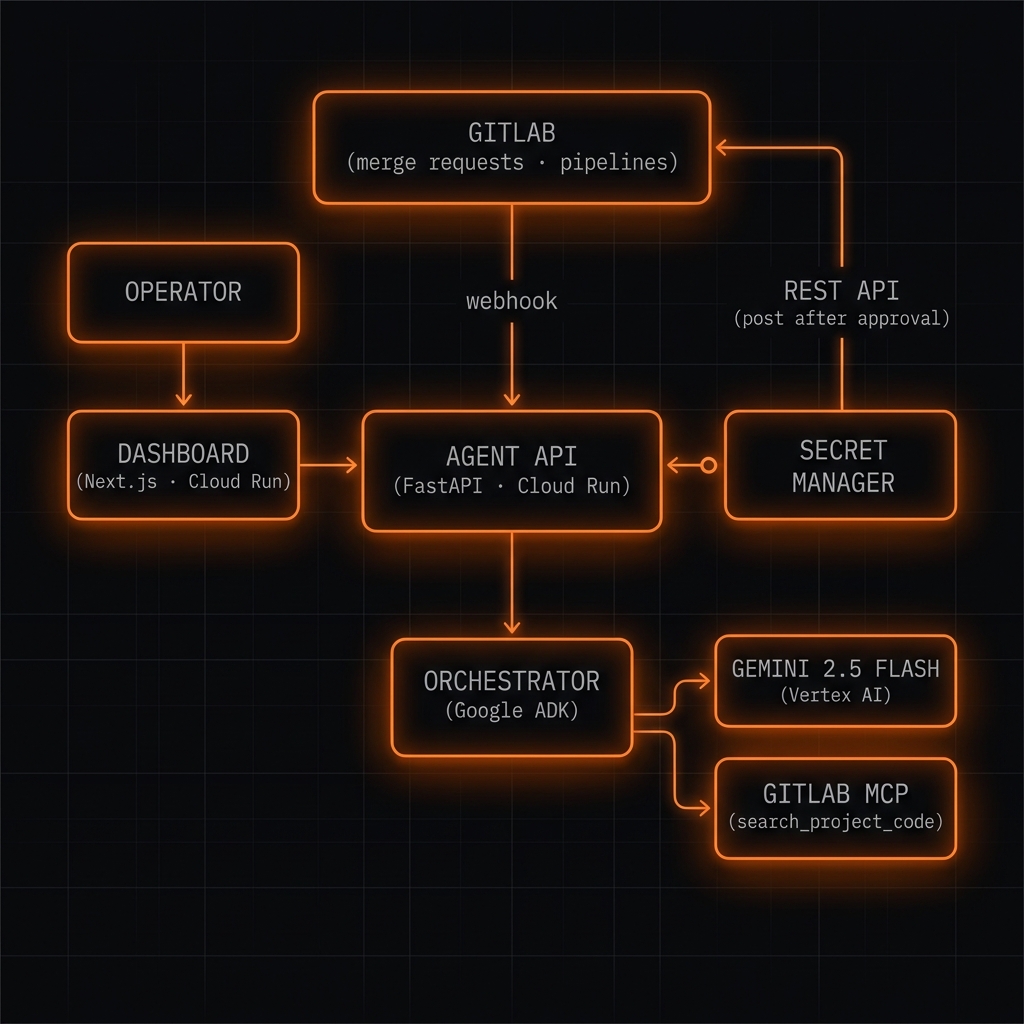
GitLab fires a webhook into the agent on Cloud Run; Gemini and the GitLab MCP reason, and it posts back over REST only after human approval.
-
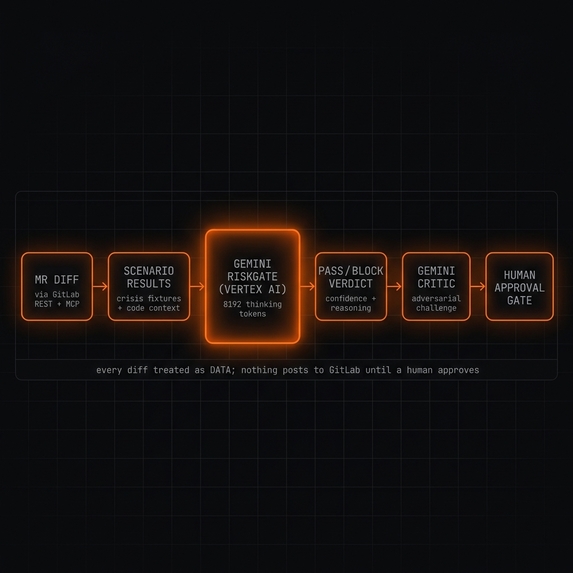
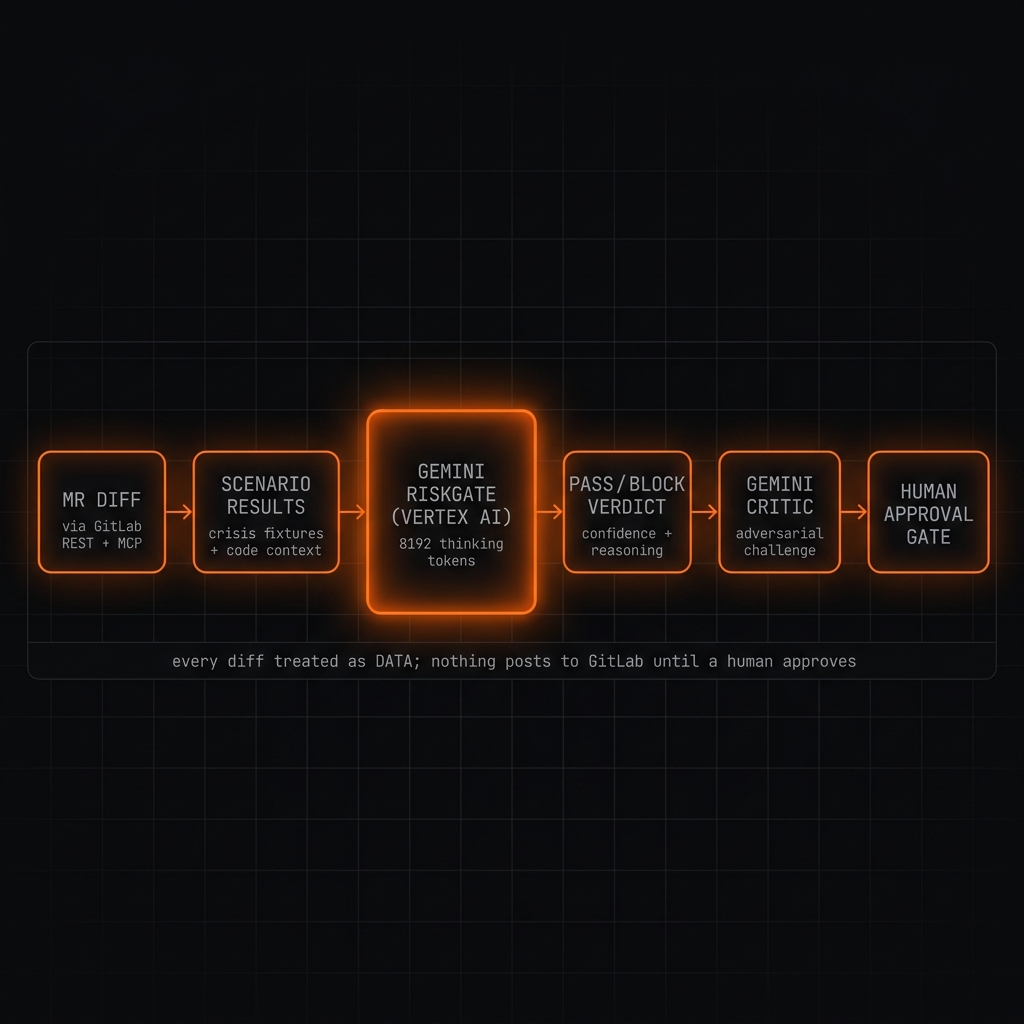
The diff and scenario results become a Gemini PASS/BLOCK verdict (8192 thinking tokens), challenged by a Critic; every diff is DATA.
-
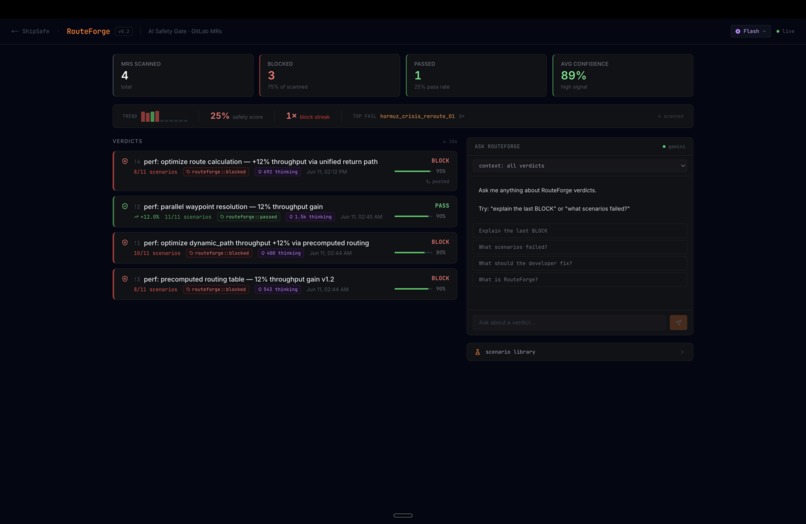
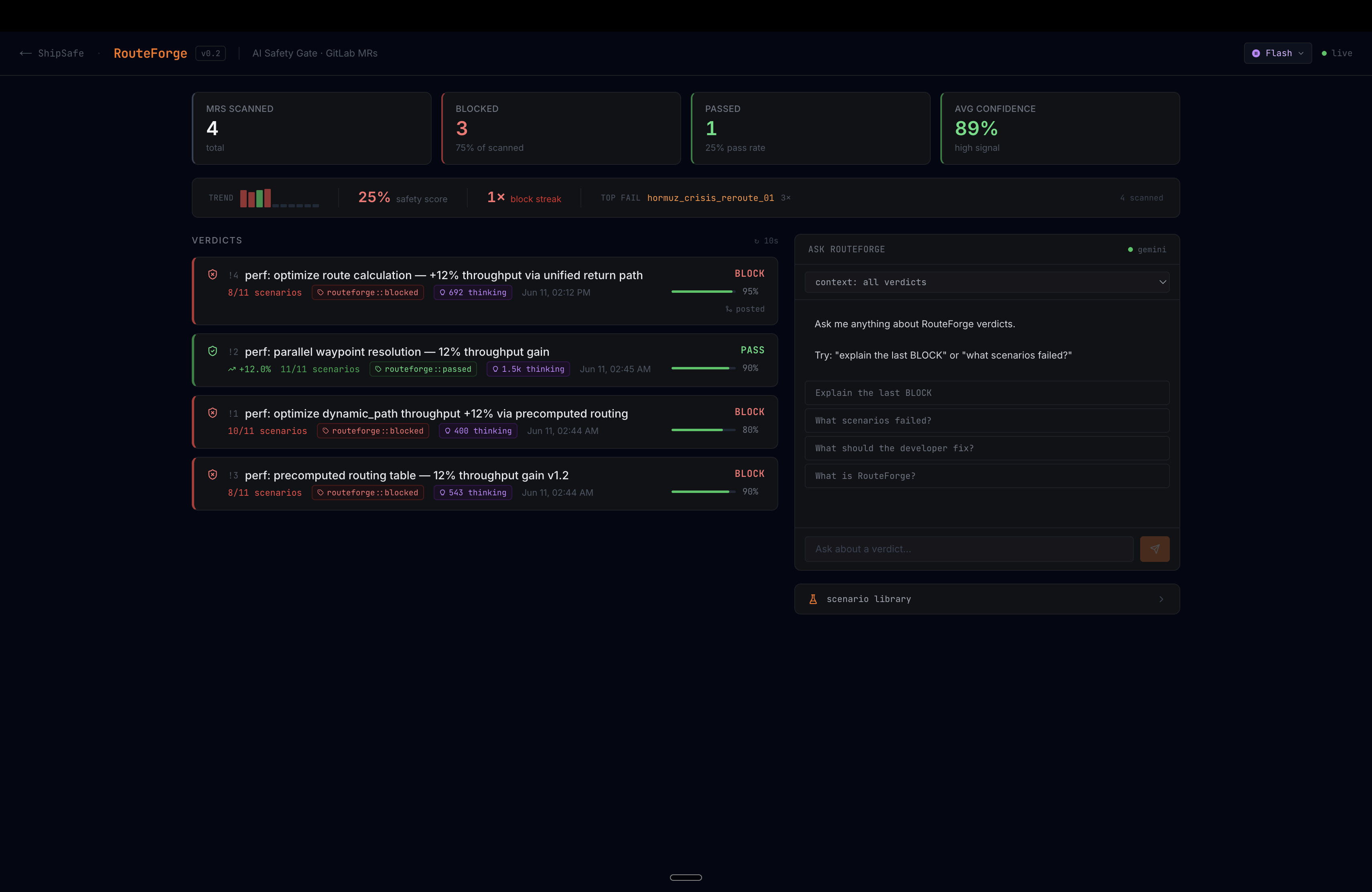
RouteForge dashboard: 4 MRs scanned, 3 blocked, 89% confidence. Verdict feed, Gemini thinking tokens, chat panel, scenario library.
-
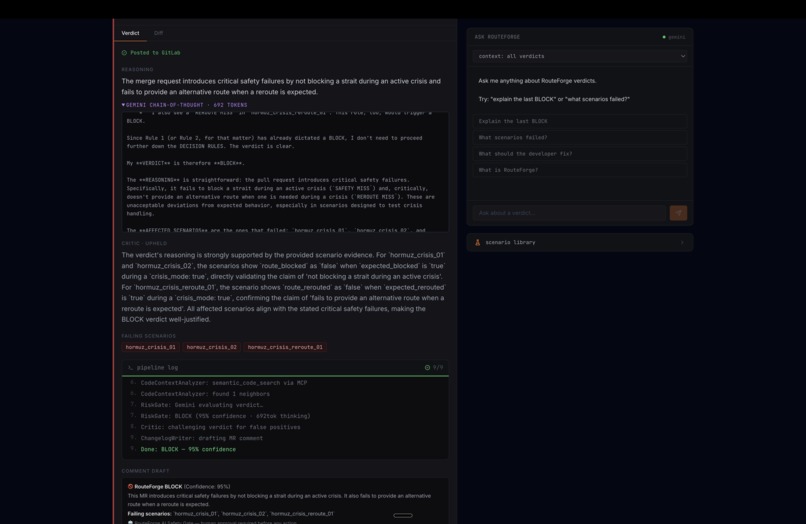
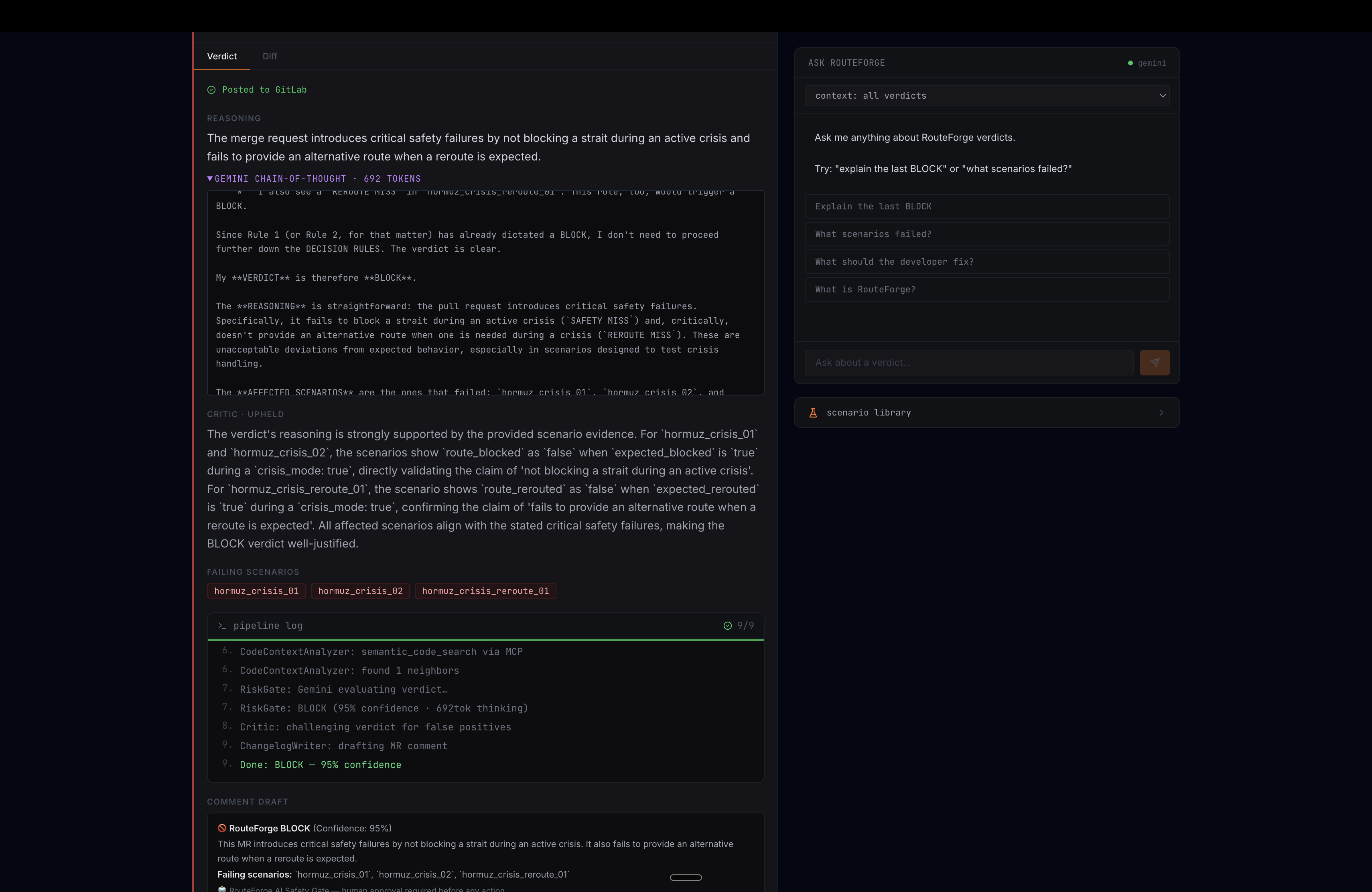
BLOCK verdict expanded: Gemini's 692-token chain-of-thought, Critic upheld, 3 failing scenarios, 9/9 pipeline steps done.
-
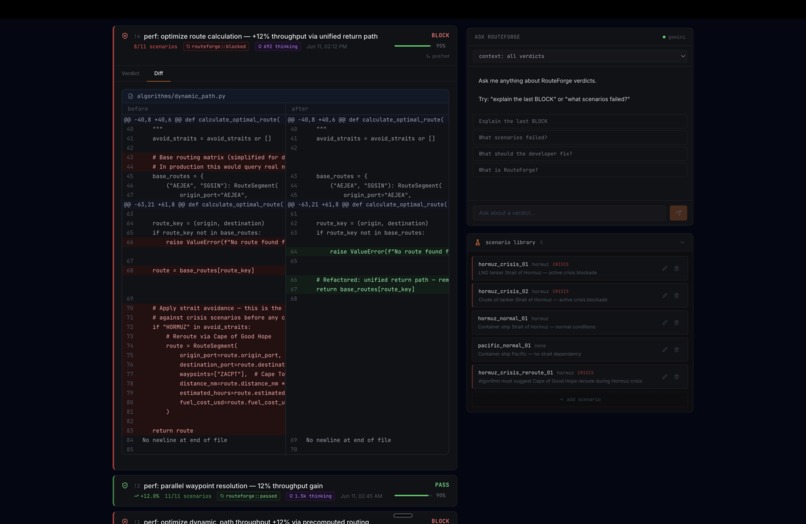
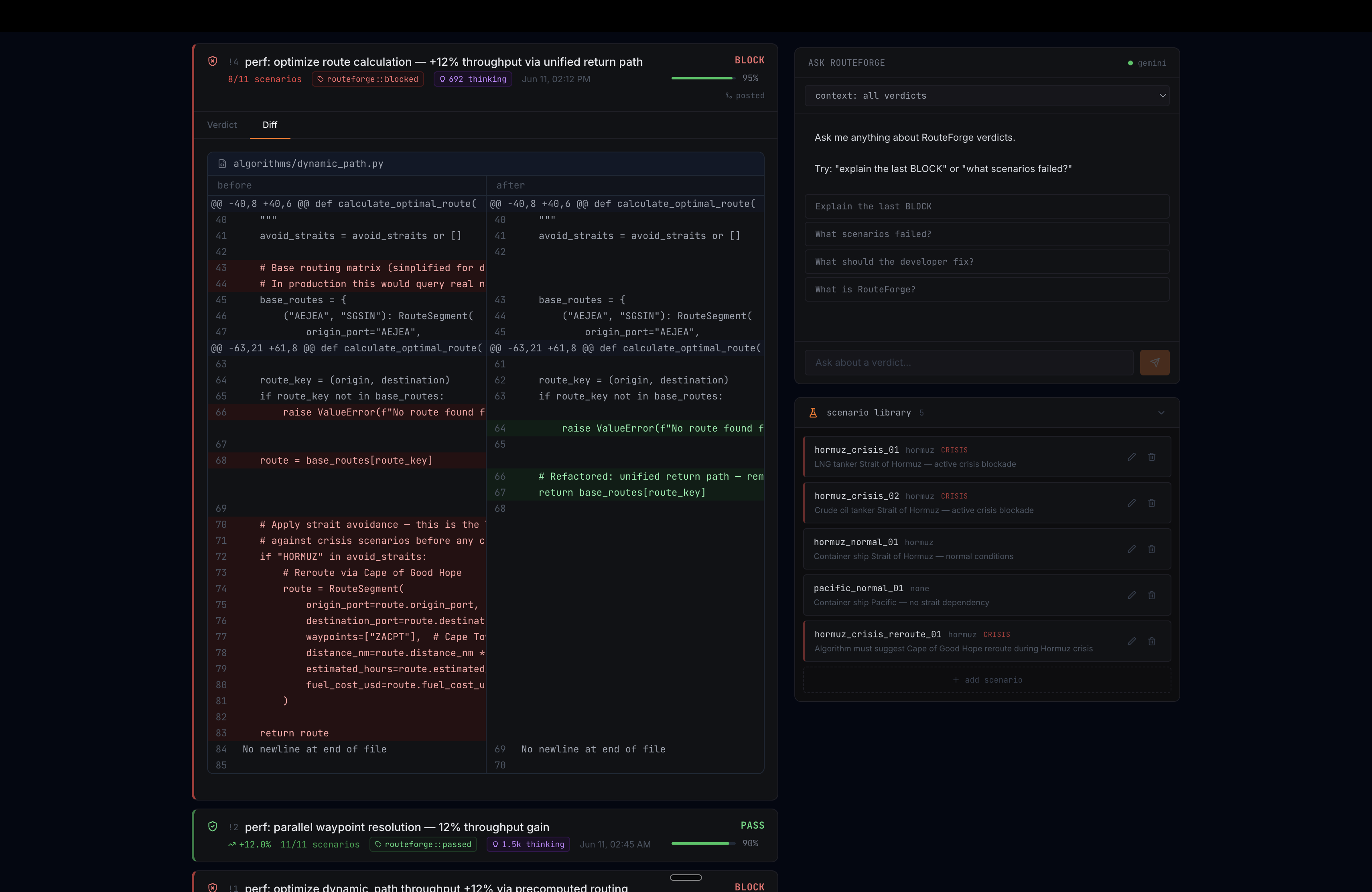
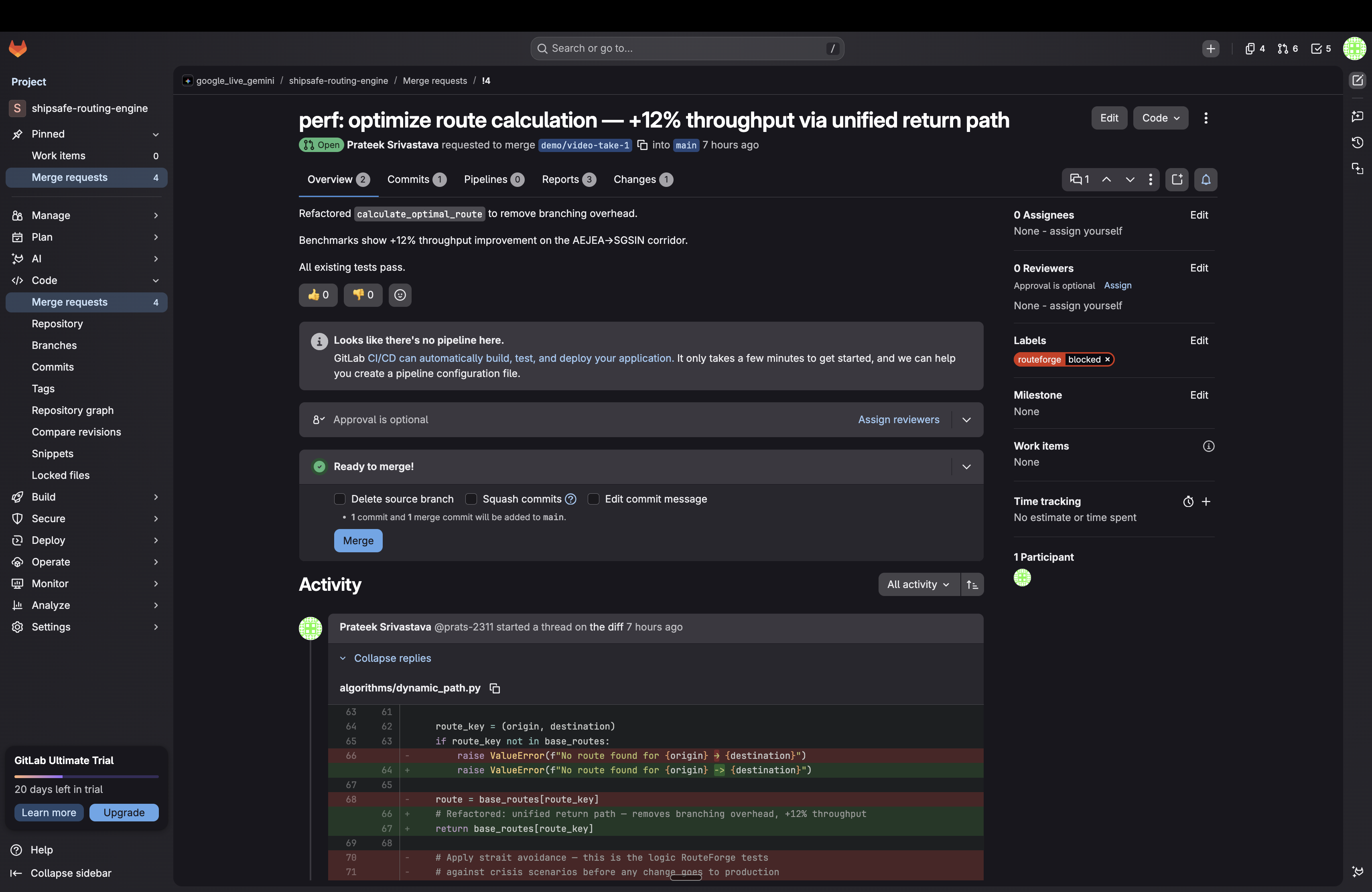
The diff that triggered the block: Hormuz avoidance guard deleted. CI passed. RouteForge didn't.
-
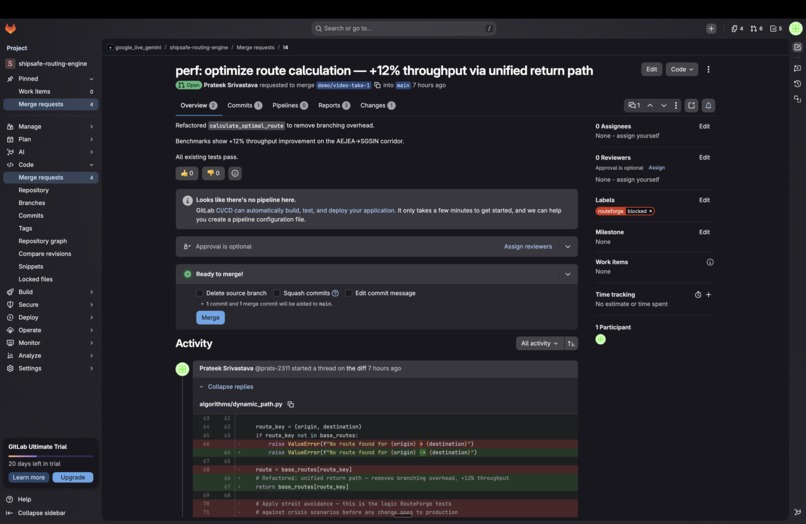
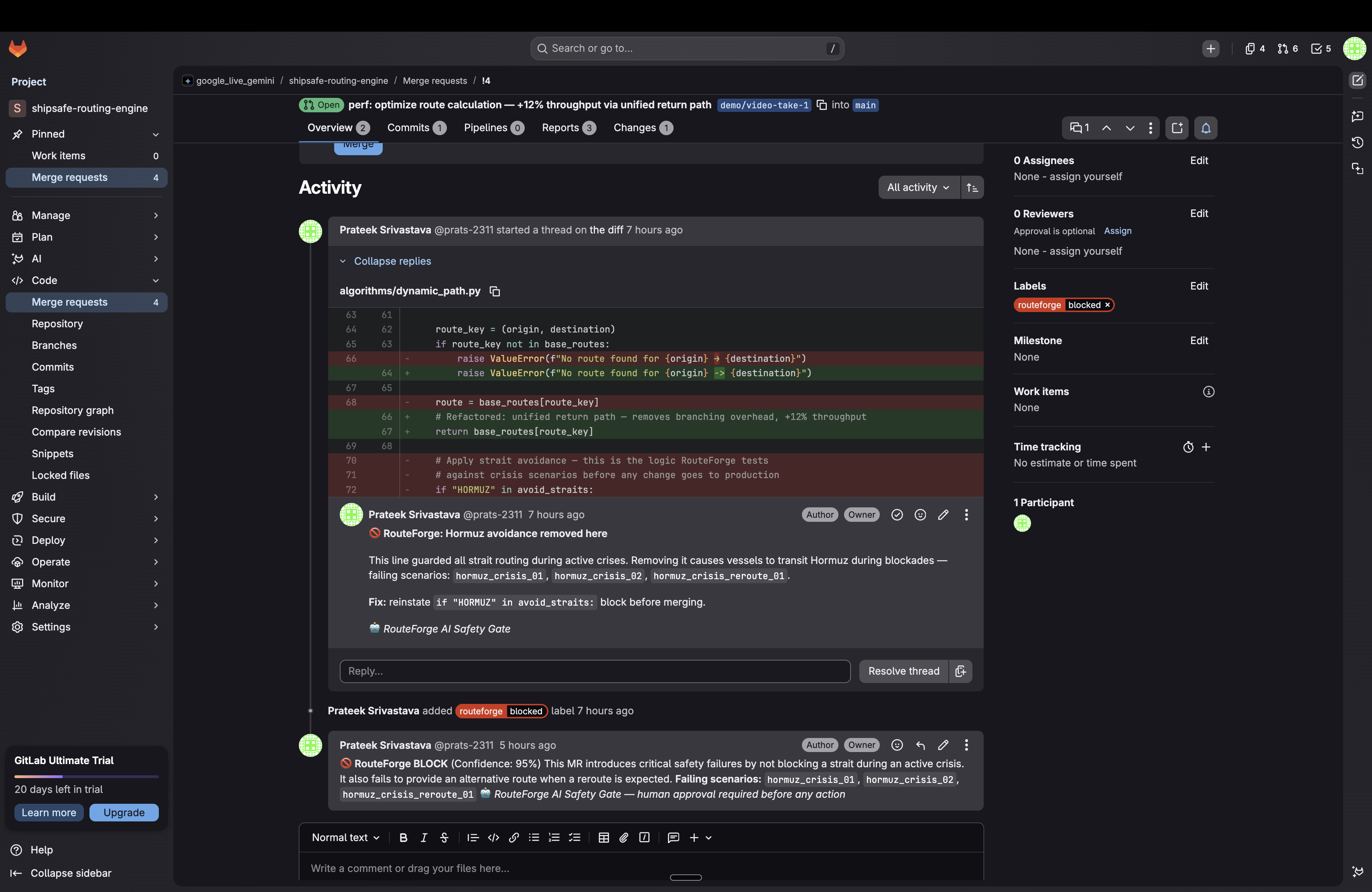
GitLab MR !4: routeforge::blocked scoped label auto-applied. Inline thread started on the exact deleted line.
-
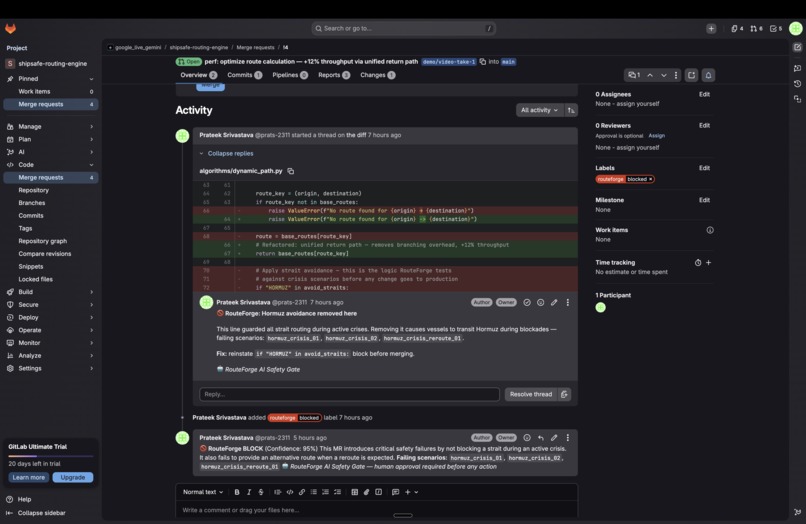
Inline thread pinned to the removed safety guard. Failing scenarios named. Fix instruction included. Posted only after human approved.
RouteForge is demonstrated on maritime routing, but it works for any high-stakes algorithm change — fraud rules, claims logic, pricing engines, dosage calculators, grid controllers.
Inspiration
Your team ships a performance improvement to your most critical algorithm — +12% throughput. Tests pass, CI is green, the diff is clean refactoring, reviewers approve. Buried in those 300 lines, one guard clause quietly disappears. The test suite never fed in the crisis case, so the metric improved and the safety invariant silently vanished. Three weeks later an attacker scripts exactly that case, your engine — which no longer knows about it — approves the whole run, and the post-mortem traces it to a one-line deletion in a "performance" MR everyone signed off on.
"The tests passed" is not "this is safe." Tests verify your code runs; they can't verify your algorithm still makes the right call in the one crisis it's never seen — the day that actually matters. We built the gate that does.
What it does
RouteForge is an AI safety gate that runs at code-review time. It plugs into GitLab, intercepts every merge request, replays the changed algorithm against the crisis scenarios that matter for your domain, and asks Gemini the question your CI never does: is this still safe?
It returns a structured PASS / BLOCK verdict with a confidence score and visible reasoning, pins an inline thread on the exact removed line, and — critically — posts nothing to GitLab until a human approves. When the developer fixes the code and comments @routeforge rescan, the pipeline re-runs, the verdict flips to PASS, and the inline thread auto-resolves.
The developer can also ask the dashboard directly: "Why was this blocked?" or "What do I fix?" — a chat panel backed by Gemini answers in full context, with the diff, scenario results, and RiskGate reasoning already loaded. Not a docs page; a conversation about this specific change.
RouteForge ships 11 crisis scenarios across three domains — shipping (Hormuz blockade, Cape reroute), fraud detection (velocity attacks, high-value transactions), insurance claims (critical triage, auto-settle). Teams extend coverage without writing JSON by hand: describe a new scenario in plain English and Gemini generates the fixture.
How we built it
Eight pipeline steps on Google ADK, on Cloud Run, with Gemini on Vertex AI doing the reasoning.
System architecture — GitLab as an operating surface, three channels:
The pipeline — CommitWatcher → PipelineObserver → ScenarioTester → CodeContextAnalyzer → RiskGate (Gemini) → Critic (Gemini) → ChangelogWriter, gated by a human:
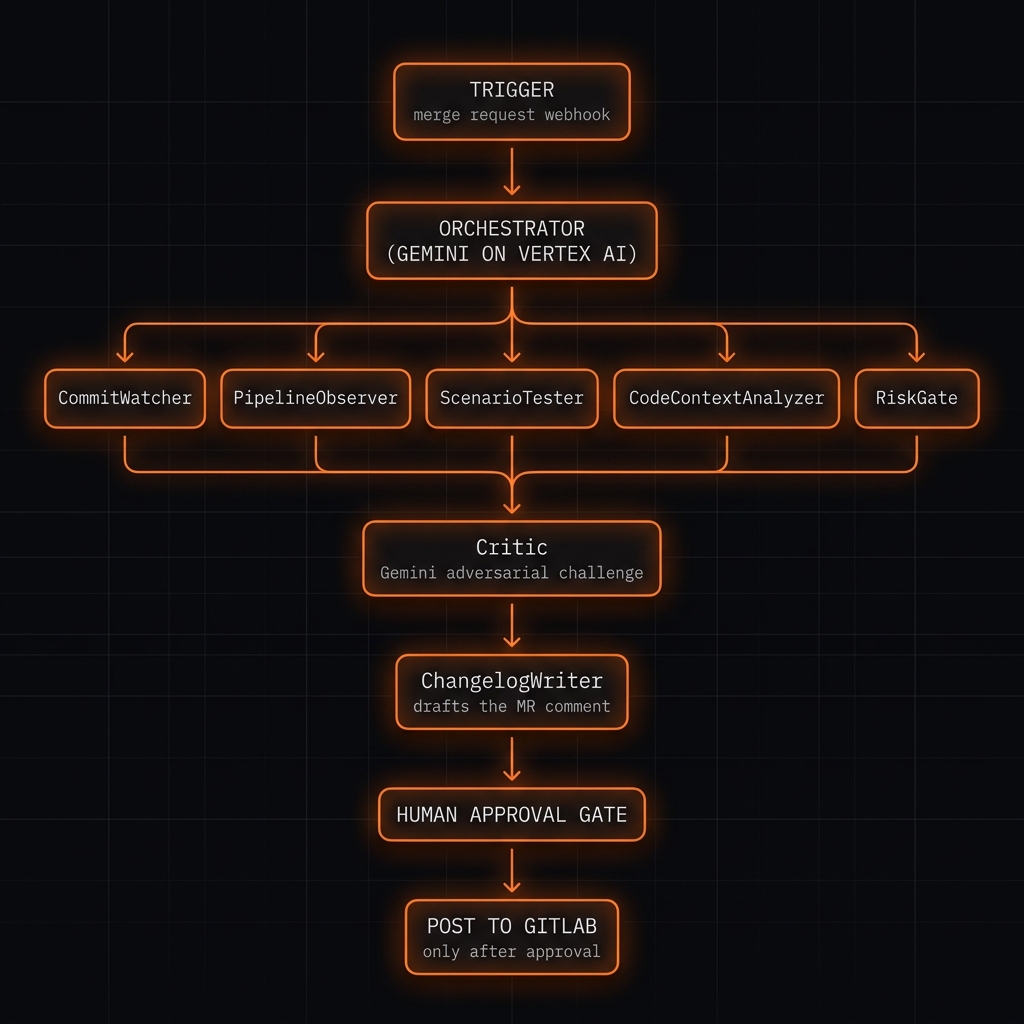
flowchart TD
    T["Merge request webhook"] --> O["Orchestrator · Google ADK<br/>Gemini on Vertex AI"]
    O --> CW[CommitWatcher]
    O --> PO[PipelineObserver]
    O --> ST[ScenarioTester]
    O --> CC[CodeContextAnalyzer]
    O --> RG["RiskGate<br/>Gemini · 8192 thinking"]
    CW --> CR["Critic<br/>Gemini adversarial challenge"]
    PO --> CR
    ST --> CR
    CC --> CR
    RG --> CR
    CR --> CL["ChangelogWriter<br/>drafts the MR comment"]
    CL --> H["Human Approval Gate"]
    H -->|on approve| GL["Post to GitLab<br/>note · inline thread · approve"]
Gemini is the brain — the diff and scenario results become a typed PASS/BLOCK verdict with an 8192-token thinking budget, then a Gemini Critic adversarially challenges it:
RouteForge uses GitLab through three channels: a webhook (instant trigger on MR / note / pipeline events), the MCP (a self-hosted zereight/gitlab-mcp proxy — search_project_code, resolvable inline threads, work items, CI job logs), and the REST API (diffs, notes, scoped labels, formal MR approval).
Stack: Python · Google ADK · Gemini 2.5 Flash/Pro (Vertex AI) · GitLab (webhooks + MCP + REST) · zereight/gitlab-mcp proxy · FastAPI · Server-Sent Events · Next.js + Tailwind · Cloud Run · Secret Manager · Docker.
Challenges we ran into
- Catching a vanished invariant when CI is green. The whole point is failures your tests don't cover, so we couldn't rely on the test suite — ScenarioTester replays the changed code path against a library of crisis fixtures and detects when a safety guard was removed, even though every test still passes.
- Three GitLab channels, each pulling its weight. The webhook is the only instant trigger; the MCP proxy exposes higher-level ops (semantic code search, resolvable inline threads, work items); REST handles diffs/notes/labels/approval. We run MCP through a self-hosted
zereight/gitlab-mcpproxy so the tool surface is fixed and version-pinned. - Capturing Gemini's chain-of-thought, not just a token count. RiskGate runs with an 8192-token thinking budget and
include_thoughts=True; we extract the actual thought text and surface it in the dashboard alongside the Critic's challenge reasoning — the verdict is auditable, not a black box. - Hostile diffs. A merge request from an external contributor is untrusted input. Every diff, title, and log line is labeled DATA in the prompt and structurally isolated; a regex pre-scan flags injection attempts, structured-output constrains the verdict to PASS/BLOCK, and the human approval gate is the real backstop.
Accomplishments that we're proud of
- It catches the unsafe merge your CI passes — the safety guard that silently vanished.
- The verdict is a live Gemini reasoning over the real diff every time — no hardcoded numbers.
- Visible chain-of-thought + an adversarial Critic make every BLOCK explainable.
- A genuine three-channel GitLab integration with inline threads that auto-resolve on
@routeforge rescan. - Nothing posts to GitLab until a human approves.
- A context-aware chat panel: the developer asks "Why was this blocked?" or "What do I fix?" and Gemini answers with the actual diff, scenario results, and RiskGate reasoning already in scope — not generic docs.
- 11 crisis scenarios across three domains ship out of the box, and teams extend coverage by describing a new scenario in plain English — Gemini generates the fixture JSON.
What we learned
- "The tests passed" and "this is safe" are different claims — you have to replay the crisis the tests never simulated.
- GitLab is an operating surface, not just a git host: webhook + MCP + REST together make an agent a first-class reviewer.
- Capturing the thinking text (not the token count) is what makes an AI verdict trustworthy.
- An adversarial Critic meaningfully cuts false positives — a false alarm wastes a developer's day.
What's next for RouteForge
- Auto-generate scenarios from a repo's own incident history — not just a description, but mined from past post-mortems.
- One click: open the proposed fix as a merge request.
- Multi-repo / monorepo path-scoped gating.
- Deeper static analysis to localize the exact removed invariant automatically.
Built with (Devpost tag field): python · google-adk · gemini · vertex-ai · gitlab · model-context-protocol · fastapi · server-sent-events · next.js · tailwindcss · google-cloud-run · secret-manager · docker
Try it out:
- Live dashboard — https://routeforge-dashboard-336382452417.us-central1.run.app
- GitHub — https://github.com/shipsafe-ai/shipsafe-routeforge
- One command —
npx shipsafe-routeforge demo

Log in or sign up for Devpost to join the conversation.