-
-
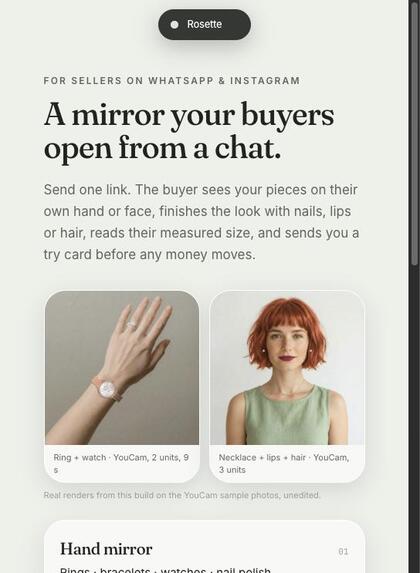
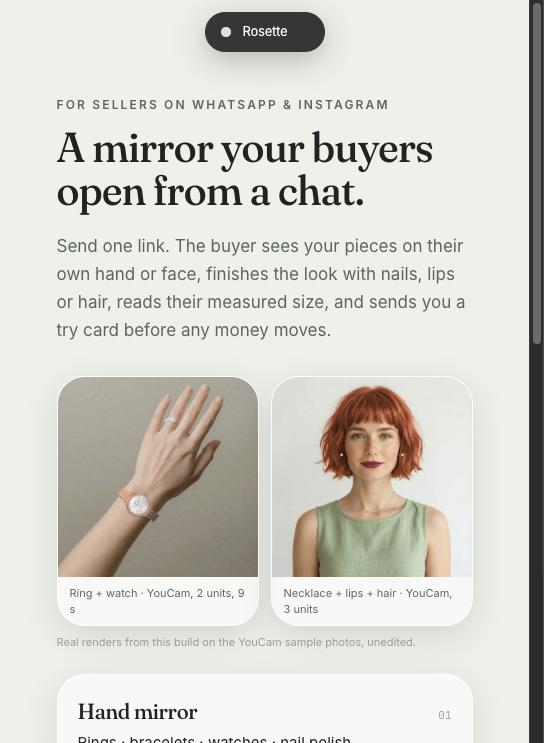
One link from a WhatsApp or Instagram seller opens a mirror on the buyer's phone. Real YouCam renders shown.
-
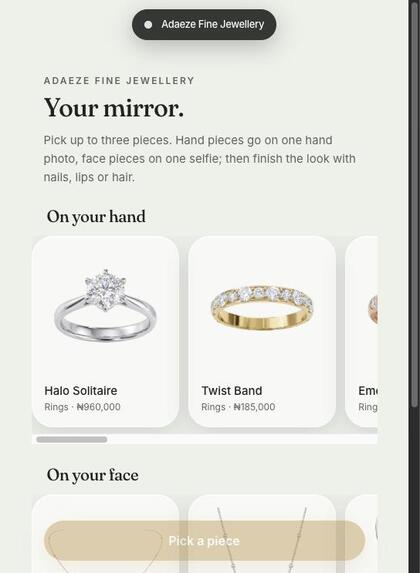
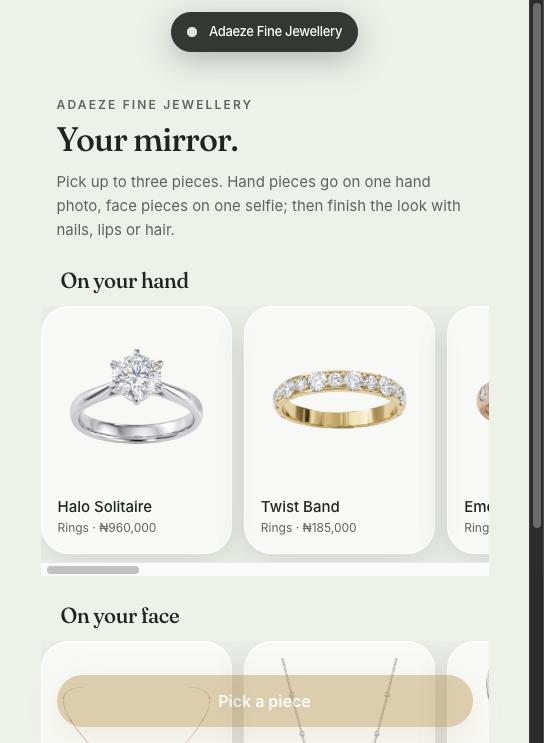
The seller's shop: the buyer picks up to three pieces for their hand or face. No app, no website.
-
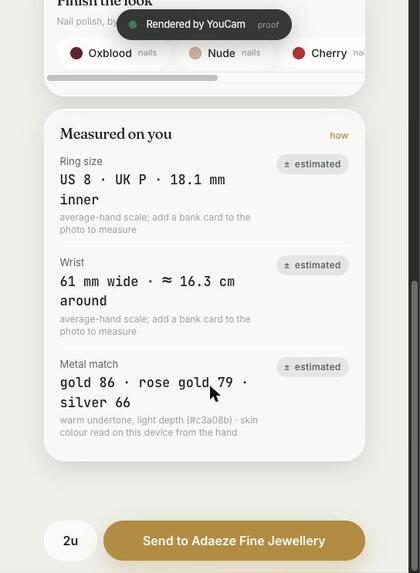
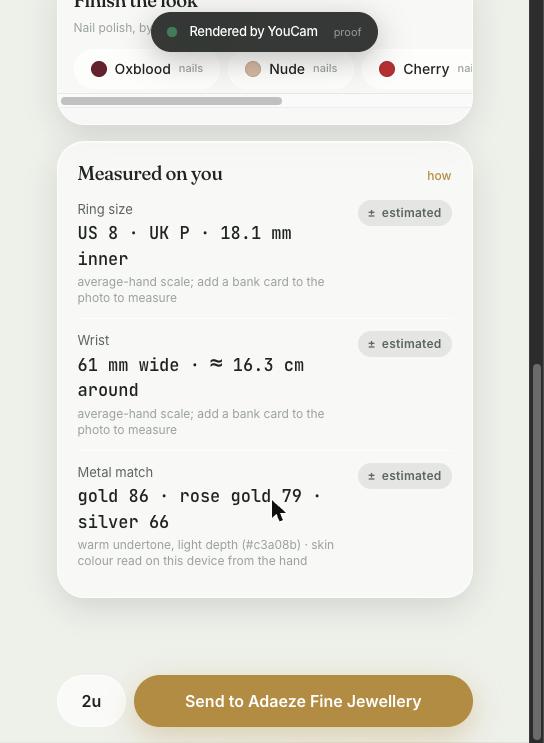
Measured on you: ring size, wrist and gold/silver/rose gold match, each labelled measured or estimated, then sent back to the seller.
-
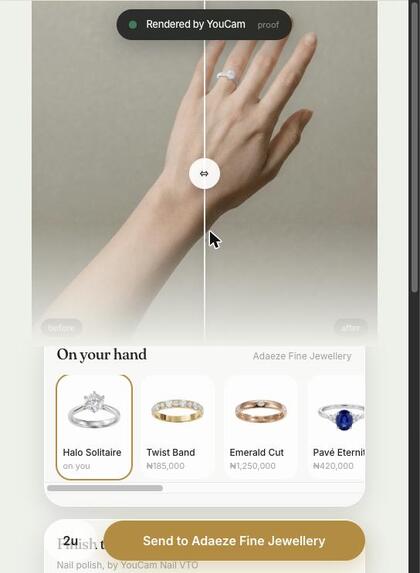
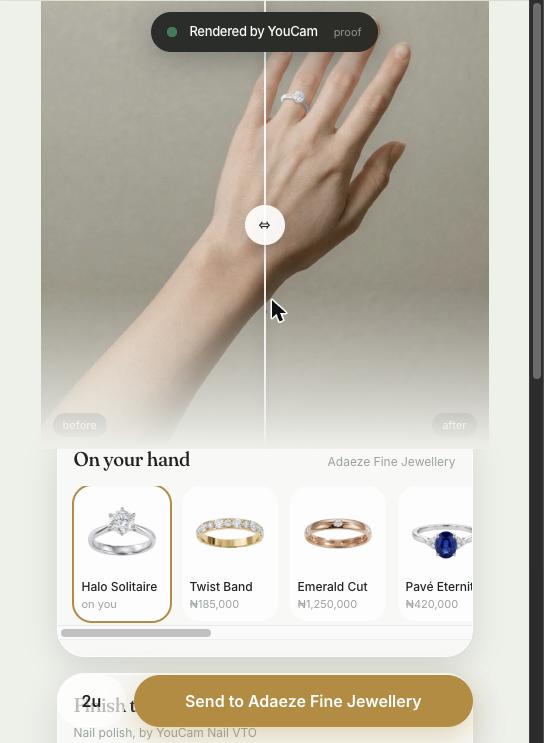
Before and after: the ring rendered on the buyer's own hand by YouCam Ring VTO.
-

The try card sent back to the seller: necklace, earrings and lip colour by YouCam on one selfie, with a measured metal match.

"Abeg, send me a picture of it on someone's hand"
If you have ever bought jewellery in Lagos, you know this conversation by heart.
A seller posts one photo of a ring on WhatsApp Status. You reply. Then the same three questions start, the ones every buyer asks every seller, every single time:
- Will it fit me?
- Will it look good on my skin? Gold or silver?
- Can you send me a picture of it on somebody like me?
The seller can't answer any of them honestly. They don't know your finger. They don't know your skin. The only "picture on someone" they have is their own hand, or a stock photo of a hand that looks nothing like yours. So they type "it will fit, trust me", you measure your finger with a strip of paper and a ruler, and you send a bank transfer for something you have never seen on your body.
Then it arrives. It's too small. Or the gold looks brassy against your skin. And there is no return, because there was never a shop, only a chat.
Rosette exists to answer those three questions before the money moves.
Who we're building for
Not big brands with websites. They already have try-on widgets and return policies.
We're building for the seller with no website: the woman running a jewellery business from her phone, the watch dealer with 2,000 contacts on WhatsApp Business, the Instagram boutique that takes orders in DMs. And for their buyer, who is being asked to trust a stranger with a bank transfer.
This is not a niche. It's how a huge share of the world actually shops:
- WhatsApp is installed on about 95% of Nigerian smartphones (BrandSpur, Sep 2026). It is the shop window, the checkout and the customer-service desk all at once.
- In a GSMA survey of Nigerian small businesses already selling online, more than half sold only through social platforms like WhatsApp, Instagram and Facebook, with no store of their own (GSMA Mobile for Development).
- 81% of Nigerian businesses on Meta's apps say those apps grew their customer base (BrandSpur, May 2026). The selling is already happening in the chat. The tools just never followed it there.
The same pattern runs across much of Africa, South and Southeast Asia and Latin America: commerce that lives in a chat thread, with no product page, no size guide and no returns desk.
The problem, in numbers
Trust is the bottleneck. Nigeria's social-media economy, as Nairametrics put it in January 2026, "may be growing faster than trust". "What I ordered vs what I got" is a national meme for a reason, and BusinessDay treats the gap between the photo and the parcel as the core weakness of the country's online marketplace. Buyers cope by demanding pay-on-delivery, and sellers then eat the cost of rejected orders (Selligate).
Jewellery is the hardest case, because fit and skin are the whole product:
- Even in markets with formal returns, roughly one in four rings bought at a distance is sent back (Clear Returns via Jewellery Focus), and wrong size alone accounts for an estimated 12 to 15% of ring returns (Eightx).
- A WhatsApp seller has no returns desk at all. A wrong size isn't a return, it's a dispute, a lost customer and a bad word in the group chat.
Try-on works when people can see themselves. Perfect Corp's own data shows brands see about a 2.5× lift in conversion after adding virtual try-on (Retail Dive), and Avon saw a 320% higher conversion from shoppers who used it (Perfect Corp case study). But that lift has only ever reached shoppers on a brand's website. The informal seller, the one who needs trust most, has never had it.
And try-on alone isn't enough. The loudest complaint about virtual try-on everywhere is that it shows the look but not the fit. One eyewear shopper wrote that the frames were too small "and the try on feature doesn't really tell you this" (Trustpilot, Zeelool, Jul 2026). AIUTA's CEO said it plainly in The Interline (Mar 2026): "Accuracy, not aesthetic enhancement, is what builds confidence." And as Perfect Corp's own blog put it this month: you can't sell, treat or reassure what you can't measure.
So the opportunity is specific: bring try-on and measurement into the chat, where informal commerce actually happens.
Our idea: a mirror that travels inside the chat
Rosette turns one WhatsApp link into a full jewellery counter on the buyer's own phone.
For the seller, it's one form. Upload a product photo (YouCam removes the background), and you get a shop link and a QR. Share a single piece and the link preview opens the mirror with that piece already chosen. No website, no app for the buyer to install, no catalogue to build.
For the buyer, it's a mirror:
- Hand mirror. Point the camera at the back of your hand. Rings, bracelets and watches appear on your hand, stacked together on the same photo, the way you'd actually wear them. Then finish the look with nail colour.
- Face mirror. Take a selfie. Earrings and necklaces go on, then lip colour and hair colour, so you see the piece with the face you'll actually wear it with, not a model's.
- Measured on you. Lay any bank card beside your hand and Rosette turns it into a ruler: your ring size (US, UK and mm) and your wrist. From the selfie, YouCam reads your skin, eye, lip and hair tones and gives an honest metal match: gold, silver or rose gold, and by how much.
- Honest labels. Every number says whether it's measured, estimated or generated. No card in the photo? The size is labelled an estimate. We'd rather lose a sale than make a promise the ring can't keep.
Then the buyer taps once and a try card goes back to the seller on WhatsApp: the piece on them, their size, their metal match. The seller's inbox shows who tried what, who said "I'll take it", and who has paid. It even learns: the most common ring size among your buyers, the metal they suit, the piece everyone tries but nobody buys.
The three questions get answered before the transfer. Will it fit? Here's your size. Will it suit my skin? Here's your metal match. Show me on someone like me? Here it is on you.
Why this idea, and why now
- Jewellery is the category nobody has built for. Round one of this hackathon had 238 entries and zero jewellery projects, because jewellery wasn't in scope. Round two opened Jewelry & Watch, and Perfect Corp's own jewellery pitch is "bridge the gap between browsing and buying". Rosette is that bridge for the seller who has no website to put it on.
- It brings try-on together, as the eCommerce VTO track asks. Not one feature on one photo, but a whole look: ring, watch, bracelet, nails on one hand; necklace, earrings, lips and hair on one face, each layer built on the last.
- It goes where the buyer already is. We didn't ask anyone to download an app or visit a store. The mirror opens from the same chat the sale was already happening in.
- It's honest by design, which is what trust needs. The labels, the card-as-ruler and the "preview is not a fit guarantee" line are features, not disclaimers.
How YouCam powers it
Every core moment is a YouCam API call, run server-side so the key never touches the phone:
| Moment | YouCam API |
|---|---|
| Ring, bracelet, watch, necklace, earrings on the buyer | Jewelry & Watch 2D virtual try-on (5 endpoints), stacked on one photo |
| Finishing the hand | Nail VTO |
| Finishing the face | Makeup VTO (lip colour) and Hair Color |
| Gold, silver or rose gold | Facial Color Tones (skin, eye, lip, hair) |
| Earring length for your face | Face Attributes (face shape) |
| Seller's product cutout | AI Background Removal |
Eleven YouCam endpoints, each doing a job the buyer can see. In our own runs, a ring renders in about 4 to 7 seconds for 1 unit, and a full face look (necklace, tone analysis, lips, hair) takes 23 units.
What we learned
- The engine's error messages are good enough to coach the buyer. When YouCam says "wrist position should be in the center" or the nails are too small in frame, Rosette turns that into a friendly instruction ("move a little closer") instead of a failure.
- Stacking works. Feeding each render back in as the next photo lets a ring, a watch and nail polish share one hand without the earlier layers degrading. That's what makes a look, not a sticker.
- Measurement is what turns a pretty picture into a decision. A bank card is in almost every buyer's wallet. Using it as the ruler was the single most useful idea in the build.
What's next
- Rosette Skin: the same mirror for skincare. YouCam AI Skin Analysis scores 12 concerns on the buyer's selfie, builds a routine from products they already own with clash warnings, and re-scans weekly to show whether it's working. Built as a separate prototype (SkinLoop) during this hackathon; next step is bringing it into the seller's link.
- Pilot with five Lagos jewellery sellers, comparing measured ring sizes against a physical sizer, and tracking disputes before and after.
- WhatsApp Business catalogue import, so a seller's existing products become try-able in one tap.
- Shoes, eyewear and fabric: the same mirror for every category informal sellers trade in.
Try it
- Live: rosette-tryon.vercel.app. Open the demo shop, pick a piece and try it on your hand or face.
- A real try card: rosette-tryon.vercel.app/c/dbp7vpbs
Built With
- background-removal
- face-attributes
- facial-color-tones
- hair-color
- makeup-vto
- mediapipe
- nail-vto
- next.js
- perfect-corp
- react
- typescript
- vercel
- vercel-blob
- virtual-try-on
- youcam-api

Log in or sign up for Devpost to join the conversation.