Inspiration
Starting a new job should feel exciting, but for many people it’s overwhelming. New hires often face unclear priorities, missing access, unanswered questions, and silent blockers—especially in their first week. Most onboarding tools focus on content delivery, not on reducing anxiety or giving HR real visibility into what’s actually going wrong.
OnboardLite was inspired by a simple question: What if onboarding focused on clarity and support instead of just completion?
What it does
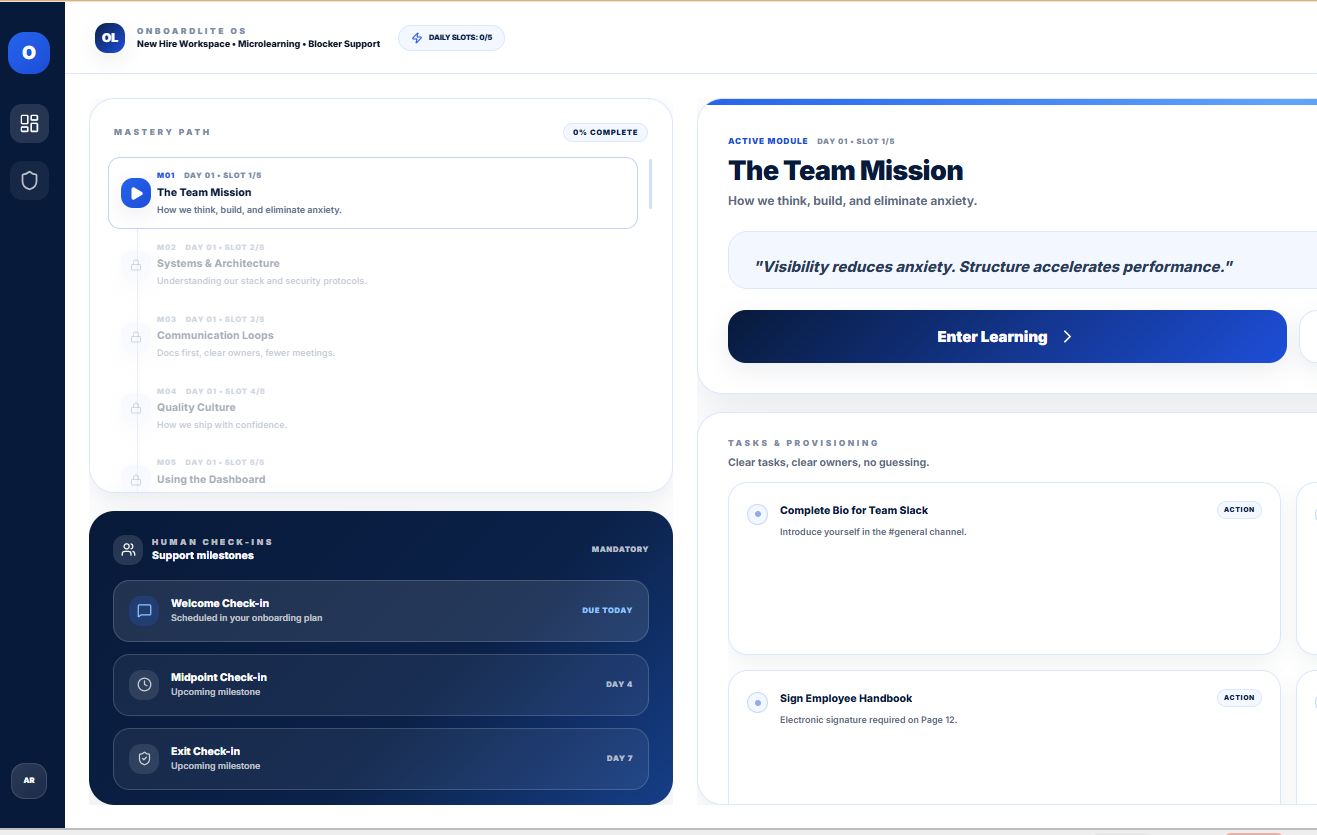
OnboardLite is an onboarding control system designed to reduce first-week friction for new hires while giving HR teams real-time visibility.
For new hires, it provides:
- A 5-minute daily learning plan to prevent overload
- Verified learning through short knowledge checks
- A simple way to report blockers without guessing severity
For HR teams, it offers:
- An auto-triaged blocker queue with priority and SLA signals
- Clear visibility into at-risk, on-track, and inactive hires
- A live view of onboarding progress across the organization
The result is faster ramp-up, less anxiety, and fewer onboarding failures.
How we built it
OnboardLite was built as a single-page web application using:
- HTML, Tailwind CSS, and JavaScript for a responsive, clean UI
- A state-driven architecture to simulate multiple hires and HR workflows
- Client-side persistence to model real onboarding timelines
- A rules-based auto-triage system to infer blocker severity from context
We intentionally focused on clarity, structure, and usability instead of adding unnecessary complexity.
Challenges we ran into
One of the biggest challenges was avoiding feature overload. It was tempting to add more analytics and automation, but we realized that too much information creates the same confusion we were trying to solve.
Another challenge was balancing two very different users:
- New hires who need reassurance and simplicity
- HR teams who need visibility and actionable signals
Designing for both required several iterations on layout, copy, and flow.
Accomplishments that we’re proud of
- Designing a system that feels human for employees and operational for HR
- Building a complete loop: learning → blockers → triage → resolution
- Implementing auto-triage logic without making the system feel punitive
- Creating a demo that tells a clear story, not just a list of features
Most importantly, OnboardLite feels like a real product, not just a hackathon prototype.
What we learned
Through this project, we learned that:
- Onboarding is not a content problem it’s a visibility problem
- Constraints like daily learning limits improve retention
- Removing decisions reduces anxiety and improves engagement
- Good HR tools should support people, not monitor them
We also learned the importance of intentional UX language and scope control.
What’s next for OnboardLite
Next, we plan to:
- Add manager involvement alongside HR workflows
- Introduce role-based access and authentication
- Integrate with real HRIS and IT ticketing systems
- Track time-to-productivity and onboarding health metrics
Long-term, OnboardLite aims to become the operating layer for onboarding, where every new hire feels supported from day one and HR never loses visibility.
Built With
- css
- html
- javascript
- tailwind-css

Log in or sign up for Devpost to join the conversation.